Common Feng Shui Myths Debunked: Separating Superstition from Science
## The Dual Nature of Feng Shui Studies Traditional Feng Shui carries genuine scientific wisdom, yet it also contains elements of superstition and outdated thinking. Over the past century, Feng Shui w
Common Feng Shui Myths Debunked: Separating Superstition from Science
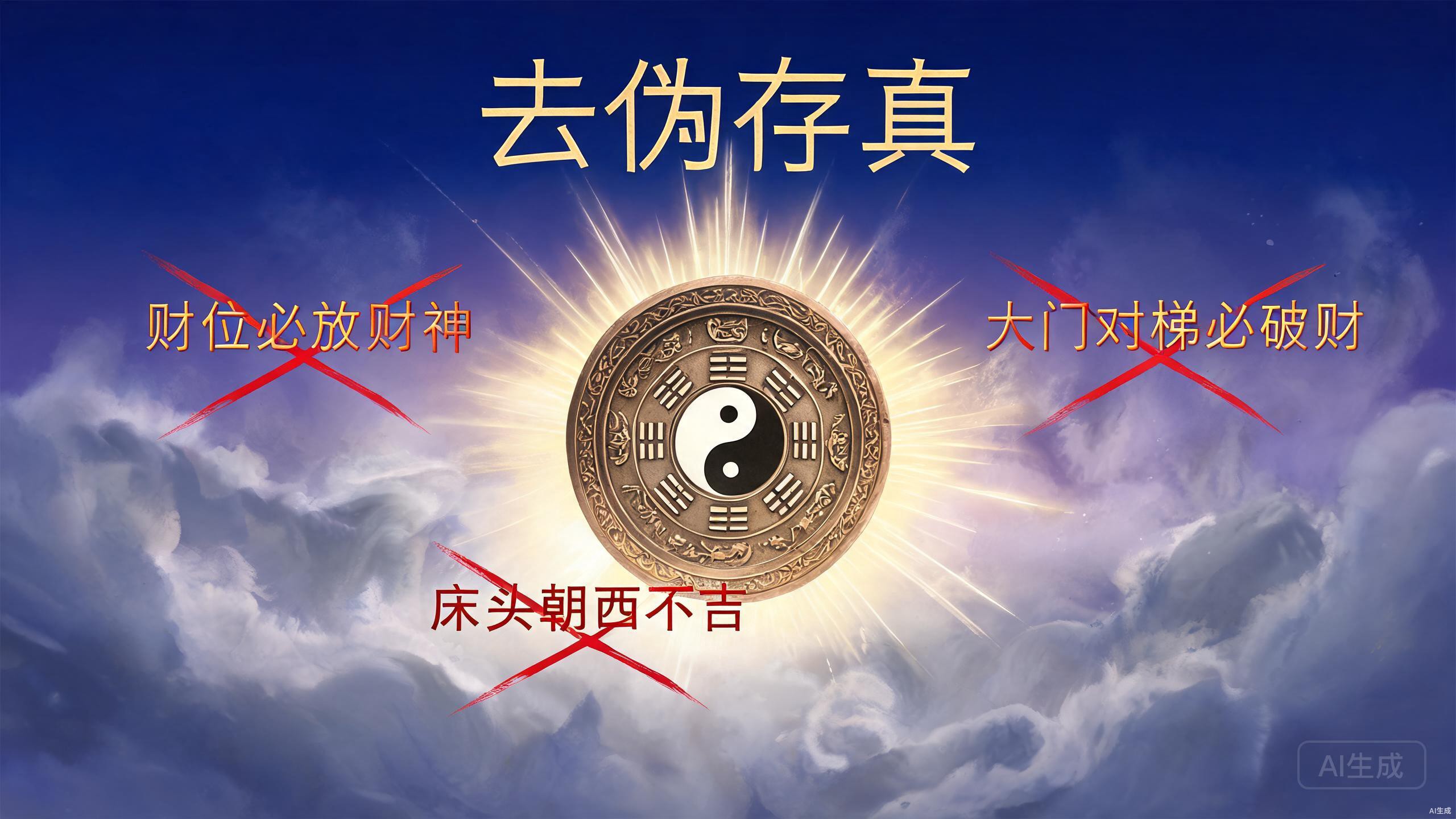
The Dual Nature of Feng Shui Studies
Traditional Feng Shui carries genuine scientific wisdom, yet it also contains elements of superstition and outdated thinking. Over the past century, Feng Shui was once branded as "feudal superstition" and cast aside. After China's reform and opening up, as cultural and academic circles experienced a renaissance of "hundred schools of thought," traditional Feng Shui culture began serving ordinary people's lives once again.
When we examine ancient Chinese Feng Shui through the lens of modern science, we discover something remarkable: beneath its mysterious surface, Chinese Feng Shui distills the essence of philosophy, aesthetics, ecology, humanities, meteorology, landscape studies, architecture, and psychology. Anyone serious about exploring this path should build a foundation of modern scientific knowledge — discarding the outdated while preserving the valuable.
Cultural Context: In the West, Feng Shui is often dismissed as mere superstition. Yet many of its core insights — about sunlight, airflow, spatial harmony, and environmental psychology — align closely with modern sustainable design principles. The key is distinguishing timeless environmental wisdom from mystical claims that cannot be tested or verified.
Debunking Common Feng Shui Myths
Myth #1: Feng Shui Is Pure Superstition
The Misconception: Feng Shui is feudal superstition with no scientific basis.
The Truth: Feng Shui is actually a natural science that integrates geography, geology, meteorology, astronomy, architecture, landscape studies, ecology, and human life information science. Many of its concepts about site selection, building orientation, and spatial layout have been validated and absorbed by modern architecture, environmental psychology, and ecology.
Of course, traditional Feng Shui does contain some mystical and absolutist claims that should be discarded. But we cannot reject the entire environmental wisdom of Feng Shui simply because of a few outdated elements.
Myth #2: Feng Shui Determines Everything
The Misconception: Good Feng Shui alone guarantees promotion, wealth, and a perfect life.
The Truth: Feng Shui teaches that a harmonious environment can positively influence physical and mental wellbeing, but it is not an all-powerful key to destiny. As the ancient saying goes: "While good Feng Shui can nurture people, only the virtuous deserve to dwell there. Where virtue is thin, Feng Shui disperses; where virtue is abundant, Feng Shui gathers."
Feng Shui simply teaches us to live in greater harmony with nature. No Feng Shui master can grant you divine favor. Do not chase or depend on Feng Shui obsessively, and never worship it as a deity. Personal effort, character, and self-cultivation remain the true foundation of one's destiny.
Quick Tips:
- Use Feng Shui as a guide for environmental harmony, not as a substitute for hard work
- Remember: a beautiful, well-arranged space supports your efforts — it does not replace them
Myth #3: The More Complex, The Better
The Misconception: The deeper and more complicated the Feng Shui theory, the more powerful its effect.
The Truth: The purpose of Feng Shui is to find Vital Qi (Sheng Qi) — places sheltered from harsh wind, open to sunlight, surrounded by clear water and lush vegetation. Many basic Feng Shui principles are remarkably simple and practical: Sitting North Facing South, Storing Wind and Gathering Qi, building near mountains and water.
The true wisdom of Feng Shui lies in "the golden mean" — everything in balance, nothing extreme. Overly complex theories can actually obscure the most fundamental principles of comfortable, healthy living.
How to Apply the "Golden Mean" Principle
- Prioritize comfort over complexity: A home that feels good to live in matters more than elaborate symbolic arrangements
- Focus on basics first: Natural light, fresh air, sensible layout, and cleanliness outweigh any advanced formula
- Avoid information overload: Master a few core principles deeply rather than skimming dozens of advanced techniques
Myth #4: Feng Shui Is Fixed Forever
The Misconception: A Feng Shui layout is permanent — good Feng Shui stays good, bad Feng Shui stays bad.
The Truth: Feng Shui is dynamic and ever-changing. The Xuan Kong Flying Stars (玄空飞星) theory holds that cosmic stellar Qi shifts with time, making different directions prosperous or declining in different periods. An auspicious direction this year may become inauspicious next year.
At the same time, Feng Shui can be improved through human intervention. "Perfectly ideal Feng Shui is rare," but by digging channels to redirect water, reinforcing landforms, or renovating the residence, one can compensate for geographical shortcomings. As the environment changes, Feng Shui changes too — the key is adjusting with the times.
Myth #5: Only Masters Can Read Feng Shui
The Misconception: Feng Shui is an impossibly deep mystery that ordinary people cannot understand without a master.
The Truth: The basic principles of Feng Shui are not difficult to grasp. Once you understand core concepts like Yin and Yang, the Five Elements, Bagua directions, and Storing Wind and Gathering Qi, you can make preliminary Feng Shui assessments of your own living space.
Of course, detailed analysis requires professional knowledge and experience. But the most essential everyday principles — ample natural light, good ventilation, sensible layout, and a clean environment — are accessible to everyone.
Myth #6: Feng Shui Is Only About Graves
The Misconception: Feng Shui mainly concerns burial sites (Yin Dwellings) and has little to do with daily life.
The Truth: Feng Shui addresses two types of sites: "Yang Dwellings" (阳宅) for the living — homes, offices, and workspaces — and "Yin Dwellings" (阴宅) for the deceased, including ancestral graves. In modern society, Yang Dwelling Feng Shui is by far the most relevant to everyday life.
Yang Dwelling Feng Shui focuses on practical concerns: site selection, floor plan layout, interior design, and furniture placement. Its goal is creating a comfortable, healthy environment that supports the physical and mental harmony of its occupants. This is the true heart of modern Feng Shui practice.
Myth #7: Placing Lucky Objects Changes Your Fate
The Misconception: Placing Pixiu, crystals, or Feng Shui spheres at home will transform your luck.
The Truth: Feng Shui tools do offer some psychological and environmental support, but they are only supplementary aids — they cannot replace fundamental layout principles. If your home has serious issues with location, orientation, or layout, no collection of lucky objects can solve the core problem.
More importantly, Feng Shui emphasizes "person and dwelling supporting each other" — environment and human must work together. The occupant's character, mindset, and effort matter far more than any decorative object.
Quick Tips:
- Use Feng Shui objects as enhancements, not solutions to fundamental problems
- A clean, well-lit, properly arranged space is more powerful than any single lucky charm
Myth #8: Feng Shui and Science Are Opposites
The Misconception: Feng Shui and modern science are incompatible systems.
The Truth: Feng Shui shares fascinating parallels with many modern sciences:
| Feng Shui Concept | Modern Science Equivalent |
|---|---|
| The concept of Qi | "Fields" in physics (electromagnetic, gravitational) |
| Yin-Yang Balance | Dynamic equilibrium in ecology |
| Qi field sensitivity | Environmental psychology's study of surroundings on human behavior |
| Storing Wind and Gathering Qi | Microclimate regulation in architecture |
| Five-colored soil examination | Soil analysis in geology |
| Indicator plants for prospecting | Bioindication in botany |
As the saying goes, "Each region nurtures its own people" — people from different areas display distinct spirits, personalities, and habits. This reflects Feng Shui's principle that "environment shapes people," an idea modern environmental science also recognizes.
A Rational Approach to Feng Shui
The Reasonable Core of Feng Shui
The reasonable core of Feng Shui lies in pursuing harmony between humanity and the natural environment. It reminds us:
- The living environment significantly affects physical and mental health
- Site selection must consider terrain, climate, and hydrology
- Interior layout should prioritize natural light, ventilation, and spatial logic
- Environmental modification should work with nature, not against it
What Should Be Discarded
At the same time, we should be alert to and discard the following elements within Feng Shui:
- Fatalism that equates Feng Shui absolutely with personal destiny
- Overly mystical claims that cannot be tested or verified
- Fraudulent practices carried out in the name of Feng Shui
- A passive attitude that ignores personal effort and depends entirely on Feng Shui
- The fantasy that specific objects or rituals can change everything
The Correct Attitude
The proper approach to Feng Shui is: take the essence, discard the dregs, reference it rationally, apply it scientifically.
Feng Shui is a vital part of traditional Chinese culture, condensing the ancient people's profound observations and wisdom about the relationship between humanity and the environment. In modern society, we should re-examine Feng Shui through a scientific lens — absorbing its reasonable insights on environmental selection, spatial layout, and ecological balance — so it becomes a practical tool for improving our living spaces, not a superstitious shackle that constrains thought.
"Value Feng Shui, but value virtue even more. Practice 'ceaseless self-improvement' and 'the capacity to bear all things with great virtue.'" (自强不息、厚德载物) — This is the most precious spiritual legacy Feng Shui offers us.
Related Articles
- [[../02-家居风水/33-阳台风水植物.md|Balcony Feng Shui Plants: Greenery Choices for Wealth and Sha Dissolution]]
- [[../02-家居风水/16-南北通透户型的风水.md|South-North Through-Type Floor Plans: Feng Shui Advantages, Hidden Risks, and Optimal Layout]]
- [[../03-财运风水/52-横财运风水.md|Windfall Wealth Feng Shui: Secret Methods for Activating Unexpected Fortune]]
- [[../03-财运风水/24-流年财运调整.md|Annual Wealth Adjustment: Yearly Feng Shui for Wealth Activation and Sha Dissolution]]