Feng Shui Five Elements and Bagua: Mutual Generation, Restriction, and the Heavenly vs. Earthly Trigrams
## The Five Elements (Wu Xing) Theory ### Characteristics of the Five Elements The Yin and Yang theory combined with the Five Elements (Wu Xing) is a profoundly influential philosophical system develo
Five Elements and Bagua: Mutual Generation, Restriction, and the Heavenly vs. Earthly Trigrams
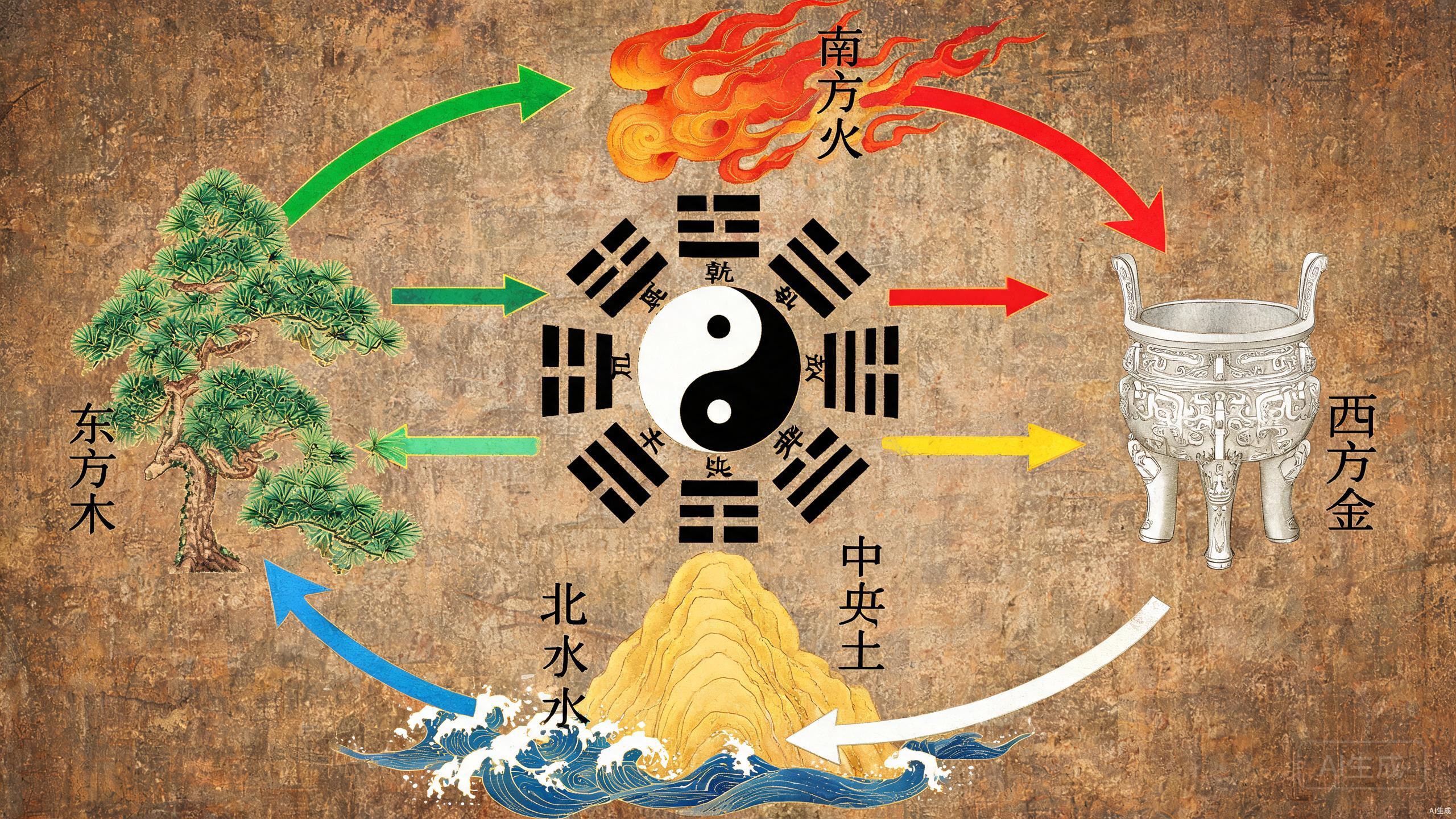
The Five Elements (Wu Xing) Theory
Characteristics of the Five Elements
The Yin and Yang theory combined with the Five Elements (Wu Xing) is a profoundly influential philosophical system developed by ancient Chinese ancestors through centuries of observing and contemplating the myriad phenomena of nature. It represents an early form of materialist philosophy with dialectical thinking at its core. As the saying goes: "The mysteries of land assessment lie entirely within the Five Elements."
The Five Elements are Metal, Wood, Water, Fire, and Earth, each possessing distinct qualities:
| Element | Quality | Direction | Color | Season |
|---|---|---|---|---|
| Metal | Clarity, Restriction | West | White | Autumn |
| Wood | Growth, Flourishing | East | Green/Blue | Spring |
| Water | Cold, Downward | North | Black | Winter |
| Fire | Heat, Upward | South | Red | Summer |
| Earth | Nurturing, Transforming | Center | Yellow | Late Summer |
In Feng Shui practice, personal destiny, professions, and even building floors are all classified according to the Five Elements, which serve to explain the dynamic relationship between humans and their environment. Mountains and rivers have their angular and curved forms, their wide and narrow passages — all embodying the Five Elements. While geography changes in countless ways, the key lies in the Qi of the Five Elements.
Cultural Context: The Five Elements system is not merely a classification of materials — it is a holistic framework for understanding how all things in nature interact. Each element both generates and restrains another, creating a continuous cycle of balance. When you understand these relationships, you gain a powerful lens for interpreting any environmental energy pattern.
Mutual Generation (Xiang Sheng)
"Generation" (生) means to nourish and promote growth. Among the Five Elements, there exists a relationship of mutual promotion and dependence — this is called "Mutual Generation" (相生).
The Generation Cycle: Water generates Wood → Wood generates Fire → Fire generates Earth → Earth generates Metal → Metal generates Water, cycling endlessly.
Within this cycle, each element has two relationships: one that "generates me" and one that "I generate" — known as the mother-child relationship. Taking Water as an example: Metal generates Water, so Metal is Water's mother; Water generates Wood, so Wood is Water's child.
Mutual Restriction (Xiang Ke)
The Restriction Cycle: Wood restricts Earth → Earth restricts Water → Water restricts Fire → Fire restricts Metal → Metal restricts Wood, cycling endlessly.
Mutual Restriction refers to the restraining and controlling relationship between elements. Like Yin and Yang, generation and restriction are two inseparable aspects of all phenomena. Without generation, nothing can begin or grow; without restriction, balance and harmony cannot be maintained through change. There is no generation without restriction, no restriction without generation. This dynamic — generation containing restriction, restriction containing generation, opposing yet complementary, working together — drives and sustains the normal growth, development, and transformation of all things.
Over-Restriction and Counter-Restriction
When generation and restriction become excessive or deficient, the normal balance breaks down, resulting in either Over-Restriction (相乘) or Counter-Restriction (相侮):
- Over-Restriction (相乘): When one element excessively restrains another. For example, if Wood becomes overly strong while Metal cannot properly restrain it, Wood will excessively attack Earth, weakening Earth further — this is "Wood over-restricting Earth."
- Counter-Restriction (相侮): When one element becomes so excessive that the element which should restrain it cannot do so, and is instead restrained by it — also known as reverse restriction. For example, under normal conditions Water restrains Fire, but when Fire is overly strong or Water is too weak, Water cannot restrain Fire and is instead evaporated by it — this is "Fire counter-restricting Water."
Quick Tips:
- In your home, balance is key — too much of any single element creates imbalance, just as in nature
- When adding new Feng Shui elements, consider what already exists to maintain harmonious energy flow
- The goal is dynamic equilibrium, not static perfection — embrace natural cycles of growth and consolidation
The Bagua (Eight Trigrams)
Basic Meanings of the Bagua
The Bagua consists of Qian, Kun, Kan, Li, Xun, Zhen, Gen, and Dui — representing Heaven, Earth, Water, Fire, Wind, Thunder, Mountain, and Lake. These eight natural phenomena serve as symbols to summarize the entire universe.
| Trigram | Natural Phenomenon | Direction (Earthly) | Element | Family Role |
|---|---|---|---|---|
| Qian (乾) | Heaven | Northwest | Metal | Father |
| Kun (坤) | Earth | Southwest | Earth | Mother |
| Zhen (震) | Thunder | East | Wood | Eldest Son |
| Xun (巽) | Wind | Southeast | Wood | Eldest Daughter |
| Kan (坎) | Water | North | Water | Middle Son |
| Li (离) | Fire | South | Fire | Middle Daughter |
| Gen (艮) | Mountain | Northeast | Earth | Youngest Son |
| Dui (兑) | Lake | West | Metal | Youngest Daughter |
Cultural Context: The Bagua is one of the foundational tools of Feng Shui. Each trigram carries layers of meaning — natural phenomena, family members, body parts, and life circumstances. This multi-dimensional symbolism allows practitioners to analyze a space from many angles simultaneously.
He Tu and the Heavenly Trigrams (Xian Tian Ba Gua)
"He Tu" (河图, River Diagram) and "Luo Shu" (洛书, Luo Writing) are two mysterious patterns passed down from ancient China, traditionally regarded as the wellsprings of Chinese civilization. Legend tells that in the time of Fuxi, a dragon-horse emerged from the Yellow River carrying the He Tu on its back and presented it to Fuxi. Fuxi then derived the Heavenly Trigrams from this diagram.
The He Tu consists of 55 black and white dots representing the numbers of Heaven and Earth:
- White dots form odd numbers 1, 3, 5, 7, 9, representing Yang and Heaven — called "Heaven Numbers," totaling 25
- Black dots form even numbers 2, 4, 6, 8, 10, representing Yin and Earth — called "Earth Numbers," totaling 30
Within the He Tu, numbers 1–5 are called "Generating Numbers" (生数), and numbers 6–10 are called "Completing Numbers" (成数). Generating and Completing Numbers exist in a relationship of mutual generation and completion. The He Tu contains five positions — East, West, South, North, and Center — each paired with one odd and one even number, symbolizing that all things are formed through the union of Yin and Yang.
The Heavenly Trigrams (先天八卦, Xian Tian Ba Gua), also called Fuxi's Trigrams, are derived from the He Tu. Legend attributes their creation to Fuxi, who observed natural phenomena and extracted their essential patterns. The Heavenly Trigrams represent the primordial state of the universe, emphasizing the opposing yet complementary relationship between Yin and Yang.
Luo Shu and the Earthly Trigrams (Hou Tian Ba Gua)
When Dayu (大禹) was controlling the great floods, a divine tortoise emerged from the Luo River carrying the Luo Shu on its back and presented it to him. Dayu used this wisdom to successfully tame the floods and divided the land into nine provinces. As the Yi Jing (Book of Changes) states: "The Yellow River produced the He Tu, the Luo River produced the Luo Shu, and the sages followed them."
The Luo Shu contains the numbers 1 through 9, arranged as: "Nine atop, One below; Three on the left, Seven on the right; Two and Four form the shoulders; Six and Eight form the feet; Five sits in the center."
- Odd numbers 1, 3, 5, 7, 9 are Yang, symbolizing the Way of Heaven
- Even numbers 2, 4, 6, 8 are Yin, symbolizing the Way of Earth
The Luo Shu represents the movement of cosmic forces: Yang energy begins in the North, rotates clockwise, gradually increases through the East, reaches its peak in the South, then gradually diminishes toward the West. The number 1 in the North represents "the first stirring of Yang"; 3 in the East represents "the opening of three Yangs (full prosperity)"; 9 in the South represents "Yang at its zenith"; 7 in the West represents "Yang in gradual decline."
The Earthly Trigrams (后天八卦, Hou Tian Ba Gua) were created by King Wen of Zhou based on the Heavenly Trigrams. When combined with the Luo Shu numbers, they formed the "Nine Palaces Bagua" (九宫八卦), widely applied across many fields. The Earthly Trigrams represent the applied state of the universe, emphasizing the flowing transformation of all things.
Differences Between Heavenly and Earthly Trigrams
| Comparison | Heavenly Trigrams | Earthly Trigrams |
|---|---|---|
| Creator | Fuxi | King Wen of Zhou |
| Source | He Tu (River Diagram) | Luo Shu (Luo Writing) |
| Focus | Essence (Origin) | Application (Use) |
| Characteristic | Yin-Yang Opposition | Cyclical Transformation |
| Application | Philosophical Ontology | Feng Shui Direction |
Application of Five Elements and Bagua in Feng Shui
Directions and the Five Elements
Feng Shui uses multiple systems to indicate directions:
- Five Elements system: Wood = East, Fire = South, Metal = West, Water = North, Earth = Center
- Bagua system: Li = South, Kan = North, Zhen = East, Dui = West
- Heavenly Stems and Earthly Branches system: Jia and Yi = East, Bing and Ding = South, Geng and Xin = West, Ren and Gui = North
- Four Symbols system: Azure Dragon (East) on the left, White Tiger (West) on the right, Vermilion Bird (South) in front, Black Tortoise (North) behind
Auspicious and Inauspicious Five-Colored Soils
Feng Shui places great emphasis on soil, primarily because soil quality reflects the underlying Qi channels. Different soil colors correspond to different Qi channels. Among the five-colored soils, red earth and yellow earth are considered best, followed by purple and white earth, while black earth is inauspicious. This is because the first four types contain less organic matter, while black earth contains abundant organic matter — and lower organic content better preserves Qi channels.
Nine Palaces Bagua and Home Layout
The Nine Palaces Bagua formed by combining the Earthly Trigrams with the Luo Shu numbers is an essential tool for home Feng Shui layout. By dividing your home into a 3×3 grid (nine palaces), each palace corresponds to a trigram and number, allowing you to analyze the auspicious and inauspicious qualities of each direction. This guides decisions about room allocation, furniture placement, and overall spatial harmony.
The Five Elements and Bagua theory serves as the foundational framework of Feng Shui, running through all schools and practices. Understanding the principles of Mutual Generation and Restriction among the Five Elements, along with the directional meanings of the Bagua, is the essential first step for anyone beginning their Feng Shui journey.
How to Apply Five Elements and Bagua in Your Home
- Map your space: Divide your home's floor plan into a 3×3 grid from a bird's-eye view
- Assign the directions: Using your front entrance as the facing direction, align the grid with the cardinal directions
- Identify each palace's trigram: Note which trigram and element governs each area of your home
- Match activities to elements: Place restful activities (Water-element zones) in the North, social gatherings (Fire-element zones) in the South
- Balance the elements: If one element is missing or excessive, add corresponding colors, materials, or shapes to restore harmony
Quick Tips:
- The center palace (Earth element) should remain open and uncluttered — it represents stability and health for the entire household
- When two elements clash (e.g., a Metal-rich West area with excessive Fire from a south-facing fireplace), introduce Water elements to mediate
- Remember: the Earthly Trigrams (not Heavenly) are used for most practical Feng Shui applications in your home
Related Articles
- [[../06-风水文化与历史/29-风水与易经:易经八卦在风水中的核心应用.md|Feng Shui and the Yi Jing: The Core Application of Yi Jing Trigrams in Feng Shui]]
- [[../08-百科问答库/44-什么是五行?五行相生相克在风水中的应用.md|What Are the Five Elements? Mutual Generation and Restriction in Feng Shui Practice]]
- [[../02-家居风水/37-植物与风水.md|Plants and Feng Shui: Five Elements Balance and Wealth-Attracting Greenery for Your Home]]
- [[../02-家居风水/55-家居色彩风水.md|Feng Shui Home Colors: Five Elements Color Matching and Harmonious Space Design]]