Feng Shui Glossary: 18 Core Terms Every Beginner Must Know
Feng Shui has its own unique system of terminology — these terms form the foundation for understanding Feng Shui theory. Below, we explain 18 of the most essential Feng Shui concepts one by one. ## 1.
Feng Shui Glossary: 18 Core Terms Every Beginner Must Know
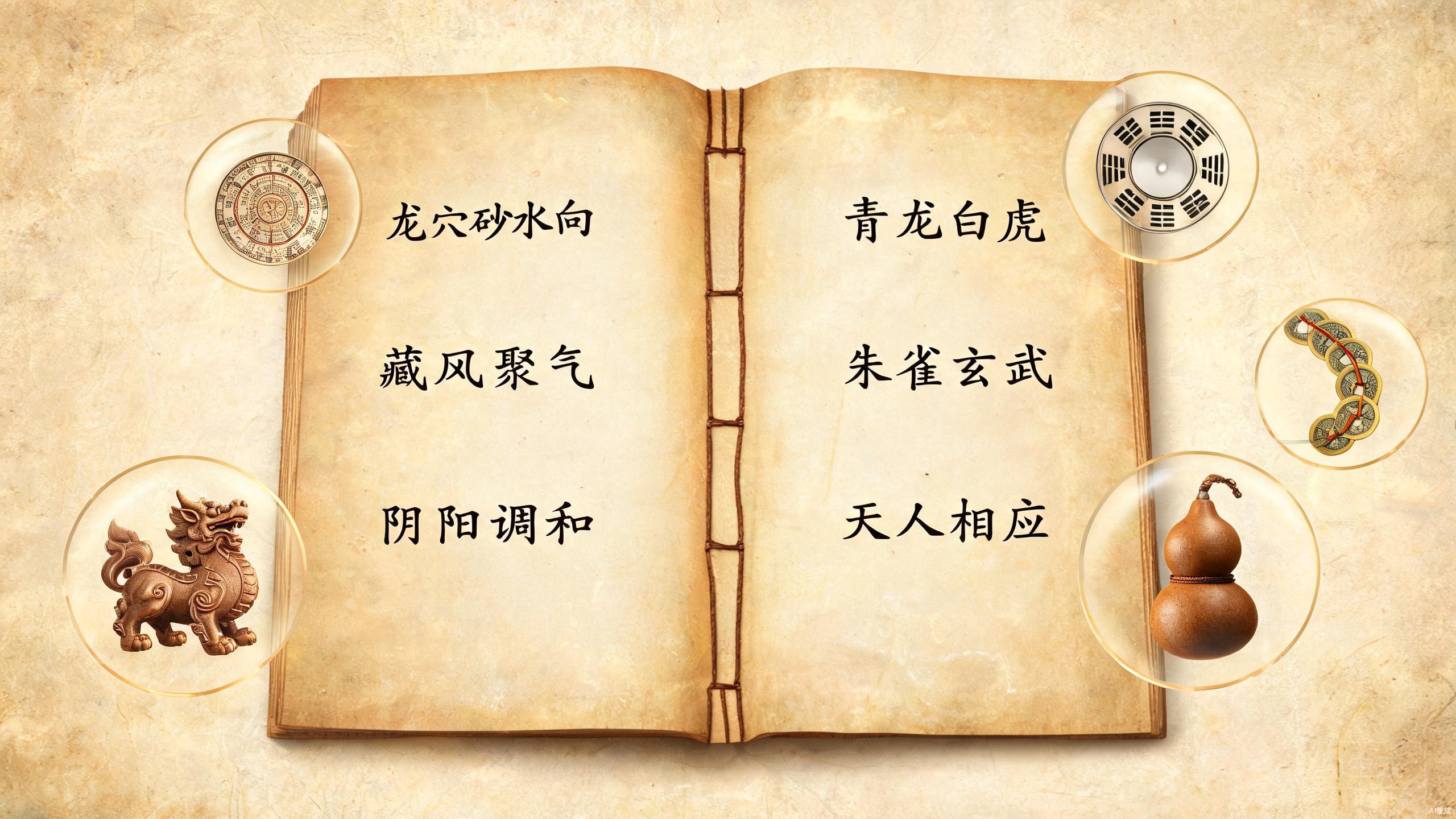
Feng Shui has its own unique system of terminology — these terms form the foundation for understanding Feng Shui theory. Below, we explain 18 of the most essential Feng Shui concepts one by one.
1. Dragon Vein (龙脉)
A Dragon Vein (龙脉, lóng mài) refers to a continuous, undulating mountain range — named because the path of the mountains resembles the winding body of a dragon. Feng Shui holds that mountains are the source of Qi, and that Qi flows along mountain ranges, hence the name "Dragon Vein." Dragon Veins are divided into Trunk Dragons (main veins) and Branch Dragons (secondary veins). The three major Trunk Dragons within China (the Northern, Central, and Southern) all originate from the Kunlun Mountains. "Three years to seek the dragon, ten years to point the acupoint" — finding the Dragon Vein is always the first step in Feng Shui assessment.
2. Feng Shui Point — Acupoint (穴)
The Acupoint (穴, xué) — literally meaning "cave" or "burial chamber" — refers in Feng Shui to either the burial site of the deceased or the auspicious location where a living person's home should be built. It is a spot naturally endowed with concentrated Vital Qi. The saying "Three years to seek the dragon, ten years to point the acupoint" reveals just how challenging and important it is to locate the correct acupoint. A good acupoint must achieve Storing Wind and Gathering Qi, be embraced by the Dragon and Tiger Sand on both sides, and have mountains and water in harmonious relationship. Identifying an acupoint requires evaluating the Qi, the acupoint itself, and the relationship between the Dragon Vein and the acupoint.
3. Sand (砂)
Sand (砂, shā) refers to the mountains surrounding the acupoint. Because Feng Shui masters historically used piles of sand to model the layout of dragons and acupoints when teaching, the mountains around a site came to be called "Sand." Sand serves multiple functions:
- Attendant Sand: positioned in front of the acupoint on both sides, it blocks harsh winds
- Guarding Sand: wraps around the dragon and protects against incoming wind from outside, while amplifying internal momentum
- Welcoming Sand: embraces the acupoint from in front
- Facing Sand: the prominent mountain standing directly before the acupoint
The quality of Sand is judged by its shape: "round and full brings wealth, slender and elegant brings nobility, slanted and swollen brings lowliness."
4. Water
Water in Feng Shui represents the vehicle for both wealth and Qi. "Mountains govern population, water governs wealth" — water is the bloodline of the dragon and the external Qi of the acupoint. When water flows away, Vital Qi disperses; when water pools and merges, internal Qi gathers. Feng Shui requirements for water are:
- Incoming water should curve and embrace the site
- Outgoing water should be closed and contained
- Quality matters: clear blue color, sweet taste, and pleasant fragrance indicate the highest grade
- Curved water is superior to straight water — "Where water bends three times, fortune and longevity dwell in peace."
5. Bright Hall (明堂)
The Bright Hall (明堂, míng táng) is the open area in front of the acupoint — the place where surrounding mountains gather and waters converge, and where Vital Qi accumulates. It is divided into:
- Inner Bright Hall: must be appropriately sized and properly shaped (square or round)
- Outer Bright Hall: must not be cramped, with mountains surrounding on all sides without gaps
Auspicious patterns include Interlocking, Tight, Advancing, Spacious, Grand Assembly, and Wide Gathering. Inauspicious patterns include Robbery Killing, Turning Back, Collapsing, and Open Wilderness.
6. Four Symbols — Four Celestial Animals (四象)
The Four Symbols are "Azure Dragon on the left, White Tiger on the right, Vermilion Bird in front, Black Tortoise behind." They represent the ideal environmental configuration around a property.
Cultural Context: These four mythological guardians correspond to the cardinal directions and the seasons in Chinese cosmology. The Azure Dragon guards the east, the White Tiger the west, the Vermilion Bird the south, and the Black Tortoise the north. Together they create a protective, balanced environment — think of them as nature's four cornerstones of good Feng Shui.
The Yang Zhai Shi Shu (Ten Books on Yang Dwelling) states: "For any dwelling, if there is flowing water on the left it is called Azure Dragon; if there is a long road on the right it is called White Tiger; if there is a pond in front it is called Vermilion Bird; if there are hills behind it is called Black Tortoise — this is the most auspicious land."
7. Water Mouth (水口)
The Water Mouth (水口, shuǐ kǒu) is where water enters or leaves a region — typically referring to the water outlet. The terminology distinguishes:
- Heaven Gate (天门): where water arrives. If the source is invisible, the Heaven Gate is "open"
- Earth Door (地户): where water departs. If the departure is hidden, the Earth Door is "closed"
The size of the Water Mouth is directly proportional to the wealth and nobility it bestows — the larger the area enclosed by the Water Mouth, the wider the region it blesses. The Water Mouth must be tightly closed; the worst configuration is water rushing straight out with no containment.
8. Facing Mountain and Desk Mountain (朝案)
Both Facing Mountain and Desk Mountain are mountains in front of the acupoint:
- Desk Mountain (案山): close to the acupoint and relatively small — like a person seated at a desk
- Facing Mountain (朝山): tall and grand — like a host greeting an honored guest
A close Desk Mountain keeps the area in front of the acupoint gathered and prevents the Bright Hall from feeling too vast and dispersed. A distant Facing Mountain provides balance and validation. Feng Shui teaches: "A desk mountain before your door is worth a thousand gold; distant joy meets the eyebrows, closeness answers the heart."
9. Vital Qi (生气)
Vital Qi (生气, shēng qì) is the central goal of all Feng Shui practice — it refers to the Heaven and Earth Qi that nourishes all living things. A place rich in Vital Qi should be sheltered from wind, sun-facing, with clear mountains, beautiful waters, flowing streams, and thriving vegetation.
Guo Pu (郭璞) wrote in the Zang Shu (Book of Burial): "Qi rides the wind and scatters, but is retained when encountering water." All Feng Shui techniques exist for one purpose: to locate and gather Vital Qi.
10. Storing Wind and Gathering Qi (藏风聚气)
Storing Wind and Gathering Qi (藏风聚气, cáng fēng jù qì) is the foundational principle of Feng Shui site selection. Because Qi disperses when met by wind, it must be "stored" away from wind. Because Qi settles when met by water, water can "contain" Qi. An ideal Feng Shui environment should have mountains embracing all sides to block wind, with water curving in front to gather Qi — preventing this precious Vital Qi from escaping.
11. Sitting and Facing (坐向)
In Feng Shui terminology, "sitting" means the back of the dwelling — the direction it faces away from. "Facing" means the direction it looks toward. For example, "Sitting North Facing South" means the sitting position is north (Kan Water) and the facing position is south (Li Fire). Setting the correct direction allows the practitioner to align Dragon, Acupoint, Sand, and Water in your favor — ensuring your home can retain wind and gather Qi. Once the sitting mountain is determined, the facing direction follows automatically.
12. Luopan — Feng Shui Compass (罗盘)
The Luopan (罗盘, luó pán), also known as Luojing or Luogeng, is the essential measuring tool used by Feng Shui masters to establish orientation and set direction. It consists of three major components: the Sea Bottom (Heaven Pool), the Inner Plate, and the Outer Plate. The Luopan features many concentric circles — each circle is called a "layer," with up to 52 layers on advanced models. Every Feng Shui school records its core teachings on the Luopan, making it a comprehensive encyclopedia of Chinese metaphysical arts.
13. Twenty-Four Mountains (二十四山)
The Twenty-Four Mountains (二十四山, èr shí sì shān) form the most fundamental and important directional system on the Luopan. Composed of eight Heavenly Stems, twelve Earthly Branches, and four inter-cardinal trigrams, each "mountain" occupies 15 degrees. The Twenty-Four Mountains divide the full 360-degree circle into 24 equal segments, allowing Feng Shui masters to precisely assess the auspiciousness of a building's sitting and facing directions. The Earth Plate Correct Needle, Human Plate Middle Needle, and Heaven Plate Seam Needle each have their own distinct applications using the Twenty-Four Mountains.
14. Central Point / Li Ji Point (立极点)
The Central Point (立极点, lì jí diǎn), also called the Li Ji Point, is the geometric center of a dwelling — the foundational reference for any Feng Shui assessment. Methods for locating it vary by building shape:
- Square or rectangular homes: the intersection of the two diagonal lines
- L-shaped homes: draw parallel lines through the midpoints of the long and short sides; their intersection is the Central Point
- Triangular homes: draw lines from the midpoints of two slanted sides to the opposite corners; their intersection is the Central Point
15. Form Sha (形煞)
Form Sha (形煞, xíng shà) refers to physical environmental features that create harmful energy affecting a home. Common types include:
| Form Sha | Description |
|---|---|
| Heaven Chopping Sha (天斩煞) | A narrow gap between two tall buildings directly facing the home |
| Reverse Bow Sha (反弓煞) | A road or river curving outward like a bow aimed at the home |
| Sharp Corner Sha (尖角煞) | A building's pointed corner aimed directly at the home |
| Opening Sha (开口煞) | The front door directly facing an elevator shaft |
Recognizing and dissolving Form Sha is a crucial part of home Feng Shui practice.
16. Dissolving Sha (化煞)
Dissolving Sha (化煞, huà shà) refers to the methods and tools used to neutralize or reduce the impact of unfavorable Feng Shui. Common approaches include:
- Adjusting the front door direction
- Building a Screen Wall to block harmful energy
- Placing Feng Shui objects: Shi Gan Dang (Taishan Stone Tablet), Pagoda, Stone Lion
- Using protective instruments: Bagua Mirror, Copper Wind Chime, Gourd (Calabash)
The guiding principle for dissolving Sha is: "Understand nature, utilize nature, transform nature, and align with nature."
17. Yuan Yun — Time Period (元运)
Yuan Yun (元运, yuán yùn) is the time-based concept from the Xuan Kong Flying Stars school of Feng Shui. Time is divided into periods:
- Each Yun (period) = 20 years
- Three Yun = one Yuan (cycle) = 60 years
- Three Yuan total (Upper, Middle, Lower) = 180 years
Different periods bring different prosperity levels to the Nine Stars. The Current Period Star brings fortune; the Lost Period Star brings misfortune. By analyzing the relationship between a home's sitting direction and the Current Period Star chart, practitioners can determine the auspiciousness of the Feng Shui.
18. Taiji Point (太极点)
The Taiji Point (太极点, tài jí diǎn) is the reference point used to determine a home's orientation in Feng Shui. In Yang Dwelling Feng Shui, once you locate the home's Central Point (Li Ji Point), you use it as the reference point to measure the home's sitting and facing direction with the Luopan. From there, you can construct the star chart or Annual Flying Stars diagram to analyze the auspiciousness of each direction — guiding your layout and décor decisions.
Quick Tip: The Taiji Point is the single most important reference for any home Feng Shui analysis. Get this wrong, and every subsequent calculation will be off. When in doubt, consult a qualified Feng Shui practitioner to verify your measurements.
These 18 terms form the basic conceptual framework of Feng Shui. Mastering them will allow you to read most Feng Shui books, understand a practitioner's analytical logic, and build a solid foundation for deeper study.
How to Use This Glossary
- Bookmark it: Refer back to this list whenever you encounter unfamiliar terms in other Feng Shui articles
- Start with the essentials: Focus first on Dragon Vein, Bright Hall, Sand and Water, and Vital Qi — these appear in almost every Feng Shui discussion
- Build gradually: Move on to Sitting and Facing, Twenty-Four Mountains, and the Luopan once you're comfortable with the basics
- Apply as you learn: Try identifying these features in your own home — what is your Bright Hall? Where is your Sitting and Facing?
Quick Tips:
- The first five terms (Dragon Vein, Acupoint, Sand, Water, Bright Hall) are collectively known as the Five Essentials of Feng Shui site selection
- Always start by locating your Taiji Point before attempting any other Feng Shui analysis in your home
- Understanding the difference between Form Sha (physical) and Spirit Sha (astrological) is essential for choosing the right remedy
Related Articles
- [[../02-家居风水/09-庭院与外部环境.md|Courtyard and External Environment: Four Celestial Animals, Dragon Vein Support, Road Patterns and Trees]]
- [[../05-命理与运势/09-面相断Yin Dwelling风水.md|Face Reading and Yin Dwelling Feng Shui — Reading the Nose for Grave Sites]]
- [[../06-风水文化与历史/11-古代都城风水:西安——十三朝古都的风水energy pattern.md|Ancient Capital Feng Shui: Xi'an — Feng Shui Layout of the Thirteen Dynasty Capital]]
- [[../06-风水文化与历史/12-古代都城风水:洛阳——天下之中的龙脉分析.md|Ancient Capital Feng Shui: Luoyang — Dragon Vein Analysis of the Central Capital]]