Feng Shui Schools Guide: Form School, Compass School, Eight Mansions, and Xuan Kong Explained
## The Formation of Feng Shui Schools Chinese Feng Shui has ancient origins, evolving and spreading through countless dynasties until it developed into the richly diverse theoretical system we know to
Feng Shui Schools Guide: Form School, Compass School, Eight Mansions, and Xuan Kong Explained
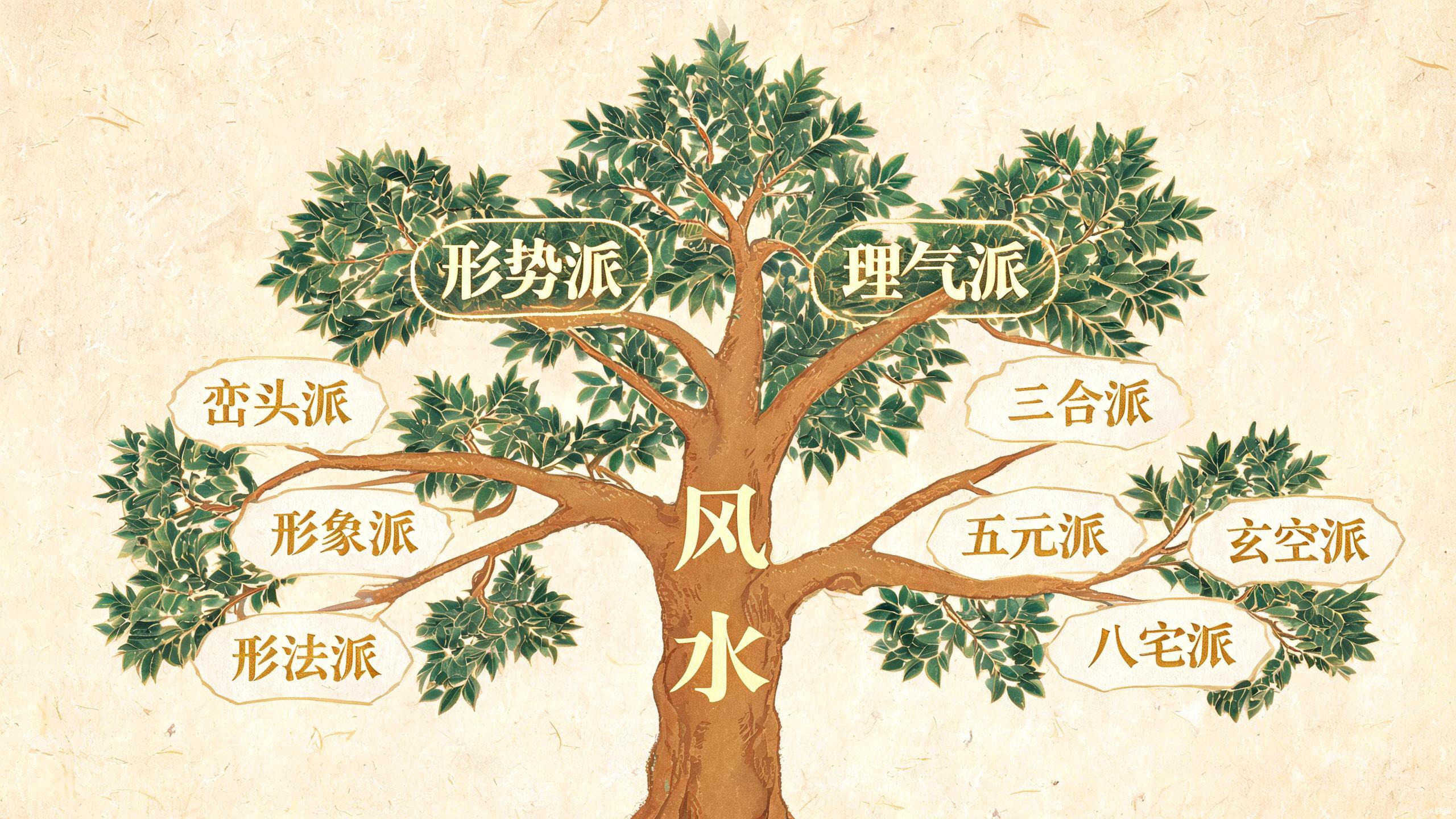
The Formation of Feng Shui Schools
Chinese Feng Shui has ancient origins, evolving and spreading through countless dynasties until it developed into the richly diverse theoretical system we know today. Around the activities of site selection and building construction, two major concerns emerged: first, investigating natural geographic conditions to create site plans; second, using divination to determine auspicious directions and timing for cities, official residences, tombs, and ancestral temples. These two branches were passed down through generations and eventually crystallized into the two great traditions of Feng Shui.
During the Han Dynasty, practitioners were divided into the "Form Method" (形法家) and "Kanyu" (堪舆家) schools. By the Tang and Song Dynasties, these evolved into the Form School (形势宗) and Compass School (理气宗). During the Ming and Qing Dynasties, further branches developed from these foundations, including the Eight Mansions School, Xuan Kong Flying Star School, Yang Gong School, and Passing Yin Yang School.
Cultural Context: The division between Form School and Compass School represents one of the most fundamental philosophical tensions in Feng Shui — observation versus calculation, landscape versus numbers, the tangible versus the abstract. Most modern practitioners draw from both traditions rather than choosing one exclusively.
Form School (Jiangxi School)
Origins and Key Figures
The Form School emphasizes observing mountains and terrain, using the Dragon, Acupoint, Sand, and Water (龙穴砂水) as its four main categories. Known for its practical effectiveness, this school spread widely throughout China. Its most important figure is the Tang Dynasty Feng Shui master Yang Yunsong (杨筠松). Because Yang Yunsong carried numerous Feng Shui texts from Chang'an to Jiangxi Province, where he taught and trained disciples, this school is also called the "Jiangxi School."
Core Theory
The Siku Quanshu Zongmu Tiyao (Complete Library of the Four Treasuries: General Catalog with Abstracts) offered this precise summary of the Form School's main theories:
- Han Long Jing (Classic of Shaking Dragon): Focuses on mountain ridges and the flow of Dragon Veins, classifying them into nine stars — Greedy Wolf, Giant Door, Lu Cun, Wen Qu, Lian Zhen, Wu Qu, Broken Army, Left Helper, and Right Helper — with detailed explanations for each
- Yi Long Jing (Classic of Doubting Dragon): The upper section discusses finding branches within trunks and focuses on water mouth configurations; the middle section covers finding the Dragon's destination and examining facing and backing methods; the lower section discusses acupoint formation patterns
- Zang Fa (Burial Method): Dedicated entirely to acupoint identification, including the leaning, covering, colliding, and adhering techniques
The Form School considers Guo Pu (郭璞), author of Zang Shu (Book of Burial), to be the ancestor of all Form School theory, since this tradition traces its written roots to his work.
Cultural Context: Guo Pu (郭璞, 276–324 AD) is reverently called the "founding father of Feng Shui." His Zang Shu contains the famous definition: "Qi rides the wind and scatters, but is retained when encountering water" — a single sentence that became the philosophical foundation for all subsequent Feng Shui practice.
Nine Star Theory
The Form School classifies the mountain peaks where Dragon Veins form acupoints into nine categories, known as the Nine Star Peaks. These nine stars are divided into auspicious and inauspicious types:
| Star Name | Auspicious/Inauspicious | Description |
|---|---|---|
| Greedy Wolf (贪狼) | Auspicious | Tall and elegant form |
| Giant Door (巨门) | Auspicious | Square and solemn form |
| Wu Qu (武曲) | Auspicious | Solid and powerful form |
| Left Helper (左辅) | Minor Auspicious | Supporting star |
| Right Helper (右弼) | Minor Auspicious | Supporting star |
| Broken Army (破军) | Inauspicious | Broken and scattered form |
| Lian Zhen (廉贞) | Inauspicious | Sharp and aggressive form |
| Lu Cun (禄存) | Inauspicious | Bulging and uneven form |
| Wen Qu (文曲) | Inauspicious | Weak and crooked form |
The first five stars together are known as the "Five Auspicious Stars," while the remaining four are considered inauspicious.
How to Apply Form School Principles in Your Home
Even without access to mountains and rivers, you can use Form School logic in modern spaces:
- Find your Dragon: Identify the tallest, most solid structure behind your home (an apartment building, a hill, or a large tree) — this is your "backing mountain" that channels protective Qi
- Locate your Acupoint: Find the center of your living space where energy naturally gathers — keep this area open, uncluttered, and well-lit
- Check your Sand: Survey the surrounding buildings and structures — they should "embrace" your home without overwhelming it
- Observe your Water: Look at the roads, pathways, and driveways near your home — curved, gentle flow brings wealth; straight, rushing roads can drain fortune
Quick Tips:
- In modern apartments, your Dragon is often the wall behind your bed or desk — avoid placing your back against windows
- Form School is the most intuitive Feng Shui method — perfect for beginners who want to start with visible, tangible adjustments
- The Jiangxi School legacy means most rural Chinese cemeteries still follow Form School principles today
Compass School (Fujian School)
Origins and Key Figures
The Compass School developed from the "Kanyu" (堪舆, Feng Shui) traditions of the Tang and Song Dynasties. Because Kanyu primarily focused on divining auspicious timing, the Compass School's activities can be traced back to the ancient practice of "divining dwelling sites" (卜宅) — chronologically earlier than the Form School. Its representative figure, Lai Wenjun (赖文俊, styled Lai Buyi 赖布衣), gained great fame for his site-reading skills while in Fujian Province, attracting many followers. Fujian Feng Shui thus became synonymous with the Compass School tradition.
Core Theory
The Compass School draws heavily from the "Qi theory" (气论) of ancient Chinese philosophy. Qi theory holds that "all things are created by Qi" (方以智, Fang Yizhi) and that "heaven and earth form one unified body" (程颢, Cheng Hao). Between all things in the universe exists a common essence called "Li" (理, principle). Li is real yet formless, and its union with form manifests as "Qi."
The principal text of the Compass School is the Jiu Tian Xuan Nu Qing Nang Hai Jiao Jing (Classic of the Mysterious Lady's Green Satchel and Sea Horn), which uses the Yin and Yang of the Zhou Yi (I Ching) as its foundation, along with the Five Elements, Trigram theory, and the Twenty-Four Mountains as its basic framework. The Zhai Jing (Classic of Dwelling), in two volumes, is also a foundational text of the Compass School and was included in the Siku Quanschu (Complete Library of the Four Treasuries).
Cultural Context: While the Form School asks "What does the landscape look like?", the Compass School asks "What time is it and what direction is favorable?" This makes Compass School calculations more abstract and mathematical — requiring mastery of the Luopan (Feng Shui Compass) and the Chinese calendar.
Eight Mansions School
The Eight Mansions School is an important branch that developed during the Ming and Qing Dynasties from both the Form and Compass traditions. This school uses the Bagua (Eight Trigrams) as its foundation and divides residences into two major categories: East Four Mansions and West Four Mansions.
- East Four Mansions: Zhen Mansion (sitting east, facing west), Xun Mansion (sitting southeast, facing northwest), Kan Mansion (sitting north, facing south), Li Mansion (sitting south, facing north)
- West Four Mansions: Qian Mansion (sitting northwest, facing southeast), Kun Mansion (sitting southwest, facing northeast), Dui Mansion (sitting west, facing east), Gen Mansion (sitting northeast, facing southwest)
The Eight Mansions School also derives "Four Auspicious Stars" and "Four Inauspicious Stars" based on the residence's sitting and facing directions:
| Auspicious Star | Meaning | Inauspicious Star | Meaning |
|---|---|---|---|
| Vital Qi (生气) | Most auspicious — wealth and career | Deadly (绝命) | Major misfortune — financial loss and injury |
| Longevity (延年) | Most auspicious — health and marriage | Five Ghosts (五鬼) | Inauspicious — disputes and lawsuits |
| Heavenly Doctor (天医) | Moderately auspicious — healing and health | Six Sha (六煞) | Inauspicious — arguments and troubles |
| Stability (伏位) | Minor auspicious — steady and peaceful | Hardship (祸害) | Inauspicious — illness and financial loss |
The Eight Mansions School teaches that a person's Life Gua (命卦) also falls into East Four Life or West Four Life categories. East Four Life individuals thrive in East Four Mansions, while West Four Life individuals flourish in West Four Mansions. Life-Mansion Compatibility (命宅相配) brings good fortune; mismatch brings misfortune.
How to Apply Eight Mansions in Your Home
- Determine your Life Gua: Based on your birth year and gender, calculate whether you belong to East Four Life or West Four Life
- Identify your mansion type: Check your home's main entrance direction to see which of the eight mansion categories it falls into
- Match Life to Mansion: Ensure your Life Gua aligns with your mansion type for optimal harmony
- Locate your four auspicious stars: Use the sitting direction to find where Vital Qi, Longevity, Heavenly Doctor, and Stability fall in your home — prioritize these areas for your bed, desk, and stove
Quick Tips:
- Eight Mansions is one of the most beginner-friendly Feng Shui methods because it requires only your birth year and your home's entrance direction
- The Four Auspicious Stars help you quickly identify the best locations for key furniture placement
- This school is especially popular for apartment Feng Shui because it works purely with directional calculations
Xuan Kong Flying Star School
The Xuan Kong School is another major tradition that developed during the Ming and Qing Dynasties, with Xuan Kong Flying Stars as its core theory. This school uses the Nine Stars (One White, Two Black, Three Jade, Four Green, Five Yellow, Six White, Seven Red, Eight White, and Nine Purple) "flying" through the Nine Palaces grid according to specific patterns. By combining time (元运, Yuan Yun — Time Periods) with space (directions), it determines auspicious and inauspicious energies.
Xuan Kong Flying Star theory holds that stellar Qi in the universe flows through time, waxing and waning across different periods. By analyzing the relationship between a home's sitting direction and the Current Period Star chart, practitioners can assess the Feng Shui quality of a residence and recommend adjustments. The Xuan Kong School has a specially designed "Xuan Kong Flying Star Luopan" (compass) with fewer layers but clear and specific markings, making it practical for real-world application.
Cultural Context: Xuan Kong Flying Star is considered the most dynamic Feng Shui system because it accounts for time. A home that was lucky in one period may need adjustments when the next Time Period begins — currently we are entering the Nine Purple Li Fire Period (九紫离火运, 2024–2043), which emphasizes Fire element energy, creativity, and technology.
School Comparison and Integration
| Comparison Item | Form School | Compass School | Eight Mansions | Xuan Kong |
|---|---|---|---|---|
| Focus | Mountains and terrain | Yin Yang and Qi | Directional matching | Flying stellar Qi |
| Tools | Luopan + field observation | Luopan + calculation | You Nian method | Flying Star chart |
| Application | Site selection, Yin Dwelling | Yang Dwelling, date selection | Yang Dwelling layout | Yang Dwelling layout |
| Characteristics | Intuitive and practical | Theoretically profound | Simple and easy to learn | Precise and dynamic |
It is important to note that these schools are not entirely opposed to one another — in practice, they blend and complement each other. True Feng Shui masters typically master multiple traditions and apply them flexibly according to real-world situations. Modern Feng Shui practice especially emphasizes "Form as the body, Qi as the function" (形势为体,理气为用), combining the strengths of both major schools for comprehensive evaluation.
Choosing the Right Feng Shui School for You
- For beginners: Start with the Eight Mansions School — its straightforward calculations and clear rules make it the easiest entry point
- For landscape lovers: The Form School suits those who enjoy observing physical environments and working with natural features
- For detail-oriented practitioners: The Compass School rewards those who appreciate philosophical depth and precise calculations
- For advanced learners: The Xuan Kong Flying Star School offers the most comprehensive and time-sensitive analysis
Quick Tips:
- Many modern Feng Shui consultants use a blended approach — the best practitioners draw from multiple schools
- When consulting a Feng Shui master, ask which schools they specialize in to ensure alignment with your needs
- Remember that no single school is "best" — each has strengths suited to different situations and property types
Related Articles
- [[../06-风水文化与历史/02-风水流派演变史.md|Evolution of Feng Shui Schools: The Historical Development of Form School and Compass School]]
- [[../06-风水文化与历史/45-宋代风水:理气派的兴起与繁荣.md|Song Dynasty Feng Shui: The Rise and Prosperity of the Compass School]]
- [[../07-风水故事/05-杨筠松救贫传奇.md|The Legend of Yang Yunsong Saving the Poor: The Legendary Life of the Jiangxi Form School Founder]]
- [[../01-风水入门/39-Feng Shui Schools Comparison and Selection.md|Feng Shui Schools Comparison and Selection: Finding the Path That Suits You Best]]