Feng Shui Site Survey: 10 Essential Methods for Field Assessment
## Core Principles of Feng Shui Site Survey The purpose of Feng Shui is to carefully observe and understand nature, then work with and adapt it to create harmonious living environments that align with
Feng Shui Site Survey: 10 Essential Methods for Field Assessment
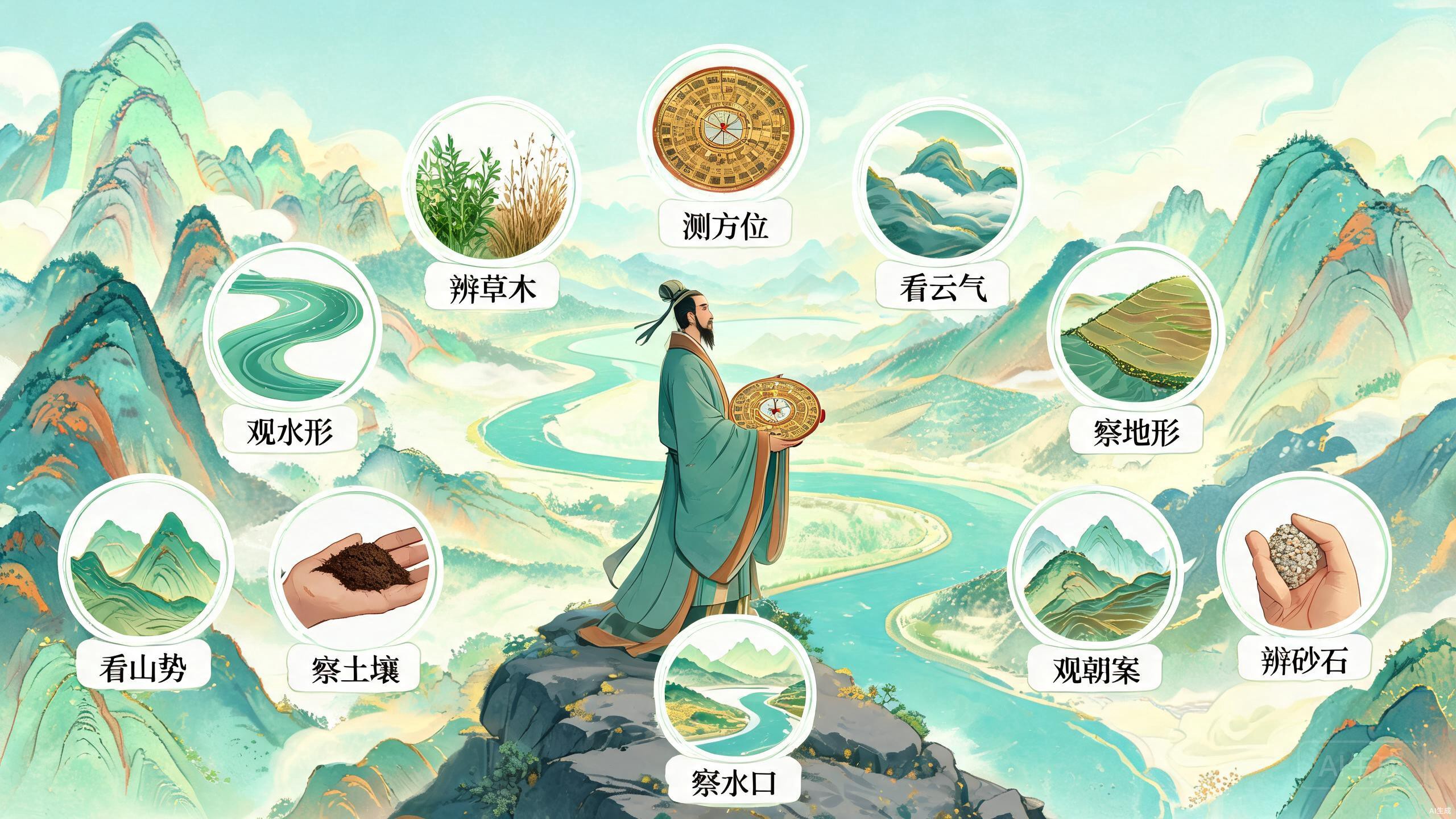
Core Principles of Feng Shui Site Survey
The purpose of Feng Shui is to carefully observe and understand nature, then work with and adapt it to create harmonious living environments that align with the best of Heaven, Earth, and Human timing. Observing Feng Shui should never mean getting a narrow, incomplete picture or simply following what others say — it must follow established principles and systematic methods.
The core workflow of any Feng Shui survey follows the sequence: Seeking Dragon (觅龙), Observing Sand (观砂), Inspecting Water (察水), and Pointing Acupoint (点穴) — guiding Qi (气) down from the Dragon Vein and gathering it into the Feng Shui Point (穴). As the classical saying goes: "Where mountain Qi flourishes and approaches water, the water gathers Qi and condenses into a Feng Shui Point." (山气茂盛,直走近水,近水聚气,凝结为穴). Building on this foundation, generations of Feng Shui masters have refined ten field assessment methods.
Cultural Context: In traditional Feng Shui, Qi is the invisible life force that flows through landscapes. Mountains are considered the "bones" that channel Qi, while water acts as the "blood" that carries and gathers it. The practitioner's job is to trace where Qi gathers — and place homes or graves at those energetic hotspots.
The Ten Survey Methods Explained
1. Examine the Ancestral Mountain's Majesty
Check whether the mountain range at the source of a great river is beautiful, tall, and majestic. The Ancestral Mountain (祖山) is the origin of the Dragon Vein, and Feng Shui holds that "the Dragon reveals its ancestor; the water traces back to its source" (龙探其祖,水溯其源). A majestic Ancestral Mountain signals a powerful Dragon Vein filled with abundant Qi; a short, crumbling source indicates a weak, depleted vein.
Ancient masters regarded the Kunlun Mountains as the source of all Dragon Veins, believing every major mountain range in the world extends from and branches off this central axis.
When observing the Ancestral Mountain, pay attention to its vital signs: "When a mountain wears a purple crown like a canopy, with misty green vapors drifting, clouds rising in layers present throughout all four seasons, with skin uneroded, luster rich and oily, vegetation lush, springs sweet, soil fragrant and fine, stones moist and bright — then Qi is gathering here and will not cease." (凡山紫色如盖,苍烟若浮,云蒸霭霭,四时弥留,皮无崩蚀,色泽油油,草木繁茂,流泉甘冽,土香而腻,石润而明,如是者,气方钟未休). The opposite is also true: "When a mountain's form is broken and wounded, its Qi disperses and dies." (凡山形势崩伤,其气散绝谓之死).
Quick Tip: Even in urban settings, identify your "Ancestral Mountain" — the tallest, most solid structure behind your home. A strong, well-maintained backing building provides stronger Qi support than a crumbling or absent one.
2. Observe the Dragon's Transformations
Check whether the mountain range rises and falls with meaningful variation. A powerful Dragon Vein never runs in a straight line — it undulates, twists, and transforms like a dragon swimming through the landscape. Feng Shui masters classify mountain formations into five dynamic forms:
| Form Name | Characteristics |
|---|---|
| Forward Form (正势) | Dragon rises in the north, faces south |
| Side Form (侧势) | Dragon originates in the west; Feng Shui Point forms in the north, faces south |
| Reverse Form (逆势) | Dragon moves against the water to face forward, flows with water to exit |
| Following Form (顺势) | Dragon follows water to face forward, moves against water to exit |
| Returning Form (回势) | Dragon body turns back to face the Ancestral Mountain |
The requirement for these forms: "Form should not stop — if it stops, Qi has nowhere to come from. Form should approach; form need not fear being exposed; form must be round — when round, it flows." (势不欲止,止则来无所从。势欲其来,势不畏露,势必欲圆,圆则顺).
3. Identify Where the Dragon Settles and Concludes
Check whether the mountain's undulations create basins or plains along its path. As a Dragon Vein travels, it eventually reaches a place where it "settles and concludes" (住结) — pausing to form terrain suitable for a Feng Shui Point. This terrain typically appears as a mountain basin or plain: surrounded by protective hills with flat, open ground in the center — ideal for building a home or laying a grave.
4. Examine the Clear "Drop Point"
Check whether the confluence of waters is clear and distinct at the river's meeting point. The "Drop Point" (落头) refers to where the Dragon Vein terminates at its Feng Shui Point — the critical junction where mountain and water energies merge. An ideal Drop Point shows three waters meeting, three mountain ridges converging, water with clear source upstream, and a controlled exit downstream.
Water Dragons have divisions and convergences: "Water divides and reunites once before the point, divides and reunites again at the Dragon-Tiger crossing, and a third time at the Lesser Ancestral Mountain. Small convergences form the Small Bright Hall; great convergences form the Great Bright Hall. Where waters meet, the Dragon ends; where waters cross, the Dragon stops." (水自穴前一分合,至龙虎所交二分合,少祖山处三分合。小合为小明堂,大合为大明堂。水会即龙尽,水交则龙止).
Cultural Context: The "Bright Hall" (明堂, míng táng) is the open space in front of a Feng Shui Point where energy gathers. Think of it as the energetic "living room" of a landscape — it should be spacious enough to hold Qi but not so vast that energy disperses.
5. Trace Where the Vein Ultimately Returns
Check the endpoint of the mountain range's journey. After traveling a certain distance, the Dragon Vein reaches its terminus — where the Qi channel finally stops. This endpoint is a prime candidate for locating the Feng Shui Point. Determining this requires observing the mountain's narrowing formations, where waters converge, and how the terrain opens or closes.
6. Examine the Flat Basin Within the Point
Check whether the small-scale terrain is suitable for forming a Feng Shui Point. An ideal Feng Shui Point should be a flat, open "nest" (窝) — like a vessel that can hold and gather Vital Qi (生气). Points vary in elevation, size, and proportion:
- High points should avoid wind exposure
- Low points should avoid flooding
- Large points suit spacious construction
- Small points suit compact construction
- Thin points require the structure to settle downward
- Fat points require the structure to float upward
The complete procedure for Pointing the Acupoint includes sixteen considerations: "Examine Yin and Yang, determine the Five Elements, decide front and back, investigate life and death, trace origins, assess star peaks, observe endpoints, analyze divisions and unions, distinguish light and shadow, verify right and wrong, observe urgency, carefully calculate surplus and reduction, know what to avoid, master skill and clumsiness, confirm proper and deviant, and examine hidden and revealed." (审阴阳,定五行,决向背,究死生,推来历,论星峰,看到头,论分合,见其明暗,核其是非,察其缓急,慎其饶减,知其避忌,精其巧拙,定其正偏,审其隐露).
7. Observe the Harmony of Sand and Water
Check whether the mountains and waters encircling the Feng Shui Point form a harmonious embrace. Sand and Water are interconnected: "Sand controls water; water controls sand." (砂关水,水关砂). An ideal configuration includes:
- Front: Facing Mountain and Desk Mountain (朝案) blocking outside Dragon Waters
- Back: Ancestral Mountain sand providing backing and support
- Left: Azure Dragon (青龙) sand protecting the eastern flank
- Right: White Tiger (白虎) sand embracing the western flank
- Base: Gently meandering streams flowing along the foot of the sand formations
Sand formations should layer upon layer, ordered front to back, all leaning inward as if showing affection. The principle is: "The Azure Dragon should be tall; the White Tiger must not raise its head." The more layers of protective sand around the point, the better.
Quick Tip: In your home, the "Azure Dragon" position is your left side when facing out from your entrance; the "White Tiger" is your right. Ensure your left side has slightly taller furniture or features than your right for optimal support.
8. Observe the Facing Mountain's Affectionate Response
Check whether the mountains in front of and behind the Feng Shui Point show "affection" (有情) — meaning the Facing Mountain (朝山) and Desk Mountain (案山) curve and embrace toward the point, like a guest meeting the host, like a courtier paying homage to the sovereign.
- A near Desk Mountain keeps the area in front of the point tight and gathered, preventing the Bright Hall from being too vast and Qi from dispersing
- A distant Facing Mountain provides pairing and validation, avoiding the problem of narrow, choking pressure
The best Facing Mountain is described as "two waters converging to form a special facing" (两水夹来为特朝). As the saying goes: "Sharp, elegant, square, or round, rising directly before you — your descendants shall become ministers and generals, jade belts at their waists." (尖秀方圆当面起,子孙将相玉横腰).
For Desk Mountains: "A Desk Mountain before your door is worth a thousand gold pieces — distant joy reaches the eyebrows; near joy touches the heart." (门前有案值千金,远喜齐眉近应心).
9. Distinguish Life and Death, Forward and Reverse
Check the auspicious and inauspicious choices of mountain and water. Feng Shui categorizes Qi veins into "life" (生) and "death" (死): Mountains and waters facing forward are true (life); mountains and waters facing backward are false (death). Wind sheltered, water reversed, Qi gathering — that is life. Wind scattered, water dispersed, Qi drifting — that is death. When selecting a Feng Shui Point, practitioners choose life over death, forward over reverse.
10. Balance Yin and Yang, Moderation and Urgency
Check the mountain and water's front-back orientation, assessing whether Yin and Yang are harmonized and whether the Qi flow is too urgent or too sluggish. A good Feng Shui Point requires balanced Yin and Yang with a moderate Qi pulse — neither too urgent (which scatters Qi through force) nor too slow (which causes Qi to stagnate and disperse).
Cultural Context: Yin and Yang represent complementary opposites — shadow and light, stillness and movement, contraction and expansion. A balanced site harmonizes both; an imbalanced one creates energetic problems ranging from restlessness to stagnation.
Supplementary Survey Methods
Method of Observing Water
"When Seeking Dragon and Pointing Acupoint, first observe the water's movement." (寻龙点穴须仔细,先须观水势). Water is the blood of the Dragon and the external Qi of the Feng Shui Point. When observing water, note these principles:
- Where water is deep, residents tend to be wealthy; where water is shallow, residents tend to be poor
- Where water scatters, residents tend to be scattered; where water gathers, residents tend to be concentrated
- Flowing water should meander; arriving water should curve and embrace
- Gathered water should be clear and pure
- The highest-quality water is emerald clear, sweet to taste, and fragrant in scent
Quick Tip: Even without natural water features, you can apply these principles indoors. A clean, gently flowing fountain or aquarium in your wealth area promotes gathering energy; a constantly draining sink or leaky faucet symbolizes wealth leakage.
Method of Distinguishing Soil
Feng Shui masters traditionally visited sites in person, grinding soil between their fingers, tasting it with their mouths, even digging wells to inspect deep soil layers, water quality, and listening with their ears pressed to the ground to detect underground water flow and sound. Among the five-colored soils, red soil and yellow soil are best, purple and white are second, and black soil is considered inauspicious.
Method of Avoiding Wind
The Di Li Ba Shi Ba Xiang Zhen Jue (《地理八十八向真诀》) classifies wind into eight types, analyzing from which direction each concave wind comes to determine auspicious or inauspicious effects. The wind at an auspicious site reflects the quality of the surrounding mountains — if the site is encircled by successive layers of protective mountain ridges, the wind will pass over them rather than blowing directly into the site.
Quick Tip: Test your home's wind protection on a windy day. Stand at your main entrance — if wind rushes straight in without obstruction, add a buffer. Tall plants, a screen, or an entryway cabinet on the windward side can significantly improve your space's energy retention.
Comprehensive Survey Judgment
Feng Shui site assessment never relies on a single method — all ten methods work together in holistic evaluation. Excellent Feng Shui requires four conditions: True Dragon (龙真), Accurate Acupoint (穴的), Encircling Sand (砂环), and Embracing Water (水抱):
- True Dragon (龙真): Mountain ranges through which Vital Qi actively flows
- Accurate Acupoint (穴的): The precise location where Vital Qi gathers — the auspicious Feng Shui Point
- Encircling Sand (砂环): The protective natural environment of overlapping mountains behind and on both sides of the point
- Embracing Water (水抱): Curving water flowing in front of the point, holding energy in place
All four are essential — none can be omitted. Only by comprehensively examining the Ancestral Mountain, Dragon Vein, Feng Shui Point, Sand and Water, Facing Mountain and Desk Mountain, and Yin-Yang balance can an accurate Feng Shui judgment be made. This embodies the Holistic System Principle of Feng Shui — viewing the environment as an integrated whole rather than examining any single factor in isolation.
How to Apply the Holistic System Principle at Home
- True Dragon equivalent: Identify the strongest flow of energy in your home — usually the main hallway or central living area
- Accurate Acupoint equivalent: Find the room or corner where you feel most relaxed and centered — this is your home's energy gathering point
- Encircling Sand equivalent: Ensure solid backing (wall, tall furniture) behind your seating and sleeping positions
- Embracing Water equivalent: Create gentle, curved pathways rather than straight, racing corridors
Related Articles
- [[../02-家居风水/13-如何看楼盘风水.md|How to Evaluate a Property's Feng Shui: Complete Guide from Community to Building]]
- [[../07-风水故事/06-赖布衣断地如神.md|Lai Buyi's Supernatural Land Judgment — The Legendary Feng Shui Master of the Southern Song]]
- [[../07-风水故事/15-赖布衣点穴传说.md|Lai Buyi's Acupoint-Pointing Legends — Strange Tales of the Common-Clothed Master]]
- [[../08-百科问答库/29-什么是穴位?点穴是什么意思?.md|What Is a Feng Shui Point? Understanding Pointing Acupoint]]