He Tu Luo Shu and the Origins of Feng Shui: Ancient Wisdom for Modern Harmony
> Cultural Context: He Tu (河图) and Luo Shu (洛书) are the two most ancient cosmological diagrams in Chinese tradition, often called the "cosmic magic squares." They form the numerical and philosophical
He Tu Luo Shu and the Origins of Feng Shui
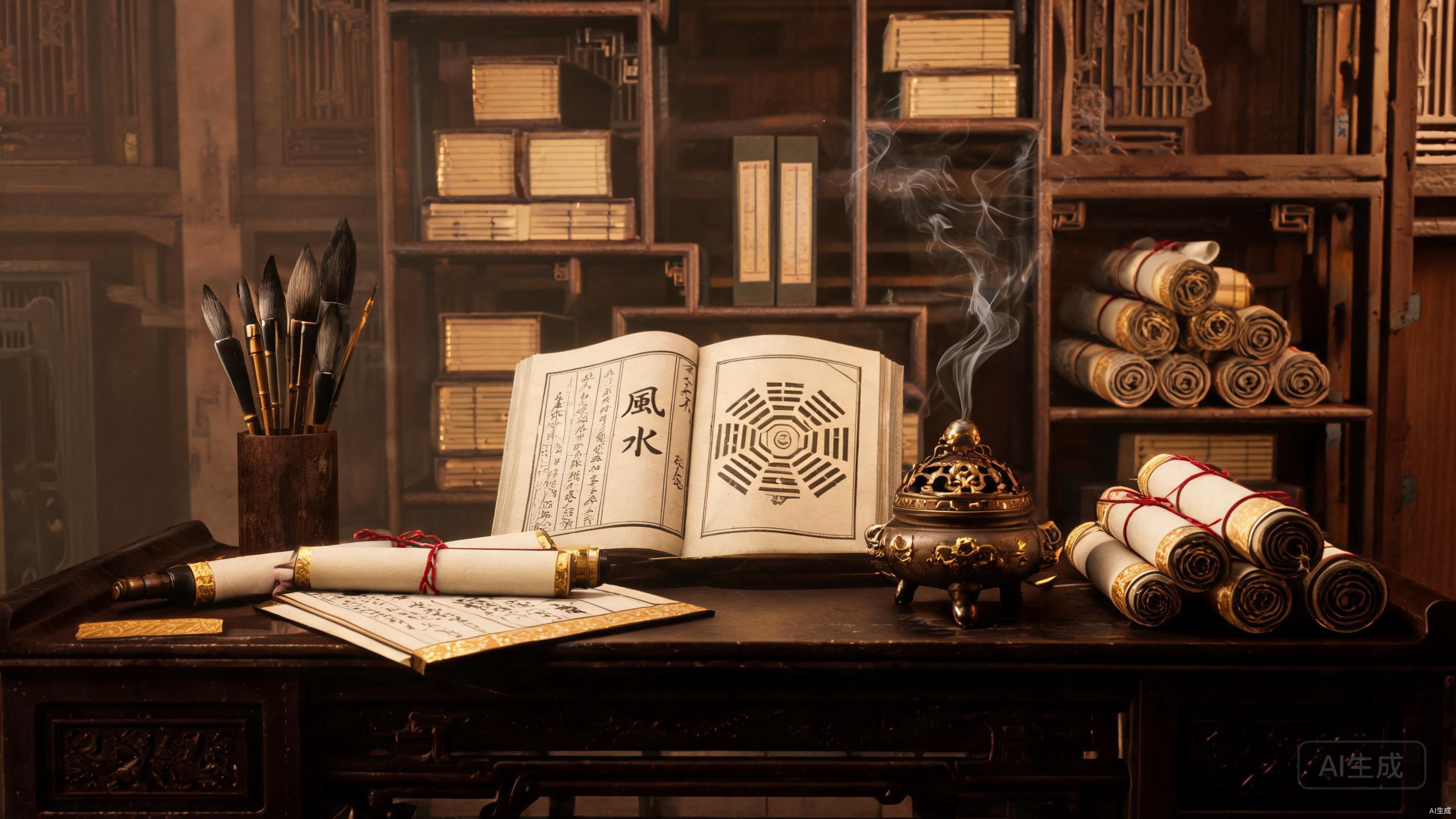
Cultural Context: He Tu (河图) and Luo Shu (洛书) are the two most ancient cosmological diagrams in Chinese tradition, often called the "cosmic magic squares." They form the numerical and philosophical foundation of Feng Shui, Yi Jing (易经) studies, and Chinese metaphysics. Understanding these patterns unlocks the deeper logic behind Bagua (Eight Trigrams), Five Elements, and nearly all Feng Shui practice.
The Legends of He Tu and Luo Shu
The He Tu (Yellow River Diagram) and Luo Shu (Luo River Writing) are two mysterious diagrams passed down from ancient China. Revered as the "cosmic magic squares," they are considered the source of Chinese civilization and the most important theoretical foundation of Feng Shui.
The Legend of He Tu (Yellow River Diagram)
Legend tells that during the era of Fuxi (伏羲), the mythical founder of Chinese culture, a dragon-horse emerged from the Yellow River carrying a mysterious pattern on its back — an offering to Fuxi. This pattern became known as the "He Tu." Inspired by its arrangement, Fuxi created the Pre-Heaven Bagua (先天八卦), opening the gateway to Chinese civilization's profound wisdom.
The Legend of Luo Shu (Luo River Writing)
When Dayu (大禹) was working to tame the great floods, a divine tortoise surfaced from the Luo River bearing another mysterious pattern. By following this diagram, Dayu successfully controlled the floods and divided the land into the Nine Provinces (九州). This became the "Luo Shu."
The Yi Jing · Xi Ci Shang (Great Commentary on the Book of Changes) records: "The Yellow River brought forth the Diagram, the Luo River brought forth the Writing, and the sages modeled their rules upon them." (河出图,洛出书,圣人则之。)
The Structure and Meaning of He Tu
The Number Arrangement
He Tu consists of 55 black and white dots arranged in a specific pattern:
        7
    2       4
8       5       3
    1       9
        6
The Numbers of Heaven and Earth
| Type | Numbers | Color | Property | Sum |
|---|---|---|---|---|
| Heaven Numbers (Yang) | 1, 3, 5, 7, 9 | White dots | Odd | 25 |
| Earth Numbers (Yin) | 2, 4, 6, 8, 10 | Black dots | Even | 30 |
- Generating Numbers (生数): 1, 2, 3, 4, 5 — the numbers through which all things are born
- Completing Numbers (成数): 6, 7, 8, 9, 10 — the numbers through which all things are completed
- The relationship: Each generating number plus 5 equals its completing number: 1+5=6, 2+5=7, 3+5=8, 4+5=9, 5+5=10
The Generation of Five Elements (Wu Xing)
He Tu reveals the Five Elements (Wu Xing) generation pattern through elegant numerical relationships:
| Direction | Generating Number | Completing Number | Five Elements |
|---|---|---|---|
| North | 1 | 6 | Water |
| South | 2 | 7 | Fire |
| East | 3 | 8 | Wood |
| West | 4 | 9 | Metal |
| Center | 5 | 10 | Earth |
The generation principle of He Tu is expressed: "Heaven gives birth to Water at One, Earth completes it at Six; Earth gives birth to Fire at Two, Heaven completes it at Seven; Heaven gives birth to Wood at Three, Earth completes it at Eight; Earth gives birth to Metal at Four, Heaven completes it at Nine; Heaven gives birth to Earth at Five, Earth completes it at Ten." (天一生水,地六成之;地二生火,天七成之;天三生木,地八成之;地四生金,天九成之;天五生土,地十成之。)
Cultural Context: The verse above encodes the "Heaven-Earth pairing" logic of Feng Shui — odd numbers belong to Heaven (Yang), and even numbers belong to Earth (Yin). This pairing principle underpins how practitioners match elements to directions in homes and offices.
The Structure and Meaning of Luo Shu
The Number Arrangement
Luo Shu consists of the numbers 1 through 9 arranged in the famous nine-cell grid:
4 9 2
3 5 7
8 1 6
This is the classical arrangement described as: "Nine on top, One on the bottom; Three on the left, Seven on the right; Two and Four as shoulders, Six and Eight as feet; Five dwells in the center." (戴九履一,左三右七,二四为肩,六八为足,五居中央)
The Foundation of Nine Palace Flying Stars
Luo Shu's numerical arrangement has remarkable characteristics:
- Every line sums to 15: Each row, column, and diagonal adds up to 15
- Yang numbers occupy the Four Cardinal Directions: 1, 3, 7, 9 sit at North, East, West, and South
- Yin numbers occupy the Four Inter-cardinal Directions: 2, 4, 6, 8 sit at Southwest, Southeast, Northwest, and Northeast
- Five rules the center: 5 occupies the central position, representing Earth that governs all four directions
Luo Shu and Directions
| Number | Direction | Five Elements | Trigram |
|---|---|---|---|
| 1 | North | Water | Kan (坎) |
| 2 | Southwest | Earth | Kun (坤) |
| 3 | East | Wood | Zhen (震) |
| 4 | Southeast | Wood | Xun (巽) |
| 5 | Center | Earth | Central Palace |
| 6 | Northwest | Metal | Qian (乾) |
| 7 | West | Metal | Dui (兑) |
| 8 | Northeast | Earth | Gen (艮) |
| 9 | South | Fire | Li (离) |
The Relationship Between He Tu Luo Shu and Feng Shui
The Source of Feng Shui Theory
He Tu and Luo Shu are the most fundamental theoretical sources of Feng Shui:
- He Tu gives rise to the Pre-Heaven Bagua: Fuxi derived the Pre-Heaven Bagua (先天八卦) from He Tu, establishing the cosmic model of Yin and Yang facing each other in their primordial state
- Luo Shu gives rise to the Post-Heaven Bagua: King Wen of Zhou derived the Post-Heaven Bagua (后天八卦) from Luo Shu, establishing the applied model of how all things flow and change in the manifested world
- Luo Shu forms the Nine Palaces: The Luo Shu nine-cell grid became the core framework of Feng Shui layout, widely applied in analyzing the auspicious energy of homes and burial sites
Applications in Feng Shui Practice
- Home Layout: Using the Luo Shu nine-cell grid as a foundation, practitioners divide a home into nine zones to analyze the auspicious and inauspicious energy of each direction
- Flying Star Calculations: The numerical arrangement of Luo Shu provides the mathematical foundation for the Nine Palace Flying Stars (九宫飞星) theory
- Date Selection: The generating-completing number relationship in He Tu is used to select auspicious dates and times
- Destiny Analysis: The number-element correspondences in He Tu and Luo Shu form an important reference in BaZi (Eight Characters) destiny studies
A Modern Perspective
From a modern scientific standpoint, He Tu and Luo Shu contain profound mathematical principles:
- Luo Shu is the earliest known Magic Square, predating its Western counterparts by more than a thousand years
- He Tu embodies the proto-concept of binary code through its Yin-Yang dual-state structure
- The symmetry and balance of He Tu and Luo Shu share common ground with modern systems theory and information theory
"He Tu and Luo Shu — the numbers of Heaven and Earth, the principles of Yin and Yang, the mothers of all creation." (河图洛书,天地之数,阴阳之理,万物之母。) Understanding He Tu and Luo Shu is the first key to unlocking the gateway of Feng Shui wisdom.
How to Apply This Ancient Wisdom Today
You don't need to master the math to benefit from these patterns. Here are practical ways to use He Tu and Luo Shu principles in modern life:
- Map your home with the Luo Shu grid: Divide your floor plan into nine equal zones. Identify your center (position 5) and orient each zone to its corresponding direction and element
- Match element to zone: Place Water features (fountains, blue décor) in the North zone, Wood (plants, green items) in the East, and Fire (candles, red accents) in the South
- Use the "sum of 15" principle for balance: When choosing décor or arranging rooms, aim for balanced energy — pair Yang (bright, active) elements with Yin (calm, restful) elements
- Apply the generating-completing pairing: When you place a Water element in the North, consider doubling it with a complementary item to "complete" the energy
Quick Tips:
- The Luo Shu grid is the foundation of the popular "Bagua map" used in Western Feng Shui — learning the original numbers gives you deeper insight
- The center of your home (position 5) represents Earth and stability — keep this area clean and uncluttered to strengthen the entire space
- Odd numbers = Yang energy (active, bright, expansive); even numbers = Yin energy (calm, soft, receptive). Mix them thoughtfully for harmony
Related Articles
- [[../06-风水文化与历史/41-马王堆帛book中的风水思想.md|Feng Shui Thought in the Mawangdui Silk Texts]]
- [[../06-风水文化与历史/42-汉代风水:从卜宅到相宅的转变.md|Han Dynasty Feng Shui: From Divination to Residence Analysis]]
- [[../01-风水入门/04-五行与八卦.md|Five Elements and Bagua: Generation, Restriction, Pre-Heaven and Post-Heaven]]
- [[../01-风水入门/12-先天八卦与后天八卦的区别.md|Pre-Heaven Bagua vs. Post-Heaven Bagua: Key Differences]]