Heavenly Stems and Earthly Branches: The Foundation of Feng Shui Time-Space
## Heavenly Stems and Earthly Branches Basics ### Ten Heavenly Stems The Heavenly Stems (十天干, shi tian gan) form an ancient Chinese cyclical system used to mark years, months, days, and hours. There a
Heavenly Stems and Earthly Branches: The Foundation of Feng Shui Time-Space
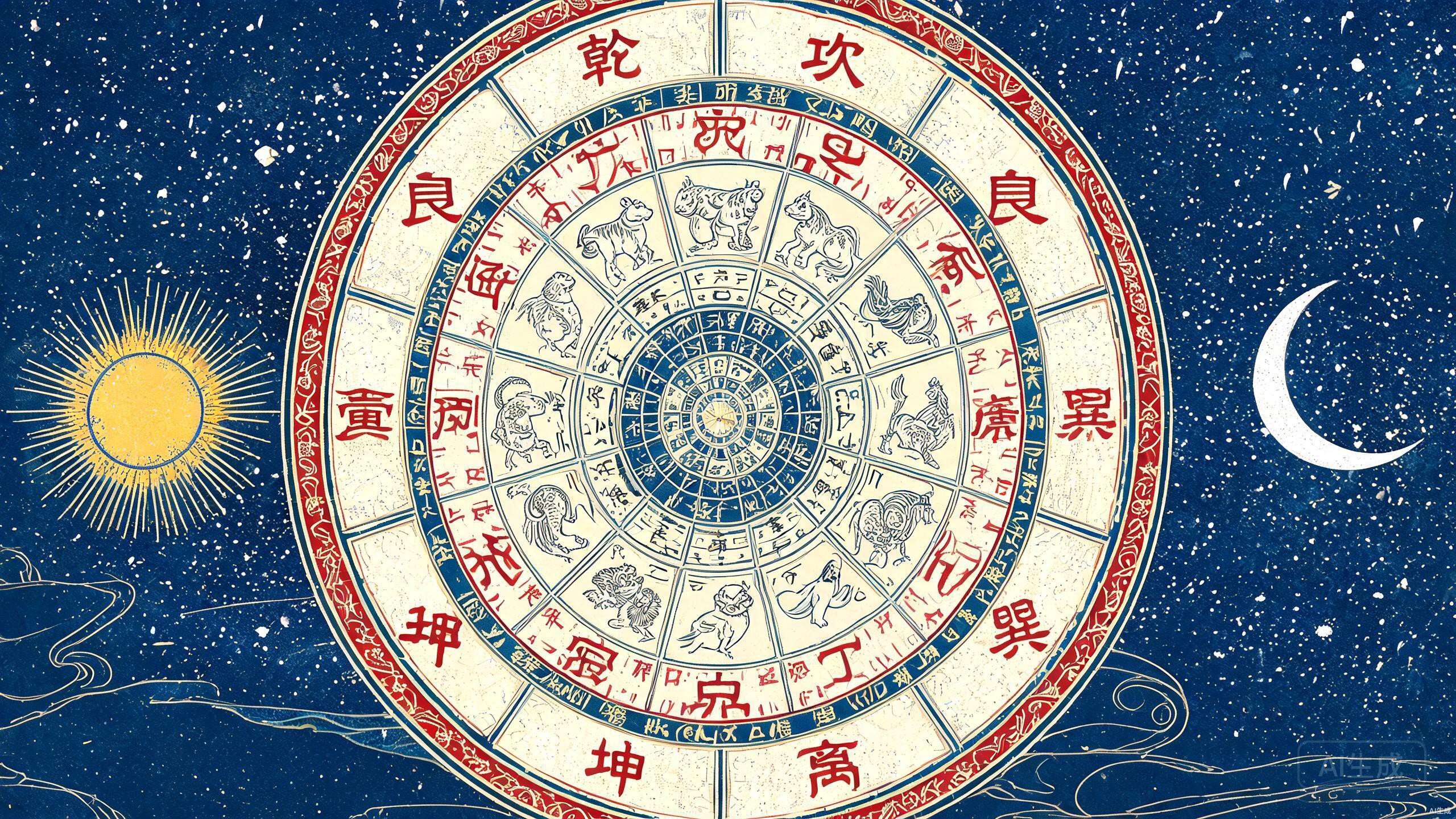
Heavenly Stems and Earthly Branches Basics
Ten Heavenly Stems
The Heavenly Stems (十天干, shi tian gan) form an ancient Chinese cyclical system used to mark years, months, days, and hours. There are ten stems in total:
| Stem | Five Elements | Yin and Yang | Direction |
|---|---|---|---|
| Jia (甲) | Wood | Yang | East |
| Yi (乙) | Wood | Yin | East |
| Bing (丙) | Fire | Yang | South |
| Ding (丁) | Fire | Yin | South |
| Wu (戊) | Earth | Yang | Center |
| Ji (己) | Earth | Yin | Center |
| Geng (庚) | Metal | Yang | West |
| Xin (辛) | Metal | Yin | West |
| Ren (壬) | Water | Yang | North |
| Gui (癸) | Water | Yin | North |
Twelve Earthly Branches
The Earthly Branches (十二地支, shi er di zhi) number twelve and correspond to the Twelve Chinese Zodiac (十二生肖, shi er sheng xiao) animals:
| Branch | Zodiac | Five Elements | Direction | Hour |
|---|---|---|---|---|
| Zi (子) | Rat | Water | North | 23:00–01:00 |
| Chou (丑) | Ox | Earth | Northeast | 01:00–03:00 |
| Yin (寅) | Tiger | Wood | Northeast | 03:00–05:00 |
| Mao (卯) | Rabbit | Wood | East | 05:00–07:00 |
| Chen (辰) | Dragon | Earth | Southeast | 07:00–09:00 |
| Si (巳) | Snake | Fire | Southeast | 09:00–11:00 |
| Wu (午) | Horse | Fire | South | 11:00–13:00 |
| Wei (未) | Goat | Earth | Southwest | 13:00–15:00 |
| Shen (申) | Monkey | Metal | Southwest | 15:00–17:00 |
| You (酉) | Rooster | Metal | West | 17:00–19:00 |
| Xu (戌) | Dog | Earth | Northwest | 19:00–21:00 |
| Hai (亥) | Pig | Water | Northwest | 21:00–23:00 |
Cultural Context: The Twelve Chinese Zodiac is one of the oldest astrological systems still in active use worldwide. Unlike Western zodiac signs, the Chinese zodiac assigns a specific animal "guardian" to each year, and these animals are directly woven into the Earthly Branches — making them inseparable from Feng Shui's spatial and temporal frameworks.
The Sixty Jiazi Cycle
The Stem-Branch Calendar System
China's traditional calendar is called the Stem-Branch Calendar (干支纪年法, gan zhi ji nian fa). It pairs each of the Ten Heavenly Stems with each of the Twelve Earthly Branches in sequence, creating a 60-year cycle known as "One Jiazi" (一甲子, yi jia zi).
The cycle begins with Jia-Zi (甲子) and ends with Gui-Hai (癸亥), with all 60 combinations forming a complete revolution:
Jia-Zi, Yi-Chou, Bing-Yin, Ding-Mao, Wu-Chen, Ji-Si, Geng-Wu, Xin-Wei, Ren-Shen, Gui-You, Jia-Xu, Yi-Hai... continuing this pattern until Gui-Hai, totaling 60 unique pairings.
Quick Tips:
- The number 60 was sacred in ancient China because it represents the least common multiple of 10 and 12 — perfectly aligning the celestial and earthly cycles
- If you know someone's birth year, you can identify their zodiac animal and element in seconds using this cycle
- The 60-year cycle repeats throughout history, which is why historical events are often referenced by their Jiazi designation
BaZi and the Four Pillars
Simply put, BaZi (八字, ba zi — literally "Eight Characters") represents the Heavenly Stems and Earthly Branches of a person's birth year, month, day, and hour. It is also called the Four Pillars (四柱, si zhu): Year Pillar, Month Pillar, Day Pillar, and Hour Pillar — eight characters in total, hence the common term "birth destiny characters" (生辰八字).
For example, a person born on April 21, 2006 at 16:33 can have their BaZi calculated through the stem-branch system. BaZi has wide-ranging applications in Feng Shui and serves as an important reference for date selection, home choice, and layout design.
How to Apply BaZi in Daily Feng Shui Practice
- Find your birth BaZi: Use a Chinese calendar converter online to generate your Four Pillars
- Identify your Day Master: The Heavenly Stem of your Day Pillar reveals your core element (e.g., Bing Fire, Geng Metal)
- Balance your space: If your Day Master is Wood, surround yourself with Wood and Fire elements (which generate Wood) to enhance your natural energy
- Time major renovations: Avoid construction during years that clash with your Day Pillar
How Heavenly Stems and Earthly Branches Connect to Feng Shui
The Twenty-Four Mountains
One of the most important features on a Feng Shui Compass (Luopan, 罗盘) is the "Twenty-Four Mountains" (二十四山, er shi si shan). This system combines the Heavenly Stems, Earthly Branches, and four Inter-cardinal Bagua (八卦) trigrams — Qian (乾), Kun (坤), Gen (艮), and Xun (巽) — to represent directions:
- Eight Heavenly Stems: Jia, Yi, Bing, Ding, Geng, Xin, Ren, Gui (Wu and Ji are excluded as they represent the center)
- Twelve Earthly Branches: Zi, Chou, Yin, Mao, Chen, Si, Wu, Wei, Shen, You, Xu, Hai
- Four Inter-cardinal Trigrams: Qian (Northwest), Kun (Southwest), Gen (Northeast), Xun (Southeast)
Each of the Twenty-Four Mountains spans 15 degrees, totaling 360 degrees for a complete circle. On the Luopan, the Twenty-Four Mountains form the most fundamental and important directional system — Feng Shui practitioners use it to determine the auspicious or inauspicious quality of a building's Sitting and Facing (坐向, zuo xiang) orientation.
Tai Sui and Clashing Sha Qi
Tai Sui (太岁, tai sui), also known as the Grand Duke, is essentially Jupiter as observed in our galactic system. Jupiter is the largest planet in our solar system, with an orbital cycle of approximately 12 years — the same as the Twelve Chinese Zodiac cycle. Each year, as Jupiter reaches a particular position relative to Earth, it strengthens the gravitational and energetic influence of that direction.
Offending Tai Sui (犯太岁) occurs in several ways:
| Type | Meaning | Explanation |
|---|---|---|
| Year Clash (年冲) | Ben Ming Nian (本命年, zodiac year) | Your zodiac animal's own year — e.g., Snake year for someone born in Snake year |
| Direct Opposition (对冲) | Six Clashes (六冲) | Six years after your zodiac year — e.g., Zi-Wu clash, Chou-Wei clash, Yin-Shen clash, Mao-You clash, Chen-Xu clash, Si-Hai clash |
| Partial Clash (偏冲) | Punishing Tai Sui (刑太岁) | Three years offset from your zodiac year — a "partial clash" with Tai Sui |
For example, in a Snake year: those born in Snake year face Tai Sui directly (Ben Ming Nian), those born in Pig year are directly opposite (clashing Tai Sui), and those born in Monkey or Tiger year are partially clashing (punishing Tai Sui).
Cultural Context: In Feng Shui, Tai Sui is not a punishment but a powerful cosmic force — much like a strong ocean current. Just as you wouldn't build a sandcastle during high tide, you avoid major earth disturbances during your Tai Sui year to prevent being "swept away" by overwhelming energies.
Feng Shui teaches that during years when you offend Tai Sui, you should avoid digging, renovating, or construction in the direction associated with that year's Tai Sui. Doing so may invite misfortune — this is the origin of the famous saying "digging on Tai Sui's head" (太岁头上动土).
How to Protect Yourself During a Tai Sui Year
- Avoid renovation in the direction of your year's Tai Sui (typically the same direction as your zodiac animal, or the opposite for direct clash)
- Place a protective item like a Tai Sui plaque or Pixiu (貔貅) in the affected area of your home
- Visit a temple at the start of the year to "pay respects" to Tai Sui and request safe passage through the year
- Wear protective colors corresponding to your element — red for Fire years, white for Metal years, etc.
- Stay mobile and active — Tai Sui challenges often manifest as stagnation, so keep your energy flowing
Na Yin (Sound Five Elements)
The pairing of Heavenly Stems and Earthly Branches serves not only for timekeeping but also for deriving "Na Yin Five Elements" (纳音五行, na yin wu xing). In the Sixty Jiazi cycle, every pair of stems and branches shares a Na Yin element — for example, "Jia-Zi and Yi-Chou signify Sea Water Metal" (海中金), and "Bing-Yin and Ding-Mao signify Furnace Fire" (炉中火). Na Yin Five Elements carry significant reference value in date selection and destiny calculations.
Timing and Feng Shui
Feng Shui is also known by its classical name "Kanyu" (堪舆, kan yu — literally "Heaven and Earth"). "Kan" (堪) represents the Heavenly way, while "Yu" (舆) represents the Earthly way. Kanyu seeks to harmonize Heaven's will with Earth's design, which requires careful timing.
"Fortune flows from the land's energy, but prosperity is activated by auspicious timing." (发福由其地脉,催福由于良辰)
Timing selection (择时, ze shi) is a vital component of land assessment. Feng Shui holds that proper timing can influence not only the magnitude of good fortune but can even compensate for imperfections in the landscape:
"Even without an authentic Dragon Vein, finding an auspicious year and month can still bring wealth and status to a family." (不得真龙得年月,也应富贵旺人家。)
Timing selection draws upon Yin and Yang, Bagua, Hetu Luoshu, and Five Elements theories. Common timing selection methods include:
- Lu Ming Method (禄命法, also called造命法): A person's BaZi determines the ideal timing for construction and burial to attract wealth
- Cong Chen Method (丛辰法): Based on the auspicious or inauspicious nature of Spirit Sha (神煞) — divided into yearly, monthly, daily, and hourly Spirit Sha
- Celestial Star Method (天星法, also called Seven Governors and Four Remainders date selection): Uses the movement patterns of celestial bodies and stars
- Yun Qi Method (运气法): Predicts climate changes and fortune based on the Five Movements and Six Qi cyclical patterns
Quick Tips:
- For major life events (wedding, moving, renovation), consult the Chinese almanac (Tong Shu) to identify personally auspicious dates
- The Lu Ming Method is most commonly used today because it personalizes timing to your individual destiny
- Avoid the first and last days of each lunar month for major decisions — these are considered "Void" (空亡) periods
Modern Applications of Stems and Branches in Feng Shui
In contemporary Feng Shui practice, the Heavenly Stems and Earthly Branches are primarily applied in the following areas:
- Determining Building Orientation: Using the Twenty-Four Mountains and Directions (二十四山向) to precisely mark a home's sitting and facing
- Date and Time Selection: Choosing auspicious dates for construction, moving, and renovation
- Life-Mansion Compatibility (命宅相配): Selecting a home's direction and layout based on the homeowner's birth BaZi
- Annual Feng Shui (流年风水): Adjusting home arrangements each year according to Tai Sui's position to attract luck and avoid misfortune
The Heavenly Stems and Earthly Branches system represents the essence of ancient Chinese astronomy and calendrical science. It organically unifies time and space, providing Feng Shui with a coherent framework for understanding how cosmic rhythms influence human environments. Mastering the basic meanings of the Stems and Branches is an indispensable foundation for any Feng Shui practice.
Related Articles
- [[../03-财运风水/01-财位基础知识.md|Wealth Position Basics: Bright vs. Hidden Wealth Position Explained]]
- [[../05-命理与运势/40-纳音五行详解.md|Na Yin Five Elements Complete Guide]]
- [[../05-命理与运势/32-生肖化太岁方法详解.md|Zodiac Methods to Dissolve Tai Sui Clash]]
- [[../08-百科问答库/60-风水学入门需要学习哪些基础知识?.md|What Basic Knowledge Do You Need to Learn Feng Shui?]]