Modern Feng Shui: 10 Essential Principles for a Lucky and Harmonious Home
## From Tradition to Modern Practice Modern Feng Shui has evolved from classical Feng Shui theory by integrating contemporary scientific knowledge. It emphasizes building on a modern scientific founda
Modern Feng Shui: 10 Essential Principles for a Lucky and Harmonious Home
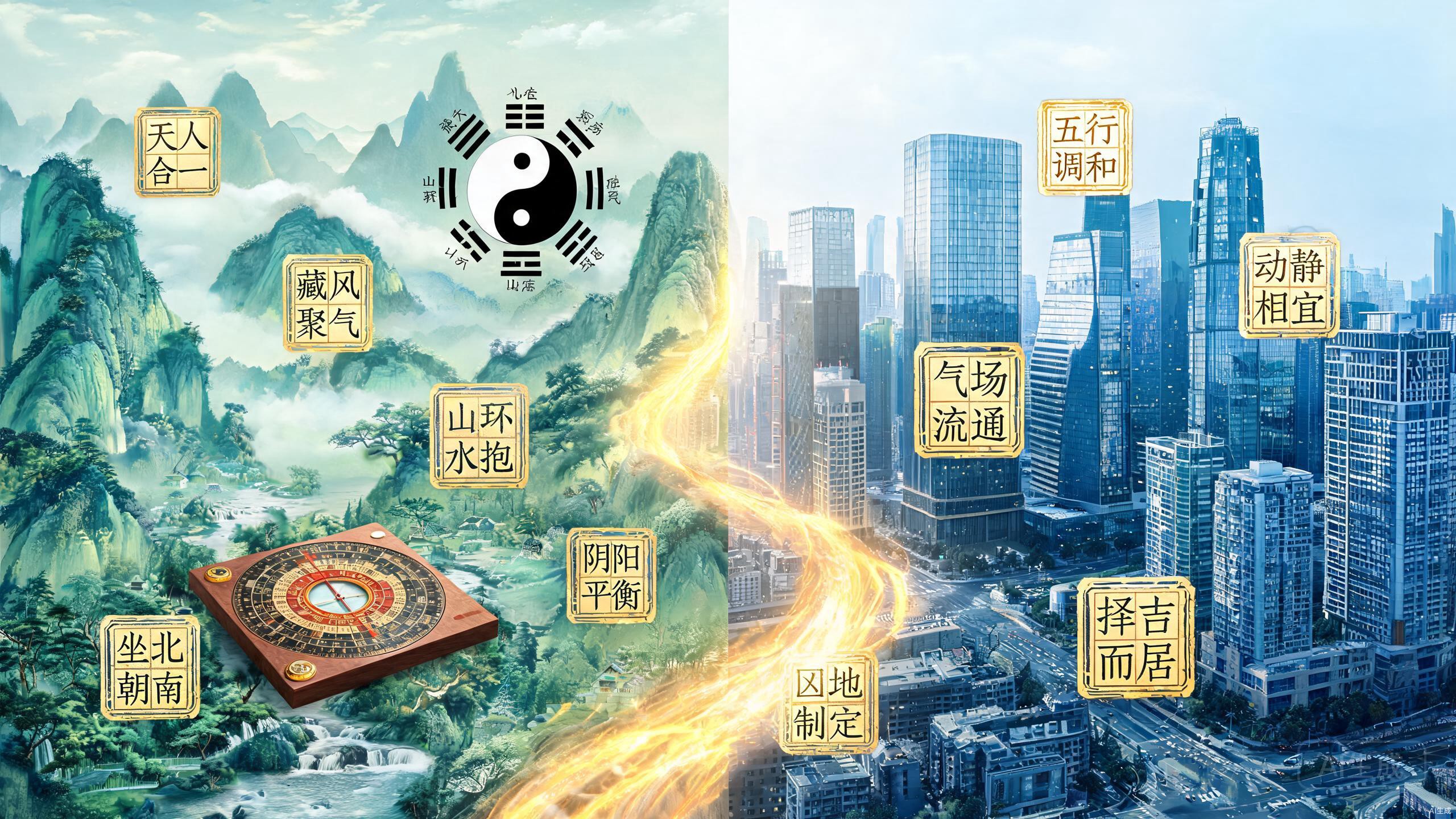
From Tradition to Modern Practice
Modern Feng Shui has evolved from classical Feng Shui theory by integrating contemporary scientific knowledge. It emphasizes building on a modern scientific foundation — discarding superstition while preserving essential wisdom — to create a more complete and rational practice. The Ten Principles of Modern Feng Shui honor the wisdom of ancient masters while addressing the realities of contemporary living environments.
The Ten Principles Explained
1. The Holistic System Principle
The holistic system principle is the overarching framework of Feng Shui, viewing any environment as an integrated whole where elements are interconnected and mutually influential. Feng Shui examines the small environment within the larger one — by observing external surroundings, we can understand the forces shaping our immediate space.
Cultural Context: This systems-thinking approach reflects the classical Chinese worldview of Unity of Heaven and Humanity (天人合一) — the belief that humans, nature, and the cosmos are inseparable. Modern environmental science echoes this insight through ecology and systems theory.
To evaluate a location's Feng Shui quality, you must consider mountains and water, climate, vegetation, geology, and hydrology together. As the Zhai Jing (Classic of Dwelling) states: "People establish the dwelling; the dwelling preserves the people. Human and home support each other, resonating with Heaven and Earth." (人因宅而立,宅因人而存。人宅相扶,感通天地) — confirming that humans and environment form an indivisible whole.
2. The Back to Mountain, Facing Water Principle
Back to Mountain, Facing Water (依山傍水) is one of the most fundamental Feng Shui guidelines. Mountains provide abundant resources and protection from floods; nearby water enables irrigation, washing, and drinking.
An auspicious site features the Four Celestial Animals as protective "Sand" formations:
- Black Tortoise (玄武) — a tall ancestral mountain behind
- Azure Dragon (青龙) — a protective ridge on the left
- White Tiger (白虎) — a balancing ridge on the right
- Vermilion Bird (朱雀) — a Facing Mountain and open Bright Hall with flowing water in front
This Mountains Embracing and Water Surrounding (山环水抱) configuration accomplishes Storing Wind and Gathering Qi while providing essential life resources.
Quick Tips:
- Archaeological evidence confirms this principle — nearly every Neolithic village site was located in such terrain. The famous Banpo Village ruins near Xi'an sit on a terrace facing the Chan River, backed by the White Deer Plateau.
- In modern terms, look for a home with solid "mountain" support behind (tall buildings, hills, or dense trees) and open "water" space in front (parks, plazas, or curved roadways).
3. The Sitting North, Facing South Principle
Because most populated regions of China lie in the northern hemisphere, a south-facing orientation is optimal for Yang Dwellings (阳宅). A home with Sitting North Facing South (坐北朝南) avoids harsh summer sun while capturing warmth and natural sterilization in winter. The folk saying goes: "A south-facing gate spares descendants from cold; a north-facing gate brings them suffering." (大门朝南,子孙不寒;大门朝北,子孙受罪。)
This principle also reflects cultural tradition. The Zhou Yi · Shuo Gua (周易·说卦) states: "The sage faces south to listen to the realm, governing toward the light." (圣人南面而听天下,向明而治) — "governing toward the light" essentially means "governing toward the sun." Additionally, most of China experiences cold northerly winds in winter and warm southerly winds in summer — a south-facing orientation blocks the cold and welcomes the warm.
A pure due-south orientation isn't strictly necessary; south-southeast or south-southwest (10°–15° deviation) often works beautifully. The key is fulfilling the three principles: wind protection, sunlight capture, and ventilation.
4. The Storing Wind and Gathering Qi Principle
"Qi rides the wind and scatters, but is retained when encountering water." (气乘风则散,界水则止。)
Storing Wind and Gathering Qi (藏风聚气) is the core requirement of Feng Shui site selection. An ideal environment features mountains embracing the site from all sides to block harsh winds, with water flowing gently in front to gather Qi.
Feng Shui classifies wind into eight types of concave wind (凹风), each with distinct auspicious or inauspicious meanings depending on direction. An auspicious site should have no wind entering at all — if the site is protected by layer upon layer of continuous mountains, the wind simply passes over without penetrating.
How to Apply the Storing Wind Principle in Your Home
- Identify wind corridors: Walk around your home on a breezy day and notice where wind enters directly
- Block direct paths: Use solid fencing, hedges, or strategic furniture placement to deflect harsh airflow
- Create gentle circulation: Allow Qi to meander rather than race — stagnant Qi and racing drafts are equally problematic
- Add a water feature: A small fountain, birdbath, or even a curved pathway symbolizes gathering water energy at your entrance
5. The Water Is Supreme Principle
"The method of Feng Shui values water above all." (风水之法,得水为上。)
Chinese Feng Shui teaches: "When water flows away, Vital Qi disperses; when water pools and stills, internal Qi gathers." (水飞走则生气散,水融注则内气聚). For selection near a river bend, a site where water wraps protectively around three sides is considered auspicious — called the Golden City Embrace (金城环抱).
Water principles to remember:
- Qi is the mother of water; water is the child of Qi — Qi moves and water follows; water stills and Qi gathers (气为水之母,水为气之子,气行则水随,水止则气蓄)
- Curved water beats straight water — "Where water forms three bends, fortune and longevity abound; where it curves toward you in embrace, glory and riches follow" (水见三弯,福寿安闲。屈曲来朝,荣华富饶)
- Smaller tributaries gather Qi; large rushing rivers scatter human energy due to excessive flow speed
- The convex bank of a river bend (where water embraces three sides) is far better than the concave bank (the Reverse Bow Sha / 反弓一侧)
6. The Riding Vital Qi Principle
Feng Shui theory advocates building residences where Vital Qi (生气, Sheng Qi) is abundant — this is called Riding Vital Qi (乘生气). Only by receiving the nourishment of Vital Qi can inhabitants enjoy health and longevity. The emphasis on Mountains Embracing and Water Surrounding serves to gather Qi and prevent it from leaking away.
From the Form perspective, Vital Qi can be assessed through two channels:
- Earth Qi (地气): Determined by lot size, elevation, soil quality, and moisture
- Door Qi (门气): The Vital Qi drawn in through the front door as the Qi Mouth (气口)
Door Qi should be neither too strong nor too weak — excessive Door Qi overwhelms Earth Qi.
Cultural Context: What ancient practitioners called "Riding Vital Qi" aligns remarkably with modern environmental health science. Soil micronutrients, moisture-related pathogens, geomagnetic fields, and underground radiation all measurably affect human wellbeing — confirming the empirical wisdom beneath this principle.
Modern science has verified that geological conditions affecting health include:
- Trace elements in soil (zinc, molybdenum, selenium, fluorine)
- Damp ordecomposing geological formations linked to arthritis and rheumatic heart disease
- Earth's geomagnetic field — strong fields can heal or harm
- Underground harmful waves from water veins, cavities, and complex geological structures
7. The Balanced Central Principle
The Balanced Central principle advocates moderation in all things — not too large or small, not too high or low, but optimized toward harmony. Qing dynasty scholar Wu Caiding wrote in Yang Zhai Cuo Yao: "A house too large for few occupants is inauspicious; a house too small for many is inauspicious; a small house with a large door is inauspicious; a large house with a small door is inauspicious." (房大人少不吉,房小人多不吉,房小门大不吉,房大门小不吉。) This teaches that dwelling size, household size, door size, and room proportions must all be in harmonious proportion.
The saying "A thousand rooms are grand, but you sleep only eight feet" (广厦千间,夜眠八尺) reminds us that a home need not be vast — what matters is sensible layout and smooth Qi circulation. Balance also applies to location: choose a position with convenient transportation, neither remote nor overcrowded.
How to Apply Balance in Your Home Today
- Match room size to function: Avoid oversized rooms for single uses or cramped bedrooms for couples
- Proportion doors to rooms: Door size should feel appropriate to the space behind it
- Don't over-furnish or under-furnish: Leave clear pathways for Qi to flow
- Position centrally when possible: Choose a home with balanced access to work, family, and amenities
8. The Greenery and Environment Principle
Feng Shui deeply values greenery, considering lush vegetation a sign of abundant Vital Qi. An ideal Feng Shui site is described as: "Clear mountains and beautiful waters, flowing streams, flourishing plants, singing orioles and dancing swallows, birdsong and fragrant flowers." (山清水秀,流水潺潺,草木欣欣,莺歌燕舞,鸟语花香)
Trees regulate climate, prevent soil erosion, block wind, and dissolve Sha Qi (化煞). Two classical prospecting methods demonstrate the Feng Shui respect for plants: "Where wild onions grow on ridges, silver lies below; where wild chives flourish, gold hides beneath" (冈生野葱,下有银丛;若生野韭,金据其中) — using indicator plants to assess geological conditions. Modern science confirms that greenery improves microclimate, purifies air, and regulates humidity.
Quick Tips:
- Place healthy living plants in your Wealth Position to invite growth energy for finances
- Use thorny plants like cactus near windows facing sharp corners to block Form Sha
- Avoid dead or dying plants indoors — they signal depleted Qi and can harm prosperity
9. The Geological Inspection Principle
Feng Shui pays close attention to soil, particularly its Qi channels. Classical Feng Shui masters personally inspected sites by grinding soil between their fingers, tasting earth, and digging wells to examine deep soil layers and water quality. Among the Five Color Soils, red and yellow earth rank highest, purple and white follow, while black earth is considered inauspicious.
Geological inspection evaluates:
- Trace elements (zinc, molybdenum, selenium, fluorine) and their health effects
- Damp or rotting geology linked to arthritis and rheumatic heart disease
- Geomagnetic field influence — strong fields can heal or harm
- Underground harmful waves from rivers, cavities, and complex geological structures radiating upward
Quick Tip: Before purchasing property, visit after rainfall and observe how quickly water drains. Pooling water suggests poor drainage and damp-related Qi problems indoors.
10. The Environmental Modification Principle
A location meeting every ideal requirement is rare. Some sites have a Trunk Dragon and protective Sand but no containing water; others have a Trunk Dragon and water but lack protective Sand. Feng Shui teaches that geographical shortcomings can often be corrected through human effort.
Common Feng Shui Remedies and Modifications
| Method | Description |
|---|---|
| Digging channels for water | Remedies water-deficient sites; channels guide Dragon Qi, protect Sand, and fill the Bright Hall |
| Building up Dragon and Sand | When the Trunk Dragon is too low or protective hills are missing, add earth and plant trees to raise and fill |
| Modifying the dwelling | Adjust the door direction, door and window sizes, or interior layout; build a Screen Wall (照壁) to block unwanted views |
| Using protective objects | Place Shi Gan Dang (Taishan Stone Tablet), Pagodas, Stone Lions, or Qilin to ward off negative forces |
| Strategic plants | Use thorny plants like cactus to block Sha; ornamental plants provide oxygen and attract prosperity |
When modifying, follow the Four Principles of Nature: understand nature, use nature, transform nature, and harmonize with nature. (了解自然,利用自然,改造自然,顺应自然)
Conclusion
These ten principles are not rigid doctrines but guiding frameworks. Real application requires flexibility based on specific environments. The essence of Feng Shui is the pursuit of harmony between humans and nature — "Heaven's timing is less important than Earth's advantage; Earth's advantage is less important than human harmony." (天时不如地利,地利不如人和。)
A good Feng Shui environment ultimately serves humanphysical and mental well-being and life happiness.
Feng Shui only teaches us to better align with nature — we cannot rely on a master's supernatural powers to receive Heaven's help. Never chase or depend on Feng Shui obsessively; do not worship it as a deity. Value Feng Shui, but value virtue even more — practice "unceasing self-improvement" (自强不息) and "bearing all with thick virtue" (厚德载物).
Related Articles
- [[../06-风水文化与历史/06-皇家建筑风水原则.md|Royal Architecture Feng Shui Principles — Confucian Orthodoxy and Divine Right of Kings]]
- [[../07-风水故事/37-台北101.md|Taipei 101 — Feng Shui Rising with the Island's Peak]]
- [[../07-风水故事/33-上海东方明珠.md|Shanghai Oriental Pearl Tower — A Feng Shui Gem on the Huangpu River]]
- [[../08-百科问答库/30-什么是藏风聚气?好风的福标准是什么?.md|What Is Storing Wind and Gathering Qi? What Are the Standards of Good Feng Shui?]]