Qi and Yin-Yang: The Core Theory Behind Feng Shui
## "Qi" — The Heart of Feng Shui ### The Concept and Origins of Qi "Qi" (气) is a profoundly abstract concept, originally devised by ancient Chinese philosophers to explain the formation of all things
Qi and Yin-Yang: The Core Theory Behind Feng Shui
"Qi" — The Heart of Feng Shui
The Concept and Origins of Qi
"Qi" (气) is a profoundly abstract concept, originally devised by ancient Chinese philosophers to explain the formation of all things in the universe. As recorded in the Zhuangzi (《庄子》), chapter "Knowledge Rambling in the North" (知北游): "Human life is the gathering of Qi; when it gathers, there is life; when it disperses, there is death." (人之生也,气之聚也,聚则为生,散而为死。) This reveals Qi as the fundamental element composing all life.
During the Jin Dynasty, Guo Pu (郭璞) introduced the concept of Qi into the Gu Ben Zang Jing (《古本葬经》), also known as the Zang Shu (Book of Burial) — and elevated it to the central principle of Feng Shui. He believed that Qi transforms infinitely and determines human fortune and misfortune. Within Feng Shui, Qi can be understood through several layers:
Cultural Context: Qi is the invisible life force that permeates everything in Chinese metaphysics. Unlike the Western concepts of "air" or "energy," Qi is neither purely physical nor purely spiritual — it is the animating essence that connects heaven, earth, and humanity. When Qi flows smoothly, life flourishes; when it scatters or stagnates, misfortune follows.
- Vital Qi (生气): The nourishing energy of heaven and earth — the ultimate goal of all Feng Shui practice
- Earth Qi (地气): Influences arising from lot size, elevation, soil quality, and humidity that affect human physical and psychological well-being
- Gate Qi (门气): The flow of energy through the main entrance of a house — when the door is correctly positioned, Vital Qi can enter freely
- Qi Vein (气脉): The Qi flowing through mountain ranges, also known as the Qi of the Dragon Vein
How Qi Moves
Feng Shui holds that Qi follows inherent movement patterns. The Zang Shu teaches: "Qi rides the wind and scatters, but is retained when encountering water. The ancients gathered it so it would not disperse and guided it so it would stay." (气乘风则散,界水则止。古人聚之使不散,行之使有止。) This reveals three fundamental principles:
- Qi fears wind: When exposed to wind, Qi scatters — so it must be sheltered
- Qi stops at water: When encountering water, Qi halts — so water serves as a Qi boundary
- Qi follows form: Qi moves along the shape of the land — the rise and fall of mountains is the flow of Qi itself
Qi requires continuity in its movement. Guo Pu's Zang Jing (《葬经》) warns: "When Qi arrives through form but is severed, the site cannot be buried." (气因形来而断不可葬也。) Once Qi is broken by water, cut by a road, or damaged by human intervention, the conditions for gathering Qi are lost.
How to Gather Qi
Feng Shui practice demonstrates that gathering Qi requires the cooperation of "form." To draw Qi down from the Dragon Vein and concentrate it at the Acupoint, one must master four key steps:
- Seeking the Dragon (觅龙): Locate the ancestral mountain — the source of Qi
- Observing the Sand (观砂): Ensure the Dragon and Tiger Sand hills flank tightly so Qi cannot escape
- Inspecting the Water (察水): Water bounds and stops Qi; curving water gathers Qi
- Locating the Acupoint (点穴): Find the auspicious spot where Vital Qi concentrates
Cultural Context: The "Dragon" in Feng Shui refers to mountain ranges viewed as energetic arteries — just as blood flows through veins in the human body, Qi flows through the earth's "Dragon Veins." This is the foundation of the practice known as "Seeking Dragon and Pointing Acupoint" (寻龙点穴).
Before the Sand hills stands the Facing Mountain (朝山), and beyond it lies the Luocheng (罗城) — protective formations layered like a vast courtyard home, with only one opening at the Water Mouth. This layout acts as a container, holding the "subtle and elusive" Qi within.
Yin and Yang — The Philosophical Foundation of Feng Shui
The Origins of Yin and Yang
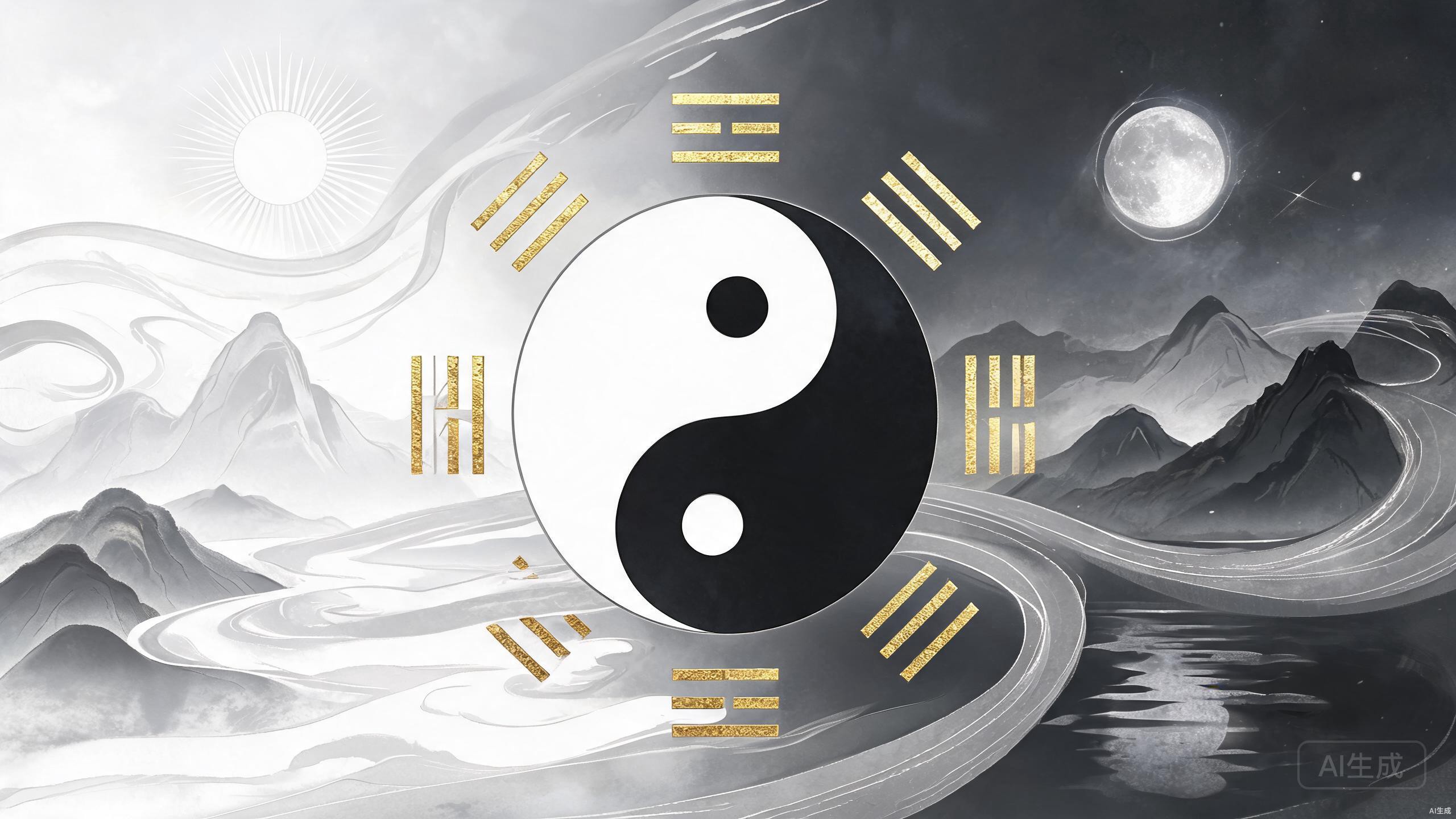
Yin and Yang form the overarching philosophy of the I Ching (《易经》, Book of Changes) and stand as one of the most important concepts in ancient Chinese thought. The Zhou Yi (《周易》) is a philosophical system constructed from two symbols representing Yin and Yang. Yin is symbolized by a broken line "--", while Yang is symbolized by a solid line "—" — and the Eight Trigrams (Bagua) and Sixty-Four Hexagrams are all combinations of these two symbols.
The Zhuangzi (《庄子》, chapter "All Under Heaven" 天下篇) articulates the principle: "One Yin, one Yang — this is called the Dao." (一阴一阳之谓道.) The I Ching · Xi Ci Shang (《易经·系辞上》) offers this profound description of Yin and Yang: "One Yin, one Yang is called the Dao. What continues it is goodness; what completes it is nature. The benevolent see it as benevolence; the wise see it as wisdom; common people use it daily yet do not know it." (一阴一阳之谓道,继之者善也,成之者性也。仁者见之谓之仁,智者见之谓之智,百姓日用不知。)
The Fundamental Laws of Yin and Yang
The unity of opposites in Yin and Yang manifests through several laws:
-
Opposition of Yin and Yang: Everything has two opposing aspects. Heaven is Yang, Earth is Yin; sun is Yang, moon is Yin; man is Yang, woman is Yin; ruler is Yang, subject is Yin.
-
Mutual Rooting of Yin and Yang: Yin contains Yang, and Yang contains Yin — they depend on each other and cannot be separated. Without Yin there is no Yang; without Yang there is no Yin.
-
Waxing and Waning of Yin and Yang: Yin and Yang are never static — they constantly grow and decline. Yang at its peak gives birth to Yin; Yin at its peak gives rise to Yang, in an endless cycle.
-
Transformation of Yin and Yang: Under certain conditions, Yin and Yang transform into each other. When a thing reaches its extreme, it turns into its opposite.
Applying Yin-Yang Balance in Feng Shui
The dialectical thinking of the Zhou Yi emphasizes the opposition, complementarity, and balance of Yin and Yang — the pursuit of harmony and unity. Feng Shui weaves this Yin-Yang theory throughout its practice:
The Yin and Yang of Direction:
- South-facing slopes are Yang; north-facing slopes are Yin
- North of water is Yang; south of water is Yin
- The left is Yang; the right is Yin
- Higher ground is Yang; lower ground is Yin
The Yin and Yang within Feng Shui:
- Mountains are Yin (stillness), water is Yang (movement)
- The solid is Yin; the empty is Yang
- The enclosed is Yin; the open is Yang
Residential Feng Shui seeks harmony between Yin and Yang. A home should not be overly Yin (dark, damp, closed off) nor overly Yang (blindingly bright, dry, restless). An ideal Feng Shui environment achieves balanced Yin and Yang — a perfect marriage of strength and softness.
How to Apply Yin-Yang Balance in Your Home
- Audit your light levels: If rooms feel dim and heavy, add warm lighting or pale wall colors to introduce Yang energy. If rooms feel harsh and glaring, soften with curtains or plants to invite Yin calm
- Balance solid and empty spaces: Avoid overcrowding furniture (too Yang) or leaving rooms completely bare (too Yin) — aim for a 50/50 distribution of filled and open space
- Pair high and low elements: Combine tall furniture (Yang) with low seating or rugs (Yin) in living areas
- Balance stillness and movement: Pair a quiet reading nook (Yin) with an active workspace or kitchen (Yang) in your home layout
Quick Tips:
- Bedrooms should lean slightly Yin — soft lighting, gentle colors, and minimal electronics promote restful sleep
- Home offices should lean slightly Yang — bright light, air circulation, and vibrant accents support productivity
- A single living plant in a sterile room instantly helps harmonize the Yin-Yang balance
Human Energy Fields and Feng Shui
All Things Possess Energy Fields
Every living thing and object carries an energy field — humans included. This personal energy field influences surrounding people and objects, and conversely, the energy field of your environment influences you. One of Feng Shui's theoretical foundations is precisely this mutual interaction between human energy and environmental energy.
Psychologist Kurt Lewin observed: "Behavior changes with changes in the person and the environment. Micro-behavior is caused by individual environmental factors, while macro-behavior is caused by the environment as a whole." This Western insight echoes the Chinese Feng Shui principle of "human perception of energy fields."
Energy Fields and Human Health
All things in the world carry magnetic fields — homes included, as are human bodies. When the energy field of a residence conflicts with that of its occupants, it produces a variety of uncomfortable physical symptoms. The purpose of Feng Shui is to create living and dietary environments compatible with the human body, minimizing the conditions that breed illness.
From a modern scientific perspective, the human body is a small magnetic field, while heaven, earth, and all things form a greater magnetic field. The surrounding environment continuously emits subtle waves that interact physically with our personal magnetic field — causing it to shift and change. This is the principle behind the saying "environment shapes the person."
Modern Interpretations of Qi and Yin-Yang
Although the Feng Shui theories of "Qi" and "Yin-Yang" carry an aura of mystery, their underlying philosophical insights resonate remarkably with modern science:
- The concept of Qi parallels modern physics' understanding of "fields" — electromagnetic fields, gravitational fields, and the quantum vacuum
- Yin-Yang balance corresponds to the dynamic equilibrium theory in modern ecology
- Energy field resonance aligns with modern environmental psychology's findings on how surroundings shape human behavior and mental states
As the saying goes, "Each region nurtures its own people" (一方水土养一方人). People living in different regions display vastly different spirits, characters, habits, and customs. This is Qi in real life — environment shapes people through energy fields, while people also reshape the energy fields of their environment.
How to Apply These Principles in Modern Life
- Treat your home as an energy ecosystem: Just as a balanced ecosystem thrives, a balanced home — with proper light, air, and movement — supports your well-being
- Audit your environment regularly: Walk through each room and ask: Does this space feel energizing or draining? Balanced or extreme?
- Make incremental changes: You don't need a complete renovation. Adding one plant, moving a piece of furniture, or adjusting lighting can shift the energy of a room
- Trust your body's response: If a space consistently makes you feel uneasy, your Qi is responding to an imbalance — investigate and adjust
Quick Tips:
- Spend 10 minutes daily in the quietest and most balanced space in your home — it recalibrates your personal energy field
- Open windows for at least 5 minutes each morning to refresh the Qi in your space
- Decluttering one small area per week prevents stagnant Qi from accumulating in hidden corners
Related Articles
- [[../02-家居风水/33-阳台风水植物.md|Balcony Feng Shui Plants: Greenery for Wealth and Sha Dissolution]]
- [[../02-家居风水/37-植物与风水.md|Plants and Feng Shui: Five Elements Balance and Wealth Attraction Through Home Greenery]]
- [[../04-商业风水/57-商业风水与员工健康.md|Commercial Feng Shui and Employee Health]]
- [[../04-商业风水/39-办公室绿植风水.md|Office Plants and Feng Shui]]