Bathroom and Balcony Feng Shui: Lucky Direction Placement and Sha Qi Remedies
## Bathroom Feng Shui ### The Feng Shui Significance of the Bathroom In Feng Shui, the bathroom falls under the Water element category — it is the space in your home responsible for draining waste and
Bathroom and Balcony Feng Shui: Lucky Direction Placement and Sha Qi Remedies
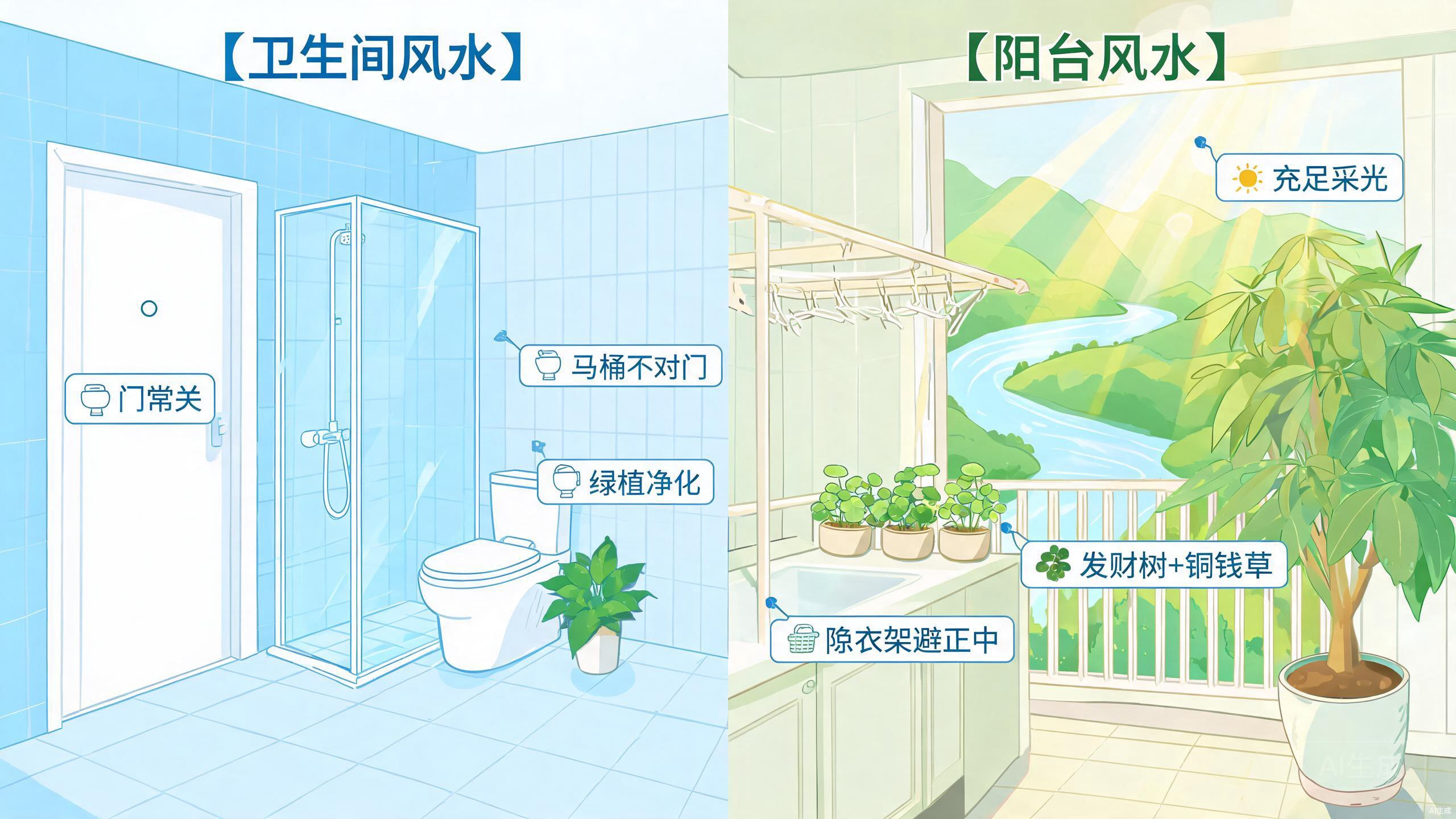
Bathroom Feng Shui
The Feng Shui Significance of the Bathroom
In Feng Shui, the bathroom falls under the Water element category — it is the space in your home responsible for draining waste and removing impurities. When the bathroom's Feng Shui is poorly arranged, it can affect not only your family's health but also your financial fortune. Classical Feng Shui places great importance on the placement of major doors, stoves, beds, and bathrooms — the bathroom being one of the most critical elements to position correctly.
Choosing the Bathroom Location
-
Avoid the Center of the Home: The center of a residence is the Taiji Point (太极点, tài jí diǎn), belonging to the Earth element — it is the energetic heart of the entire home. Since the bathroom belongs to Water, placing it at the center creates a condition called "Water Polluting the Center" (水污中宫), which contaminates the home's overall Qi field. Additionally, the center of a home typically lacks windows, leading to poor ventilation.
-
Avoid Due South: Due South belongs to Fire, while the bathroom belongs to Water. This creates a "Fire-Water Clash" (水火相冲) — a highly unfavorable clash of opposing elements.
-
Avoid the Northwest: The Northwest belongs to the Qian (乾) Trigram, representing the male head of household. A bathroom in the Northwest creates a "Filthy Qian Position" (污秽乾位), which weakens the male household leader's fortune and health.
-
Favor Inauspicious Sectors Over Auspicious Ones: Because the bathroom expels waste and impurity, it should ideally be placed in an inauspicious sector to "use inauspicious energy to counter inauspicious energy." Placing it in an auspicious sector contaminates the lucky Qi you want to preserve.
-
Ensure Natural Light and Ventilation: A bathroom with windows provides natural daylight and airflow, helping to expel dampness and impurities.
Bathroom Layout Taboos
-
Bathroom Door Should Not Face the Main Entrance: Seeing the bathroom immediately upon entering allows impure Qi to rush toward the front door, causing family fortune to decline. Remedy: Hang a bead curtain on the bathroom door, or place a Folding Screen (屏风) between the entrance and bathroom door.
-
Bathroom Door Should Not Face the Bedroom Door: Impure Qi rushing into the bedroom disturbs sleep and harms health.
-
Bathroom Door Should Not Face the Kitchen Door: This creates a Water-Fire clash and allows impure Qi to contaminate the cooking area, affecting dietary health.
-
Bathroom Door Should Not Face the Dining Table: Seeing the toilet while eating is unhygienic and suppresses appetite.
-
Bathroom Should Not Be Above the Bedroom: A bathroom directly above a bedroom creates "Water Pressing the Bed" (水压床), which is harmful to health.
-
Bathroom Should Not Be Above an Altar or Ancestral Tablet: This shows disrespect to deities and ancestors.
Bathroom Remedies
- Maintain Cleanliness: Clean the bathroom frequently and keep it tidy and sanitary
- Ensure Ventilation: Install an exhaust fan to expel dampness and odors promptly
- Keep It Dry: Wipe down floors after use to prevent moisture buildup
- Keep the Door Closed: Always close the bathroom door to prevent impure Qi from spreading into living areas
- Add Plants: Place shade-loving plants like pothos (绿萝) to purify the Qi
- Use Sea Salt (粗盐): Coarse salt absorbs dampness and cleanses the Qi
- Hang Bead Curtains: If the bathroom door faces another important area, a bead curtain helps block and disperse the impure Qi
Balcony Feng Shui
The Feng Shui Significance of the Balcony
The balcony is a transitional space where your home meets the outside world — it serves as one of the home's Qi Mouths (气口). The balcony directly influences indoor air quality and natural light through its ventilation and exposure. In Feng Shui, the balcony is a vital channel for receiving Qi, and its condition affects the overall fortune of the entire residence.
Balcony Orientation
-
East-Facing Balcony is Auspicious: The East is the direction where the sun rises, symbolizing "Purple Qi Arriving from the East" (紫气东来). The gentle morning sunlight brings vibrant, life-giving energy into your home.
-
South-Facing Balcony is Auspicious: The South receives abundant sunlight, staying cool in summer and warm in winter — this is the most common and reliable balcony orientation.
-
Southeast-Facing Balcony is the Best: The Southeast combines gentle morning sun with excellent ventilation, making it the ideal balcony orientation.
-
West-Facing Balcony Requires Adjustments: The afternoon sun is intense, creating strong "Western Exposure" heat. Solution: Install shade structures or grow climbing vines for protection.
-
North-Facing Balcony Requires Adjustments: The North receives little sunlight, making the balcony cold and damp. Solution: Improve insulation and ensure proper ventilation.
Cultural Context: "Purple Qi Arriving from the East" (紫气东来) is a classical Chinese phrase originating from Laozi's encounters described in the Zhuangzi. It refers to auspicious cosmic Qi arriving from the east — a powerful omen of renewal, vitality, and good fortune that has shaped Chinese architectural orientation for millennia.
Balcony Sha Dissolving
The balcony is your home's first line of defense against the outside environment — many external negative influences enter through this space. Below are the most common Balcony Sha and their remedies:
1. Heaven Chopping Sha (天斩煞)
This harmful energy occurs when your front door — or balcony — faces directly into a narrow gap between two tall buildings, as if a giant axe blade were descending. The influence is severe and linked to accidents among household members.
How to Remedy:
- Place a brass horse or Qilin (麒麟) on the balcony
- Hang a convex Bagua Mirror (八卦镜) to reflect the Sha Qi away
- Plant tall, dense greenery to create a visual barrier
2. Reverse Bow Sha (反弓煞)
This pattern forms when the road or river outside your balcony curves outward in a bow shape, with the blade of the arc pointing toward your home.
How to Remedy:
- Place Stone Lions (石狮子) on the balcony facing the direction of the Sha
- Hang a convex Bagua Mirror to deflect the harmful energy
3. Sharp Corner Sha (尖角煞)
This occurs when a sharp architectural corner from a neighboring building points directly at your home.
How to Remedy:
- Place a pair of Stone Lions facing the sharp corner
- Plant tall plants to block the sightline
- Hang curtains to soften the visual impact
4. Street Noise Sha (临街噪煞)
When your balcony faces a busy street, noise and exhaust fumes disturb the living environment.
How to Remedy:
- Install double-glazed soundproof windows
- Grow broad-leafed plants on the balcony to absorb noise and pollutants
- Use curtains or blinds as additional barriers
Balcony Layout Essentials
- Do Not Use as Storage: Clutter obstructs the natural flow of Qi — keep the balcony open and clear
- Avoid Fully Enclosing as a Storage Room: Closing in the balcony destroys its function as a Qi channel
- Choose Plants Wisely: Broad-leafed evergreens like Money Tree (发财树) and Evergreen (万年青) are ideal. Thorny plants like cactus can block Sha Qi but should be used sparingly
- Limit Mirrors: Avoid placing large mirrors that face the balcony from inside — this creates "Light Sha" (光煞)
- Maintain Cleanliness: Keep the balcony tidy and well-kept at all times
The Balcony's Relationship to Interior Spaces
- Balcony Door Should Not Face the Main Entrance: This creates "Piercing Hall Sha" (穿堂煞), allowing Qi to rush straight through from front door to balcony
- Balcony Door Should Not Face the Bedroom Door: This compromises bedroom privacy and quiet
- Balcony Should Not Face the Stove: Outdoor Qi rushing toward the kitchen stove destabilizes the Fire element
- Install Sliding Doors Between Balcony and Living Room: These maintain ventilation and light while allowing you to block energy flow when needed
Balcony Plants in Feng Shui
The balcony is an ideal place for growing plants. Thoughtful plant selection can significantly enhance your home's Feng Shui:
Choosing Plants by Five Elements
Feng Shui classifies plants according to the Five Elements (Wu Xing):
| Element | Plant Characteristics | Representative Plants | Function |
|---|---|---|---|
| Metal | Yellow-tone flowers with metallic pots | Money Tree (发财树), ZZ Plant (金钱树) | Attracting Wealth |
| Wood | Green seed-bearing plants | Podocarpus (竹柏), Green Emerald (绿宝石) | Growth and Vitality |
| Water | Hydroponic plants | Lucky Bamboo (开运竹), Evergreen (万年青) | Flow and Circulation |
| Fire | Flowering or fruiting plants, red tones | Anthurium (火鹤花), Impatiens (凤仙花) | Activation and Energy |
| Earth | Shade-tolerant plants in dark pots | Green Emerald (绿宝石), Cactus | Stability and Grounding |
Balcony Plant Taboos
- Do not grow excessively tall trees that block light
- Do not overplant thorny species — this creates excessive Sha energy
- Do not allow climbing vines to overwhelm the balcony — "vines wrapping the house" (藤缠屋) is associated with misfortune
- Remove wilted or dead plants immediately — never leave them on the balcony
Quick Tips:
- Two to three healthy plants are ideal — too many plants clog Qi flow
- Choose plants with rounded leaves to invite harmony and wealth
- Replace any struggling plant promptly — dying plants drain your home's lucky energy
Conclusion
Although the bathroom and balcony are not the primary living spaces in your home, they play crucial roles in Feng Shui. The bathroom's core purpose is "expelling waste and impurities while maintaining cleanliness and dryness"; the balcony's core purpose is "receiving Qi, ensuring ventilation, and dissolving external Sha." When these two spaces are properly aligned with Feng Shui principles, they preserve the purity and circulation of your home's Qi field — supporting your family's health, harmony, and fortune.
Related Articles
- [[../01-风水入门/15-二十四山向详解.md|Twenty-Four Mountains and Directions Explained]]
- [[../01-风水入门/32-理气派详解.md|Compass School Explained: Unlocking the Feng Shui Code of Direction and Time]]
- [[../03-财运风水/21-十二生肖招财法.md|Zodiac Wealth Attraction: Personalized Lucky Directions and Items by Birth Year]]
- [[../03-财运风水/41-破财化解.md|Wealth Loss Remedies: A Complete Guide to Identifying and Resolving Financial Drain Patterns]]