Bedroom and Wedding Chamber Feng Shui: Bed Placement, Colors, Lighting, and Taboos
## Why Bedroom Feng Shui Matters The bedroom is where you rest and sleep — you spend roughly one-third of your entire life there. The quality of your bedroom Feng Shui directly affects your sleep qual
Bedroom and Wedding Chamber Feng Shui: Bed Placement, Colors, Lighting, and Taboos
Why Bedroom Feng Shui Matters
The bedroom is where you rest and sleep — you spend roughly one-third of your entire life there. The quality of your bedroom Feng Shui directly affects your sleep quality, physical health, and marital harmony. In Feng Shui (风水) practice, the most important locations in a home are the main door, stove, bed, and bathroom — and among these, the placement of the bed is especially critical.
Cultural Context: In classical Feng Shui, the bedroom is considered the most intimate energetic space in a home. Because you are most vulnerable during sleep, the energy configuration of this room has an outsized influence on your health, relationships, and ability to attract wealth and good fortune.
Bed Placement
Essential Bed Placement Principles
-
The headboard should have a solid backing: Your headboard should rest against a solid wall — never a window or empty space. A backing provides psychological security and deeper, more restful sleep. Headboards under windows expose you to outside light, noise, and disruptive energy.
-
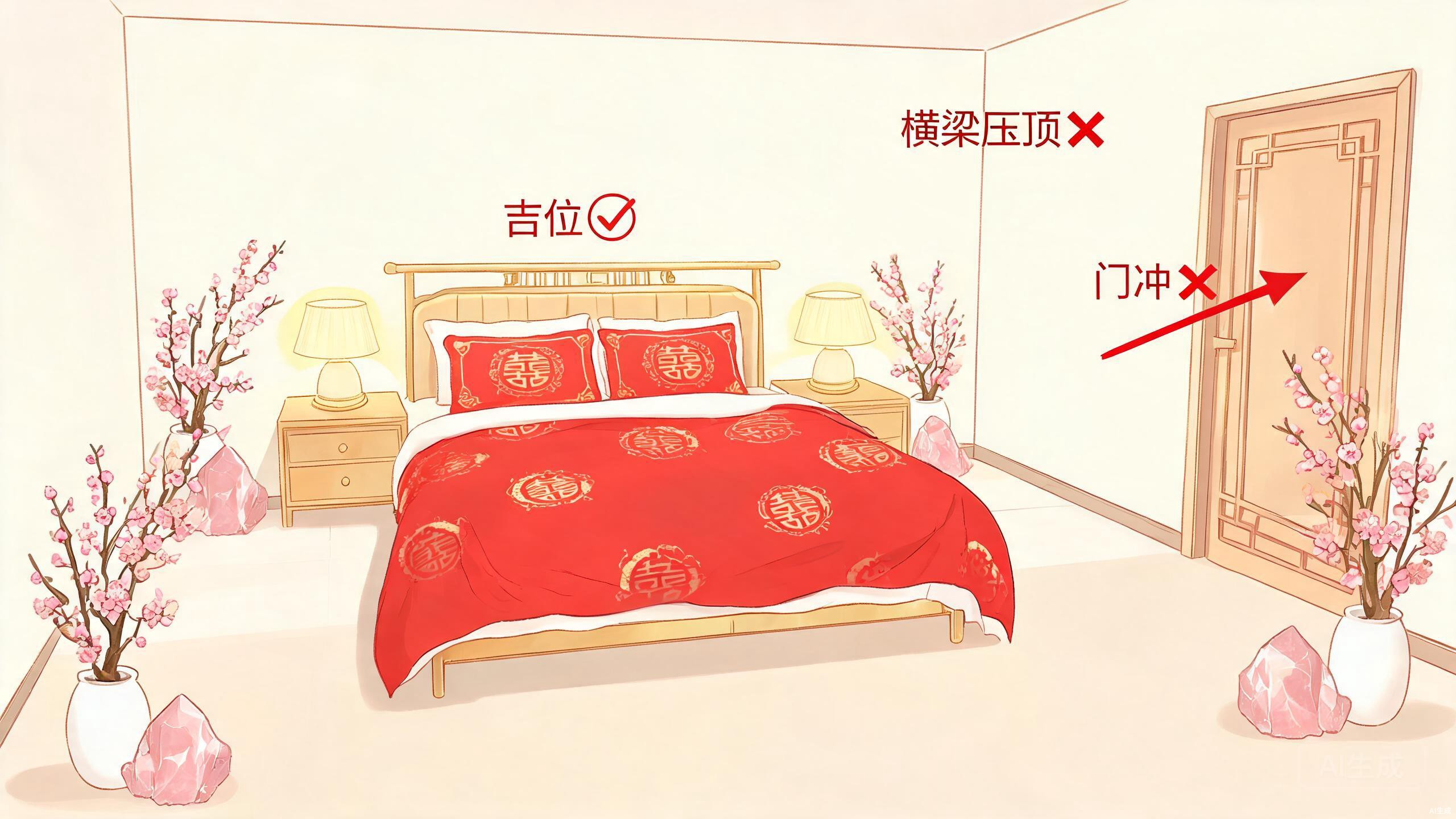
Never position the headboard directly facing the door: When the bed's headboard faces the room door, Feng Shui calls this "charging the door" (冲门). It creates a feeling of vulnerability and may trigger nightmares. If you cannot reposition the bed, place a Folding Screen (屏风) between the door and the bed.
-
Avoid placing the bed directly facing a mirror: Waking suddenly at night and seeing your own reflection can startle the nervous system and disturb sleep. Pay special attention to dressing table mirrors — cover them with a cloth when not in use.
-
Never sleep under an exposed beam: A heavy overhead beam pressing down on the bed creates the dreaded "beam pressure" (横梁压顶), causing chronic tension, anxiety, and health problems. The remedy is to move the bed entirely out from under the beam.
-
Avoid hanging heavy objects above the headboard: Heavy picture frames, pendant lights, or shelves above the bed risk falling and create subconscious feelings of pressure. Keep the wall above your bed light and unencumbered.
-
Never place the bed directly facing the bathroom door: The bathroom carriesfilth (impure) energy that flows directly toward the bed and harms health. Remedies include hanging a bead curtain on the bathroom door and keeping it closed at all times.
-
Don't let the bed sit flush against the floor: Leave space beneath the bed for air circulation. A bed flush to the floor traps moisture and encourages mold and bacteria.
Bed Direction and Orientation
Sleep direction relates to the Earth's magnetic field. Daoist philosophy holds that the human body is a miniature universe with its own magnetic field — the head and feet acting like the north and south poles. Sleeping aligned north-to-south parallels the Earth's magnetic lines, allowing the body to recalibrate the magnetic disturbances accumulated during busy daytime hours.
Sleeping east-to-west places the body perpendicular to magnetic lines, which may disturb sleep quality. However, the ideal direction ultimately depends on your personal Life Gua (命卦) and the specific layout of your bedroom.
Quick Tip: If you wake up feeling unrefreshed despite adequate hours, try rotating your bed 90 degrees. Many people notice an immediate improvement in sleep quality when their body aligns with Earth's magnetic field.
Ideal Bed Height
The optimal bed height sits roughly level with — or slightly above — the sleeper's knee, around 16–24 inches (40–60 cm). Too high makes getting in and out difficult; too low invites dampness. Keep the space under the bed clear of stored items to maintain healthy airflow.
Bedroom Colors and Lighting
Choosing the Right Colors
Bedroom colors should feel warm, soothing, and restful:
- Primary palette: Cream white, ivory, and light beige work best — these tones are easiest on the visual nervous system and promote relaxation.
- Warm tones: Soft pink and pale yellow add a sense of warmth and intimacy, ideal for a master bedroom.
- Cool tones: Light blue and pale green calm the mind and help those prone to insomnia.
- Colors to avoid: Bright crimson, deep black, and other intense shades should not dominate the bedroom.
Purple encourages tranquility and emotional stability. Among all colors, blue-green tones are considered the easiest on the eyes.
Cultural Context: Color choice in Feng Shui ties directly into the Five Elements (Wu Xing) system. Warm tones activate Fire energy (intimacy, passion), cool tones activate Water and Wood energy (calm, growth), while neutral tones ground the room with Earth energy (stability, nourishment).
Lighting Requirements
- Keep bedroom lighting soft rather than harsh
- Allow natural daylight during the day, warm artificial light at night
- Install reading lamps at the bedside for nighttime reading
- Maintain complete darkness during sleep — heavy curtains are essential
- Avoid pendant lights hanging directly above the headboard
How to Design Your Bedroom Lighting
- Layer your light sources: Combine overhead ambient light, bedside task lamps, and accent lighting to create flexibility
- Use warm bulbs: Choose bulbs rated 2700K–3000K (warm white) for a cozy, sleep-friendly glow
- Install dimmers: Adjustable brightness lets you wind down gradually before sleep
- Block outside light: Invest in blackout curtains if you live near streetlights or in early sunrise regions
Quick Tips:
- Cool white bulbs above 4000K suppress melatonin production — avoid them in bedrooms
- Salt lamps provide a soft amber glow and are believed in Feng Shui to purify the room's energy
- Position your bed so you can see the bedroom door from it, but are not directly in line with it
Bedroom Taboos
1. Avoid Oversized Bedrooms
"A large room with few occupants invites bad fortune." When a bedroom is too spacious for its occupants, Qi becomes thin and scattered — it cannot gather into the nourishing Vital Qi (生气, sheng qi) needed for health and rest. Even imperial bedchambers rarely exceeded a few dozen square meters. The ideal bedroom size ranges from 100 to 200 square feet (10–20 square meters); larger rooms disperse the occupants' personal energy.
2. Avoid Irregular Room Shapes
Square or rectangular bedrooms are ideal. Lopsided rooms with sharp angles, polygons, or circular shapes disrupt the energetic field and disturb sleep.
3. Bedroom Door Should Not Face the Front Door
When the bedroom door aligns directly with the home's main entrance, it sacrifices privacy and allows Qi to rush straight from the entrance into your most private space. Remedies include placing a Folding Screen or entryway cabinet between the two doors.
4. Avoid Exposed Beams in the Bedroom
Beams pressing over the bed or seating area create a constant subconscious feeling of pressure. The effect is strongest when a beam crosses directly over the headboard or the center of the bed.
5. Minimize Electronics in the Bedroom
Televisions, computers, and other electronics emit electromagnetic radiation that may disrupt sleep and long-term health. Keep electronics to a minimum — and never place them on the bedside table.
6. Avoid Aggressive or Fierce Imagery
Swords, taxidermy predators, and paintings of fierce animals generate Sha Qi (harmful energy) that disturbs sleep and strains marital relationships.
7. No Aquariums or Water Features
The bedroom is Yin in nature, and water is also Yin — "Yin upon Yin" creates excessive coldness that harms health. The sound of water from aquariums also disrupts sleep.
Wedding Chamber Feng Shui for Newlyweds
Choosing the Wedding Chamber Location
The newlywed bedroom should occupy one of the most auspicious locations in the home. According to Eight Mansions Feng Shui (八宅风水), people with an East Four Life (东四命) should select a room in the East Four directions (East, Southeast, South, North), while those with a West Four Life (西四命) should choose West Four directions (West, Northwest, Southwest, Northeast).
Setting Up the Wedding Chamber
-
Colors: You may use red as accent color in a newlywed bedroom, but avoid drowning the room in crimson — excessive red agitates the mind and may cause friction between partners. Build the palette around warm, soothing tones and add touches of red for celebration and luck.
-
The marriage bed: Always use a new bed for the wedding chamber. Follow the bed placement principles above — particularly the rules about a solid headboard backing and avoiding direct alignment with doors or mirrors.
-
Decorative items: Display objects symbolizing marital happiness, such as the double happiness character (囍), mandarin duck paintings, or dragon-and-phoenix motifs. Avoid lonely or solitary imagery.
-
Plants: Place Lucky Bamboo (开运竹) and lilies, both symbols of lasting love and "a hundred years of harmonious union."
Wedding Chamber Taboos
- Avoid placing the wedding room next to the bathroom
- Do not let the bedroom door face the bathroom door directly
- Avoid excessive mirrors in the wedding chamber
- Avoid harsh, glaring lighting
- Avoid overly cool color schemes
Quick Tip: Place a pair of mandarin duck figurines or a double happiness symbol on the nightstand — these are classic Feng Shui enhancers for marital harmony and are believed to attract lasting love energy.
Bedroom Feng Shui for Different Household Members
Master Bedroom
The master bedroom belongs to the head of household and should occupy the home's best location. When the head of household thrives, the entire family benefits. The master bedroom's direction must create an auspicious energetic configuration for the primary occupant.
Elderly Parents' Room
Choose a quiet, warm location for elderly parents — away from the kitchen and bathroom. Use soft, warm colors, and select furniture with rounded edges for safety. Keep the bed at a comfortable height for easy access.
Guest Room
Keep the guest room simple and uncluttered. If the room goes unused for long periods, open the windows regularly to keep the Qi circulating and the space energetically fresh.
Conclusion
The quality of your bedroom Feng Shui directly shapes your sleep, health, and overall well-being. To create excellent bedroom energy, focus on three essentials: proper bed placement, soothing colors and lighting, and avoiding common taboos. When your bedroom energy is balanced and harmonious, sleep becomes truly restorative — leaving you refreshed, healthy, and ready to attract prosperity into every area of your life.
Related Articles
- [[../03-财运风水/38-卧室与财运.md|Bedroom and Wealth Fortune: Unlock the Prosperity Code in Your Sleep]]
- [[../02-家居风水/24-卧室床位选择.md|Bedroom Bed Placement: Which Direction to Face and Which Wall to Lean On]]
- [[../02-家居风水/26-婚房风水布置.md|Wedding Chamber Feng Shui: A Complete Layout Guide for Newlyweds]]
- [[../03-财运风水/28-财位风水禁忌大全.md|Wealth Position Taboos: 30 Wealth-Draining Mistakes and Remedies]]