Courtyard and External Environment: Four Celestial Animals, Dragon Vein Backing, Road Patterns, and Trees
## The Feng Shui Significance of the External Environment Feng Shui examines small environments within the larger context of the natural world. By observing how a smaller space relates to its surround
Courtyard and External Environment Feng Shui: Four Celestial Animals, Dragon Vein Backing, Road Patterns, and Trees — Attract Harmony & Good Energy
The Feng Shui Significance of the External Environment
Feng Shui examines small environments within the larger context of the natural world. By observing how a smaller space relates to its surroundings, we can understand the external influences that shape its energy. A home's external environment — including the surrounding mountains, road patterns, vegetation, and neighboring structures — has a fundamental impact on its Feng Shui. As the classical saying goes, "When the outer environment is poor, no amount of inner adjustment can compensate." When choosing a home, the external environment must always be evaluated first.
The Four Celestial Animals and the Ideal Layout
The Four Celestial Animals (四神砂)
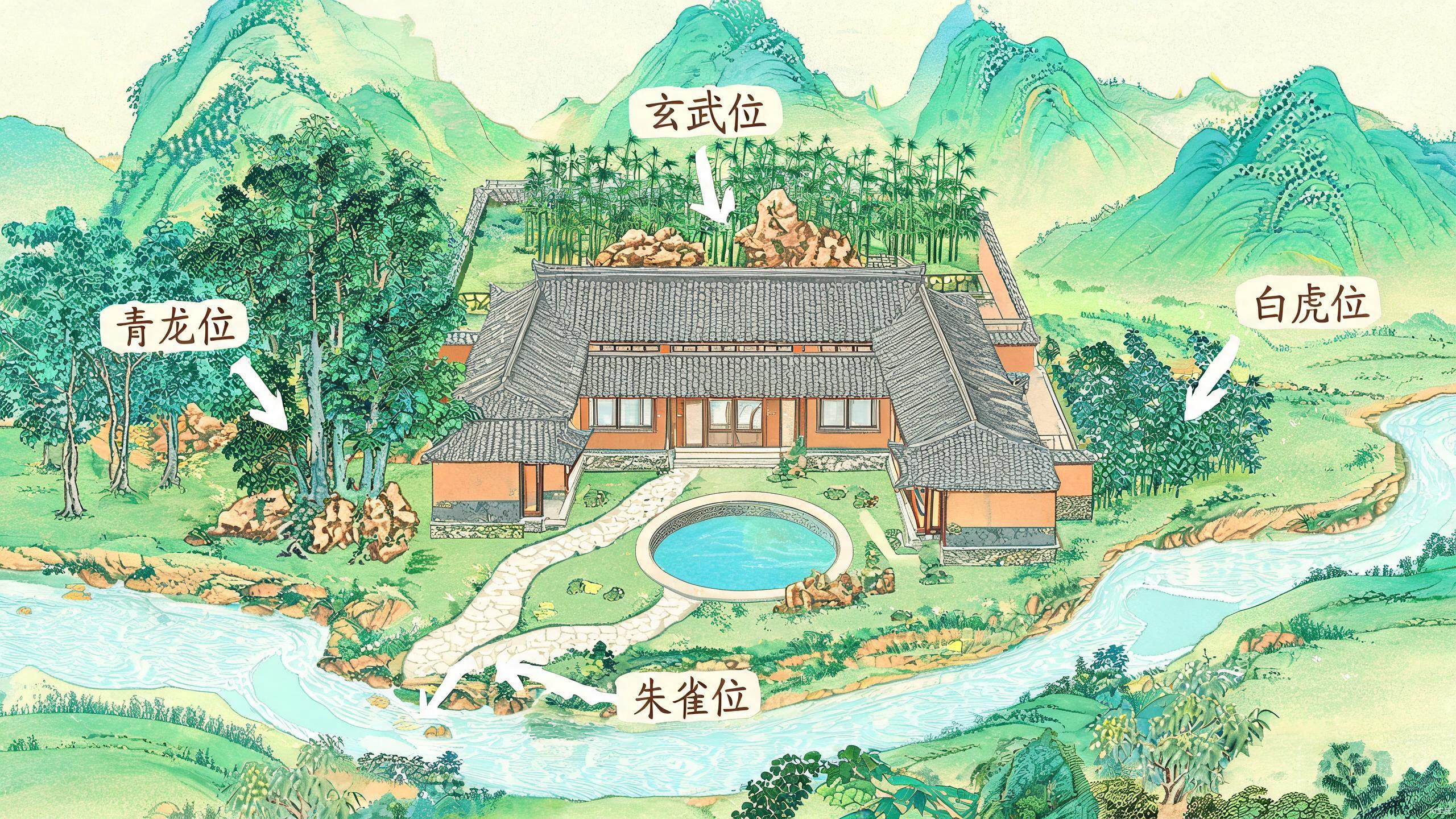
The "Four Celestial Animals" — Azure Dragon on the left, White Tiger on the right, Vermilion Bird in front, and Black Tortoise behind — are the four directional markers of an ideal Feng Shui layout. The Yang Zhai Shi Shu (Ten Books on Yang Dwelling) states: "When a home has flowing water on the left, it is called the Azure Dragon; a long road on the right is the White Tiger; a pool in front is the Vermilion Bird; hills behind are the Black Tortoise — this is the most noble of sites."
Cultural Context: The Four Celestial Animals (四象, Four Symbols) come from ancient Chinese astronomy and represent the four cardinal directions. Each animal embodies protective qualities: the Dragon brings vitality, the Tiger provides strength, the Bird offers clarity and vision, and the Tortoise ensures stability and support. The interplay of Yin and Yang — the dual forces of dark/light, passive/active — governs all Feng Shui applications.
| Direction | Animal | Element | Meaning |
|---|---|---|---|
| Left (East) | Azure Dragon (青龙) | Flowing Water | Vitality and growth |
| Right (West) | White Tiger (白虎) | Long Road | Pathways and travel |
| Front (South) | Vermilion Bird (朱雀) | Bright Hall (pool/flat ground) | Openness and Qi gathering |
| Rear (North) | Black Tortoise (玄武) | Hills (Backing Mountain) | Support and stability |
The Four Great Layouts of Yang Dwelling
Popular tradition holds that a home should embody the "Four Great Layouts," derived from the Vermilion Bird in front, Black Tortoise behind, Azure Dragon on the left, and White Tiger on the right. The Chong Jiao Zheng Di Li Xin Shu states: "Hills behind, grassland in front, a pond to the east, and ridges to the west — auspicious."
The ideal Feng Shui configuration is: hills behind for backing (Black Tortoise), an open Bright Hall in front (Vermilion Bird), protective hills embracing left and right (Azure Dragon and White Tiger), and water flowing gently in front. This arrangement of "Mountains Embracing and Water Surrounding" (山环水抱) both stores wind and gathers Qi while providing the resources essential for life.
Dragon Vein and Backing Mountain
Dragon Vein (龙脉)
A Dragon Vein refers to a range of mountains that rises and falls like the undulating body of a dragon, which is how the concept earned its name. Feng Shui teaches that all the world's mountain ranges originate from the Kunlun Mountains. The three major mountain ranges within China are known as the "Three Trunk Dragons" (三大干龙):
- Northern Trunk Dragon: Passes through the Yin Mountains and Helan Mountains, enters the Beijing region and reaches the Bohai Sea. Its branch dragons include Heng Mountain, Taihang Mountains, and Yan Mountains
- Central Trunk Dragon: Passes through Sichuan into the Central Plains, eventually reaching the sea via the Huai River. Its branch dragons include Zhongnan Mountain, Hua Mountain, Tai Mountain, and Song Mountain
- Southern Trunk Dragon: Passes through Yunnan into Hunan. Its branch dragons include Wuling Mountain, Heng Mountain, Lu Mountain, and Tianmu Mountain
Backing Mountain (靠山)
The mountain or tall structure behind a home is called the "Backing Mountain." Its functions include:
- Blocking Wind: Shields the home from harsh northern winds
- Gathering Qi: Prevents Vital Qi from escaping through the rear
- Providing Stability: Creates a sense of security and support
Requirements for an ideal Backing Mountain:
- Should be tall, majestic, and beautifully formed
- Should have lush vegetation, never barren or broken
- Should not be too close (creates oppressive pressure) or too far (loses its supportive function)
- "The Azure Dragon should be tall; the White Tiger must not raise its head" — the Azure Dragon on the left should be higher than the White Tiger on the right
Road Patterns
In modern Feng Shui, roads function as "virtual water" — their direction and shape significantly influence a home's energy.
Auspicious Road Patterns
-
Embracing Road (Jade Belt Around the Waist): The road curves around the home like a jade belt encircling the waist, gathering wealth and absorbing Qi
-
Inside a U-Shaped Road: The home sits within the curve of a U-shaped road, like a castle protected by a moat — stable and reassuring
-
Winding, Meandering Roads: "A winding path leads to serenity" — curved roads are better than straight ones because they soften the flow of energy
Inauspicious Road Patterns
-
Reverse Bow Road (Sickle Cutting the Waist): The road curves but bends outward, with the arc pointing directly at the home. The Ba Zhai Ming Jing warns: "A street that curves outward like a bow's back is inauspicious!" The centrifugal force of a reverse bow road sends exhaust, noise, and negative emotions toward the home
-
Scissor Crossroads: A home situated at the intersection of two diagonal streets forming a "scissor mouth." Folk tradition warns: "A home at the scissor crossing will see injury and loss of life"
-
Road Rushing Sha (Hidden Arrow Striking the Chest): A straight road aimed directly at the front door creates a "gun Sha." Vehicles rushing toward the home destabilize the energy field
-
T-Junction: A home located at a T-intersection where traffic crisscrosses chaotically, creating excessive disturbance and restlessness
-
Y-Junction: A home at a Y-shaped fork where vehicles enter from both sides — violating the principle of a "stable and balanced" dwelling
Remedies for Unfavorable Road Patterns
You can counter unfavorable road patterns through these methods:
- Build a Screen Wall or perimeter wall for shielding
- Plant trees or green barriers to soften the impact
- Install a Folding Screen or entry partition
- Place Shi Gan Dang (Taishan Stone Tablet) or other protective objects
Trees and Feng Shui
The Role of Trees in Feng Shui
- Blocking Wind and Dissolving Sha: Trees can shield against harsh winds and harmful energy
- Gathering Qi and Generating Prosperity: Lush vegetation signals abundant Vital Qi — wherever "mountains are clear, waters are beautiful, and grasses thrive," Qi must flourish
- Climate Regulation: Trees moderate temperature and humidity while purifying the Qi
- Aesthetic Enhancement: Trees make the living environment more beautiful and comfortable
Auspicious and Inauspicious Trees
Lucky Trees:
- Fruit trees (such as orange, pomegranate, and persimmon) — symbolizing abundant harvest and many children
- Evergreen trees (such as pine and cypress) — symbolizing longevity and stability
- Osmanthus tree — "gui" (桂) sounds like "gui" (贵, nobility), symbolizing wealth and status
- Banyan tree — with deep, spreading roots symbolizing a solid foundation
Unlucky Trees:
- Dead or withered trees — symbolizing decline and death
- Climbing vines — "vinesentwining the house" creates excessive Yin Qi and invites trouble
- Too many thorny trees — excessive thorns generate heavy Sha Qi affecting family fortune
- Tall trees blocking the front door — "tree crashing into door" blocks the flow of fortune
Principles for Planting Trees in the Courtyard
- Trees should not be too tall: Large trees block sunlight, making the home dark and damp
- Trees should not be too close to the home: Roots may damage the foundation; branches may harm the roof
- Trees should not face the front door directly: "Tree crashing into door" disrupts Qi absorption
- Trees should not be planted in the courtyard center: This creates the "困" (trapped) character configuration
- Remove dead trees promptly: Withered trees symbolize decline and damage Feng Shui
Courtyard Feng Shui
Courtyard Layout
-
The courtyard should be square or rectangular: Regular shapes (square or rectangular) are best; avoid triangular or irregular forms
-
The courtyard should be lower in front and higher in back: This enables "rising step by step." A front-high, back-low arrangement leads to decline
-
The courtyard should not be too large: The courtyard size should be proportional to the home — "a large courtyard with a small house" disperses Qi
-
Courtyard walls: Walls should not be too high (creating a prison-like feeling of oppression). They should be complete, without breaks or damage
Courtyard Water Features
A water feature can be placed in the courtyard, but consider these guidelines:
- Place water in the front of the courtyard or in an auspicious direction
- The water should not be too large or deep — safety first
- Keep the water clean and clear
- Round or naturally curved shapes are best — avoid sharp angles
- The water feature should not face the front door directly
Courtyard Plant Arrangement
- The front yard is suitable for low-growing plants that don't block the view
- The back yard can accommodate tall trees serving as a Backing Mountain
- The left side (Azure Dragon position) is ideal for tall trees
- The right side (White Tiger position) suits shorter plants
- Avoid planting large trees in the center of the courtyard
Comprehensive External Environment Assessment
When evaluating a home's external environment, consider these factors holistically:
| Assessment Item | Auspicious | Inauspicious |
|---|---|---|
| Backing Mountain | Tall, beautiful hills behind | No backing or broken support |
| Bright Hall | Open, flat area in front | Blocked or pressured by tall buildings |
| Roads | Embracing or winding roads | Roads rushing directly or reverse bow |
| Water | Curving, clear water flow | Reverse bow or polluted water |
| Vegetation | Lush, thriving greenery | Withered, barren trees |
| Surroundings | Harmonious neighboring buildings | Sharp corners or Heaven Chopping Sha |
Conclusion
The external environment forms the foundation of a home's Feng Shui. "Mountains Embracing and Water Surrounding, Storing Wind and Gathering Qi" represents the ideal external setting. When selecting a home, carefully evaluate the Four Celestial Animals layout, the Dragon Vein Backing Mountain, road patterns, and surrounding vegetation. When the outer environment is strong, minor weaknesses inside can be corrected; when the outer environment is poor, even the most refined interior adjustments cannot fundamentally transform the home's fortune. This embodies the Feng Shui principle of "examine the outer before the inner, the large before the small."
Quick Tips:
- Before purchasing or renting a home, always observe it from outside first — at different times of day if possible
- Note the surrounding roads and traffic patterns — a curved, embracing road is far better than a straight, rushing one
- Pay attention to seasonal changes in vegetation — trees that flourish year-round bring sustained Vital Qi
- Trust your body's response: if a space feels oppressive, chaotic, or restless from the outside, the Qi inside will likely reflect that
Related Articles
- [[../01-风水入门/06-风水基础概念词典.md|Feng Shui Glossary: 18 Core Terms Explained]]
- [[../01-风水入门/31-Xing Shi School (Luan Tou School) Detailed Guide.md|Form School (Luan Tou School): The Ancient Tradition of Dragon Vein and Sand]]
- [[../04-商业风水/07-商业风水宜忌大全.md|Complete Guide to Commercial Feng Shui Do's and Don'ts]]
- [[../06-风水文化与历史/11-古代都城风水:西安——十三朝古都的风水energy pattern.md|Ancient Capital Feng Shui: Xi'an — The Feng Shui Layout of a Thirteen-Dynasty City]]
Note on the Five Elements: The Five Elements (Wu Xing) — Wood, Fire, Earth, Metal, and Water — form the foundation of Feng Shui energy theory. Each element interacts with the others in cycles of generation and control, influencing the Qi flow in your environment.