Feng Shui Home Buying Guide: Location, Floor, Layout & Surroundings for Lucky Living
## Core Principles of Feng Shui Home Selection The ancient *Huang Di Zhai Jing* (Yellow Emperor's Classic of Dwelling) teaches: "People stand through dwelling, dwelling exists through people. When peo
Feng Shui Home Buying Guide: Location, Floor, Layout & Surroundings for Lucky Living
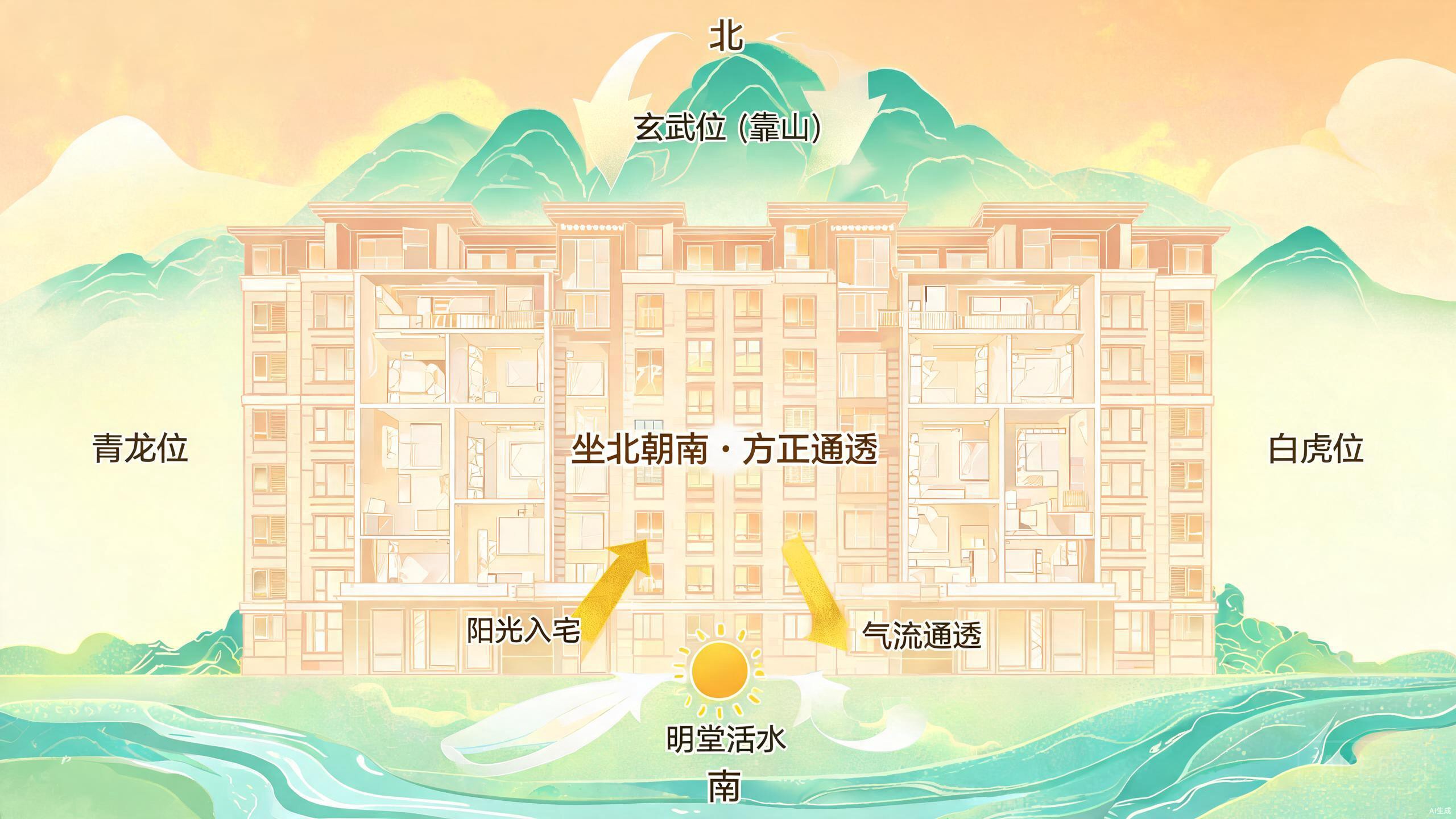
Core Principles of Feng Shui Home Selection
The ancient Huang Di Zhai Jing (Yellow Emperor's Classic of Dwelling) teaches: "People stand through dwelling, dwelling exists through people. When people and home support each other, they resonate with Heaven and Earth." (人因宅而立,宅因人而存。人宅相扶,感通天地。)
Your home is the foundation of your life — its Feng Shui directly affects your fortune, health, and happiness. When choosing a property, you must weigh multiple factors: geographic location, surrounding environment, floor level, layout shape, natural lighting, and ventilation.
Modern home buyers and builders take Feng Shui seriously — paying close attention to geographic position, light environment, spatial layout, air flow, and water environment. Feng Shui is not mystical or mysterious; it is a practical discipline closely tied to construction and property selection.
Cultural Context: The Yellow Emperor (Huang Di) is the legendary founder of Chinese civilization. Classical texts attributed to him form the philosophical bedrock of Chinese metaphysics, including Feng Shui, traditional medicine, and destiny studies.
Property Location Feng Shui
Mountains and Water Environment
The fundamental criteria for selecting a Feng Shui blessed site:
- Mountains should be tall and majestic — mountain form and vitality serve as the source of Qi
- Surrounding peaks should embrace the Bright Hall — like open arms of a friend welcoming you, known as "embracing friendship"
- More surrounding mountains the better — Qi disperses less easily, making the Feng Shui stronger
- The dwelling should rest against mountains and face water — mountains provide life resources, water supports irrigation, washing, and sustenance
Cultural Context: The principle of "Storing Wind and Gathering Qi" (藏风聚气) means creating an environment where beneficial energy enters but does not escape. The front door is considered the "Qi Mouth" — when roads or water approach in gentle curves, Qi naturally gathers, promoting healthy air circulation and well-being.
An ideal dwelling should be bright and welcoming inside — this is auspicious. Dark, gloomy, barren spaces are inauspicious.
Roads and Surrounding Environment
When choosing property, avoid these dangerous locations:
- Avoid "Reverse Bow" streets: When the road in front of your home curves inward toward your door, Feng Shui calls this "the sickle cutting the waist." The centrifugal force of an outward-curving road throws exhaust fumes, noise, and negative energy toward homes on the outside of the arc
- Avoid "Road Scissors": Never build or buy where two streets cross diagonally in a "scissors" pattern — folklore warns "a scissor-cut home brings injury and death"
- Avoid "Heaven Chopping Sha" (天斩煞): When a narrow gap between two tall buildings directly faces your home, the narrower and longer the gap and the closer it is, the more severe the harmful energy
- Avoid "Coffin-Carrying Road": Homes sandwiched between two straight roads crashing toward the front and back
Land and Terrain Guidelines
Pay attention to these terrain characteristics:
- Front-narrow-back-wide or front-wide-back-narrow lots weaken the building's presence and create an unfavorable impression
- Homes built on hillsides should have a higher back and lower front, but never a steep drop or cliff directly behind
- Building lots lower than surrounding terrain collect moisture and become damp during rain
- When a road or river curves in a U-shape, homes located inside the U-curve are considered auspicious
How to Apply: Evaluating a Property's Location
- Walk the perimeter: Circle the property three times at different times of day to observe traffic patterns, noise levels, and light conditions
- Check the surrounding energy: Look for supportive "mountains" (tall structures, hills, mature trees) behind and protective "sand" on the sides
- Identify the Qi Mouth: Your front entrance should be approached by gently curving paths, not by harsh straight angles
- Map the Sha Qi: Use your phone to photograph the view from each window — any sharp angles, electrical poles, or narrow gaps visible from inside create Form Sha
Quick Tips:
- Stand at the front door and look outward — you want to see open space or gentle curves, not a road rushing directly toward you
- Listen for traffic noise — if cars roar past, the Feng Shui of that location is compromised
- Visit the property during rain to check drainage and verify the land does not collect standing water
Floor Level Selection
Floors and the Five Elements
Floor numbers traditionally correspond to the Five Elements (Wu Xing, 五行):
| Floor | Element | Suitable Chinese Zodiac |
|---|---|---|
| 1st, 6th | Water | Rat, Pig |
| 2nd, 7th | Fire | Snake, Horse |
| 3rd, 8th | Wood | Tiger, Rabbit |
| 4th, 9th | Metal | Monkey, Rooster |
| 5th, 10th | Earth | Ox, Dragon, Goat, Dog |
(Floors above 10 follow the same pattern based on the last digit.)
Cultural Context: The Five Elements theory underlies much of Feng Shui practice. Each element has natural affinities with certain zodiac animals, and matching your personal energy to the right floor can enhance harmony and fortune.
Common Floor Selection Mistakes
Many people rush to buy the 8th, 18th, or 28th floor, believing that the number "eight" (八) — which sounds like "wealth" in Chinese — guarantees riches. This is a misconception.
Homes on the same floor, in the same building, with the same sitting direction, even those sharing the number "eight," do not bring identical outcomes. Some residents prosper while others fail — the difference lies in the compatibility between the individual and the energetic field of that particular home.
Practical Considerations for Floor Choice
Selecting a floor should also reflect real-world needs:
- For asthma or allergies: Higher floors reduce exposure to pollen, dust, and ground-level pollutants
- For vertigo or fear of heights: Lower floors provide comfort and stability
- For mixed commercial-residential use: Floors three to five tend to balance accessibility with separation from street-level disturbance
How to Choose Your Lucky Floor
- Calculate your Life Gua (命卦) based on your year of birth to find your auspicious directions
- Match to the element chart: Verify which floor element aligns with your personal energy
- Test in person: Ride the elevator to your prospective floor — pay attention to how your body feels. Comfort often signals compatibility
- Consider practical needs: Health conditions, family members, and lifestyle routines matter as much as numerology
Layout and Floor Plan Selection
The Importance of a Square Layout
The classical text Yang Zhai Cuo Yao (Essentials of Yang Dwelling) states: "Every Yang dwelling must have an even, square foundation with orderly framework. If the east expands and the west contracts, family wealth and members will suffer." (凡阳宅须地基方正,间架整齐,东盈西缩,定损丁财。)
A square layout is ideal. Avoid these shapes:
- Triangular layouts: Waste space and carry excessive Fire energy, which can create imbalance
- L-shaped layouts: If part is recessed, the missing area should be compensated to approximate a square
- Missing-corner layouts: Each missing corner corresponds to a specific family member's fortune and health being affected
Layout "Compatibility" and First Impressions
Your very first impression of a home is crucial:
- If the home immediately feels warm, lively, harmonious, and free of conflict — you have an "emotional connection" (有情) with the property
- If your first impression is lifeless, dark, oppressive, overwhelming, or marred by major defects — the home is "incompatible" (无情), meaning it is not your destiny
Trust your instincts. The home that calls to you on first sight is most likely aligned with your energy.
Balanced Room Proportions
Classical wisdom warns: "A large house with few people is inauspicious; a small house with many people is inauspicious; a small room with a large door is inauspicious; a large room with a small door is inauspicious."
Balance must exist between home and occupants, and between rooms and their doors and windows. A spacious home devoid of people cannot generate Human Qi (人气) or Vital Qi (生气). Modern villas and large residences are particularly prone to this imbalance.
Cultural Context: The principle of "Human Qi" (人气) reflects the belief that living spaces require active, vibrant human presence to stay energetically alive. Empty rooms — even beautifully furnished — lose their beneficial energy.
How to Evaluate a Floor Plan
- Sketch the layout: Draw the floor plan and check for square or rectangular proportions
- Mark the center: Locate the Taiji Point (geometric center) — this area should remain open and uncluttered
- Test the entrance-to-living-room flow: Energy should not rush straight from front door to back window (Piercing Hall Sha)
- Check room-to-room balance: No single room should dominate while others feel cramped
- Walk through in person: Even with perfect plans, your body's response inside the space matters
Quick Tips:
- Run your finger along the floor plan's edges — if the shape resembles any letter other than a clean rectangle, reconsider
- Visit the property at least twice — once during the day, once in the evening — to feel how the energy shifts
- Ask yourself: "Can I see my family happily living here for the next 10 years?" If doubt creeps in, trust it
Natural Light and Ventilation
Sunlight Exposure
Sunlight is the most important form of natural illumination. When skin absorbs ultraviolet rays from sunlight, the body produces vitamin D, preventing rickets in children. Sunlight also kills harmful airborne microorganisms, enhances vitality, and strengthens the immune system.
A home with abundant sunlight is auspicious; one shrouded in perpetual darkness is inauspicious.
Daylight Calculation
The amount of natural light depends on room depth relative to windows:
- The ratio of room depth to the height from floor to the top of the window should not exceed 2.5:1
- The ratio of effective window area to floor area should be at least 1:10
These ratios ensure that every corner of your home receives healthy natural light.
Ceiling Height Standards
For optimal Feng Shui and air quality:
- Southern regions: Ceiling height should be at least 2.8 meters (about 9 feet)
- Northern regions: Ideal ceiling height ranges from 2.6 to 3.0 meters (about 8.5 to 10 feet)
Building codes typically require a minimum clear ceiling height of 2.8 meters in living spaces. Since people consume oxygen and exhale carbon dioxide within occupied rooms, insufficient ceiling height reduces air quality and can cause fatigue, headaches, and respiratory discomfort.
indoor Qi Cleanliness
Every home must have windows on multiple sides to allow cross-ventilation. Each person requires approximately 20–25 cubic meters of room volume for healthy air quality. Concentrations of carbon dioxide, sulfur dioxide, and formaldehyde must remain below harmful thresholds.
Cultural Context: In Feng Shui, fresh, flowing Qi represents healthy Qi movement. stagnant Qi signals trapped or decaying energy, while rushing drafts indicate wealth energy slipping away. The goal is gentle, meandering air circulation.
Quick Checklist for light and air
- ☑ Every main room receives direct sunlight for at least part of the day
- ☑ At least two walls have windows for cross-ventilation
- ☑ Ceiling height meets or exceeds 2.8 meters (9 feet)
- ☑ No persistent musty, damp, or chemical odors
- ☑ Qi feels fresh and comfortable even with windows closed for several hours
Orientation and Color Selection
Choosing the Right Orientation
The Zhai Jing (Classic of Dwelling, 《宅经》) recommends the best orientations for receiving light:
Homes with windows facing south, southeast, or southwest enjoy the best natural illumination throughout the day.
For determining the sitting and facing direction of urban residences (where natural mountains and water may not be visible), use this priority order:
- The sunniest side faces outward; the shadier side is the back (sitting)
- The side facing visible water faces outward; the side with solid backing faces back
- The side opening onto a plaza, garden, or broad space faces outward; the opposite is the back
- If no mountain, water, or Bright Hall is visible, choose the side with the largest window exposure as the facing direction
Cultural Context: "Sitting and Facing" (坐向) is one of the most fundamental concepts in Feng Shui. The "sitting" direction is where the building rests its back; the "facing" direction is where the front door opens toward. Getting this orientation right harmonizes the home with Earth's magnetic field and solar energy.
Color Selection for Harmony
The most auspicious colors for home interiors are milky white, ivory, and pure white — these three shades are easiest on the human visual nervous system.
When choosing materials, natural wood tones are preferred because they stimulate creativity and clarity of mind. This is especially important for home offices and studies, where wood surfaces inspire fresh thinking and intellectual energy.
Among all colors:
- Blue-green and green are easiest on the eyes and support vision health
- Purple has a calming, stabilizing effect on emotions
- The right color in bedrooms can significantly improve sleep quality and mood
How to Apply Color Principles Room by Room
| Room | Recommended Colors | Why |
|---|---|---|
| Living Room | Warm whites, beige, soft wood tones | Welcoming, balanced, stimulates conversation |
| Bedroom | Soft blue, lavender, muted earth tones | Promotes rest and emotional peace |
| Study/Workspace | Natural wood, light green, ivory | Sparks creativity and mental clarity |
| Dining Area | Warm yellow, soft orange, cream | Encourages warmth and appetite |
| Kitchen | White, light yellow, pale green | Maintains cleanliness and freshness |
Quick Tips:
- Avoid pure black for large wall surfaces — it absorbs light and can feel energetically draining
- Use natural wood furniture whenever possible — especially in work and study areas
- For small rooms, stick with light, airy colors to make the space feel larger and more energetic
Conclusion: Choosing Your Lucky Home
Feng Shui home selection is not superstition — it is a practical discipline that synthesizes natural environment, spatial design, and human well-being. The core principles are simple:
Abundant light • fresh air • Sensible layout • Clean surroundings
When you choose the right home, you lay a solid foundation for a fortunate, healthy, harmonious life.
Remember the timeless wisdom: "The first impression matters most." A home that greets you with warmth, vitality, and harmony is the home that resonates with your energy — and it will welcome prosperity for years to come.
Related Articles
- [[../04-商业风水/04-大型商业楼宇site selection.md|Feng Shui for Large Commercial Building Site Selection]]
- [[../04-商业风水/10-企业风水布局.md|Corporate Feng Shui Layout]]
- [[../05-命理与运势/52-楼层数字风水.md|Floor Number Feng Shui]]
- [[../06-风水文化与历史/10-古代帝王陵寝风水.md|Imperial Tomb Feng Shui: Location Principles, Architectural Evolution & Burial Culture]]