Feng Shui Sha Dissolving Tools: Complete Guide to Talismans, Lucky Charms, and Taiji Point Location
In Feng Shui, certain objects are believed to possess the power to dissolve Sha Qi (harmful energy). When placed in your home, these tools can transform the negative influences caused by unfavorable F
Feng Shui Sha Dissolving Tools: Complete Guide to Talismans, Lucky Charms, and Taiji Point Location
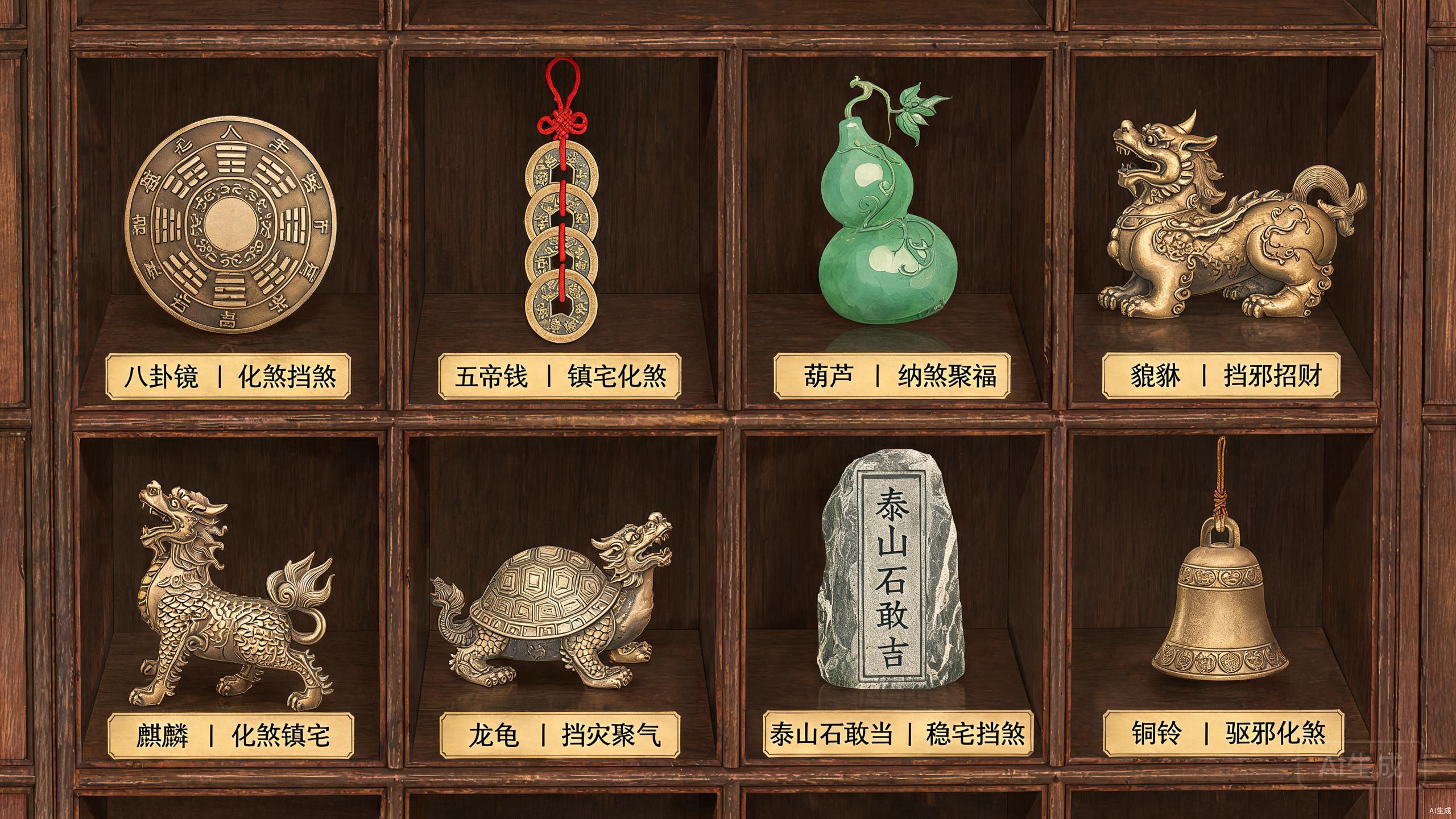
In Feng Shui, certain objects are believed to possess the power to dissolve Sha Qi (harmful energy). When placed in your home, these tools can transform the negative influences caused by unfavorable Feng Shui. Common Sha-dissolving instruments include Folding Screens, Screen Walls, mirrors, auspicious beasts, and lucky charms (copper coins, gold ingots, etc.). When chosen and used correctly, these tools can effectively improve the Qi quality of your living environment.
This article systematically introduces the most commonly used Feng Shui Sha-dissolving tools and their specific applications, while also explaining the Taiji Point location method — a foundational skill for effective Sha remedy placement.
Part One: Categories of Sha Dissolving Tools
Feng Shui Sha-dissolving tools can be broadly divided into the following categories by function:
| Category | Representative Tools | Main Functions |
|---|---|---|
| Auspicious Beasts | Qilin, Pixiu, Dragon Turtle, Stone Lion, Copper Elephant, Copper Horse | Block Sha, Attract Wealth, Add Children, Protect Home |
| Talismans | Bagua Mirror, Five Emperor Coins, Shan Hai Zhen, Gourd (Calabash) | Dissolve Sha, Ward Off Evil, Remedy Form Sha |
| Plants | Cactus, Dragon Bone, Rose, Evergreen, Money Tree | Dissolve Sha (spiny plants) or Generate Prosperity (broad-leaf plants) |
| Functional Objects | Bead Curtain Screens, Aquarium, Crystal, Wind Chime | Separate Sha, Gather Qi, Activate Wealth |
| Decorative Charms | Gold Ingot, Golden Toad, Copper Coins, Large Copper Coins | Attract Wealth, Block Disasters, Ensure Peace |
Part Two: Detailed Guide to Common Sha Dissolving Tools
1. Aquarium (Fish Tank)
"Mountains govern nobility, water governs wealth" — an aquarium has powerful wealth-activating properties.
An aquarium is synonymous with "Water." Beyond its decorative value, it serves as a powerful tool for receiving Qi and dissolving Sha in Feng Shui practice.
Important Guidelines:
- Aquarium size matters — Water that is too abundant or too deep is unfavorable. The tank height should not exceed an adult's eye level when standing
- Place in unfavorable directions — Feng Shui teaches "channeling water into the void." Directing water toward Lost Period positions can transform misfortune into blessing
- Never place behind a sofa — Water's nature is ever-changing and unsuitable as a backing/support
- Those whose BaZi (Eight Characters)taboo water should avoid fish tanks — Always evaluate personal destiny compatibility before installation
2. God of Wealth
The God of Wealth (财神) comes in two main forms: the Martial God of Wealth (Guan Gong) and the Civil God of Wealth:
| Type | Characteristics | Placement Key Points |
|---|---|---|
| Martial God of Wealth (Guan Gong) | Mighty and powerful, protects wealth and guards the home | Must face the door, never face inward |
| Civil God of Wealth | Gentle and refined, attracts wealth and blessings | Avoid facing the door; should face inward |
If venerated improperly, the God of Wealth becomes a wealth-dispersing deity. Particularly with the Martial God Guan Gong — if placed incorrectly, instead of bringing fortune, his large blade may cause harm.
3. Crystal
Crystals are classified as natural or synthetic, with natural crystals being far superior in effect. Crystals stabilize magnetic fields and purify ambient Qi. Different colors serve different purposes:
- Clear Quartz (White Crystal) — Purifies magnetic field, enhances mental clarity
- Amethyst (Purple Crystal) — Develops wisdom, supports relationships
- Citrine (Yellow Crystal) — Attracts and activates wealth energy
- Green Phantom (Green Ghost) — Career fortune, regular wealth fortune
- Rose Quartz (Pink Crystal) — Peach Blossom luck, romantic fortune
4. Gold Ingot (金元宝)
Primarily used for generating and activating wealth, typically placed in pairs. There are two main methods:
- Window Wealth Attraction — Place a pair of gold ingots on the largest window or windowsill in your home, one at each corner, to draw in wealth Qi from outside
- Wealth Position Enhancement — Place them at the diagonal corner when entering through the front door (this is the Wealth Position where Wind is Stored and Qi is Gathered), to strengthen the energy of attracting wealth
5. Stone Lion
Stone Lions carry inherent masculine Yang energy and serve as powerful home protectors. They can dissolve multiple types of Form Sha while strengthening official authority or the homeowner's personal Yang energy.
Key Usage Points:
- When placing Stone Lions for Sha dissolution and protection, the lion's mouth must face outward
- If your balcony faces a building with overwhelming energy (such as a large bank or office tower), place a pair of Stone Lions on either side of the balcony
- If your balcony directly faces a Yin-heavy building (temple, hospital, funeral home), a pair of Stone Lions is also required for protection
- When a window faces unfavorable directional clashes, placing a pair of Stone Lions facing the window can dissolve the Sha
6. Copper Lion
Copper Lions' primary function is to dissolve Sha and block disasters, typically placed facing the main entrance.
- Ideal when facing road clashes or when the door directly faces lamp posts
- Since copper (Metal) can counter Wood's harsh influence, Copper Lions are suitable when large trees are visible across from windows
- Particularly effective for homes with Water-element occupants — Metal generates Water, which enhances wealth fortune
7. Wenchang Pagoda (文昌塔)
The Wenchang Pagoda is one of the most commonly used talismans, specifically beneficial for studying, academic achievement, and career advancement.
- Children can place it at the head of the bed
- Adults can place it on the desk
- Scholars can store it within their bookcase
It sharpens the mind and supports top examination performance. Hong Kong's Ping Shan in Yuen Long features such a Feng Shui pagoda, and the village has historically produced numerous scholars and high officials.
8. Pixiu (貔貅)
The Pixiu is an auspicious beast — scaly-less, furless, and fiercely majestic — making it an excellent Feng Shui ornament.
- Ideal for those in Side Wealth or sales-driven professions
- Particularly effective for people with fluctuating income
- When placing, the head should face the door or window
- Beneficial for Side Wealth; less effective for Regular Wealth (unless paired with a pair of Dragon Throne ornaments)
9. Copper Gourd (铜葫芦)
The gourd's ability to dissolve illness is widely known, but few realize that a Copper Gourd can also enhance marital harmony.
- Couples with thinfated affinity (relationship bond) may place a Copper Gourd at the bedhead to deepen affection
- Households with ill members can benefit health-wise by placing this talisman
- Homes with children and elderly members especially benefit
- To a certain extent, it can also dissolve Sha and block disasters — making it remarkably versatile
10. Wooden Gourd (木葫芦)
- Homes with chronically ill members may hang three Wooden Gourds
- For serious illness, three gourds placed at the bedhead are recommended
- Suitable for both men and women; can be hung for extended periods
11. Qilin (麒麟)
Together with the Dragon, Phoenix, and Turtle, the Qilin was revered in ancient times as one of the Four Sacred Beasts.
- Versatile applications for attracting wealth, adding children, and dissolving Sha
- Simply face the head outward — the energy is powerful
- Smaller, more refined pieces are preferable; beneficial for both men and women
- The Qilin is considered a benevolent beast that values propriety and trustworthiness
- Those earnestly seeking a noble child may place a pair of Qilin on a sea-facing balcony
12. Golden Toad (金蟾)
The Golden Toad is a superior wealth-activating instrument:
- Features three legs, with the Big Dipper on its back and two strings of copper coins in its mouth
- Crowned with the Taiji and Liangyi symbols, standing atop a mountain of ingots
- Engraved with auspicious phrases like "Attracting Wealth and Treasure" and "Multiplying Prosperity"
- When placing, the head should face inward — symbolizing wealth Qi flowing into the home
13. Dragon Turtle (龙龟)
The Dragon Turtle is an auspicious beast governing auspiciousness and Sha dissolution.
- The turtle is an extremely Yin and yielding creature, excelling at using softness to overcome hardness
- It also symbolizes transforming adversity into blessing
- Using it for Sha dissolution aligns with the principle: "Harmful Sha should be dissolved, not fought"
- When placing copper or stone turtles, the two heads must face each other
Five Scenarios Where the Dragon Turtle Applies:
| Scenario | Description | Remedy Method |
|---|---|---|
| Balcony faces Heaven Chopping Sha | Narrow gap between two buildings like a blade | Place a pair of copper turtles on either side of the balcony |
| Balcony faces direct street rush | Fierce tiger charging forward | Copper turtles on both sides of balcony + convex mirror |
| Balcony faces sharp corner thrust | Sharp eaves of nearby buildings pointing directly at you | Place copper turtles to dissolve |
| Balcony faces sawtooth-shaped building | Exterior wall forms multiple sharp angles | Use copper turtles to dissolve |
| Balcony faces Reverse Bow Road | Curved road pointing toward balcony like a drawn bow | Place copper turtles |
14. Bagua Flat Mirror (八卦平光镜)
- Functions to screen unfavorable architectural shapes outdoors
- Must be placed outdoors; never place indoors where it points at people
- Can dissolve any type of Form Sha
- Do not hang too many — only one per direction, no more than three in the entire home
- Otherwise it will backfire, turning inauspicious into dangerous
15. Bagua Convex Mirror (八卦凸镜)
- Unlike the flat mirror, the convex mirror has a reflective function
- If a window or opposite building has Sha-dissolving tools pointed at your home, use the convex mirror to reflect them back
- This mirror should also be placed outdoors, never pointing at people or placed in front of the door
16. Bagua Tiger Head Mirror / Tiger Head Plaque (八卦虎头镜 / 虎头牌)
- Pure copper tiger head plaque, specifically treating major Sha, work-shaped Sha, and people-shaped Sha
- Similar in nature to the Bagua mirror, but with more targeted applications
17. Five Emperor Coins (五帝钱)
Five Emperor Coins refer to copper coins from the reigns of five Qing Dynasty emperors: Shunzhi, Kangxi, Yongzheng, Qianlong, and Jiaqing. They block Sha and ward off evil.
The Five Emperor Coins are among the most widely used Sha-dissolving tools:
- Placed inside the door threshold, they block sharp corner thrusts, flying blade Sha, spear Sha, Reverse Bow Sha, and Opening Sha
- Carried on your person, they ward off evil and prevent spiritual disturbance
- Packaged in red envelopes or strung on a cord around your neck, they enhance personal luck
- Color may be chosen according to the wearer's favorable element (喜用神)
18. Copper Wind Chime (铜风铃)
- Specifically dissolves the Five Yellow Sha
- When annual Five Yellow flies to your main door or room door, hanging a Copper Wind Chime can eliminate it
- Five Yellow Sha belongs to Earth; the Copper Wind Chime belongs to Metal, which can drain Earth Qi
- The swinging motion of the chime strengthens Metal Qi
19. Copper Elephant (铜大象)
- Elephants are skilled at absorbing water, and water represents wealth
- For homes where large windows face the sea or a pool ("Bright Hall gathering water"), placing a Copper Elephant can attract both great and small fortunes
- Elephants are naturally docile by nature, bringing auspiciousness when placed in the home
- Placed at the wealthiest location indoors, the entire family benefits
20. Bead Curtain Screen (珠帘屏风)
- Can dissolve Spear Sha, Reverse Bow Sha, and Opening Sha
- Uses softness to overcome hardness, combining decorative beauty with Sha-dissolving function
- When the main door faces a corridor, a shoe cabinet can also serve as a screen to block Sha
21. Large Copper Coin (大铜钱)
Its nature is to dissolve Sha, block disasters, and ensure safe passage. Three usage methods:
- Place on the ground at the entrance — Addresses situations where the door directly faces stairs or elevator openings
- Hang on the right side of the main door — String with yellow thread and hang to prevent excessive quarrelsomeness among women in the household
- Under the pillow — Place two copper coins under the pillow to maintain a harmonious marriage
Part Three: Sha Dissolving Plants for the Balcony
The balcony is your home's first line of defense against Sha. Choose different plants based on what your balcony overlooks:
Prosperity-Generating Plants (For Pleasant Environments)
| Plant | Characteristics | Feng Shui Effect |
|---|---|---|
| Evergreen (万年青) | Thick sturdy stems, thick lush green leaves | Strong vitality, energizes the home |
| Money Tree (金钱树) | Round thick abundant leaves, easy to grow | Absorbs external Metal Qi, supports wealth luck |
| Sago Palm (铁树) | Long narrow leaves with yellow markings, symbolizes resilience | Replenishes home's vital energy |
| Lady Palm (棕竹) | Trunk resembles palm, leaves like bamboo | Grown on balcony to ensure household safety |
| Fortune Tree (发财树) | Thick sturdy stem, lush green leaves | Full of vitality and vigor |
| Rubber Tree (橡胶树) | Straight trunk, thick glossy leaves | Strong reproductive energy, suitable for indoors and outdoors |
Sha Dissolving Plants (For Harsh Environments)
| Plant | Characteristics | Feng Shui Effect |
|---|---|---|
| Cactus (仙人掌) | Thick fleshy stems covered in sharp spines | Dissolves external Sha invisibly |
| Dragon Bone (龙骨) | Straight upright stems resembling a dragon's spine | Powerfully blocks external Sha |
| Jade Qilin Plant (玉麒麟) | Horizontal growth resembling a stone mountain | Steady Sha dissolution, protective function |
| Rose (玫瑰) | Beautiful but thorny | Sha-dissolving function, suitable for homes with many women |
| Bougainvillea (杜鹃/九重葛) | Dense flowers and leaves with sharp thorns | Excellent Sha-dissolving plant |
What distinguishes Sha-dissolving plants from prosperity-generating plants is that their stems, flowers, or leaves bear thorns — those thorns serve to push back and repel external Sha.
Part Four: How to Locate the Taiji Point
The Taiji Point is an extremely important concept in Feng Shui layout and serves as the fundamental reference for determining where to place Sha-dissolving tools.
What Is the Taiji Point?
In Feng Shui, the Taiji Point (太极点, tai ji dian) refers to the center of your home (or a specific functional area) — the origin point of its Qi field. All directional judgments, Nine Palace Flying Star layouts, and Sha-dissolving tool placements are measured using the Taiji Point as the reference.
Methods for Determining the Taiji Point
Method 1: Geometric Center (Most Commonly Used)
- Draw the floor plan of your home (or room)
- Connect the diagonal lines — the intersection point of the two diagonals is the Taiji Point
- Using this point as the center, use a Luopan (Feng Shui Compass) to measure the eight directions
Method 2: Center of Gravity Method
When your home has an irregular shape (such as L-shaped, protruding, or with missing corners):
- Divide the irregular shape into several regular shapes
- Find the center point of each regular shape
- Take the weighted average position of these center points as your Taiji Point
Method 3: Standing Center Method (Professional Use)
- Stand at the center of your home
- Hold the Luopan (Feng Shui Compass) at chest height, keeping it level
- Use the directions measured by the Luopan as your reference
- Determine the auspiciousness and inauspiciousness of each direction according to the Nine Palace Flying Star chart
Important Notes for Taiji Point Location
- Regular floor plans — Simply use the geometric center
- Duplex homes or villas — Each floor should have its own Taiji Point
- Homes with severely missing corners — Determine the Taiji Point based on actual usable area
- Once the Taiji Point is established, all Sha-dissolving tools and wealth-activating items should be placed using this point as the reference
Cultural Context: The Taiji Point concept originates from the Yin and Yang philosophical tradition, where Taiji represents the primordial center from which all Qi radiates. In Feng Shui practice, accurately identifying this point is considered the first and most critical step — every subsequent calculation depends on it.
How to Apply Taiji Point in Your Home
- Draw a floor plan: Sketch your home's layout on graph paper, marking all walls, doors, and windows
- Mark the Taiji Point: Use Method 1 for simple rectangular spaces; use Method 2 for irregular layouts
- Verify with a Luopan: Confirm the eight directions from your Taiji Point using a Feng Shui Compass
- Reference all placements: When placing any talisman, plant, or remedy, measure its position relative to the Taiji Point — not relative to furniture or walls
Quick Tip: If you don't have a Luopan, you can use a standard compass for rough measurements, but always account for magnetic declination. For precise Sha-dissolving work, invest in a quality Feng Shui Compass with multiple plates.
Part Five: General Principles for Using Sha Dissolving Tools
When using Sha-dissolving tools, always observe these essential principles:
- Prescribe the right remedy — Different Form Sha require different Sha-dissolving tools; do not mix and match arbitrarily
- Use in moderation — Too many Sha-dissolving tools can create chaotic Qi rather than harmonious flow
- Accurate positioning — Placement must precisely target the source of the Sha
- Regular cleaning — Sha-dissolving tools lose effectiveness when dusty; clean them regularly
- Consider personal destiny — Some tools (like aquariums and crystals) should align with the user's Five Elements based on BaZi (Eight Characters)
Special Reminder: While Sha-dissolving tools can improve Qi quality, they cannot fully compensate for fundamental structural defects in your home. If your home has serious architectural problems (such as a bathroom at the center, or severely missing corners), prioritize structural adjustment first, with Sha-dissolving tools as supplementary support.
Conclusion
Feng Shui offers a vast array of Sha-dissolving tools, but the core principle remains constant: using the Five Elements' Mutual Generation and Restriction cycle and the symbolic meaning of specific objects to transform unfavorable Qi influences on occupants. In practical application, it is recommended to consider your home's actual circumstances and personal destiny when selecting the most suitable Sha remedy plan.
If conditions allow, it is advisable to consult a professional Feng Shui practitioner for an on-site inspection before deciding on the types and placement of Sha-dissolving tools, ensuring the best possible results.
Further Reading: Identifying and Dissolving Form Sha in Feng Shui | 100 Home Feng Shui Taboos
Related Articles
- [[../01-风水入门/54-风水布局常用工具清单.md|Feng Shui Layout Tool Checklist: Essential Equipment for Creating an Auspicious Home]]
- [[../08-百科问答库/10-什么是八卦镜?八卦镜的用法和禁忌.md|What Is a Bagua Mirror? Usage and Taboos]]
- [[../08-百科问答库/09-什么是五帝钱?如何使用五帝钱化煞?.md|What Are Five Emperor Coins? How to Use Them for Sha Dissolution]]
- [[../02-家居风水/43-山海镇与八卦镜.md|Shan Hai Zhen and Bagua Mirror: Powerful Sha Dissolution Tools]]