Feng Shui for Large Commercial Buildings: Site Selection Guide for Business Prosperity
## 1. Overview of Commercial Building Site Selection In modern cities, towering buildings function like the peaks and mountain ranges described in Feng Shui, while roads of varying directions resemble
Feng Shui for Large Commercial Buildings: A Complete Site Selection Guide
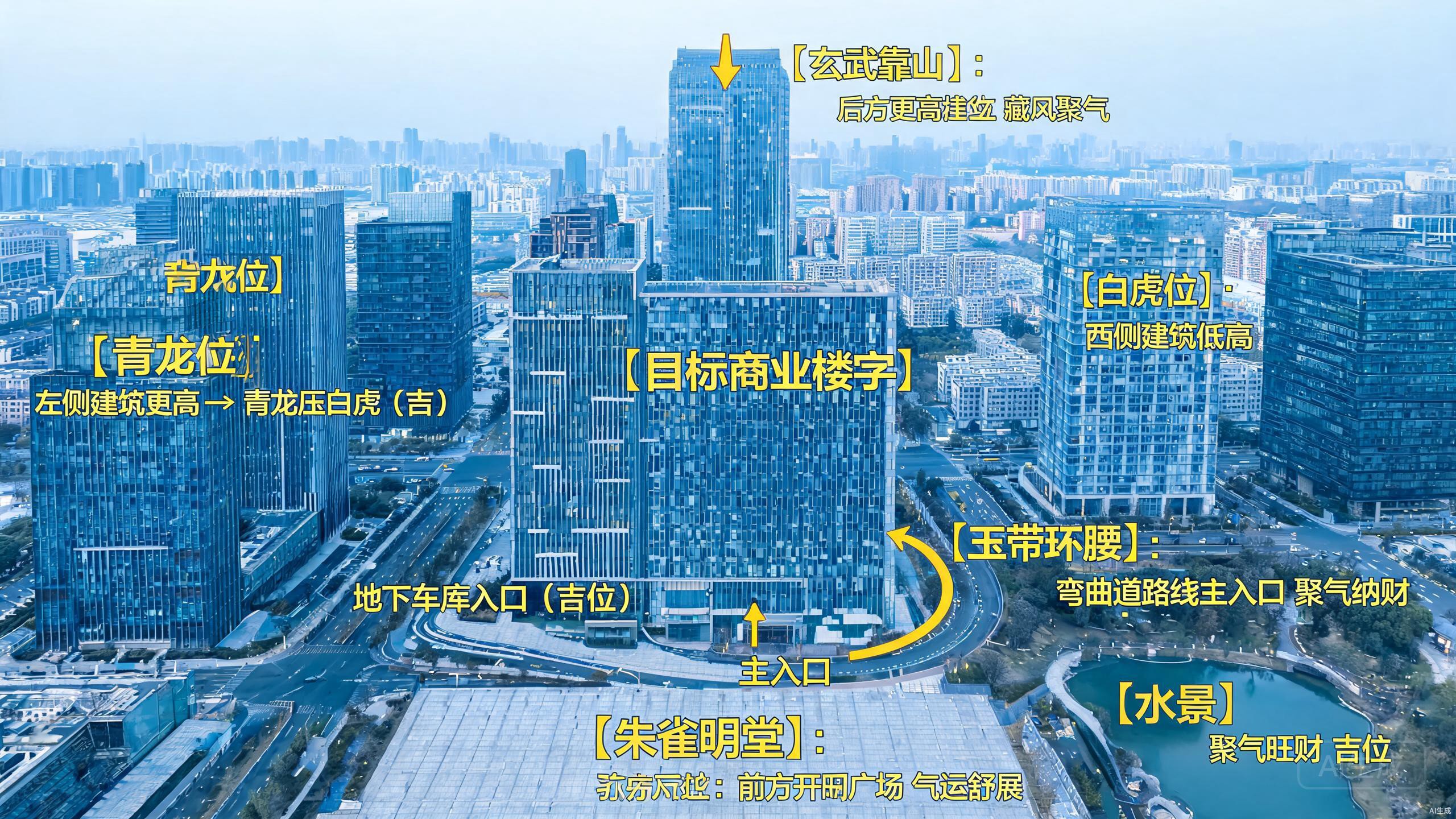
1. Overview of Commercial Building Site Selection
In modern cities, towering buildings function like the peaks and mountain ranges described in Feng Shui, while roads of varying directions resemble complex rivers. Parks and plazas serve as lakes. Together, these elements form the macro Feng Shui environment of the urban landscape. Within this larger setting, some buildings harmonize with Feng Shui principles and support thriving businesses, while others conflict with these principles and hinder commerce. This is why site selection becomes so critical.
2. The Main Entrance of a Commercial Building
2.1 The Entrance as a Qi Mouth
The main entrance of a commercial building is the Qi Mouth (气口) — the point where vital energy is drawn inward. The Feng Shui quality of this entrance directly influences the fortune of every business operating inside the building:
- Spacious and bright: Attracts wealth and gathers Qi effectively
- Narrow and dim: Blocks the inflow of beneficial Qi, harming business
- Obstructed: Prevents Qi from entering, weakening overall fortune
2.2 Orientation of the Entrance
When determining the entrance direction, consider these factors:
- Whether it faces the main flow of foot traffic
- Whether it avoids harmful Sha Qi (煞气) patterns
- Whether it harmonizes with the surrounding road layout
2.3 The Bright Hall in Front of the Entrance
- The area in front of the building entrance should be an open space (known as the Bright Hall)
- The Bright Hall should not be blocked by planters, sculptures, or other obstacles
- An expansive Bright Hall welcomes prosperity from all directions
Cultural Context: Bright Hall (明堂, ming tang) is one of the most important concepts in Feng Shui. Originally referring to the open courtyard before an ancient palace or tomb, it symbolizes the gathering and amplification of beneficial Qi. In modern terms, think of it as the "energy field" of your entrance — the more open and welcoming, the more fortune flows in.
3. Key Considerations for Building Site Selection
3.1 Assessing the Macro Environment
Site selection begins with evaluating the larger environment:
- Area development potential: Choose locations with growth prospects
- Transportation access: Proximity to subways, bus stops, and major routes
- Foot traffic: Sufficient pedestrian flow in the surrounding area
- Commercial atmosphere: Established retail and business activity nearby
3.2 Feng Shui of Building Clusters
In modern cities, the Feng Shui of building clusters must account for:
- Sheng Ju (生局, Generating Layout): Surrounding building shapes that generate prosperous Qi
- Wang Ju (旺局, Thriving Layout): A commercially vibrant area with strong Human Qi (人气)
- Cai Ju (财局, Wealth Layout): Roads and waterways (virtual water) forming wealth-gathering patterns
3.3 Pool and Road Feng Shui
Both real water and virtual water govern wealth:
- Real water (实水): Rivers, lakes, ponds
- Virtual water (虚水): Roads and streets
- Curved roads embracing the building are auspicious
- Roads rushing straight toward the building are inauspicious
4. Building Shape Requirements
4.1 Square and Stable Shape Preferred
- The building's exterior should be square and balanced
- Avoid L-shaped, cross-shaped, or enclosed (回字) layouts
- Interior partitions should be logical and well-proportioned
4.2 Building Height
- Building height should not be excessively tall or short
- It should harmonize with surrounding building heights
- Too tall creates isolation; too low creates suppression
4.3 The Jade Belt Embrace (玉带环腰)
For commercial buildings, the "Jade Belt Embracing the Waist" (玉带环腰) pattern is highly auspicious:
- A road curves gently in front of the building
- The road wraps around the structure like a jade sash
- This pattern gathers Qi and generates wealth
4.4 Avoid These Five Road Sha
When constructing or selecting a building, avoid these five harmful road patterns:
- Straight road rushing directly at the building
- Reverse bow road (curving away)
- Scissors road (converging from two angles)
- T-shaped road
- Crossroad with direct alignment
Quick Tips:
- Use Google Maps or visit the site at different times to observe traffic patterns before committing to a location
- A curved road that gently embraces your building signals steady, accumulating wealth
- A road that aims directly at your entrance is one of the most common wealth-blocking patterns — especially damaging for retail
5. Floor Selection
5.1 Floors and the Five Elements
Different floor levels correspond to the Five Elements (Wu Xing):
| Floor Ending | Element | Suitable Industries |
|---|---|---|
| 1, 6 | Water | Logistics, tourism, beverages |
| 2, 7 | Fire | Restaurants, electronics, beauty |
| 3, 8 | Wood | Fashion, education, publishing |
| 4, 9 | Metal | Finance, jewelry, machinery |
| 5, 0 | Earth | Real estate, agriculture, ceramics |
5.2 Floors and the Building Occupant
Floor selection should also consider the Five Elements preferences of the main occupant. Choose a floor whose element generates (相生) the occupant's favorable element rather than restricting (相克) it.
How to Choose the Right Floor for Your Business
- Identify your element: Determine the Five Element associated with the industry you operate in
- Check personal compatibility: If you know your BaZi (八字) or dominant element, factor it in
- Match to a floor number: Select a floor whose element supports rather than conflicts with yours
- Verify in person: Visit the chosen floor at different times of day to feel its energy before signing a lease
6. Water Levels and the Building
6.1 Avoid Excessively High Water Tables
Building on land with an overly high water table is unfavorable:
- A high water table causes dampness
- Damp environments disrupt the gathering of Qi
- This affects both health and fortune
6.2 Reading Water to Judge Business Fortune
Observe water features to assess business luck:
- Curved, embracing water flow is auspicious
- Water rushing straight toward the building is inauspicious
- Clear water is auspicious
- Turbid water is inauspicious
7. Surrounding Environment
7.1 Buildings to Avoid Nearby
The following facilities should not be located near your commercial building:
- Funeral homes and cemeteries
- Garbage processing plants
- Sewage treatment facilities
- Power substations and high-voltage towers
- Hospitals (unless your business is healthcare-related)
- Temples and churches (energy from these affects certain industries unfavorably)
7.2 Beneficial Surroundings
- Parks and green spaces (provide Vital Qi)
- Plazas and squares (create Bright Hall energy)
- Banks and financial institutions (wealth energy)
- Well-known enterprises (drive foot traffic and visibility)
Cultural Context: In traditional Chinese Feng Shui, certain facilities are considered to emit heavy Yin or Sha Qi that disrupts commercial energy. For example, hospitals and cemeteries are associated with endings and transitions, which energetically conflict with the growth-and-expansion vibration needed for business success. While Western readers may approach this intuitively (who wants a funeral home next to their restaurant?), Feng Shui formalizes these observations into a systematic framework.
8. Office Door Feng Shui
8.1 Office Doors Should Not Face Elevators
An office door directly facing an elevator is unfavorable:
- Qi is constantly disturbed by the elevator's opening and closing
- This disrupts the ability to gather and stabilize energy
- It affects the fortune of office workers
Remedy: Install a Folding Screen (屏风) or entryway partition between the door and the elevator.
8.2 The Centrality Principle
When determining a location within the building, apply the centrality principle:
- Offices should not be located in overly remote corners
- Choose a position with convenient access
- Avoid the most isolated or hidden spots in a large building
9. Quick Reference Table for Large Commercial Building Selection
| Selection Factor | Auspicious Signs | Inauspicious Signs |
|---|---|---|
| Building Entrance | Spacious, bright, open Bright Hall | Narrow, dim, obstructed |
| Road Layout | Curved embracing roads, Jade Belt pattern | Straight rush, reverse bow |
| Building Shape | Square, stable, balanced | L-shaped, cross-shaped, enclosed |
| Surrounding Environment | Parks, plazas, commercial districts | Funeral homes, garbage sites, power stations |
| Water Table | Moderate, dry | Excessively high, damp |
| Transportation | Convenient, high foot traffic | Inconvenient, low foot traffic |
| Floor Level | Matches industry's element | Conflicts with industry's element |
10. The Three Core Principles of Site Selection
10.1 Location Over Timing
Different commercial districts have unique Feng Shui characteristics:
- Choose a setting that supports career and business growth
- Choose a working environment with favorable regional energy
- Choose a location suitable for your specific investment
10.2 Storing Wind and Gathering Qi
Select an environment that stores wind and gathers Qi (藏风聚气):
- Avoid harsh or environmentally degraded locations
- The surroundings should provide "mountains" (tall buildings) and "water" (roads)
- The Qi field should be stable yet flowing
10.3 Adapting to Local Conditions
Match your location to your specific industry:
- Settings suitable for retail operations
- Settings suitable for office work
- Settings suitable for manufacturing and production
Conclusion
The site selection of a large commercial building is a matter of grand-scale Feng Shui (格局) that can determine the rise or fall of an entire enterprise. When selecting a site, you must holistically evaluate the development potential of the larger environment, transportation convenience, foot traffic, and commercial atmosphere — alongside the building's own shape, entrance orientation, and surrounding road patterns. The core principle is to choose a location that stores wind and gathers Qi, features the Jade Belt Embrace pattern, and offers an expansive Bright Hall — while avoiding all forms of road Sha and negative environmental influences. Only when the macro environment is favorable can a strong foundation be laid for the long-term prosperity of any business.
Related Articles
- [[../02-家居风水/01-选房风水指南.md|Feng Shui Home Selection Guide: Location, Floor, Layout & Surroundings]]
- [[../02-家居风水/02-大门风水.md|Main Door Feng Shui: Four Auspicious Directions, Three Sees & Three Don't Sees, Colors & Sizes]]
- [[../06-风水文化与历史/10-古代帝王陵寝风水.md|Imperial Tomb Feng Shui — Site Selection Principles, Architectural Evolution & Burial Culture]]
- [[../07-风水故事/09-肯德基麦当劳的商铺风水.md|KFC & McDonald's Feng Shui — Location Strategy of Global Brands]]