Face Reading Feng Shui: Nine Palaces and Bagua Guide for Your Home's Energy
## 1. The Theoretical Foundation of Face Reading Feng Shui Face Reading Feng Shui is the intersection of physiognomy (面相) and Feng Shui (风水). Its core principle is rooted in the philosophy of "Unity o
Face Reading Feng Shui: Nine Palaces and Bagua Guide for Your Home's Energy
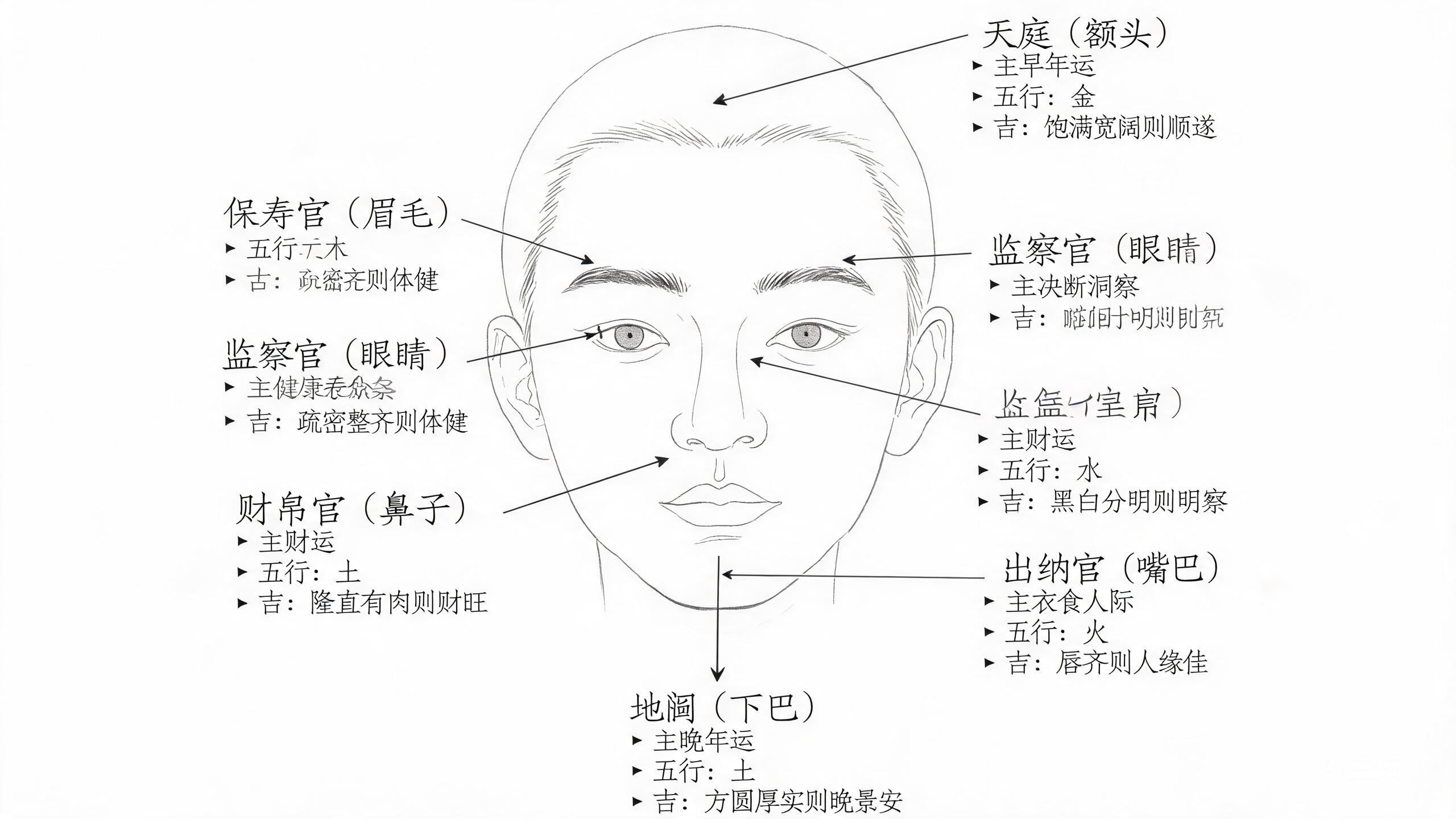
1. The Theoretical Foundation of Face Reading Feng Shui
Face Reading Feng Shui is the intersection of physiognomy (面相) and Feng Shui (风水). Its core principle is rooted in the philosophy of "Unity of Heaven and Humanity" (天人合一) — the belief that a person's facial features correspond directly to the Feng Shui of their Yang Dwelling (阳宅, their home).
Cultural Context: In Chinese metaphysics, the face is considered a "living blueprint" of your environment. Just as a Luopan (Feng Shui Compass) reveals the energy of a landscape, your facial features reveal the energy of your home. This is why the practice is called "reading Feng Shui through the face."
Your face is not merely a reflection of destiny — it is a mirror of your living environment's Feng Shui. By observing facial features, practitioners can infer the auspicious and inauspicious qualities of a person's home. This is the fundamental principle of "reading Feng Shui through the face."
As noted in Feng Shui Written on the Face: "The face itself is a form of Feng Shui written on the skin — three parts determined by heaven, seven parts determined by yourself." (面相更是一种写在脸上的风水,三分天注定,七分靠自己.)
Face Reading Feng Shui holds that facial zones correspond to specific directional zones and functional areas of a home. The complexion, shape, and condition of each facial area reveals the quality of the corresponding living space.
2. Three Divisions and Six Bureaus — The Foundational Framework
The Three Divisions (三停)
The Three Divisions divide the face vertically into three zones, each corresponding to a life stage and a level of the home:
| Division | Location | Age Range | Feng Shui Correspondence | Meaning |
|---|---|---|---|---|
| Upper Division | Hairline to upper brow | 1–30 (early years) | Front yard, main gate, Bright Hall | Intelligence, ancestral blessings |
| Middle Division | Upper brow to nose tip | 31–50 (middle years) | Main structure, central hall | Career, relationships, ability |
| Lower Division | Nose tip to chin | 51+ (later years) | Backyard, Backing Mountain | Stability, skill, later-life fortune |
Upper Division represents "Heaven." A high, full Upper Division suggests the home's front area is open and the Bright Hall is bright — excellent Feng Shui. A narrow, low Upper Division indicates possible obstruction or pressure in front of the home.
Middle Division represents "Human." A full Middle Division indicates a structurally sound home with a spacious central hall. A prominent nose bridge reflects strong career energy and abundant Qi at the home's center.
Lower Division represents "Earth." A round, full Lower Division suggests the home has a solid Backing Mountain (靠山) and a substantial backyard. A pointed, receding chin reveals emptiness and lack of support behind the home.
The Six Bureaus (六府)
The Six Bureaus work alongside the Three Divisions, dividing each division into a left and right Bureau:
| Six Bureaus | Location | Feng Shui Correspondence | Meaning |
|---|---|---|---|
| Upper Left Bureau | Left forehead corner | Front-left of home | Noble help, external support |
| Upper Right Bureau | Right forehead corner | Front-right of home | Noble help, external support |
| Middle Left Bureau | Left cheekbone | Left side of home | Authority, execution power |
| Middle Right Bureau | Right cheekbone | Right side of home | Authority, execution power |
| Lower Left Bureau | Left jaw | Back-left of home | Stability, foundation |
| Lower Right Bureau | Right jaw | Back-right of home | Stability, foundation |
Full, fleshy Six Bureaus suggest the home is well-protected on all sides by surrounding "sand" (neighboring structures or hills). Sunken, hollow Bureaus indicate gaps or weaknesses in the home's protective surroundings.
3. Face Nine Palaces and Bagua Mapping
By mapping the face according to the Nine Palaces and Bagua (Eight Trigrams), each palace corresponds to a specific directional zone of the home:
Nine Palace Distribution on the Face
| Palace | Facial Location | Bagua Direction | Yang Dwelling Correspondence | Auspicious Feature |
|---|---|---|---|---|
| Kan Palace (North) | Center of chin | North | Backing Mountain behind home | Full indicates strong support |
| Gen Palace (Northeast) | Left jaw | Northeast | Northeast corner of home | Full indicates prosperous descendants |
| Zhen Palace (East) | Left cheekbone | East | Left side — Azure Dragon (青龙) | Prominent indicates helpfulbenefactors |
| Xun Palace (Southeast) | Left forehead corner | Southeast | Southeast corner of home | Full indicates strong Wenchang (文昌) |
| Li Palace (South) | Center of forehead | South | Bright Hall in front of home | Broad indicates bright future |
| Kun Palace (Southwest) | Right forehead corner | Southwest | Southwest corner of home | Full indicates lady of the house's luck |
| Dui Palace (West) | Right cheekbone | West | Right side — White Tiger (白虎) | Balanced indicates peace and safety |
| Qian Palace (Northwest) | Right jaw | Northwest | Northwest corner of home | Full indicates gentleman of the house's luck |
| Central Palace | Nose | Center | Home's central area | Prominent indicates prosperous household luck |
Palace-to-Home Feng Shui Correspondence
Nose (Central Palace): The nose is the "First of the Five Sacred Mountains" of the face, corresponding to the home's center. A prominent bridge with a fleshy tip indicates abundant Qi at the home's core and strong household fortune. A sunken bridge suggests flaws at the home's center — such as a bathroom or staircase located in the central zone.
Forehead (Li Palace / Bright Hall): The forehead represents the Bright Hall (明堂) in front of the home. A broad, full forehead indicates an open, unobstructed space in front of the home — excellent Feng Shui. A low, narrow forehead with scars suggests tall buildings blocking the front or a Road Rushing Sha (路冲煞) facing the entrance.
Chin (Kan Palace / Backing Mountain): The chin represents the Backing Mountain behind the home. A round, full chin indicates mountains or tall buildings providing support behind. A pointed, receding chin reveals emptiness and lack of support behind the home.
Left Cheekbone (Zhen Palace / Azure Dragon): The left cheekbone represents the Azure Dragon (青龙) sand formation on the home's left side. A prominent, strong left cheekbone indicates protective dragon energy on the left, attracting helpfulbenefactors and noble assistance.
Right Cheekbone (Dui Palace / White Tiger): The right cheekbone represents the White Tiger (白虎) sand formation on the home's right side. Balanced symmetry between left and right cheekbones indicates harmony — the White Tiger does not overpower the Azure Dragon. A right cheekbone higher than the left signals "White Tiger raising its head," associated with disputes and arguments.
4. Twelve Facial Palaces and Home Function Zones
| Twelve Palaces | Facial Location | Home Correspondence | Auspicious Features |
|---|---|---|---|
| Life Palace | Between the brows | Main entrance of home | Open, bright, no lines or moles |
| Wealth Palace | Nose | Wealth Position of home | Prominent, fleshy, full nostrils |
| Siblings Palace | Eyebrows | Bedrooms of home | Neat, lustrous, not scattered |
| Spouse Palace | Outer eye corners (fish-tail area) | Master bedroom | Smooth, no lines, good complexion |
| Children Palace | Lower eyelids (tear hall) | Children's room | Full, not sunken, no moles or lines |
| Health Palace | Mountain root (upper nose bridge) | Health sector of home | High, unmarked, clear complexion |
| Travel Palace | Forehead corners (Heavenly Granary) | Doors and pathways of home | Full, open, no scars |
| Servant Palace | Chin (Earth Pavilion) | Service areas of home | Square, full, fleshy jaws |
| Career Palace | Center of forehead | Study of home | Smooth, broad, no moles or lines |
| Property Palace | Upper eyelids | Overall home | Full, bright, no marks or moles |
| Fortune Palace | Above brow tail | Fortune sector of home | Full, fleshy, good complexion |
| Parent Palace | Sun and Moon corners of forehead | Elders' room of home | Full, complete, clear complexion |
5. Real-World Examples: Reading Home Feng Shui Through the Face
Example 1: Sunken Nose Bridge
A person with a sunken nose bridge may have Feng Shui flaws at the center of their home. Common issues include: a bathroom, staircase, or well located in the home's central zone, causing Qi to scatter rather than gather.
Recommended Remedy: Restructure the home's center layout, keeping it clean, open, and uncluttered. If relocation isn't possible, use a Folding Screen (屏风) or strategically placed furniture to redirect energy flow.
Example 2: Scars on the Forehead
Scars or moles on the forehead suggest Sha Qi (harmful energy) in front of the home. Common causes include: utility poles, Road Rushing Sha (路冲), or Sharp Corner Sha (尖角煞) pointing at the entrance.
Recommended Remedy: Install a screen wall at the entrance, plant tall greenery, or hang a Bagua Mirror (八卦镜) to deflect the harmful energy.
Example 3: Pointed, Receding Chin
A pointed, receding chin indicates emptiness behind the home. Common causes include: an empty lot, descending slope, or body of water directly behind the residence.
Recommended Remedy: Plant tall trees behind the home or install a rockery/artificial hill to symbolically create a Backing Mountain. Tall furniture (such as a high bookshelf) can serve the same purpose indoors.
Example 4: Asymmetrical Cheekbones
Noticeably asymmetrical cheekbones indicate imbalance between the left and right sides of the home. When the right cheekbone is higher than the left, it suggests the White Tiger is overpowering the Azure Dragon — associated with female dominance, relationship tension, and disputes.
Recommended Remedy: Strengthen the Azure Dragon (left) side of the home. Add tall plants, a green rug, or active décor on the left side. A small water feature on the left can also help balance the energy.
6. Cultivating the Mind to Improve Your Face and Luck
Face Reading Feng Shui emphasizes the principle: "Three parts determined by heaven, seven parts determined by yourself." Facial features are not fixed — through inner cultivation, you can transform your face, and in turn, transform your Feng Shui luck.
- Smile often: Smiling naturally fills out the Middle and Lower Bureaus, improving relationships and projecting stability
- Practice kindness: Acts of kindness gradually fill out the Lower Division over time, enhancing later-life fortune
- Cultivate inner peace: A calm, peaceful mind produces a healthy complexion, which uplifts the entire facial aura
- Help others freely: Helping others is the only true path to changing your own destiny
How to Start Your Face Reading Practice
If you're new to Face Reading Feng Shui, begin with these simple observation exercises:
- Look in the mirror weekly: Notice changes in your complexion, fullness, and facial symmetry
- Compare with your home: When you observe a facial area that appears weak or sunken, check the corresponding zone of your home for clutter, damage, or Sha Qi
- Track changes after home adjustments: After applying Feng Shui remedies, observe whether your facial features gradually improve
- Take monthly photos: Subtle changes are easier to track when you compare images over time
Quick Tips:
- Start with the Three Divisions — they are the easiest framework for beginners to apply
- Your nose is the most important facial feature for assessing overall home fortune
- The forehead reveals your home's "public face" — what the world sees when approaching your residence
- Cheekbone balance reflects harmony between household members and the surrounding environment
Face Reading Feng Shui is an intersection of traditional physiognomy and Feng Shui theory. This article is compiled from related classical sources for cultural research reference only.
Related Articles
- [[../02-家居风水/10-居家风水100忌.md|100 Home Feng Shui Taboos: Complete Guide by Category]]
- [[../08-百科问答库/52-手相和面相能看出风水问题吗?.md|Can Palm and Face Reading Reveal Feng Shui Problems?]]
- [[../08-百科问答库/22-什么是反弓煞?如何化解?.md|What Is Reverse Bow Sha? Remedies and Solutions]]
- [[../09-Yin Dwelling风水/03-Yin Dwelling风水与Yang Dwelling风水的区别与联系.md|Yin Dwelling vs Yang Dwelling Feng Shui: Differences and Connections]]