Face Reading for Yin Dwelling Feng Shui: How the Nose Reveals Ancestral Grave Energy and the Facial Map of Graves
## 1. The Principle Behind Face Reading for Yin Dwelling Feng Shui Face Reading (面相) can do far more than evaluate the Feng Shui of a living home — it can also reveal the auspicious and inauspicious q
Face Reading for Yin Dwelling Feng Shui: How the Nose Reveals Ancestral Grave Energy and the Facial Map of Graves
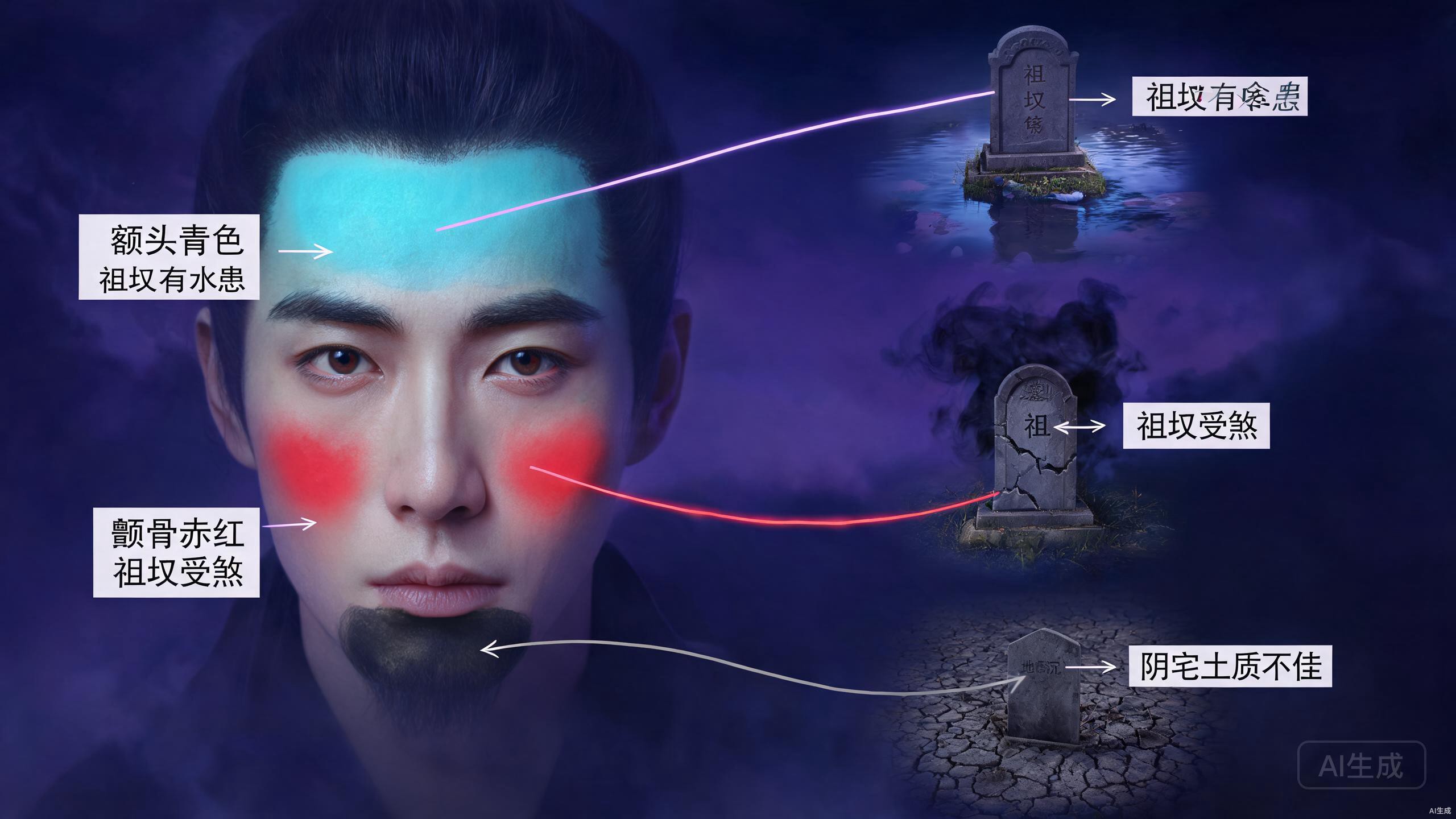
1. The Principle Behind Face Reading for Yin Dwelling Feng Shui
Face Reading (面相) can do far more than evaluate the Feng Shui of a living home — it can also reveal the auspicious and inauspicious qualities of your ancestral grave (Yin Dwelling, 阴宅). Traditional physiognomy teaches that a deep correspondence exists between the human face and the Feng Shui of one's ancestral tomb: each facial feature mirrors a different structural element of the grave, while the complexion, shape, and markings of the face reflect the burial environment, the surrounding landscape, and the overall quality of the resting place.
The theoretical foundation for this practice lies in the concept of Bloodline Resonance (血脉感应): the Feng Shui energy field of the spot where ancestral remains are buried is transmitted through the bloodline to influence the physiognomy of descendants. Read the face, and you can read the grave.
Cultural Context: This concept is rooted in the Chinese belief that the living and the dead remain energetically connected through family lineage. Just as the health of a tree reflects the health of its roots, the fortunes of descendants are believed to mirror the Feng Shui quality of their ancestors' resting place.
2. Complete Facial-to-Grave Correspondence Table
| Facial Feature | Yin Dwelling Correspondence | What to Observe | Auspicious/Inauspicious Reading |
|---|---|---|---|
| Nose | The grave site and burial acupoint | Bridge, tip, nostrils | Straight and fleshy = excellent grave Feng Shui |
| Mouth | Bright Hall front water (Ming Shui) | Shape, lip color, corners | Square and moist = favorable water element |
| Chin | Facing Mountain (front Desk Mountain) | Width, shape, fleshiness | Square and full = excellent Facing Mountain |
| Forehead | Ancestral grave coming Dragon (back Dragon) | Height, width, fullness | High and broad = powerful incoming Dragon Vein |
| Cheekbones | Left and right Dragon and Tiger Sand of the grave | Height, symmetry, fleshiness | Symmetrical and full = protective Sand and Water |
| Ears | Acupoint Star (Parent Mountain) | Size, thickness, luster | Large, thick, bright = favorable Acupoint Star |
| Nasolabial Folds | Water channels and ditches at the grave | Depth, length, direction | Deep and clear = favorable water method |
| Philtrum | Bright Hall pathway at the grave | Depth, width, length | Deep and straight = excellent Bright Hall |
| Lower Jaw (below chin) | Residual Qi in front of Acupoint (felt cushion) | Square/round, fullness | Square and full = abundant residual Qi |
3. Detailed Reading: How the Nose Reveals the Grave
The nose is the central facial feature in Yin Dwelling Feng Shui reading, corresponding to the ancestral grave itself.
The Nose Bridge — Grave's Dragon Vein
The nose bridge represents the incoming Dragon Vein (龙脉) that the grave leans against:
- High, straight bridge: The ancestral grave's Dragon Vein is powerful, the coming Dragon is long and grand — descendants will prosper
- Collapsed or flat bridge: The Dragon Vein is weak, coming Dragon is short or broken — descendants' luck declines
- Crooked bridge: The Dragon Vein is winding and unstable — descendants will experience ups and downs
- Bumpy or knotted bridge: The Dragon Vein has breaks or damage — descendants may face obstacles
- Moles on the bridge: The Dragon Vein may have suffered damage or disturbance
The Nose Tip — Grave's Acupoint Star
The nose tip represents the Acupoint Star (穴星) where Qi converges at the grave:
- Plump and fleshy: The Acupoint Star is full, achieving Storing Wind and Gathering Qi (藏风聚气) — excellent Feng Shui
- Sharp and fleshless: The Acupoint Star is thin and weak, Qi cannot gather — poor Feng Shui
- Red and inflamed: The grave may be afflicted by Fire Sha — possibly from nearby power lines, chimneys, or similar
- Bluish or black: The grave may be damp, waterlogged, or burdened by excessive Yin Qi (阴气)
The Nostrils — Left and Right Sand of the Grave
The nostrils represent the Dragon and Tiger Sand (龙虎砂) flanking the grave:
- Full and symmetrical nostrils: The left and right Sand provide strong protection; Feng Shui achieves Storing Wind and Gathering Qi
- One side sunken: One side of the grave's protective Sand is missing — incomplete protection
- Flared outward nostrils: The Sand turn away from the grave — Qi cannot gather
- Moles or scars on nostrils: The protective Sand may be damaged or excavated
4. The Mouth as Bright Water
In face reading for Yin Dwelling, the mouth represents the Bright Hall (明堂) water in front of the grave — the stream, river, or pond before the burial site.
Mouth Shape and Water Method
| Mouth Shape | Water Correspondence | Reading |
|---|---|---|
| Square and proper | Water flows straight and embraces | Auspicious — gathers wealth |
| Wide and broad | Large Bright Hall water | Neutral — too much water disperses Qi |
| Narrow and small | Small or no Bright Hall water | Neutral — depends on other features |
| Upturned corners | Water embraces with affection | Auspicious — wealth and progeny flourish |
| Downturned corners | Water flows away in reverse bow | Inauspicious — wealth loss and family decline |
| Thick lips | Deep, clear water | Auspicious — abundant wealth source |
| Thin lips | Shallow or dry water bed | Inauspicious — insufficient wealth source |
Lip Complexion and Water Quality
- Rosy lips: The water before the grave is clear and sweet — excellent quality
- Dark or black lips: The water is polluted or stagnant — poor quality
- Pale lips: The grave may lack water or the waterway has dried up
- Bluish-purple lips: The water may contain toxins or contamination
5. The Chin as the Facing Mountain
The chin (地阁, Earth Pavilion) represents the Facing Mountain (朝山) and Desk Mountain (案山) in front of the grave.
Chin Shape and Facing Mountain
| Chin Shape | Facing Mountain Correspondence | Reading |
|---|---|---|
| Square, round, full | Facing Mountain is proper and affectionate | Highly auspicious — descendants attain wealth and status |
| Pointed and receding | No Facing Mountain or one too far away | Neutral — descendants lack support |
| Double chin | Layered, affectionate Facing Mountain | Auspicious — descendants enjoy deep blessings |
| Crooked or asymmetrical | Facing Mountain is tilted and unaffectionate | Inauspicious — unstable descendant fortune |
| Scarred chin | Facing Mountain has been damaged | Inauspicious — descendants suffer harm |
| Broad and wide chin | Facing Mountain is close and powerful | Auspicious — descendants gain strong support |
6. The Forehead as the Coming Dragon
The forehead represents the Coming Dragon (来龙) behind the ancestral grave — the trajectory of the mountain range that backs the burial site.
- High, broad, full forehead: The Coming Dragon is powerful and far-reaching; the grave has strong backing — descendants have deep roots
- Low and narrow forehead: The Coming Dragon is weak and short; backing is insufficient — descendants have shallow foundations
- Scarred forehead: The Coming Dragon may have been severed or damaged — perhaps by road construction or mining
- Rounded forehead: The Coming Dragon is smooth and affectionate — gentle, harmonious grave Feng Shui
- Square forehead: The Coming Dragon is upright and vigorous — strong, righteous grave Feng Shui
7. Comprehensive Assessment Method
Reading Yin Dwelling Feng Shui from the face requires integrating all features — no single feature tells the complete story.
Step-by-Step Assessment
- Start with the nose: Evaluate the grave site and burial acupoint itself
- Then examine the forehead: Assess the strength of the Coming Dragon
- Next, look at the chin: Determine whether the Facing Mountain and Desk Mountain are proper
- Observe the mouth: Evaluate the Bright Hall water method for auspiciousness
- Check the cheekbones: Assess whether the left and right Sand provide protection
- Read the complexion: Form an overall judgment of the grave's energy field
Integrated Auspicious and Inauspicious Readings
Highly Auspicious Signs: Straight nose bridge, fleshy nose tip, full forehead, square-rounded chin, upturned mouth corners, symmetrical cheekbones — the ancestral grave Feng Shui is excellent, achieving Storing Wind and Gathering Qi, and descendants will flourish.
Highly Inauspicious Signs: Collapsed nose bridge, sharp fleshless nose tip, low narrow forehead, pointed chin, downturned mouth corners, asymmetrical cheekbones — the ancestral grave Feng Shui has significant defects, and descendants' fortunes will decline.
8. Important Considerations
- Traditional scope: Face reading for Yin Dwelling applies to traditional burial practices. Modern methods such as cremation urns or sea burial do not fall within this framework.
- Combine with reality: Facial reading is only a reference. Authentic Yin Dwelling Feng Shui assessment requires on-site inspection.
- Complexion changes: Facial complexion shifts over time, reflecting the recent state of the ancestral grave rather than a permanent picture.
- Cultivation transforms fate: Even if your ancestral grave Feng Shui is less than ideal, cultivating virtue and doing good deeds can still improve your fortune.
Face reading for Yin Dwelling Feng Shui is part of traditional physiognomy theory. This article is compiled from related classical texts for cultural research reference only.
Related Articles
- [[../01-风水入门/06-风水基础概念词典.md|Feng Shui Basics Dictionary: 18 Core Terms Explained]]
- [[../07-风水故事/58-风水与丧葬.md|Feng Shui and Burial — The Ancient Tradition of Yin Dwelling Feng Shui]]
- [[../07-风水故事/01-曾国藩葬地择选记.md|Zeng Guofan's Grave Site Selection — The Feng Shui Wisdom of "Heaven Dislikes Cunning"]]
- [[../08-百科问答库/50-墓碑有什么风水讲究?墓碑朝向怎么定?.md|What Are the Feng Shui Rules for Tombstones? How to Determine Tombstone Direction?]]