Qi Color Reading Feng Shui: Facial Complexion and Ancestral Grave Energy Connection
## I. The Theoretical Foundation of Qi Color Feng Shui Qi color (气色) represents the highest level of observation in Face Reading (面相, mian xiang), and stands as one of the core techniques for diagnosi
Qi Color Reading Feng Shui: Facial Complexion and Ancestral Grave Energy Connection
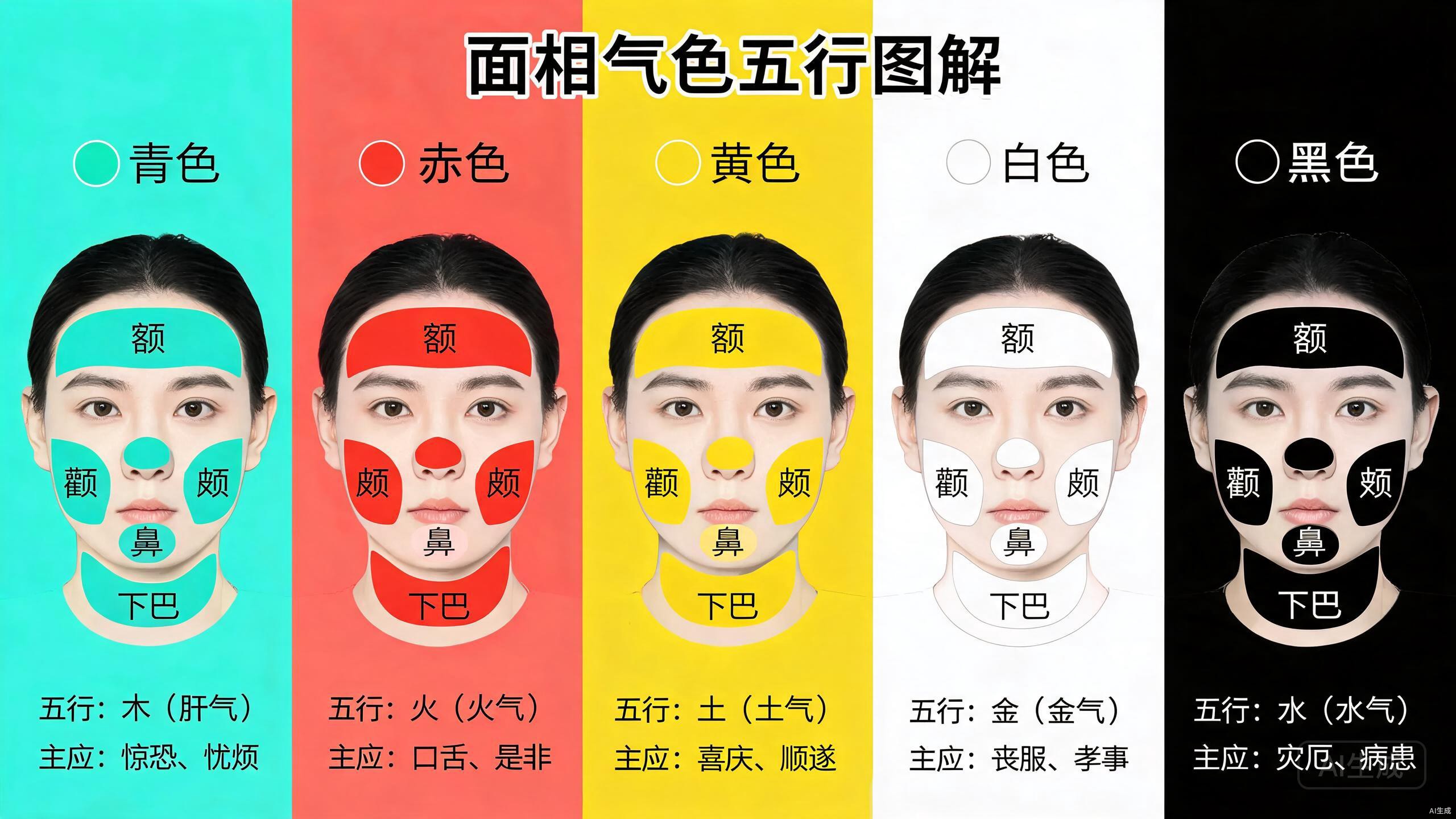
I. The Theoretical Foundation of Qi Color Feng Shui
Qi color (气色) represents the highest level of observation in Face Reading (面相, mian xiang), and stands as one of the core techniques for diagnosing Feng Shui through facial features. Unlike skin tone, Qi color refers to the luminosity and vitality expressed on the face — the combined result of internal blood-Qi circulation and external Feng Shui environmental influences.
Cultural Context: In traditional Chinese metaphysics, the face is considered a mirror of both personal health and ancestral fortune. Practitioners believe that your facial Qi color provides a real-time reflection of your Ancestral Grave Feng Shui (祖坟风水) — the energetic conditions of your family's burial site, which traditional teachings link to the destiny of descendants.
Traditional physiognomy holds that facial Qi color reflects the real-time condition of Ancestral Grave Feng Shui. When the ancestral grave enjoys good Feng Shui, descendants display a moist, full complexion; when problems arise at the grave site, their Qi color deteriorates. Because these color changes typically appear before external events manifest, observing Qi color allows practitioners to predict Auspicious and Inauspicious (吉凶, ji xiong) developments in advance.
II. Basic Categories of Qi Color
The Five Fundamental Qi Colors
| Qi Color | Five Elements (Wu Xing) | Direction | Ancestral Grave Feng Shui Meaning | Auspicious/Inauspicious |
|---|---|---|---|---|
| Blue-Green | Wood | East | Trees or roots intruding into the coffin at the ancestral grave | Inauspicious |
| Red (Vermilion) | Fire | South | Fire Sha (harmful energy) or excessive dryness near the grave | Inauspicious (excessive) / Auspicious (slight) |
| Yellow | Earth | Center | Good soil quality; Feng Shui is thriving | Auspicious (bright yellow) / Inauspicious (dull yellow) |
| White | Metal | West | Metal/stone Sha or heavy cold Qi at the grave | Neutral |
| Black | Water | North | Water intrusion or excessive Yin Qi at the grave | Highly Inauspicious |
The Three States of Qi Color
Moist (润): Qi color that is lustrous and glowing, like the polish of fine jade. Indicates that Ancestral Grave Feng Shui is thriving and fortune is ascending.
Withered (枯): Qi color that is dry and dim, like the hue of dead leaves. Indicates that Ancestral Grave Feng Shui is declining and fortune is deteriorating.
Full (丰): Qi color that is plump and substantial, like a ripe fruit. Indicates that Ancestral Grave Feng Shui is stable and fortune will remain constant.
III. The Dry-Withered-Yellow-Moist-Full Assessment Method
Moist — Feng Shui Is Thriving
Facial Qi color is lustrous and bright; the skin carries a natural glow, as though lightly oiled without appearing greasy.
| Moist Area | Ancestral Grave Feng Shui Status | Fortune Prediction |
|---|---|---|
| Moist forehead | The incoming Dragon Vein (来龙) carries strong Qi; the grave has solid backing | Career ascending; benefactors appear |
| Moist nose | The Acupoint (穴) holds abundant Qi; the grave's Feng Shui is thriving | Wealth flows smoothly; income increases |
| Moist chin | The Facing Mountain (朝山) shows affection; surplus Qi is plentiful | Stable later years; descendants flourish |
| Moist entire face | Overall Ancestral Grave Feng Shui is excellent | All areas of fortune rise |
Withered — Feng Shui Is Declining
Facial Qi color is dry and dim; the skin appears rough and lackluster, like leaves deprived of water.
| Withered Area | Ancestral Grave Feng Shui Status | Fortune Prediction |
|---|---|---|
| Dark withered forehead | The Dragon Vein Qi is fading; backing is weak | Career obstacles; benefactors distance themselves |
| Dry withered nose | The Acupoint Qi has scattered; grave's Feng Shui declines | Wealth decreases; financial leakage and loss |
| Withered thinning chin | The Facing Mountain shows no affection; surplus Qi is insufficient | Lonely later years; descendants weak |
| Dark withered entire face | Overall Ancestral Grave Feng Shui has declined | Fortune falls across all areas |
Yellow — Earth Qi Feng Shui
Yellow is the most direct indicator of Ancestral Grave Feng Shui, because the grave rests within the earth.
| Yellow Type | Qi Color Characteristics | Ancestral Grave Feng Shui Status | Auspicious/Inauspicious |
|---|---|---|---|
| Bright Moist Yellow | Like gold leaf, moist but not parched | Excellent soil quality; Feng Shui thriving | Highly Auspicious |
| Dull Withered Yellow | Like parched earth, dry and lifeless | Poor soil or disturbance at the grave | Inauspicious |
| Yellow with Blue-Green | Yellow tinged with blue-green | Tree roots intruding into the grave | Inauspicious |
| Yellow with Black | Yellow tinged with dark gray | Water intrusion or dampness at the grave | Highly Inauspicious |
| Yellow with White | Yellow tinged with pallid white | Cold Qi or Yin Qi at the grave | Neutral leaning Inauspicious |
Full — Feng Shui Is Stable
Facial Qi color is plump and substantial — neither floating nor restless, like a ripe fruit.
Full color indicates that Ancestral Grave Feng Shui has remained stable over the long term. Though there may be no great surge of fortune, there is also no severe decline; fate proceeds steadily and consistently. Those who display Full color typically have ancestral graves located on level ground — free from major Sha (煞) but also without exceptional prosperity.
IV. Facial Regions and Their Corresponding Ancestral Grave Feng Shui
Forehead Qi Color — Reveals the Incoming Dragon
- Bright moist forehead: Ancestral grave's Dragon Vein carries strong Qi; the backing mountain is tall and powerful
- Blue-green forehead: Trees have grown into the back of the grave, or the backing mountain has been excavated
- Black forehead: Ancestral grave's Dragon Vein has been severed; the backing mountain has collapsed or been destroyed
- Red forehead: Fire Sha behind the ancestral grave — such as high-voltage power lines, chimneys, or transformers
Nose Qi Color — Reveals the Acupoint
- Bright moist yellow nose: Ancestral grave's Acupoint Qi is strong; the grave's Feng Shui is at its peak
- Blue-green nose: Tree roots penetrating the coffin, or nearby vegetation invading the grave
- Black nose: Water intrusion at the ancestral grave; coffin dampened
- Red nose: Fire Sha near the grave, or the burial site is excessively dry
- Pallid white nose: Excessive Yin Qi at the ancestral grave, or the site lies in a cold, shaded location
Chin Qi Color — Reveals the Facing Mountain
- Moist chin: Ancestral grave's Facing Mountain shows affection; the forward area is open and spacious
- Dark chin: Blockage or newly built structures obstructing the front of the ancestral grave
- Blue-green chin: Newly planted trees blocking the front of the ancestral grave
- Red chin: Fire Sha or red-colored structures in front of the ancestral grave
Cheekbone Qi Color — Reveals the Dragon and Tiger Sand
- Moist symmetrical cheekbones: The ancestral grave's left and right Dragon and Tiger Sand (龙虎砂) provide strong protection
- One cheekbone dark, the other bright: One side of the grave's protective Sand is missing; protection is incomplete
- Blue-green cheekbones: Trees intruding on both sides of the ancestral grave
- Black cheekbones: Both sides of the ancestral grave have been excavated or destroyed
V. The Prophetic Significance of Qi Color Changes
Qi color is not fixed — its transformations often signal shifts in Ancestral Grave Feng Shui:
Sudden Improvement in Qi Color
When facial Qi color suddenly becomes lustrous and bright, it mayindicate:
- Ancestral Grave Feng Shui has improved due to natural environmental changes (such as a new water project bringing favorable Water Dragon energy)
- Recent ancestral worship or grave-tending has restored the site
- Surrounding Sha Qi (harmful energy) has naturally dissipated
Sudden Deterioration in Qi Color
When facial Qi color suddenly darkens and withers, it mayindicate:
- The ancestral grave has been damaged (construction excavation, tomb robbery)
- Water intrusion or coffin decay at the ancestral grave
- New Sha-creating structures erected near the ancestral grave (such as high-voltage lines or chimneys)
- Tree roots from surrounding vegetation penetrating the burial chamber
Long-Term Stability of Qi Color
When facial Qi color remains consistently lustrous and stable, it indicates that Ancestral Grave Feng Shui has remained in good condition and requires no special intervention.
VI. Methods to Improve Qi Color
If your facial Qi color is poor — suggesting potential problems with Ancestral Grave Feng Shui — consider the following approaches:
- Inspect the ancestral grave in person: Check for water intrusion, root penetration, newly built Sha-creating structures, and other issues
- Restore the ancestral grave: Clear weeds, repair the tomb mound, and unblock drainage channels
- Relocate the grave: If Ancestral Grave Feng Shui has serious problems, consider selecting a new auspicious site for reburial
- Honor ancestors through virtue: Maintain regular ancestral worship and grave-tending visits; cultivate filial piety — virtuous conduct transforms fortune
- Cultivate the inner self: Personal cultivation also improves Qi color. As tradition teaches: "Helping others is the only way to change your own destiny"
How to Apply This Wisdom Today
Even if you cannot easily visit or modify an ancestral grave, you can still work with these principles:
- Begin with self-observation: Notice your complexion patterns over time — track which areas consistently look moist or withered
- Strengthen ancestral connection: Participate in family memorial practices, even from a distance; this honors Bloodline Resonance (血脉感应)
- Address environmental parallels: If your reading suggests "water intrusion," check whether your own living space has dampness issues — your personal environment often mirrors ancestral patterns
- Practice Qi cultivation: Adequate sleep, hydration, and stress management naturally improve facial Qi color
Quick Tips:
- Examine your reflection in natural morning light for the most accurate Qi color reading
- A consistently lustrous forehead often signals career opportunities approaching
- A suddenly darkened nose warrants prompt attention to both financial decisions and ancestral grave conditions
VII. Important Considerations
- Observe Qi color in natural light: Natural daylight provides the most accurate assessment; artificial lighting distorts judgment
- Long-term observation is essential: A single observation may reflect temporary health conditions; track changes over weeks and months for reliable patterns
- Rule out health factors: Qi color changes can also signal health issues — always rule out medical causes before drawing Feng Shui conclusions
- Use comprehensive judgment: Qi color is only one dimension of Face Reading Feng Shui diagnosis; combine it with facial shape, structure, and other features for complete assessment
Qi Color Reading Feng Shui represents an advanced technique within traditional physiognomy. The content of this article has been compiled from relevant classical sources for cultural study and reference only.
Related Articles
- [[../07-风水故事/17-朱元璋祖坟传说.md|Zhu Yuanzhang's Ancestral Grave Legend: The Feng Shui Mysteries of the Fengyang Imperial Tomb]]
- [[../08-百科问答库/48-祖坟风水不好怎么办?如何改善?.md|How to Remedy Poor Ancestral Grave Feng Shui]]
- [[../08-百科问答库/47-什么是Yin Dwelling风水?Yin Dwelling风水真的影响后代吗?.md|What Is Yin Dwelling Feng Shui? Does It Truly Affect Descendants?]]
- [[../09-Yin Dwelling风水/33-祖坟风水与子孙官运的关系.md|The Relationship Between Ancestral Grave Feng Shui and Descendants' Official Career Fortune]]