Classic Feng Shui Texts Explained: Yi Long Jing — The Guide to Identifying True Dragon Veins
The *Yi Long Jing* (Classic of Doubting Dragon) is another major work by Yang Yunsong (杨筠松), the great Tang Dynasty Feng Shui master. Together with the *Han Long Jing* (Classic of Shaking Dragon), it
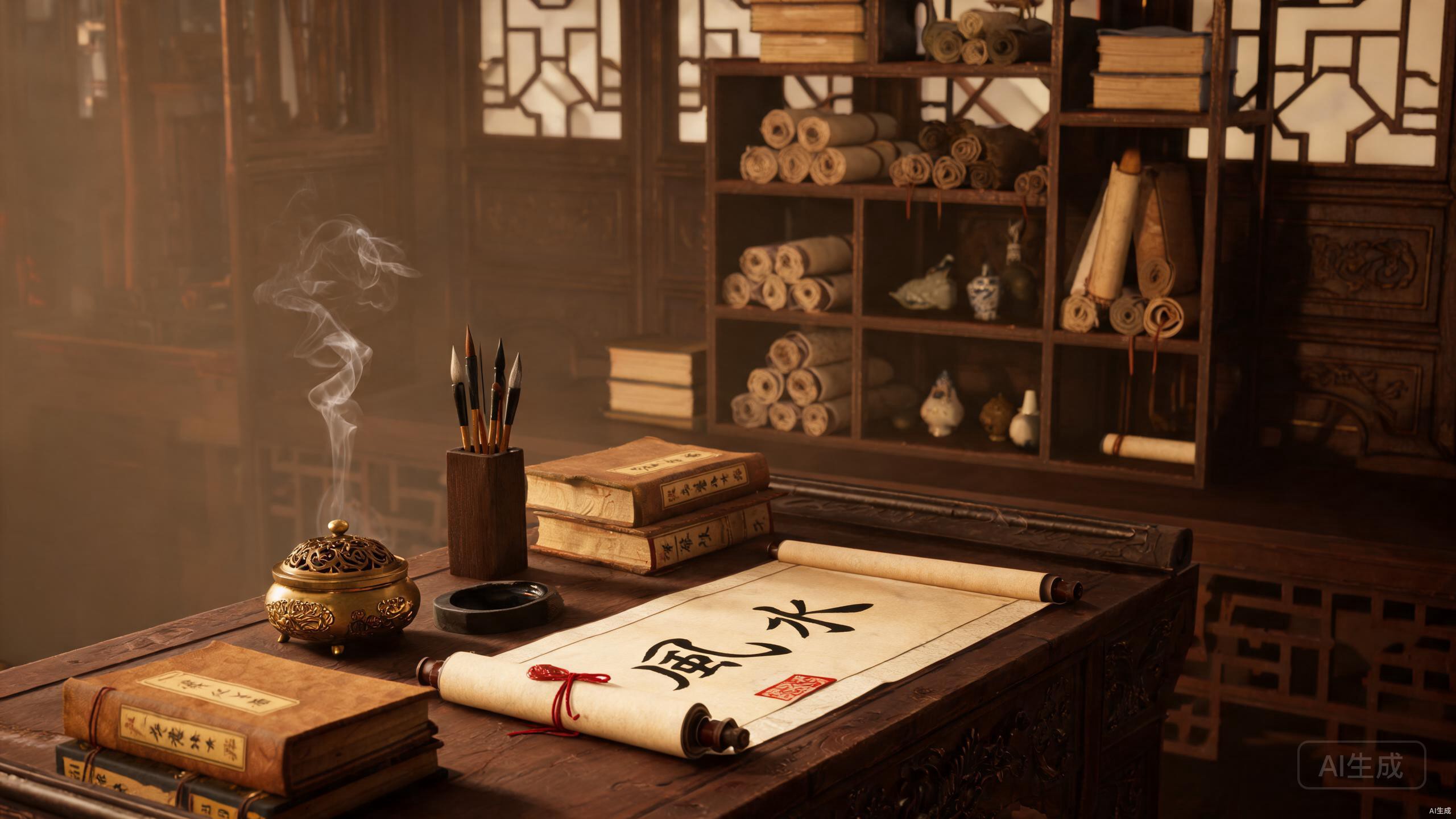
Introduction: The Unique Value of Yi Long Jing
The Yi Long Jing (Classic of Doubting Dragon) is another major work by Yang Yunsong (杨筠松), the great Tang Dynasty Feng Shui master. Together with the Han Long Jing (Classic of Shaking Dragon), it forms the "twin masterpieces" of Yang Yunsong's Form School (形势派, Xing Shi Pai) Feng Shui.
Cultural Context: The Form School is one of the oldest branches of Feng Shui practice, focusing on the physical landscape — mountains, rivers, and terrain shapes — rather than compass calculations. If the Han Long Jing teaches how to find and identify a true Dragon Vein, the Yi Long Jing teaches how to recognize and reject false ones.
If the Han Long Jing teaches people how to seek and identify true Dragon Veins (龙脉), then the Yi Long Jing teaches them how to distinguish and eliminate false ones. The character "疑" (yí) in the title means "to doubt" or "to question," reflecting Yang Yunsong's deep insight into the common pitfalls and confusions in Feng Shui practice.
The unique value of the Yi Long Jing in the history of Feng Shui lies in its "reverse approach" — systematically analyzing various forms of "false dragons" that are easily mistaken for true Dragon Veins. It provides practitioners with a methodological framework for discerning the real from the fake. This "combining Yin and Yang perspectives" approach creates a perfect complement to the Han Long Jing, together forming the complete theoretical system of Yang Yunsong's Form School.
Writing Background and Motivation
Chaos in Feng Shui Practice
Yang Yunsong wrote the Yi Long Jing during a period when Feng Shui was spreading widely among the common people. As demand grew, more and more people entered the profession — but their skill levels varied dramatically. Many practitioners lacked systematic training and offered readings based on half-understood knowledge, leading to widespread misjudgments and misguided advice.
Through decades of practice, Yang Yunsong came to deeply understand the harm caused by this chaos. He witnessed many people choosing unfavorable burial sites or residential plots due to faulty judgments, resulting in family decline and continuous misfortune. He therefore decided to write the Yi Long Jing, systematically summarizing his years of practical experience and insights, creating a definitive guide for practitioners everywhere.
Teachings for Disciples and Future Students
The Yi Long Jing also serves as earnest guidance for Yang Yunsong's disciples and future students. Throughout the text, he repeatedly emphasizes that Seeking Dragon and Pointing Acupoint (寻龙点穴) is not a simple task — it requires deep understanding of mountain and water formations, along with rich practical experience. He warns his students not to be deceived by surface appearances, urging them to make comprehensive judgments from multiple angles in order to find the true "Dragon Acupoint" (龙穴).
Core Content of the Yi Long Jing
Types of False Dragons
The Yi Long Jing systematically classifies "false dragons" and identifies several common forms:
First, the "Broken Mountain" (断山) false dragon. A broken mountain refers to a landform where the mountain range suddenly breaks off — cut by a river, road, or other artificial feature. On the surface, a broken mountain may possess the momentum of a Dragon Vein, but since its "energy channel" (气脉) has been severed, it has lost the conditions for "forming an acupoint." Yang Yunsong notes that a broken mountain is like a person with a severed head — having a body but no life.
Second, the "Lone Mountain" (独山) false dragon. A lone mountain is an isolated hill unconnected to any main mountain range. Although it may have an attractive shape, it lacks the "Qi" of a Dragon Vein to support it — "water without a source, a tree without roots" — and cannot become an auspicious acupoint. As Yang Yunsong emphasizes: "Dragons fear solitude, acupoints fear emptiness; lone mountains and lone waters cannot store wind."
Third, the "Stone Mountain" (石山) false dragon. A stone mountain is one composed primarily of rock with very little soil. Although its terrain may be dramatic, the lack of sufficient soil means it cannot "store Qi," and Vital Qi (生气, sheng qi) cannot settle there. Such mountains are unsuitable for burial sites or residential plots. Yang Yunsong states clearly: "Stone mountains should not be used for burial; burial there will surely bring disaster."
Fourth, the "Passing Mountain" (过山) false dragon. A passing mountain is a landform where the mountain range merely passes through without pausing. Although the Dragon Vein's path is clearly visible, the "Qi" does not gather here — it rushes past — and therefore cannot form an acupoint. Yang Yunsong explains: "When the mountain passes through, it rests briefly, then rises again ahead. If you find a suitable acupoint, it must pause; do not let the dragon depart without turning back."
Methods for Distinguishing True and False Dragon Veins
The Yi Long Jing proposes systematic methods for辨别 true and false Dragon Veins, reflected in the following aspects:
First, examine the "ancestor" mountain. Yang Yunsong believed that a true dragon must have a tall, majestic "ancestor mountain" (祖山) as its source — the more imposing the ancestor mountain, the stronger the Dragon Vein's momentum. If a mountain has no clear ancestor mountain, or its source is low and unimpressive, it cannot become a true dragon regardless of its surface appearance.
Second, examine the "passing-through" (过峡) formation. The passing-through point is where the Dragon Vein transitions from one mountain body to another. In a true dragon, this point typically "constricts the Qi" — the mountain narrows to form a "bee's waist" (蜂腰) or "crane's knee" (鹤膝) shape before expanding again. In a false dragon, this transition is scattered and disorderly, or the "Qi" is broken at this point.
Third, examine the "opening canopy" (开帐) formation. The opening canopy refers to the way the Dragon Vein extends lateral branches during its course, like a tent opening. In a true dragon, the canopy is typically "symmetrically balanced," with branch veins flanking the main vein in protective formation. In a false dragon, the canopy is usually asymmetrical, with branches on only one side and emptiness on the other.
Fourth, examine the features of the "acupoint" (结穴). The acupoint of a true dragon typically displays four formations: "nest" (窝 — concave), "pincer" (钳 — clamping), "nipple" (乳 — protruding), or "peak" (突 — prominent). False dragons lack these features or display them in incomplete forms.
The Five Elements Method for Distinguishing Authenticity
The Yi Long Jing also applies the Five Elements (Wu Xing) theory to Dragon Vein verification, proposing the "Five Elements authentication method." Yang Yunsong believed that a true dragon has a "pure" Five Elements attribute — one mountain has one dominant element without mixing. False dragons, by contrast, often display mixed elements — for example, a mountain shape resembling both Metal and Wood, making it difficult to classify.
Yang Yunsong further pointed out that the Five Elements attribute of a true dragon should be "generating" (相生) or "harmonizing" (比和) with the Five Elements of its location — not "restrictive" (相克). For example, a Metal-shaped mountain (round form, belonging to Metal) located in the East (which belongs to Wood) creates a Metal-restricts-Wood relationship — an unfavorable arrangement. However, a Metal-shaped mountain located in the West (which belongs to Metal) creates a Metal-harmonizes-Metal relationship — an auspicious arrangement.
Interpretation of Famous Passages
"Ten Questions on Doubting the Dragon"
The most brilliant section of the Yi Long Jing is the "Ten Questions on Doubting the Dragon" (疑龙十问), where Yang Yunsong uses a question-and-answer format to address ten common difficult problems in Feng Shui practice. These ten questions cover nearly all the key aspects of Seeking Dragon and Pointing Acupoint — the Dragon Vein's source, path, passing-through points, canopy, acupoint, facing mountains, water mouth, and more.
Cultural Context: The "Ten Questions" format reflects a classical Chinese teaching style dating back to the Analects of Confucius. By presenting knowledge through dialogue, teachers allowed students to understand not just the answers but the reasoning process — making the teachings more memorable and applicable.
In the "Ten Questions," Yang Yunsong particularly emphasizes the critical role of "water" (水) in distinguishing true from false Dragon Veins. He notes that the water near a true dragon is typically "affectionate" (有情) — flowing in a curving, embracing manner, moving slowly with clear quality. The water near a false dragon, by contrast, is "heartless" (无情) — rushing straight away, flowing turbulently, or appearing muddy.
The "On Passes and Narrows" Chapter
The "On Passes and Narrows" (论关峡) is an important chapter in the Yi Long Jing, specifically discussing the "passes" (关) and "narrows" (峡) of Dragon Veins. The "pass" refers to key nodes along the Dragon Vein's path, typically guarded by mountain formations or water mouths. The "narrow" refers to the constricted transition points where the mountain body narrows.
Yang Yunsong considered passes and narrows as crucial evidence for judging the authenticity of Dragon Veins. In a true dragon, the passes and narrows are typically flanked by "protective sand" (护砂) — smaller hills on either side — creating a "stars surrounding the moon" effect. In a false dragon, the passes and narrows lack protective sand, or the sand is positioned incorrectly, failing to provide proper protection.
Academic Value of the Yi Long Jing
Methodological Contributions
The Yi Long Jing's important methodological contribution is its introduction of "negative argumentation" (反面论证) — reasoning from the opposite side. In Feng Shui studies, most classical texts describe what makes good terrain from a positive perspective. The Yi Long Jing takes the opposite approach, explaining what terrain is "false" and why. This "combining Yin and Yang" reasoning allows practitioners to evaluate terrain more comprehensively in practice.
Practical Guidance Significance
The Yi Long Jing provides significant practical guidance for Feng Shui work. It teaches practitioners that when Seeking Dragon and Pointing Acupoint, they must not only search for "true dragons" but also specifically eliminate "false dragons." In practice, spotting false dragons is often easier than spotting true ones, because false dragons typically display obvious flaws. Using this elimination method, practitioners can progressively narrow the search area until they locate the true "Dragon Acupoint."
Influence on Later Generations
The Yi Long Jing has had a profound influence on subsequent Feng Shui studies. Liao Yu (廖禹), a great Song Dynasty Form School master, extensively cited the Yi Long Jing's viewpoints in his own Xie Tian Ji (Revealing Heaven's Secrets) and developed his own theories on that foundation. Ming Dynasty works such as Di Li Ren Zi Xu Zhi (Essential Geography for Men's Sons) and Zang Jing Yi (Wings of the Burial Classic) also drew extensively from the Yi Long Jing.
In folk Feng Shui practice, the Yi Long Jing is actually used even more widely than the Han Long Jing. This is because the Yi Long Jing uses more accessible language, with examples closer to everyday situations, making it easier for beginners to grasp. Many folk practitioners use the Yi Long Jing as their introductory text — after mastering its methods for identifying false dragons, they then proceed to study the dragon-seeking techniques in the Han Long Jing.
Conclusion
As an important work by Yang Yunsong, the Yi Long Jing holds a unique position in the history of Chinese Feng Shui. With its focus on "discerning the false," it takes a reverse approach to systematically analyze the characteristics of various false dragons and the methods for identifying them, providing an important methodological tool for Feng Shui practice. In contemporary society, although we no longer place blind faith in the mystical elements of Feng Shui, the methodological spirit embodied in the Yi Long Jing — careful observation, comprehensive analysis, and prudent judgment — still offers valuable lessons. Studying the Yi Long Jing not only helps us understand the theoretical system of ancient Chinese Feng Shui, but also deepens our appreciation of how the ancients observed and reflected upon the natural environment.
Related Articles
- [[../01-风水入门/02-风水流派介绍.md|Introduction to Feng Shui Schools: Form School, Compass School, Eight Mansions School, Xuan Kong School]]
- [[../07-风水故事/05-杨筠松救贫传奇.md|The Legend of Yang Yunsong Saving the Poor — The Extraordinary Life of the Jiangxi Form School Patriarch]]
- [[../01-风水入门/39-Feng Shui Schools Comparison and Selection.md|Comparing and Choosing Feng Shui Schools: Finding the Path That Suits You Best]]
- [[../06-风水文化与历史/17-风水典籍解析:《撼龙经》——杨筠松的寻龙诀.md|Classic Feng Shui Texts Explained: Han Long Jing — Yang Yunsong's Dragon Seeking Secrets]]