Feng Shui and Architecture: The Ancient Wisdom of Harmony in Chinese Traditional Buildings
Feng Shui and traditional Chinese architecture share an inseparable bond. Over thousands of years, Feng Shui has served as one of the most important guiding theories for Chinese building design — shap
Introduction: The Inseparable Bond Between Feng Shui and Architecture
Feng Shui and traditional Chinese architecture share an inseparable bond. Over thousands of years, Feng Shui has served as one of the most important guiding theories for Chinese building design — shaping everything from site selection to spatial layout, from structural form to decorative details, from construction materials to color choices.
Cultural Context: In traditional Chinese culture, the home was never just a shelter — it was a microcosm of the universe. Every building decision, from which direction the front door faces to how high the back wall rises, was believed to influence the health, wealth, and destiny of its inhabitants.
You cannot truly understand Chinese traditional architecture without understanding its Feng Shui roots. Many design choices that appear self-evident today — the Sitting North Facing South orientation, the Central Axis symmetry, courtyard-based spatial organization, gracefully curved rooflines — all carry profound Feng Shui principles behind them.
Feng Shui Principles for Building Site Selection
The Art of Land Assessment (Xiang Di)
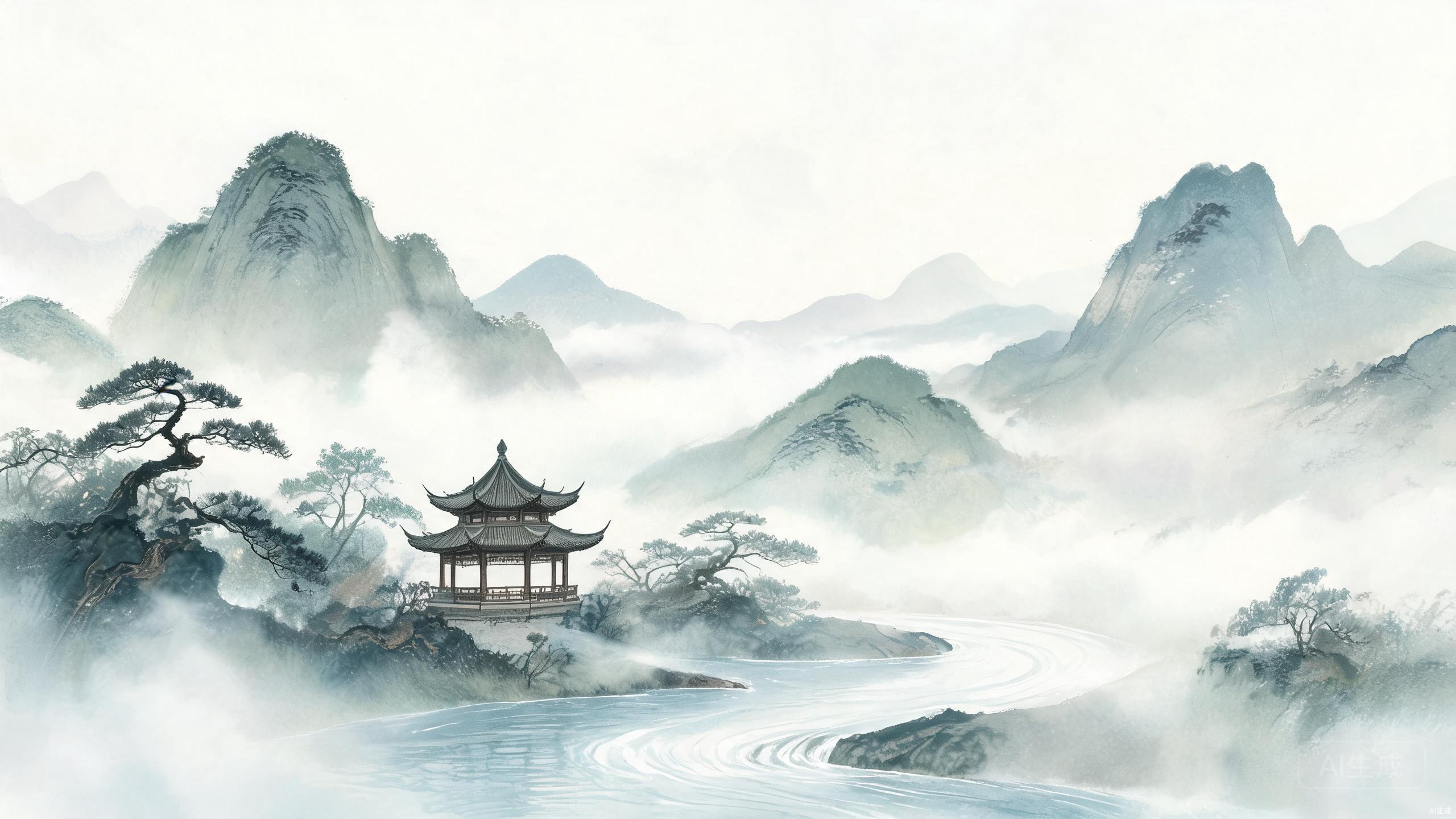
The first step in any traditional Chinese building project is "Xiang Di" (相地) — selecting an auspicious site. This practice represents the most fundamental application of Feng Shui, with its core principles being Mountains Embracing and Water Surrounding (山环水抱) and Storing Wind and Gathering Qi (藏风聚气).
An ideal building location should feature: a Backing Mountain (靠山) behind the structure, a flowing water feature in front, protective hills flanking both sides, and a Facing Mountain (朝山) in the near distance. This configuration is called the "Complete Four Symbols" (四象俱全) pattern — recognized as the most auspicious arrangement in Feng Shui.
Cultural Context: The Four Symbols — Azure Dragon (青龙), White Tiger (白虎), Vermilion Bird (朱雀), and Black Tortoise (玄武) — represent celestial guardians in Chinese cosmology. When all four appear in proper positions around a site, it is believed to receive maximum cosmic protection and blessing.
Traditional buildings — whether imperial palaces, temples, or vernacular homes — consistently followed this principle. The Forbidden City (紫禁城) is a textbook example: Jingshan Mountain serves as its Backing Mountain, the Golden Water River flows in front, and the moat and city walls act as protective flanks.
Adapting to Local Conditions
Feng Shui strongly emphasizes "adapting to local conditions" (因地制宜). Rather than rigidly applying fixed formulas, ancient builders determined placement and orientation based on the specific geographical environment. This flexible, responsive approach reflects the wisdom of China's early architects.
- Mountainous terrain: Buildings were typically placed on hillsides or at the foot of mountains — not on peaks (which catch harsh winds) or in valleys (which trap dampness). This positioning also optimizes natural light and ventilation.
- Flat plains: Structures were usually erected on slightly elevated ground to avoid flooding and dampness while maintaining good drainage.
Quick Tips:
- When choosing any property, observe how it sits relative to the surrounding landscape — gentle slopes usually outperform flat flood-risk areas
- Notice existing wind patterns: areas with stiff constant winds scatter Qi, while stagnant pockets suffocate energy
- Look for natural "armchair" formations — higher ground behind, open space ahead, gentle slopes or features at the sides
Feng Shui Principles for Architectural Layout
Central Axis Symmetry
One of the most distinctive features of traditional Chinese architecture is its Central Axis Symmetry (中轴对称). From imperial palaces to temples, from grand mansions to humble homes, the central axis has always been the organizing spine of the entire design.
The Central Axis is revered in Feng Shui as the building's "Dragon Vein" (龙脉). Key structures along this axis ascend gradually from south to north, forming what practitioners call a rising "dragon spine." This rising configuration symbolizes family prosperity and career advancement.
In a Siheyuan (四合院, traditional courtyard residence), the central axis typically contains: the main gate, spirit wall (影壁), front courtyard, principal north room (正房), rear courtyard, and back service quarters. The principal room — the tallest and most important structure — sits at the heart of the axis and is occupied by the family elders. The east and west wing rooms flank the axis symmetrically and house younger generations.
Cultural Context: This "orderly hierarchy" reflects the fusion of Confucian ritual principles (礼制) with Feng Shui cosmology. Physical position on the central axis directly corresponded to social rank, creating a living embodiment of the cosmic order within the family home.
Low in Front, High in Back
Another crucial layout principle is "Low in Front, High in Back" (前低后高). From the entrance gate to the principal north room, building heights progressively rise — creating a configuration called "Step-by-Step Ascent" (步步高升).
This arrangement, beyond its practical benefits for natural lighting, ventilation, and rainwater drainage, is believed in Feng Shui to "gather Qi." Practitioners call this pattern "children and grandchildren will be heroic and talented" (前低后高,子孙英豪), reflecting the belief that a rising back invites both fortune and prosperity into the home.
The Siheyuan: A Masterclass in Feng Shui Wisdom
The Siheyuan represents the quintessential Feng Shui-informed Chinese dwelling. Its layout — comprising a principal north room, east and west wings, a south-facing reception building, and enclosing walls — creates a sheltered courtyard defined by Feng Shui logic.
The Siheyuan's enclosed design exemplifies the Storing Wind and Gathering Qi principle (藏风聚气). The walls and buildings create a semi-sealed space that retains beneficial Qi while blocking external Sha Qi (harmful energy).
The main entrance is conventionally placed in the southeast corner — a placement known as the "Xun Gate" (巽门). The Xun trigram (巽卦) represents both the southeast direction and wind itself, carrying the auspicious meaning "wind rises, water flows" — symbolizing the stirring of fortune and abundance. Inside the gate, a spirit wall (影壁) blocks Sha Qi from rushing directly into the courtyard while also providing privacy.
Quick Tip: You can apply Siheyuan logic to modern homes by creating a defined entry threshold — even a small foyer with a console table or decorative screen mimics the Xun Gate function and prevents energy from rushing straight through your front door.
Feng Shui Principles for Building Structure
Roof Form and Design
The distinctive curved rooflines of traditional Chinese architecture serve both aesthetic and Feng Shui purposes. The graceful sweeps embody the cosmological concept of "Heaven is round, Earth is square" (天圆地方).
The curved ridges and eaves are designed to guide the flow of Qi, allowing it to glide smoothly across the roof surface. The decorative roof ornaments — the chiwen (鸱吻, mythical roof finials) and ridge animals (脊兽) — are believed to possess the power of Dissolving Sha (化煞) and warding off negative influences.
Bay Width and Building Depth
Even the proportions of traditional buildings — the relationship between width (开间, kaijian) and depth (进深, jinshen) — follow Feng Shui calculations. These dimensions were carefully determined to align with the "auspicious numbers" (吉数) of the tradition.
In imperial palaces and major temples, the number of bays is always odd: three, five, seven, or nine. Odd numbers are considered "Yang numbers" (阳数) in Feng Shui — representing positive, life-affirming energy. Nine bays represent the highest tier, reserved exclusively for the emperor.
Door Orientation
The direction a building's main door faces is perhaps the single most critical Feng Shui decision. In traditional practice, door placement was determined through the Bagua (八卦, Eight Trigrams) and Five Elements (五行) systems.
South-facing doors are the most common configuration. In Feng Shui, south corresponds to the Li trigram (离卦) and the Fire element — symbolizing brightness, warmth, and illumination. A south-facing door captures ample sunlight, benefiting residents' health, and is believed to "receive blessings" (纳福) from the surrounding environment.
How to Choose Your Door Direction
- Identify the facing direction: Stand inside your home facing outward through the main door — this is your "facing" direction
- Check the Bagua alignment: South-facing aligns with the Li trigram, traditionally the most auspicious for residential entry
- Observe light and traffic: Doors that receive morning or midday light tend to feel more welcoming and energetically vibrant
- Avoid direct alignment with roads: A door aimed straight at an oncoming street invites the Road Rushing Sha (路冲煞) — remedy with a screen or planting
The Feng Shui Significance of Architectural Decoration
Colors and the Five Elements
Color choices in traditional Chinese architecture were never purely decorative — they followed Five Elements principles. Each hue carries elemental associations, and their application followed the rules of Mutual Generation and Restriction (相生相克).
- Red — Fire element, symbolizing good fortune and celebration; the most widely used color in traditional buildings
- Yellow — Earth element, representing imperial authority; reserved exclusively for royal architecture
- Green — Wood element, signifying vitality and growth; common in garden pavilions and landscaped settings
- Blue — Water element, evoking tranquility and depth; frequently used in religious and ceremonial buildings
Auspicious Motifs
Traditional Chinese architecture is rich with auspicious symbols — dragons, phoenixes, Qilin (麒麟), bats, plum blossoms, lotus flowers — each carrying Feng Shui significance and believed to attract good fortune while warding off misfortune.
The dragon, as the totem of the Chinese nation, corresponds to the Azure Dragon (青龙) in Feng Shui — one of the Four Celestial Animals. The phoenix represents the Vermilion Bird (朱雀), another of the four guardians. Combined as "dragon and phoenix bringing auspiciousness" (龙凤呈祥), this motif symbolizes marital harmony and family happiness. Bats (蝙蝠, bianfu) carry a particularly clever blessing — their pronunciation mirrors "fortune" (福), giving rise to the saying "fortune descends from heaven" (福从天降).
Conclusion
The relationship between Feng Shui and Chinese traditional architecture represents one of the deepest and richest dimensions of ancient Chinese building culture. Feng Shui provided the foundational principles for site selection, layout, structure, and decoration — transforming traditional Chinese architecture into an integrated art form that united philosophy, aesthetics, and practical science.
Cultural Context: The deepest Feng Shui principle is Tian Ren He Yi (天人合一) — "Unity of Heaven and Humanity." This philosophy holds that human dwellings should exist in harmonious dialogue with cosmic forces, natural landscapes, and social order. Modern sustainable design movements share surprising overlap with these ancient ideas.
Even in today's world of steel, glass, and advanced engineering, the Feng Shui principles of cosmic harmony and balanced coexistence retain meaningful relevance. Studying and scientifically analyzing the Feng Shui wisdom embedded in traditional Chinese architecture helps us better protect and transmit this invaluable cultural heritage to future generations.
Quick Tips:
- Modern homeowners can apply Central Axis principles by aligning major rooms and furniture pieces along a single sightline from the main entrance
- Choose paint colors based on the directional Bagua of each room — south-facing rooms benefit from red and warm tones, north-facing rooms from blue and black
- Maintain clear sightlines and avoid clutter along your home's central axis to keep Qi flowing freely through the space
Related Articles
- [[../02-家居风水/29-厨房炉灶风水.md|Kitchen Stove Feng Shui: The Cooking Path to Water-Fire Balance and Household Peace]]
- [[../02-家居风水/28-book房文昌位布置.md|Study Room Wenchang Position Setup: Feng Shui Secrets to Boost Academic and Career Luck]]
- [[../04-商业风水/05-办公室风水布局.md|Office Feng Shui Layout: Executive Office and Desk Direction for Business Owners]]
- [[../08-百科问答库/15-什么是九宫飞星?如何推算流年吉凶方位?.md|What Are the Nine Palace Flying Stars? How to Calculate Annual Auspicious and Inauspicious Directions?]]