Feng Shui and the I Ching: Core Applications of the Eight Trigrams in Feng Shui Practice
The *I Ching* (易经, Book of Changes) is one of the most important classics of ancient China, revered as the "First of All Classics and Source of the Great Way." It serves not only as a shared philosoph
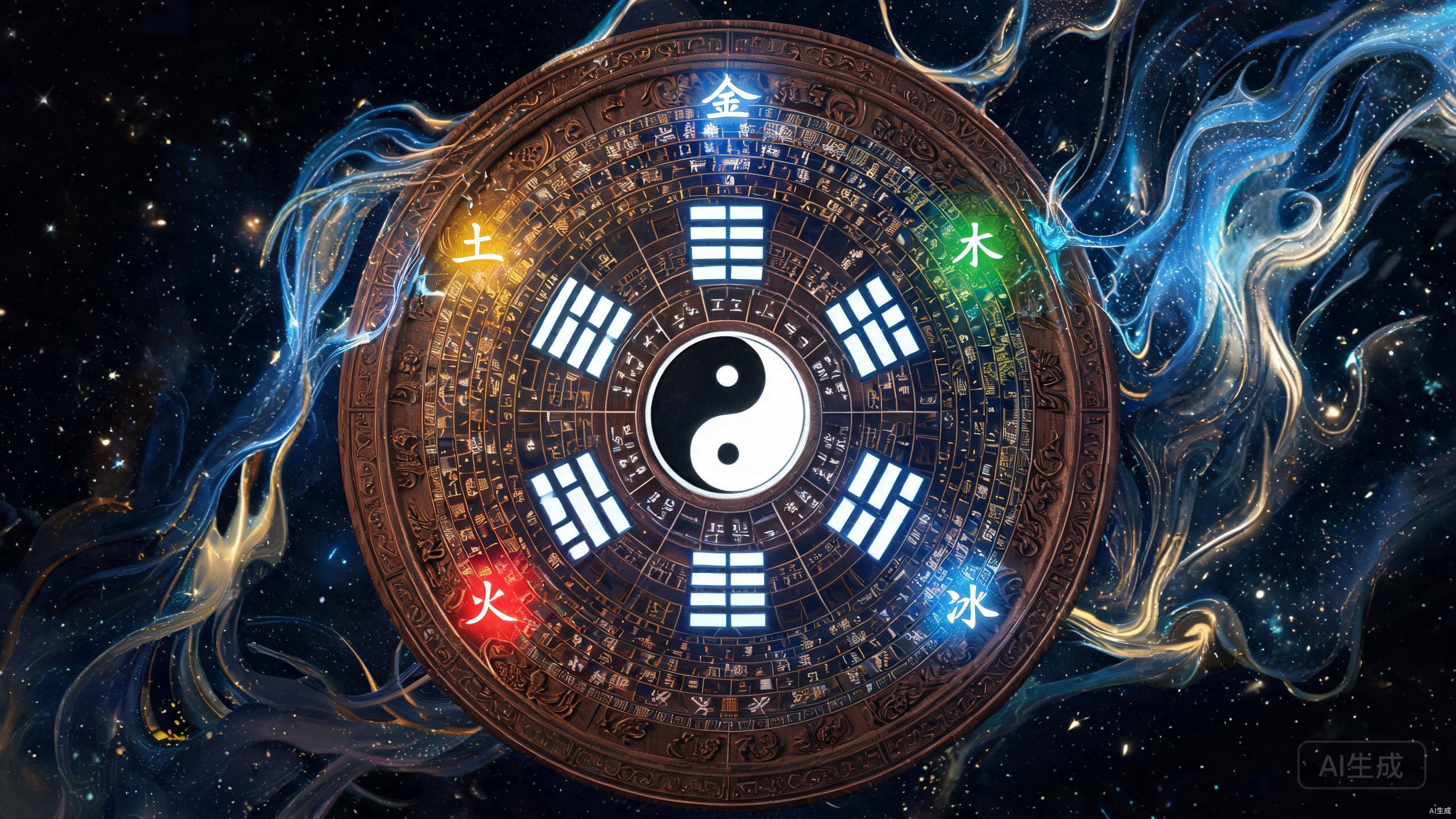
Introduction: The Relationship Between the I Ching and Feng Shui
The I Ching (易经, Book of Changes) is one of the most important classics of ancient China, revered as the "First of All Classics and Source of the Great Way." It serves not only as a shared philosophical foundation for Confucianism and Daoism but also as the most important theoretical source for Feng Shui. The core concepts found within the I Ching — the Yin-Yang theory, the Eight Trigrams (Bagua) framework, and the Five Elements' cycles of generation and restriction — form the most fundamental theoretical structure of Feng Shui.
The relationship between Feng Shui and the I Ching can be described as one of "substance and application": the I Ching is the "substance," serving as the philosophical foundation of Feng Shui; Feng Shui is the "application," representing the concrete spatial practice of I Ching thought. To understand the I Ching is to grasp the "why" of Feng Shui; to master Feng Shui is to grasp the practical "how-to" of the I Ching.
Basic Concepts of the I Ching and Eight Trigrams
The Origin and Meaning of the Eight Trigrams
The Bagua (八卦, Eight Trigrams) form the core content of the I Ching. Tradition holds that they were created by Fuxi (伏羲) based on the revelations of the Hetu (River Diagram) and Luoshu (Luo Writing). The Bagua consist of eight basic symbols (gua), named Qian, Kun, Zhen, Xun, Kan, Li, Gen, and Dui. Each trigram is composed of three yao (lines) — either yin or yang — representing eight fundamental categories of phenomena in the universe.
- Qian (乾) — three yang lines — represents Heaven, strength, the father, and the northwest
- Kun (坤) — three yin lines — represents Earth, yielding, the mother, and the southwest
- Zhen (震) — one yang line below — represents Thunder, movement, the eldest son, and the east
- Xun (巽) — one yin line below — represents Wind, penetration, the eldest daughter, and the southeast
- Kan (坎) — one yang line in the middle — represents Water, danger, the middle son, and the north
- Li (离) — one yin line in the middle — represents Fire, brightness, the middle daughter, and the south
- Gen (艮) — one yang line on top — represents Mountain, stillness, the youngest son, and the northeast
- Dui (兑) — one yin line on top — represents Lake, joy, the youngest daughter, and the west
Cultural Context: The Eight Trigrams are the building blocks of Chinese cosmology. Each trigram is a symbolic code capturing the essential qualities of a natural force or human relationship. When read together, they form a complete map of reality that has guided Chinese philosophy, medicine, and Feng Shui for over three thousand years.
The Correspondence Between the Bagua and Directions
The correspondence between the Bagua and directions is one of the most important applications in Feng Shui. Within the practice, the Bagua are used to mark the auspicious and inauspicious properties of different directions. Two main directional systems exist: the Earlier Heaven Bagua (先天八卦) and the Later Heaven Bagua (后天八卦).
The Earlier Heaven Bagua is traditionally attributed to Fuxi, with the following arrangement: Qian in the south, Kun in the north, Li in the east, Kan in the west, Dui in the southeast, Zhen in the northeast, Xun in the southwest, and Gen in the northwest.
The Later Heaven Bagua is traditionally attributed to King Wen of Zhou, with the following arrangement: Li in the south, Kan in the north, Zhen in the east, Dui in the west, Qian in the northwest, Kun in the southwest, Gen in the northeast, and Xun in the southeast.
In actual Feng Shui practice, the Later Heaven Bagua is used far more widely. Its directional system aligns more closely with China's actual geography, so it is the standard system employed in capital city planning, architectural layout, and burial site selection.
The Sixty-Four Hexagrams and Feng Shui
The Sixty-Four Hexagrams are formed by pairing and stacking the eight trigrams in all possible combinations, representing more complex phenomena and situations. In Feng Shui, the Sixty-Four Hexagrams are also used for auspicious and inauspicious judgments.
Each of the Sixty-Four Hexagrams in the I Ching includes a hexagram judgment (gua ci) and line judgments (yao ci), which are considered statements about the fortune of various situations. When facing complex cases, Feng Shui masters sometimes use the Sixty-Four Hexagrams for supplementary judgment. For example, the "Xuan Kong Da Gua" (玄空大卦) method within Xuan Kong Feng Shui uses the Sixty-Four Hexagrams to calculate auspicious and inauspicious outcomes.
The Application of Yin-Yang Theory in Feng Shui
The Principle of Yin-Yang Balance
The I Ching proposes that "One yin and one yang constitute the Dao" (一阴一阳之谓道), holding that the balance of Yin and Yang is the foundation for the proper functioning of all things in the universe. Feng Shui applies this principle to terrain evaluation, believing that the fortune of a place depends on whether Yin and Yang are in balance.
In practice, the principle of Yin-Yang balance is reflected in several dimensions:
- Terrain: Mountains (Yin) and water (Yang) must be in harmony. Mountains that are too tall create an excess of Yin; water that is too vast creates an excess of Yang. Only balanced mountain-and-water landscapes qualify as auspicious sites.
- Orientation: Sitting north (Yin) and facing south (Yang) is the ideal orientation, because north corresponds to Yin and south to Yang — achieving equilibrium at a single stroke.
- Interior Layout: The spaces inside a building must also honor Yin-Yang balance. Bedrooms favor Yin, living rooms favor Yang, kitchens favor Yang, and bathrooms favor Yin.
The Transformation of Yin and Yang
The I Ching holds that Yin and Yang are not fixed but transform into one another. This idea of "Yin-Yang transformation" is also reflected in Feng Shui.
Feng Shui believes that fortune and misfortune are not absolute — they can transform into each other. A particular Feng Shui pattern may be auspicious at one time but inauspicious at another. This is why the Compass School (理气派) emphasizes the time factor of the Three Cycles and Nine Periods (三元九运): as time changes, the Yin-Yang configuration shifts, and judgments of fortune must adjust accordingly.
Quick Tips:
- Check whether your home's mountains (solid structures behind) and water (open spaces or actual water features in front) feel balanced
- If your bedroom feels too stimulating, add Yin elements (soft fabrics, warm lighting, muted colors)
- If your living room feels cold or lifeless, add Yang elements (bright lamps, vibrant artwork, fresh flowers)
The Application of the Five Elements Theory in Feng Shui
The Generating and Restricting Relationships of the Five Elements
Although the Five Elements (五行, Wu Xing) theory does not originate directly from the I Ching, it is closely linked to the I Ching's Yin-Yang system. In Feng Shui, the generating and restricting cycles of the Five Elements are among the most basic tools for evaluation.
Mutual Generation (相生): Wood generates Fire, Fire generates Earth, Earth generates Metal, Metal generates Water, Water generates Wood.
Mutual Restriction (相克): Wood parts Earth, Earth absorbs Water, Water extinguishes Fire, Fire melts Metal, Metal cuts Wood.
In Feng Shui practice, the generating and restricting relationships are used to evaluate interactions between different directions and elements. For example, when determining a building's orientation, the practitioner's personal Five Element attribute is consulted: choose a direction that generates the practitioner's element, and avoid directions that restrict it.
The Correspondence Between Five Elements and Directions
In Feng Shui, the correspondence between the Five Elements and directions is: east belongs to Wood, south to Fire, west to Metal, north to Water, and center to Earth. This correspondence forms the foundation upon which the Compass School calculates fortune.
In Feng Shui layout, decorative colors, material choices, and functional arrangements in each direction should be determined according to the Five Elements' attributes. For example, since the east belongs to Wood, green décor is appropriate to strengthen Wood Qi; since the south belongs to Fire, red décor enhances Fire Qi. If a particular direction's element clashes with the building's function, the "Five Element Bridge" (五行通关) method can be used to harmonize the conflict.
Cultural Context: The Five Elements are not just substances — they are dynamic qualities of energy. "Wood" represents growth and flexibility, "Fire" represents transformation and visibility, "Earth" represents stability and nourishment, "Metal" represents clarity and structure, and "Water" represents flow and adaptability. When you decorate a space, you are inviting these qualities into your life.
Specific Applications of the Bagua in Feng Shui
Eight Mansions Feng Shui
Eight Mansions Feng Shui (八宅风水) is the direct application of the Bagua in residential Feng Shui. The Eight Mansions method divides homes into East Four Mansions and West Four Mansions, and uses the homeowner's "Life Gua" (命卦) to determine the house's orientation and the layout of rooms.
- East Four Mansions include Zhen (east), Xun (southeast), Li (south), and Kan (north)
- West Four Mansions include Qian (northwest), Kun (southwest), Gen (northeast), and Dui (west)
Homeowners' Life Gua are likewise divided into East Four Life and West Four Life. East Four Life people thrive in East Four Mansions; West Four Life people thrive in West Four Mansions.
The Eight Mansions method further divides the eight directions of a home into "Four Auspicious" and "Four Inauspicious" directions. Auspicious directions are best assigned to important functions (such as the bedroom, living room, or study), while inauspicious directions are better suited to secondary functions (such as the bathroom, storage room, or kitchen).
Xuan Kong Nine Palaces
The Xuan Kong Nine Palaces (玄空九宫) extends the Bagua into the dimension of time. It combines the Bagua with the Nine Palaces of the Luoshu, tracking how nine stars move through the nine palaces to calculate the fortune of each direction at different times.
The core of Xuan Kong Nine Palaces is the "Flying Stars" — nine stars (One White Greedy Wolf, Two Black Giant Door, Three Jade Lu Cun, Four Green Literary Star, Five Yellow Lian Zhen, Six White Military Star, Seven Red Broken Army, Eight White Left Helper, and Nine Purple Right Helper) moving along their trajectories through the Nine Palaces. Each star carries its own Five Element attribute and fortune quality. As time and the "Yun" (period) change, the stars' positions shift, affecting the fortune of every direction.
The Bagua and the Twenty-Four Mountains
The Twenty-Four Mountains (二十四山) is the precise directional system used in Feng Shui, dividing the full circle into twenty-four equal segments of fifteen degrees each. The Twenty-Four Mountains are composed of the Twelve Earthly Branches, eight Heavenly Stems, and the four inter-cardinal trigrams (Qian, Kun, Gen, Xun) — the latter taken directly from the Bagua.
The Twenty-Four Mountains system is a refinement of the Bagua directional system, allowing Feng Shui masters to determine building orientation and layout with much greater precision. Within the Compass School, the Twenty-Four Mountains serve as the foundational tool — all judgments of fortune are built upon this framework.
How to Apply the Bagua in Your Home
- Identify your Life Gua: Calculate your personal trigram number using your year of birth — this determines which directions are most auspicious for you
- Map your home's Bagua: Stand at your front door facing inward and place the Bagua over your floor plan, with the bottom edge aligned to your entrance wall
- Assign functions to directions: Place key living spaces (bedroom, office) in your auspicious directions and secondary spaces (storage, bathroom) in less favorable ones
- Enhance each sector: Decorate each Bagua sector with its corresponding element, colors, and imagery
The Use of Hexagram Imagery in Feng Shui Judgment
The Correspondence Between Hexagrams and Natural Environments
In practice, Feng Shui masters often use hexagram imagery to describe and evaluate natural environments. For example, the Qian trigram represents Heaven and also the northwest direction. If there is a tall mountain to the northwest, it is considered a "Qian Mountain." The Kun trigram represents Earth and also the southwest direction. If there is a low-lying area to the southwest, it is considered "Kun Land."
Through these correspondences between hexagrams and natural environments, masters can quickly judge the fortune of a place. For example, the Qian direction (northwest) prefers height to lowness, while the Kun direction (southwest) prefers lowness to height — a consistency with the attributes of Qian (Heaven) and Kun (Earth).
The Correspondence Between Hexagrams and Architecture
Hexagram imagery is also applied to architectural analysis. For example, the Qian trigram represents "strength" and is suited to main buildings; the Kun trigram represents "yielding" and is suited to auxiliary buildings. In architectural layout, assigning different functional spaces according to hexagram attributes can achieve the effect of attracting fortune and avoiding misfortune.
The "Tai Hexagram" (泰卦, Hexagram 11: Earth over Heaven) in the I Ching is considered an auspicious symbol, representing the fusion of Heaven and Earth and the smooth flow of all things. In Feng Shui layout, achieving the configuration of the Tai Hexagram — where the Qi of Heaven and Earth intermingle — is regarded as a fortunate pattern.
Quick Tip: While modern apartments rarely allow you to literally reshape the surrounding landscape, you can honor hexagram principles by ensuring the most prominent structure (your home's main building or the tallest structure nearby) anchors your "Qian" direction, while softer, lower landscaping balances your "Kun" direction.
Conclusion
The relationship between the I Ching and Feng Shui represents one of the most profound "substance and application" pairings in Chinese traditional culture. The I Ching provides Feng Shui with its core theoretical tools — Yin and Yang, the Bagua, and the Five Elements — elevating Feng Shui into a discipline grounded in deep philosophy. Feng Shui, in turn, transforms the abstract theories of the I Ching into concrete spatial practice, allowing the wisdom of the I Ching to find tangible expression in everyday life.
In contemporary society, we should re-examine the relationship between the I Ching and Feng Shui with a scientific attitude. The dialectical thinking and systems perspective embedded in the I Ching continue to hold meaningful insights for modern scientific research. Although Feng Shui carries elements of mysticism, the I Ching wisdom it preserves is a treasured spiritual heritage of the Chinese nation — well worth our careful study and inheritance.
Related Articles
- [[../01-风水入门/04-五行与八卦.md|Five Elements and Bagua: Mutual Generation, Restriction, and Earlier/Later Heaven]]
- [[../08-百科问答库/45-什么是八卦?八卦在风水中有什么作用?.md|What Are the Eight Trigrams? Their Role in Feng Shui]]
- [[../01-风水入门/18-风水中的藏风聚气.md|The Principle of "Storing Wind and Gathering Qi" in Feng Shui]]
- [[../02-家居风水/37-植物与风水.md|Plants and Feng Shui: Five Elements Harmony and Wealth Activation Through Greenery]]