Feng Shui Classics in the Siku Quanshu: Imperial Library's Collection of Ancient Feng Shui Texts
The *Siku Quanshu* (Complete Library of the Four Treasuries) is the largest book collection in Chinese history, compiled during the Qianlong reign of the Qing Dynasty (1773–1782). Led by Ji Yun (纪昀, a
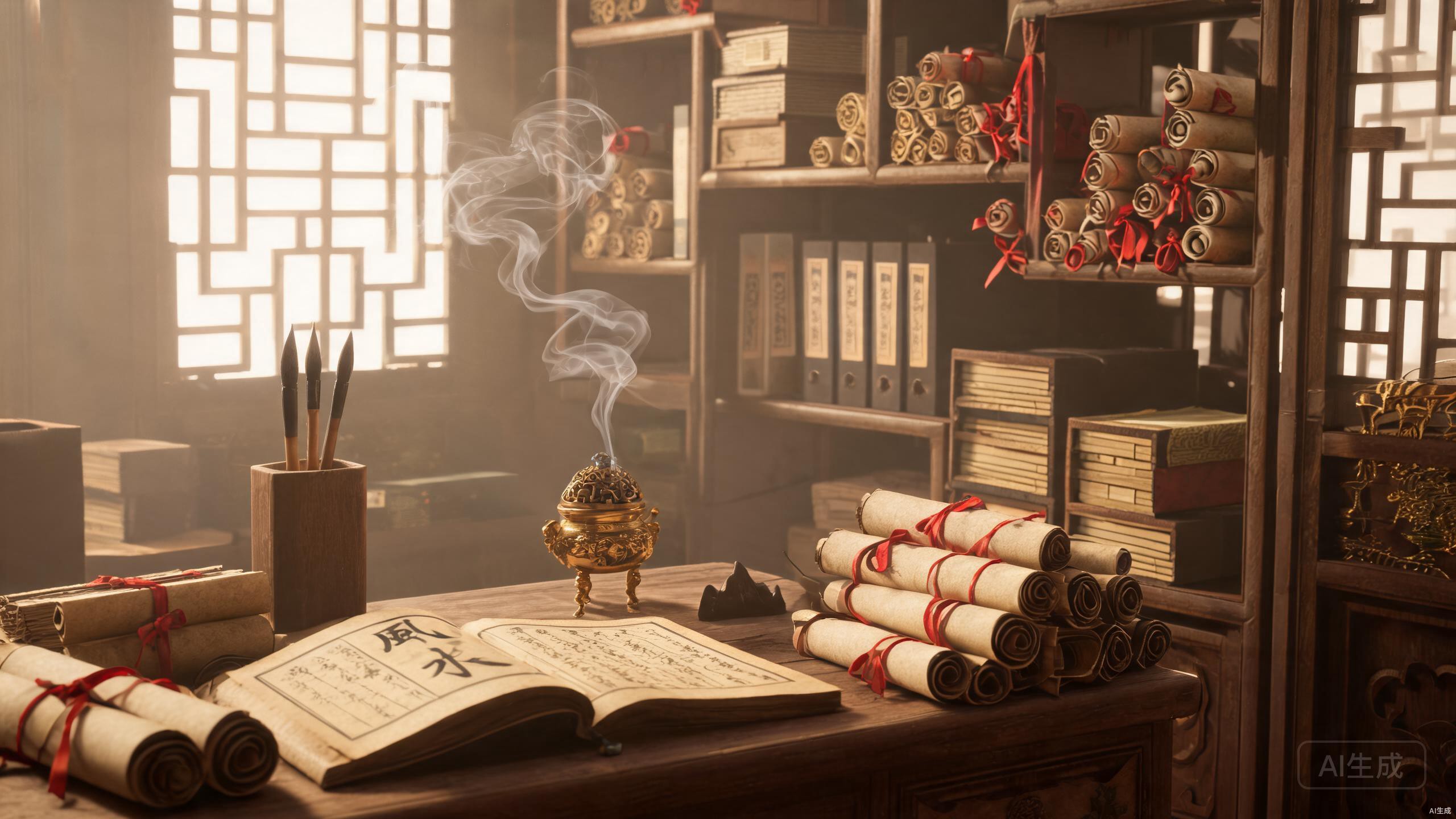
Introduction: The Feng Shui Category in the Siku Quanshu
The Siku Quanshu (Complete Library of the Four Treasuries) is the largest book collection in Chinese history, compiled during the Qianlong reign of the Qing Dynasty (1773–1782). Led by Ji Yun (纪昀, also known as Ji Xiaolan) and over 360 scholars, the project took more than a decade to complete. The collection contains 3,461 works across 79,309 volumes, organized into four divisions: Classics, History, Philosophy, and Literature. Feng Shui texts were primarily classified under the Philosophy division's Shu Xue (术数, "Arts of Calculation") category, alongside mathematics, astronomy, dwelling and grave divination, and fortune-telling.
Cultural Context: The Siku Quanshu represents one of the most ambitious literary preservation projects in world history. The compilers followed a selective principle — "including works that align with reason, while removing those that dwell on the bizarre and absurd" — making it both a treasure trove and a curated filter for traditional Chinese knowledge.
The Four Library Compilers (四库馆臣) applied the principle of "preserving works aligned with rational principles and eliminating those tainted by superstition" to systematically examine, organize, and evaluate Feng Shui texts across the dynasties. This article provides a systematic investigation of the Feng Shui works in the Siku Quanshu, including their general scope, compilation principles, catalog summaries, and lasting academic influence.
Overview and Classification of Feng Shui Classics
Collection Scope and Composition
The Feng Shui works in the Siku Quanshu are primarily found under the "Dwelling and Grave Divination" (相宅相墓) subcategory within the Philosophy division's Shu Xue category. According to the Siku Quanshu Zongmu (General Catalog of the Complete Library), over 20 Feng Shui works were included — both standalone texts and related works appearing under other categories. These classics span from the Han Dynasty to the Ming Dynasty, representing the major schools and foundational works of Chinese Feng Shui. Additionally, extensive Feng Shui-related discussions appear scattered throughout other sections of the Classics, History, and Philosophy divisions. Though limited in number, the selected texts are carefully chosen, reflecting the main theoretical systems and historical development of ancient Chinese Feng Shui.
Quick Tips:
- The Shu Xue (术数) category includes various traditional Chinese metaphysical disciplines, not just Feng Shui
- The compilers' selective approach means some influential Feng Shui texts were excluded — their absence doesn't necessarily reflect the texts' historical importance
Key Classics Included
Among the most significant Feng Shui works in the Siku Quanshu are:
Zang Shu (Book of Burial) — Traditionally attributed to Guo Pu (郭璞) of the Jin Dynasty, this is the foundational text of Feng Shui theory. The Four Library Compilers determined that while Guo Pu was not the original author, the work "principally addresses landform and configuration" (大旨主于形势), making it the theoretical source of the Form School. The book systematically discusses the gathering and dispersing of Qi, the influence of mountain formations on grave site auspiciousness, and introduces the core tenet: "Burial means riding Vital Qi" (葬者乘生气也).
Zhai Jing (Classic of Dwelling) — Traditionally attributed to the Yellow Emperor but actually compiled during the Tang Dynasty, this is an essential text on residential Feng Shui. Built on the theoretical foundation of Yin and Yang and the Bagua (Eight Trigrams), it emphasizes the relationship between dwelling orientation, layout, and the occupant's destiny, proposing the assertion that "a dwelling is the pivot of Yin and Yang."
Qing Nang Ao Yu (Green Satchel Mysterious Words) and Tian Yu Jing (Classic of Heavenly Jade) — Traditionally attributed to Yang Yunsong (杨筠松) of the Tang Dynasty, these are important texts of the Form School. Written in poetic verse, the former focuses on identifying Dragon Veins and Feng Shui Points, while the latter emphasizes the coordination of Li Qi (Compass Energy) and directional alignment.
Di Li Da Quan (Comprehensive Geography) and Di Li Tong Yi Quan Shu (Unified Complete Book of Geography) — These are the great compendiums of Ming Dynasty Feng Shui, compiling the theoretical essence of all Feng Shui schools from the Song and Yuan dynasties onward, reflecting the complete picture of Ming-era Feng Shui scholarship.
The Four Library Compilers' Principles and Academic Stance
Selection Standard: Eliminating Falsehood, Preserving Truth
When selecting Feng Shui texts, the compilers explicitly applied the principle of "removing falsehood and preserving truth" (去伪存真). In the preface to the Shu Xue category of the Siku Quanshu Zongmu, Ji Yun and his colleagues observed: "The arts of calculation have existed for a long time. Yet when astronomical observation and calendrical calculation occasionally produce verified results, they cannot be entirely dismissed as absurd. As for forced interpretations and bizarre fabrications, these must be carefully distinguished."
Cultural Context: This balanced approach reflects the Qianlong-era scholarly ideal of "seeking truth from facts" (实事求是). The compilers did not reject all metaphysical traditions outright — they distinguished between practical, theoretically coherent works and those lacking rigorous foundations.
Based on this principle, the compilers conducted strict screening, prioritizing works with complete theoretical systems, elegant prose, and academic value, while excluding crude, superstitious texts of no scholarly merit.
Academic Criticism: Distinguishing Scholarly Traditions
The compilers did not accept the included Feng Shui texts uncritically — they conducted thorough academic criticism. In the catalog summaries of the Siku Quanshu Zongmu, they examined each work's authorship authenticity, compilation date, textual lineage, and academic value. For example, regarding the Zang Shu, the compilers carefully verified that the author was not Guo Pu, but rather later practitioners who "attached themselves to his name." However, they simultaneously noted that "its principles have merit" (理有可取), and therefore included it. This attitude of "examining authenticity and evaluating right from wrong" embodies the Qianlong-Jiaqing scholarly tradition of evidence-based textual research.
Reconstruction and Organization During Compilation
During the compilation process, the editors also recovered multiple lost Feng Shui works from the Yongle Dadian (Yongle Encyclopedia). The most representative example is the reconstruction of the Zhai Jing. The compilers extracted its lost passages from various rhyme sections of the Yongle Dadian and reorganized the scattered Yellow Emperor's Classic of Dwelling into a complete text based on records in the Song Shi: Yi Wen Zhi (Treatise on Literature of the Song History). This recovery work preserved many Feng Shui texts on the verge of being lost forever, making a vital contribution to the transmission of Feng Shui scholarship.
Catalog Summary Content and Academic Evaluation
Documentary Value of the Summaries
Each catalog summary of a Feng Shui text in the Siku Quanshu Zongmu holds exceptional documentary value. The compilers examined each work's authorship, historical period, content focus, and textual lineage, providing reliable academic foundations for later scholars studying Feng Shui literature. For instance, in the Zang Shu summary, the compilers traced the text's transmission from the Tang to Ming dynasties, noting that "since the Song Dynasty, it has been revered by practitioners." In the Qing Nang Ao Yu summary, they analyzed the core elements of Yang Yunsong's Feng Shui theory and compared its similarities and differences with later Feng Shui schools.
Academic Bias in the Summaries
It must be acknowledged that the compilers' evaluations of Feng Shui also carry obvious historical limitations and scholarly biases. As Confucian orthodox scholars, they maintained a dismissive attitude toward the "ghosts and spirits" concepts and "incantations" found in Feng Shui, frequently using terms like "preposterous" (悠谬) and "bizarre and absurd" (怪诞) to denigrate such content. This evaluation reflects the Qing official academic establishment's rejection of folk beliefs, and to some extent influenced later generations' objective assessment of Feng Shui's academic value. However, it is precisely this "critical inclusion" approach that allows the Siku Quanshu to preserve Feng Shui literature while simultaneously providing future generations with multiple perspectives from which to examine the tradition.
Quick Tips:
- When reading Qianlong-era evaluations of Feng Shui, consider the Confucian scholarly bias of the period
- Terms like "bizarre" and "preposterous" in the original summaries often reflect officialdom's discomfort with folk practices rather than genuine textual criticism
- Modern researchers benefit from reading these evaluations alongside the actual texts to form balanced judgments
Academic Influence and Historical Position
Impact on Qing Dynasty Feng Shui Scholarship
The compilation and inclusion of Feng Shui texts in the Siku Quanshu had a profound influence on the development of Qing Dynasty Feng Shui studies. On one hand, the compilers' critical findings provided reliable textual foundations for Qing Feng Shui scholars. On the other hand, their academic treatment of Feng Shui texts elevated the field's scholarly status, gradually moving it from purely folk practice into academic discourse. The Feng Shui textual research works that emerged in the mid-to-late Qing Dynasty — such as Di Li Bian Zheng Shu (Commentary on Correcting Geography) and Feng Shui Qu Huo (Dispelling Doubts About Feng Shui) — were all produced under the influence of the Siku academic tradition.
Documentary Value for Modern Feng Shui Research
The Feng Shui texts included in the Siku Quanshu remain essential sources for researchers today. These works have been systematically organized by the compilers, with reliable editions and standardized texts, offering high academic reference value. Simultaneously, the catalog summaries in the Siku Quanshu Zongmu provide researchers with the academic framework and evaluation context for understanding ancient Feng Shui literature. In contemporary Feng Shui scholarship, the texts preserved in the Siku Quanshu remain indispensable foundational sources.
Conclusion: The Contemporary Significance of Feng Shui Classics in the Siku Quanshu
The Feng Shui texts included in the Siku Quanshu represent a systematic organization and academic evaluation of China's ancient Feng Shui cultural heritage by Qing Dynasty scholars. These works preserve the theoretical essence of Feng Shui while also reflecting the Qing official academic establishment's attitude toward folk metaphysical traditions. Today, re-examining the Feng Shui literature in the Siku Quanshu not only helps us understand the historical evolution of Feng Shui as a discipline, but also enables us to approach this unique Chinese cultural phenomenon with greater objectivity. As cultural heritage, the value of these Feng Shui texts has transcended the narrow category of "metaphysical arts" — they have become important historical materials for studying ancient Chinese cosmology, environmental philosophy, and social life.
How to Apply This Historical Understanding
- For researchers: Use the Siku Quanshu Zongmu summaries as a starting point for identifying reliable Feng Shui texts, but always consult the actual works for nuanced interpretation
- For practitioners: Understanding the historical compilation context helps distinguish between academically grounded Feng Shui principles and later folk embellishments
- For students: The critical method demonstrated by the Four Library Compilers — examining authenticity and evaluating merit — is a valuable model for approaching any traditional knowledge system
- For cultural enthusiasts: Recognize that Feng Shui has both philosophical depth and folk practice dimensions; the Siku Quanshu captures this duality in fascinating ways
Related Articles
- [[../06-风水文化与历史/19-风水典籍解析:《青囊序》——曾文辿的玄空启蒙.md|Feng Shui Classic Analysis: "Preface to the Green Satchel" — Zeng Wendan's Introduction to Xuan Kong]]
- [[../06-风水文化与历史/15-风水典籍解析:《葬书》——郭璞的风水理论精髓.md|Feng Shui Classic Analysis: "Book of Burial" — The Essence of Guo Pu's Feng Shui Theory]]
- [[../01-风水入门/10-风水常见误区澄清.md|Common Feng Shui Misconceptions: Distinguishing Superstition from Science]]
- [[../01-风水入门/51-风水测量工具大全.md|Complete Guide to Feng Shui Measurement Tools: From Traditional to Modern Equipment]]