Feng Shui in Wei, Jin, and Northern & Southern Dynasties: Development Under Metaphysical Influence
The Wei, Jin, and Northern & Southern Dynasties period (220–589 AD) was one of political upheaval and dramatic social transformation in Chinese history — yet it was also an era of unprecedented intell
Introduction: A New Chapter for Feng Shui in the Era of Xuanxue
The Wei, Jin, and Northern & Southern Dynasties period (220–589 AD) was one of political upheaval and dramatic social transformation in Chinese history — yet it was also an era of unprecedented intellectual activity and academic innovation. During this time, the rise of Xuanxue (玄学, "Dark Learning" or Neo-Daoist metaphysics), the formation and development of Daoism, and the introduction and localization of Buddhism together created a complex and pluralistic intellectual landscape.
Within this cultural context, Feng Shui also encountered an important opportunity for development. The Wei-Jin metaphysical exploration of philosophical categories such as "nature," "Qi," and "being/non-being" provided a more refined philosophical foundation for Feng Shui theory. The appearance of Guo Pu's Zang Shu (Book of Burial) marked the establishment of Feng Shui's theoretical system. And the aristocratic clans' emphasis on burial sites drove the widespread dissemination of Feng Shui practice among the elite.
This article systematically examines the development of Feng Shui during the Wei, Jin, and Northern & Southern Dynasties from the perspectives of metaphysical influence, theoretical construction, school differentiation, and social practice.
The Influence of Xuanxue Thought on Feng Shui Theory
The Concept of Nature and the Philosophization of Feng Shui
One of the central debates of Wei-Jin Xuanxue was the relationship between "nature" (自然, zìrán) and "the conventional order" (名教, míngjiào). The Xuanxue thinkers emphasized "the Dao follows nature," holding that the universe has its own内在 order and patterns, and that human beings should align with nature rather than work against it.
Cultural Context: Xuanxue (玄学, "Dark Learning") was a philosophical movement that flourished among the elite of the Wei-Jin era. Often called "Neo-Daoism" by Western scholars, it reinterpreted Daoist classics through abstract metaphysical speculation. Its influence on Feng Shui was profound: it shifted the practice away from religious divination toward a more philosophical understanding of natural patterns. The interplay of Yin and Yang — the dual forces of dark/light, passive/active — governs all Feng Shui applications.
This concept of "nature" had a far-reaching impact on Feng Shui theory. Under its influence, Feng Shui began to break away from the dense religious theology of the Han Dynasty's "Heaven-Human Resonance" (天人感应) and turned toward a more rational exploration of natural patterns. The concept of "Qi" (气) within Feng Shui theory acquired a more philosophical meaning — Qi was no longer a mysterious, supernatural force, but the fundamental constituent element of all things in the universe, whose gathering and dispersal follow natural laws. This philosophization gave Feng Shui a more refined and abstract theoretical form.
The Debate on Words and Meanings and the Evolution of Feng Shui Methods
The Wei-Jin Xuanxue "debate on words and meanings" (言意之辨) — the philosophical discussion of whether language can fully express meaning — also influenced Feng Shui methodology. The Xuanxue philosopher Wang Bi (王弼) proposed the epistemology of "capturing the meaning and forgetting the image; capturing the image and forgetting the words" (得意忘象,得象忘言), emphasizing the need to transcend concrete "images" (trigrams, visual forms) to grasp the "meaning" (essence, underlying principles).
This way of thinking influenced the Feng Shui concept of "form and configuration" (形势). When a Feng Shui practitioner observes the configuration of mountains and rivers, they should not remain at the surface level of mere "form," but must see through the "form" to grasp the flow of Qi and the auspicious or inauspicious "meaning" within. This "capturing the meaning and forgetting the form" methodology transformed Feng Shui practice from rigid rule-following into a more flexible and intuitive form of judgment.
Guo Pu and the Theoretical Contributions of the Zang Shu
The Composition of the Zang Shu and the Question of Authorship
The Zang Shu (《葬书》, Book of Burial) is one of the most influential classics in the history of Feng Shui, traditionally attributed to Guo Pu (郭璞) of the Jin Dynasty. Guo Pu (276–324 AD), courtesy name Jingchun (字景纯), was a native of Wenxi in Hedong Commandery. He was a renowned Eastern Jin scholar, well-versed in Yin-Yang calendrical calculations and the Five Elements arts, and authored scholarly works such as Erya Zhu (Annotations on the Erya) and Fangyan Zhu (Annotations on Fangyan). He was also accomplished in literature.
Cultural Context: Guo Pu is reverently called the "Founder of Feng Shui" (风水鼻祖) in Chinese tradition. Beyond his scholarly pursuits, he was famous for his abilities in divination and his somewhat unorthodox lifestyle — including reportedly transforming into a crane. His legacy bridges mainstream Confucian scholarship and esoteric metaphysical arts. The interplay of Yin and Yang — the dual forces of dark/light, passive/active — governs all Feng Shui applications.
Regarding whether Guo Pu actually wrote the Zang Shu, academic debate exists. Qing Dynasty scholars of the Siku Quanshu (Complete Library of the Four Treasuries) concluded that while the Zang Shu was not in Guo Pu's own hand, its main emphasis on "form and configuration" can be traced back to his theoretical lineage. Modern scholars generally believe that the core content of the Zang Shu was formed during the Wei-Jin period, with Guo Pu likely serving as its principal theoretical founder, while the text was supplemented and revised by later generations.
The Core Theory of the Zang Shu
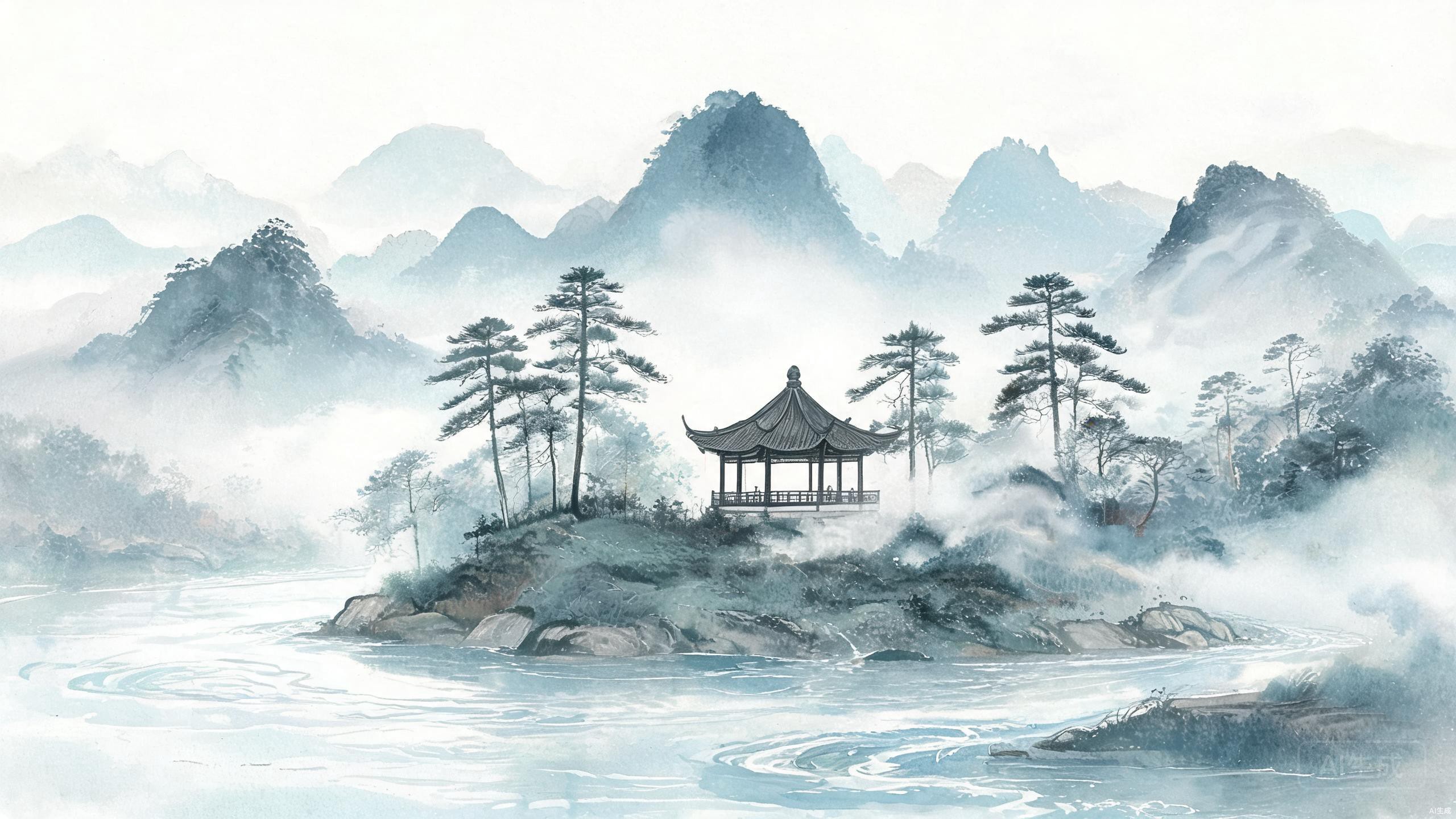
The central proposition of the Zang Shu is: "Burial means riding upon Vital Qi" (葬者乘生气也). This statement introduces the concept of Qi into burial site selection, holding that the key to choosing a burial site lies in finding where Vital Qi gathers and concentrates. Vital Qi (生气, sheng qi) is the inexhaustible life force of the universe — it disperses when encountering wind, and stops when encountering water. Therefore, a good burial site should be able to "store wind and gather Qi" (藏风聚气) — surrounded by embracing mountains to block the wind, with water flowing in front to contain the Qi.
Cultural Context: "Storing Wind and Gathering Qi" (藏风聚气, cáng fēng jù qì) remains one of the most important foundational principles of Feng Shui practice today. Whether designing a garden, siting a home, or arranging an office, practitioners apply this same logic: block harsh incoming forces while retaining nourishing energy. The interplay of Yin and Yang — the dual forces of dark/light, passive/active — governs all Feng Shui applications.
The Zang Shu also proposed the theory that "the Five Qi move within the earth and generate all things" (五气行乎地中,发而生乎万物), linking the Qi of the Five Elements (五行) to geographic environment. The book discussed in detail methods for identifying the gathering and dispersal of Qi by observing the configuration of mountains and rivers — including the form theory of "a thousand feet constitutes momentum; a hundred feet constitutes form" (千尺为势,百尺为形), and the Four Animals model of "Azure Dragon on the left, White Tiger on the right, Vermilion Bird in front, and Black Tortoise behind" (左青龙、右白虎、前朱雀、后玄武). These theories became the core content of the Form School (形势派) of Feng Shui in later generations.
The Historical Significance of the Zang Shu
The appearance of the Zang Shu marked Feng Shui's elevation from scattered empirical observation to a systematic theoretical framework. It established the basic conceptual architecture of Feng Shui (Qi, momentum, form, dragon, acupoint, sand, water, etc.), providing a theoretical paradigm for the development of later Feng Shui schools. Only after the Zang Shu did Feng Shui possess a true "classic" in the meaningful sense — every later school, whether the Form School (形势派) or the Compass School (理气派), traces its theoretical roots back to this text. It can fairly be called a landmark work in the history of Feng Shui.
The Differentiation of Feng Shui Schools and Regional Characteristics
The Rise of Southern Feng Shui Traditions
An important development in Feng Shui during the Wei, Jin, and Northern & Southern Dynasties period was the rise of southern Feng Shui traditions. As central plains aristocratic clans migrated southward, Feng Shui knowledge was introduced to the Jiangnan region, where it merged with the southern geographic environment to form regionally distinctive practices.
Cultural Context: The Jiangnan region — the area south of the Yangtze River — features abundant waterways, low hills, and a humid subtropical climate. These conditions naturally favored Feng Shui approaches that emphasized water management, gentle landscape contours, and the integration of built structures with mist-laden scenery — quite different from the dramatic mountain-and-river landscapes of the north. The interplay of Yin and Yang — the dual forces of dark/light, passive/active — governs all Feng Shui applications.
The Jiangnan region's mountainous terrain and abundant waterways prompted Feng Shui practitioners to pay greater attention to observing and judging the configuration of mountains and rivers, advancing the development of Form School theory. At the same time, the flourishing of Daoist culture in the south infused Feng Shui with new religious elements.
Daoism's Influence on Feng Shui
The Wei, Jin, and Northern & Southern Dynasties was a critical period for the formation and rapid development of Daoism, which exerted a far-reaching influence on Feng Shui. The Daoist classic Taiping Jing (Scripture of Great Peace) contained rich Feng Shui thought, emphasizing the notion that "the dwelling is the root of the person" (宅者,人之本). Daoist cultivation and understanding of Qi also provided new resources for Feng Shui theory. Daoist elements such as "talismans" (符箓) and "incantations" (咒语) were integrated into Feng Shui practice, forming the tradition of "talismans and incantations" (符咒) within Feng Shui. The interaction between Daoism and Feng Shui in both theory and practice is a defining feature of Feng Shui's development during this period.
The Socialization of Feng Shui Practice
The Aristocratic Clans and Feng Shui Burial Sites
During the Wei, Jin, and Northern & Southern Dynasties period, the aristocratic clan society attached extreme importance to Feng Shui burial sites. The great families regarded burial sites as crucial to the rise and fall of the clan, sparing no expense in hiring Feng Shui masters to search for "auspicious sites" (吉地). This custom is well documented in texts such as the Shishuo Xinyu (A New Account of Tales of the World) and the Jin Shu (Book of Jin).
For example, Eastern Jin power figures such as Wang Dao (王导) and Huan Wen (桓温) were extremely particular about their burial site selections, and historical records also contain legendary stories of "Feng Shui grave-robbing" (风水发冢). The aristocratic clans' enthusiasm for Feng Shui drove the dissemination of Feng Shui knowledge and the rise of Feng Shui as a profession.
Quick Tips:
- The social prestige of Feng Shui in early imperial China was largely driven by elite patronage — when powerful families invested in burial site selection, it elevated the practice's legitimacy
- Many of the foundational Feng Shui texts were preserved because aristocratic families commissioned copies for their own use, then passed them down through generations
Feng Shui Records in World Literature
The historical records, zhiguai (志怪, "records of the strange") fiction, and geographic treatises of the Wei, Jin, and Northern & Southern Dynasties period preserve a wealth of documentation on Feng Shui practice. Strange tales in works such as the Soushen Ji (搜神记, In Search of the Supernatural) and Shiyi Ji (拾遗记, Records of Neglected Matters) include many stories of Feng Shui wonders. Geographic works such as the Shuijing Zhu (水经注, Commentary on the Water Classic) contain rich geographic knowledge and Feng Shui concepts. These texts provide invaluable material for researching Feng Shui practice during this period.
Conclusion: The Feng Shui Legacy of the Xuanxue Era
During the Wei, Jin, and Northern & Southern Dynasties period, under the profound influence of Xuanxue thought, Feng Shui completed its transformation from the Han Dynasty system of occult arts into a more theoretical and philosophical discipline. The appearance of Guo Pu's Zang Shu established the basic theoretical paradigm of Feng Shui. The rise of southern Feng Shui traditions laid the foundation for the development of the Form School. The interaction between Daoism and Feng Shui enriched Feng Shui's theoretical resources.
The Feng Shui developments of this period not only prepared the theoretical groundwork for the maturation of Feng Shui in the Sui and Tang Dynasties, but also opened up the possibility of Feng Shui's diverse development in later eras. The scholarly legacy of Wei, Jin, and Northern & Southern Dynasties Feng Shui deserves further in-depth exploration and research by contemporary scholars.
Related Articles
- [[../07-风水故事/13-郭璞择葬传说.md|Guo Pu's Burial Site Legend: The Founder of Feng Shui's Grave Secrets]]
- [[../01-风水入门/18-风水中的藏风聚气.md|"Storing Wind and Gathering Qi" Principle in Feng Shui]]
- [[../07-风水故事/58-风水与丧葬.md|Feng Shui and Burial: The Ancient Tradition of Yin Dwelling Feng Shui]]
- [[../08-百科问答库/01-什么是风水?风水的科学依据是什么?.md|What Is Feng Shui? What Is the Scientific Basis of Feng Shui?]]