Feng Shui Masters: Shen Zhuqi — Founder of Shen's Xuan Kong Study
Shen Zhuqi (沈竹祁, 1849–1906 AD), courtesy name Shaoxun and pen name Xizhu, was a renowned Feng Shui master of the late Qing Dynasty, originally from Qiantang (modern Hangzhou), Zhejiang Province. He st
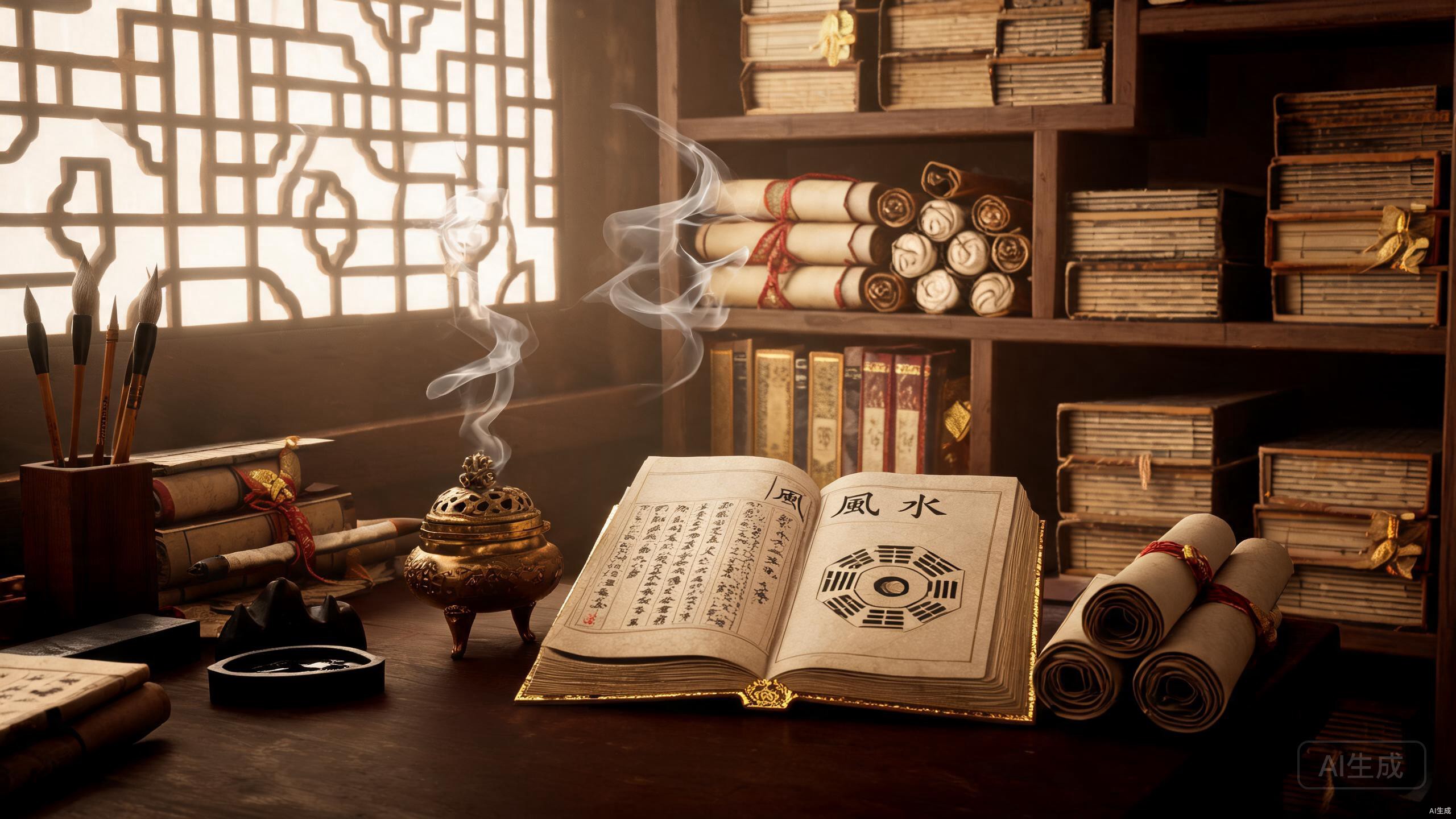
Introduction: Shen Zhuqi's Position in Modern Feng Shui History
Shen Zhuqi (沈竹祁, 1849–1906 AD), courtesy name Shaoxun and pen name Xizhu, was a renowned Feng Shui master of the late Qing Dynasty, originally from Qiantang (modern Hangzhou), Zhejiang Province. He stands as one of the most important figures in modern Chinese Feng Shui history. His system, known as "Shen's Xuan Kong Study," became the most influential Xuan Kong Feng Shui school since the late imperial era and is widely regarded as the "orthodox tradition of Xuan Kong Feng Shui."
Shen Zhuqi's scholarly contribution lies in how he built upon Jiang Dahong's Xuan Kong theory and further refined the calculation methods of Xuan Kong Flying Stars (玄空飞星), making the system more systematic and practical. His four-volume masterwork, Shen's Xuan Kong Study (《沈氏玄空学》), remains a classic text in modern Xuan Kong Feng Shui and an essential manual for serious students of the discipline.
The Life of Shen Zhuqi
Family Background and Early Years
Shen Zhuqi was born in the twenty-ninth year of the Daoguang reign of the Qing Dynasty (1849 AD) in Qiantang (modern Hangzhou), Zhejiang. He came from a merchant family: his father, Shen Huang, ran a prosperous silk business in Hangzhou. Shen Zhuqi showed exceptional intelligence and a love of learning from childhood, but tragedy struck before he reached adulthood — both parents died while he was still young, and the family fortune quickly declined.
To support himself, Shen Zhuqi was forced to abandon the imperial examination route and turned to commerce. He opened a fabric shop in Hangzhou, but found little satisfaction in business. His true passion was scholarly research — especially Feng Shui studies.
The Path of Self-Education
Shen Zhuqi developed a deep fascination with Feng Shui at a young age. Alongside his commercial duties, he devoured every Feng Shui text he could find — from the Zang Shu (Book of Burial) to the Han Long Jing (Classic of Shaking Dragon), from the Qing Nang Jing (Green Satchel Classic) to the Di Li Bian Zheng (Correcting Geography).
However, he discovered that many of these texts were cryptic and full of contradictory claims. Determined to uncover the true principles of Feng Shui, Shen Zhuqi sought out living teachers, visiting numerous masters. Most disappointed him — some were deliberately obscure, while others possessed only superficial knowledge.
For years, Shen Zhuqi searched but could not find a teacher who truly mastered Xuan Kong Feng Shui. Undeterred, he intensified his self-study, repeatedly reading Jiang Dahong's Di Li Bian Zheng word by word and pondering every passage. After years of dedicated effort, he finally penetrated the mysteries of Xuan Kong Feng Shui.
Cultural Context: Before modern publishing made classical texts widely available, Chinese scholars often spent decades — even lifetimes — mastering a single discipline through solitary study. Shen Zhuqi's journey reflects the traditional Confucian ideal of self-cultivation: knowledge earned through perseverance is more deeply rooted than knowledge received from a teacher.
Creating Shen's Xuan Kong Study
Rather than keeping his insights private, Shen Zhuqi chose to publish them for the benefit of broader society. He spent several years compiling his research into a four-volume work titled Shen's Xuan Kong Study.
This magnum opus systematically explained the principles and calculation methods of Xuan Kong Feng Shui. Shen Zhuqi simplified and expanded Jiang Dahong's theoretical framework, making the Flying Star calculation methods clearer and more accessible. He also included numerous real-world case studies to demonstrate practical application, allowing readers to grasp the methodology through concrete examples.
When Shen's Xuan Kong Study was published, it caused a sensation in the Feng Shui community. Practitioners who read it reported sudden clarity, and their understanding of Xuan Kong Feng Shui reached new heights. Shen Zhuqi quickly rose to prominence, becoming the leading figure of modern Xuan Kong Feng Shui studies.
Quick Tip: If you are beginning to explore Xuan Kong Feng Shui today, start with modern interpretations of Shen's Xuan Kong Study. Its clarity makes it far more beginner-friendly than Jiang Dahong's original classical texts.
Later Years and Legacy
In his later years, Shen Zhuqi continued his research and teaching. He established the "Xuan Kong Study Society" in Hangzhou, where he accepted disciples and transmitted his knowledge. Many of his students went on to become renowned Feng Shui masters themselves, spreading Shen's Xuan Kong Study throughout China.
Shen Zhuqi passed away in the thirty-second year of the Guangxu reign (1906 AD) at the age of fifty-eight. Though his life was relatively short, his contributions to Feng Shui continue to resonate nearly 120 years later.
The Core Theory of Shen's Xuan Kong Study
Three Cycles and Nine Periods with Flying Star Trajectories
The theoretical foundation of Shen's Xuan Kong Study rests on the time-division system of the Three Cycles and Nine Periods (三元九运) and the directional calculation of Nine Palace Flying Stars (九宫飞星). Building upon Jiang Dahong's framework, Shen Zhuqi provided a far more precise exposition of Flying Star trajectories and calculation methods.
He divided 180 years into three cycles — Upper, Middle, and Lower — each lasting 60 years. Each cycle was further divided into three periods of 20 years, totaling nine periods. During each "period," the nine stars occupy different positions within the nine palaces; this shifting arrangement is the essence of "Flying Stars." Shen Zhuqi meticulously documented the specific positions and movement patterns of stars in every period, providing practitioners with precise calculation tools.
Cultural Context: The Three Cycles and Nine Periods system divides time into 180-year macro-cycles, with each 20-year "period" favoring different stars and energies. We are currently in the transition toward Period 9 (九紫离火运 — Nine Purple Li Fire Period), expected to peak around 2024–2043, associated with Fire element, vision, technology, and cultural transformation.
Zheng Shen and Ling Shen (Prosperous and Declining Stars)
Shen Zhuqi inherited and developed Jiang Dahong's theory of "Zheng Shen" (正神, Proper Spirit) and "Ling Shen" (零神, Residual Spirit). Zheng Shen refers to the prosperous Current Period Star (当运星) representing active, beneficial forces; Ling Shen refers to the Lost Period Star (失运星) representing depleted, weakening forces.
Shen Zhuqi further clarified that in Feng Shui layout, Zheng Shen should be positioned on the "mountain" — the elevated area behind the building — while Ling Shen should be positioned at the "water" — the lower area in front of the building. This principle of "Zheng Shen placed properly, Ling Shen released toward water" became one of the defining axioms of Shen's Xuan Kong Study.
Coordination of Mountain Dragon and Water Dragon
Shen's Xuan Kong Study places special emphasis on the harmonious interaction between Mountain Dragon (山龙) and Water Dragon (水龙). Shen Zhuqi viewed mountain and water as interdependent, mutually restraining forces in any Feng Shui formation. An auspicious configuration requires their balanced coordination.
He articulated the classic principle: "The mountain dragon spirit does not descend into water, and the water dragon spirit does not ascend the mountain" — drawn from the Qing Nang Xu (Preface to Green Satchel). Mountain spirits belong in mountain positions; water spirits belong in water positions. Mixing them creates the inauspicious "mountain-below, water-above" pattern, which harms the occupants.
Practical Methods of Shen's Xuan Kong Study
Using the Feng Shui Compass
In Shen's Xuan Kong Study, Shen Zhuqi provided detailed instructions for using the Luopan (Feng Shui Compass). He considered the compass the most essential tool of a Feng Shui practitioner, with precise orientation being the foundation of any assessment.
He particularly emphasized the distinction between the Earth Plate Correct Needle (地盘正针) and the Heaven Plate Seam Needle (天盘缝针), and how to use the Luopan to determine a building's Sitting and Facing (坐向). He also introduced the concept of Inclined Direction (兼向) — when a building's orientation falls exactly on the boundary between two sectors, both sectors must be considered simultaneously.
Flying Star Chart Construction
The construction of Flying Star charts is the core technical skill of Shen's Xuan Kong Study. Shen Zhuqi elaborated precisely how to construct three interconnected charts: the Period Chart (运盘), the Mountain Chart (山盘), and the Facing Chart (向盘).
The Period Chart is determined by the "period" in which the building stands, serving as the foundation. The Mountain Chart is calculated from the building's "sitting" orientation, and the Facing Chart from its "facing" orientation. By overlaying these three charts, one can determine the auspicious and inauspicious qualities of each directional sector within a building.
Case Study Analysis and Verification
Shen's Xuan Kong Study contains an extensive collection of real-world case studies covering residences, shops, ancestral halls, temples, and various other building types. Through these examples, Shen Zhuqi demonstrated how theory translates into practice, making the methodology immediately tangible for readers.
This case-study approach became a vital pedagogical method for subsequent generations of Xuan Kong scholars. By analyzing real situations, beginners can rapidly master the calculation methods and evaluation standards of Xuan Kong Feng Shui.
Historical Assessment of Shen Zhuqi
The Influence of Shen's Xuan Kong Study
Shen's Xuan Kong Study remains the most influential Xuan Kong Feng Shui school of the modern era. Before Shen Zhuqi, Xuan Kong Feng Shui — though anchored by Jiang Dahong's Di Li Bian Zheng — was theoretically dense and largely inaccessible to general readers. Shen Zhuqi's systematic simplification opened the door for countless new practitioners.
The school's influence is particularly profound in Hong Kong, Macau, Taiwan, and across Southeast Asia. Many overseas Chinese Feng Shui practitioners adopt Shen's Xuan Kong Study as their primary theoretical framework. His work has been translated into multiple languages and continues to circulate widely throughout the global Chinese diaspora.
Comparison with Jiang Dahong
The relationship between Shen Zhuqi and Jiang Dahong is a fascinating chapter in Feng Shui history. Shen Zhuqi's work substantially inherited Jiang Dahong's theories, yet significantly developed and refined them.
Compared to Jiang Dahong, Shen Zhuqi's exposition is notably clearer and more accessible. Jiang Dahong's Di Li Bian Zheng employs dense classical language with heavy use of allegorical codes and ciphers that can frustrate modern readers. Shen Zhuqi's Shen's Xuan Kong Study, by contrast, uses plain language with clear structure, supported by abundant charts and case examples that make the principles immediately understandable.
Controversies and Criticisms
Shen Zhuqi has not escaped historical criticism. Some scholars argue that his simplification of Jiang Dahong's theory sacrificed much of the original depth and subtlety. Others claim that certain innovations deviated from the original classical intent, amounting to "misinterpretation of scripture."
Additionally, Shen Zhuqi's Inclined Direction (兼向) theory has generated ongoing debate within the Feng Shui community. Some practitioners consider it overly complex and problematic in practical application.
The Modern Relevance of Shen Zhuqi
Value for Academic Research
Shen's Xuan Kong Study is essential material for studying modern Feng Shui history. Examining Shen Zhuqi's work illuminates how Feng Shui scholarship evolved during the late imperial period and how Xuan Kong Feng Shui transitioned from classical to modern expression.
Value for Practical Application
Shen Zhuqi's Xuan Kong Flying Stars method remains widely used today. Contemporary Feng Shui practitioners routinely consult his theoretical framework when conducting layout analysis. His case-study methodology also serves as an important pedagogical model for modern Feng Shui education.
Conclusion
As a celebrated Feng Shui master of the modern era, Shen Zhuqi's scholarly contributions and historical standing are beyond dispute. Through Shen's Xuan Kong Study, he systematized and simplified Xuan Kong Feng Shui theory, enabling countless people to learn and master this discipline. His academic achievements generated widespread influence in his own time and continue to shape practice today. In the contemporary world, we should approach Shen Zhuqi's intellectual legacy with a scientific mindset — extracting its essential wisdom while leaving behind its limitations — so that this ancient cultural heritage continues to serve modern society.
Related Articles
- [[../01-风水入门/34-玄空飞星派完整教程.md|Xuan Kong Flying Star School Complete Tutorial: The Feng Shui Mysteries of Time and Space]]
- [[../01-风水入门/17-玄空飞星与八宅风水的区别.md|Xuan Kong Flying Stars vs. Eight Mansions Feng Shui]]
- [[../03-财运风水/24-流年财运调整.md|Annual Wealth Fortune Adjustment: Yearly Feng Shui Wealth Activation and Sha Remedies]]
- [[../03-财运风水/18-玄空飞星催财法.md|Xuan Kong Flying Stars Wealth Activation: Annual Wealth Star Directions and Layouts]]