Feng Shui of Ancient Capitals: Luoyang — Dragon Vein Analysis of the Center of the World
Luoyang, anciently known as Luoyi (洛邑), Luoyang (雒阳), or the Divine Capital (神都), is located in western Henan Province on the southern bank of the middle and lower Yellow River. It ranks as the second
Introduction: Luoyang's History as a Capital and Its Feng Shui Significance
Luoyang, anciently known as Luoyi (洛邑), Luoyang (雒阳), or the Divine Capital (神都), is located in western Henan Province on the southern bank of the middle and lower Yellow River. It ranks as the second-longest-serving capital in Chinese history after Xi'an. Since the Xia Dynasty first established its capital here, thirteen successive dynasties made Luoyang their seat of power — including the Shang, Western Zhou (Chengzhou), Eastern Zhou, Eastern Han, Cao Wei, Western Jin, Northern Wei, Sui (Eastern Capital), Tang (Eastern Capital), Later Liang, Later Tang, and Later Jin — accumulating over 850 years of continuous capital history.
Luoyang holds a unique position in ancient Chinese theories of capital site selection. The geographic concept of "Center of the World (天下之中)" is not merely a matter of cartography — it is a profound proposition in Feng Shui studies.
The Feng Shui Meaning of "Center of the World"
Historical Origins of the "Center of the World" Concept
The concept of "Center of the World" can be traced back to the Zhou Dynasty. After quelling the Rebellion of Guan and Cai, the Duke of Zhou (周公旦) sought to strengthen control over the eastern vassal states and decided to build the Eastern Capital Chengzhou (成周) along the banks of the Luo River. According to the Shang Shu · Luo Gao (尚书·洛诰), the Duke of Zhou performed detailed divination when selecting the site and ultimately chose Luoyi as the "Center of the World." This choice was not only based on political and military considerations — it was deeply influenced by the Feng Shui concepts of the time.
From the geographic understanding of that era, Luoyi sat at the heart of Chinese civilization — east to Qi and Lu, west to Qin and Long, south to Jing and Chu, north to Yan and Zhao. Its central location made it convenient for transporting tribute from all directions and communicating imperial decrees. This concept of "center (中)" was later further developed in Feng Shui theory and became an important standard for judging the auspiciousness of city site selection.
Luoyang's Position in the Dragon Vein System
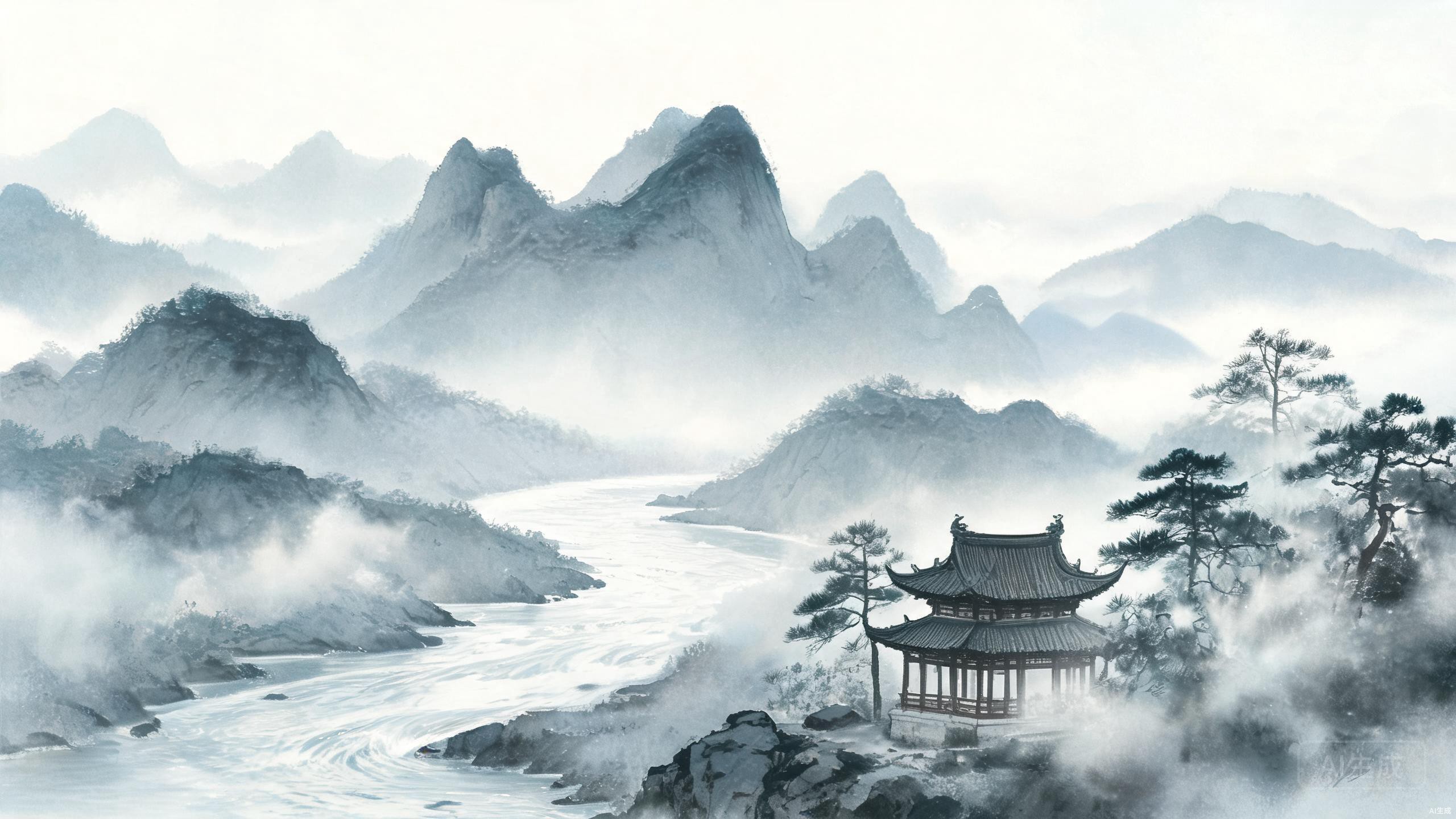
Within the Chinese Feng Shui Dragon Vein (龙脉) system, Luoyang occupies a critical node on the Central Dragon (中龙). The Central Dragon originates from the Kunlun Mountains (昆仑山), flows through the Qilian and Qinling ranges eastward, and branches in the western Henan region into two tributaries: the northern branch extends along the Xiaoshan, Xiong'er, and Songshan mountains, while the southern branch travels along the Funiu and Waifang mountains. Luoyang sits precisely cradled between these two branches, forming the classic pattern of "mountains flanking both sides, a river flowing through the center."
From a micro-topographic perspective, the Luoyang Basin is backed by Mangshan (邙山) to the north, faces Longmen Mountain (龙门山) to the south, borders Xiaoshan to the west, and reaches Songshan to the east — forming a relatively enclosed yet well-connected geographic unit. Mangshan stretches east to west for over 100 kilometers, lying across the northern edge of the Luoyang Basin as a natural barrier. Mangshan enjoys a sterling reputation in Feng Shui: since the Eastern Han Dynasty, it has been the premier burial ground for royalty and nobility, giving rise to the saying: "To live, choose Suzhou and Hangzhou; to be buried, choose Northern Mangshan (生在苏杭,葬在北邙)."
Cultural Context: The Dragon Vein system in Feng Shui maps the flow of Qi across entire landscapes. Grand mountain ranges are seen as "dragons" carrying the Earth's energy from the Kunlun — considered the mother of all Chinese mountain ranges — southeastward across the land. A capital city built on a powerful Dragon Vein node was believed to channel cosmic power to its rulers and people.
The Water System of the Heluo Region
Feng Shui Significance of the Luo River and Yi River
Luoyang's very name derives from the Luo River (洛河), the most important waterway in the Luoyang Basin. The Luo River originates on the southern slopes of Mount Hua in Shaanxi, flows through the mountainous region of western Henan, and joins the Yellow River after merging with the Yi River near Luoyang. From a Feng Shui perspective, the Luo River winds and meanders with a gentle flow — a textbook example of "sentimental water (有情水)," the kind of water that nurtures and retains energy rather than dispersing it.
The Yi River (伊河) rises in the Funiu Mountains and merges with the Luo River at Longmen Mountain south of Luoyang. Longmen Mountain consists of cliffs on both banks of the Yi River; the two mountains face each other while the Yi River flows between them, forming a natural gateway — hence the name "Dragon Gate (龙门)." Longmen is not only Luoyang's southern gateway but also a crucial Feng Shui pass. Legend holds that during the Great Yu's flood control efforts, he carved through the cliffs here to allow the Yi River to pass — the same site where the famous Longmen Grottoes would later be carved.
The Relationship Between the Yellow River and Luoyang
The Yellow River lies approximately 20 kilometers north of the Luoyang Basin and serves as an important outer water system for the city. At the Mengjin (孟津) section north of Luoyang, the Yellow River's channel widens and the flow becomes gentle, forming the famous ferry crossing of the middle and lower Yellow River. From a Feng Shui perspective, the Yellow River here functions as "boundary water (界水)" — blocking Sha Qi from the north and protecting the safety of the Luoyang Basin.
However, the Yellow River is a river of dual nature. Throughout history, it has changed course numerous times and caused devastating floods, severely impacting agriculture and daily life in the Luoyang region. In Feng Shui terms, this phenomenon can be understood as "water flowing too urgently (水势过急)" or "water failing to gather (水势不聚)" — the Yellow River's volume is too vast and its current too forceful to form the ideal pattern of "Gathering Water at the Heaven Heart (水聚天心)."
Analysis of Luoyang's Capital Feng Shui Layout
The Protective Function of Mangshan
Mangshan is the most important Feng Shui element of the Luoyang Basin. It stretches approximately 120 kilometers east to west and 15 to 20 kilometers north to south, with elevations between 200 and 300 meters. Although its mountains are not particularly tall, their orientation runs perpendicular to Luoyang's urban axis, creating a natural barrier that effectively blocks cold air and Sha Qi from the north.
Another essential Feng Shui function of Mangshan is "Storing Wind (藏风)." Blocked by Mangshan, the airflow within the Luoyang Basin remains relatively stable and is not prone to strong winds — meeting the classic Feng Shui requirement of "Storing Wind and Gathering Qi (藏风聚气)." This is one of the key reasons why Luoyang was chosen as a capital by so many dynasties.
The Axis and Orientation of Luoyang City
Luoyang's urban axis design evolved through multiple dynasties. The Eastern Han capital was centered on the Northern and Southern Palaces, forming a north-south central axis. The Northern Wei capital expanded upon the Han foundation and clarified the central axis further. The Sui-Tang capital then shifted the central axis eastward to accommodate new urban planning needs.
From a Feng Shui perspective, Luoyang's axis design reflects the traditional principle of "Sitting North Facing South (坐北朝南)." The imperial palace was located in the northern part of the city, facing due south — symbolizing the emperor occupying the position of the North Star, overseeing all beneath heaven. This layout not only satisfies Feng Shui requirements but also adapts to the Luoyang Basin's topography, which slopes gently from north to south.
The Water Mouth Pattern of Dragon Gate and the Luo River
Longmen Mountain and the Luo River together form Luoyang's "Water Mouth (水口)" configuration. In Feng Shui theory, the water mouth is the location where water enters or exits a region — an important standard for determining auspiciousness. Luoyang's water mouth lies near Longmen Mountain, where the Luo and Yi rivers merge and pass through the mountain before flowing north into the Yellow River.
The cliffs on both sides of Longmen Mountain function like two giant hands guarding Luoyang's water mouth, creating the pattern of "Tightly Closed Water Mouth (水口紧闭)." This configuration is considered highly auspicious in Feng Shui because it means wealth energy and Vital Qi will not easily leak away. The Tang Dynasty poet Bai Juyi (白居易) praised this scene: "Among Luoyang's four suburban landscapes, none surpasses the scenic grandeur of Dragon Gate (洛都四郊,山水之胜,龙门首焉)." This reveals the significant position Longmen Mountain holds in Luoyang's Feng Shui layout.
Cultural Context: The "Water Mouth" is one of the most important concepts in the Form School of Feng Shui. An open water mouth allows energy and wealth to drain away; a tightly closed water mouth — guarded by mountains, hills, or man-made structures — retains energy and accumulates prosperity. This is why traditional Chinese villages and imperial capitals were almost always built with protective "mouths" at their water exits.
Historical Feng Shui Assessment of Luoyang as a Capital
Advantages of Luoyang as a Capital
Luoyang offered several distinct Feng Shui advantages as a capital:
- Central location: Situated at the "Center of the World," the geography was ideal for controlling the entire realm
- Fertile land: The Luoyang Basin's flat terrain and rich soil provided excellent agricultural conditions
- Abundant water: The Luo, Yi, and Yellow River systems ensured plentiful water resources
- Protective mountains: Mangshan, Longmen Mountain, and surrounding ranges created a relatively enclosed and secure space
Disadvantages of Luoyang as a Capital
However, Luoyang also possessed some inherent Feng Shui weaknesses:
- Limited expansion: The Luoyang Basin has a finite area, leaving insufficient space for large-scale population growth
- Military vulnerability: Located in the heart of the Central Plains, Luoyang had no natural defenses to deter invaders — historically, it suffered repeated destruction in warfare, directly tied to its inadequate military defensibility
- Diffused Qi: Although Luoyang's Dragon Vein is vigorous, its "Qi" is not sufficiently concentrated. Because Luoyang sits at the confluence of multiple rivers, the water flow disperses, making it difficult to achieve the "Water Gathering at Heaven Heart (水聚天心)" effect
- Insufficient mountain height: While the surrounding mountains do embrace the basin, they are not high enough to fully achieve the "Storing Wind" effect compared to Xi'an
How to Apply These Ancient Capital Feng Shui Principles
Even if you don't live in an ancient Chinese capital, you can apply these principles to evaluate your own home:
- Check for mountain backing: Does your home have solid support behind it (another building, a hill, or a tall tree line)? This is your "protective mountain"
- Evaluate water flow: Are there roads, pathways, or actual water features that curve gently past your home — or do they rush straight at your entrance?
- Assess your "water mouth": Identify where the energy exits your property. Is there something that "closes" and protects this exit, or does energy flow freely out?
- Observe seating vs. facing: Does your main door face a favorable direction with open, welcoming views (rather than facing directly into a wall or busy road)?
Quick Tips:
- A home with mountains behind and water in front is considered the most auspicious Feng Shui layout — and you can simulate it through furniture arrangement, plants, and water features
- If your home sits on a busy thoroughfare, use Folding Screens, tall plants, or entryway cabinets to slow down rushing energy
- Avoid homes where the back is lower than the front, as this is believed to cause wealth to "flow downhill" and away from the family
Conclusion
As the ancient capital of the "Center of the World," Luoyang's Feng Shui layout holds unique academic value. From the macro perspective of the Dragon Vein system to the micro details of urban planning, Luoyang embodies the essence of ancient Chinese capital site selection theory. While Luoyang's Feng Shui layout does possess some inherent natural shortcomings, over more than a thousand years of capital history, successive rulers maximized Luoyang's Feng Shui advantages through careful urban planning and construction, creating the brilliant Heluo civilization.
Studying Luoyang's Feng Shui layout not only helps us understand the theoretical system of ancient Chinese capital site selection but also provides valuable historical reference for modern urban planning.
Related Articles
- [[../01-风水入门/06-风水基础概念词典.md|Feng Shui Glossary: 18 Core Terms Explained]]
- [[../01-风水入门/31-Xing Shi School (Luan Tou School) Detailed Guide.md|Form School (Luan Tou School) Explained: The Millennium Legacy of Dragon, Acupoint, Sand, and Water]]
- [[../02-家居风水/09-庭院与外部环境.md|Courtyard and External Environment: Four Celestial Animals, Mountain Backings, Road Patterns, and Trees]]
- [[../07-风水故事/03-Qin Shi Huang Severing Jinling's Dragon Vein.md|Qin Shi Huang Severed the Jinling Dragon Vein — The Feng Shui Panic of the First Emperor]]