Feng Shui Schools Evolution: From Form School to Compass School Through History
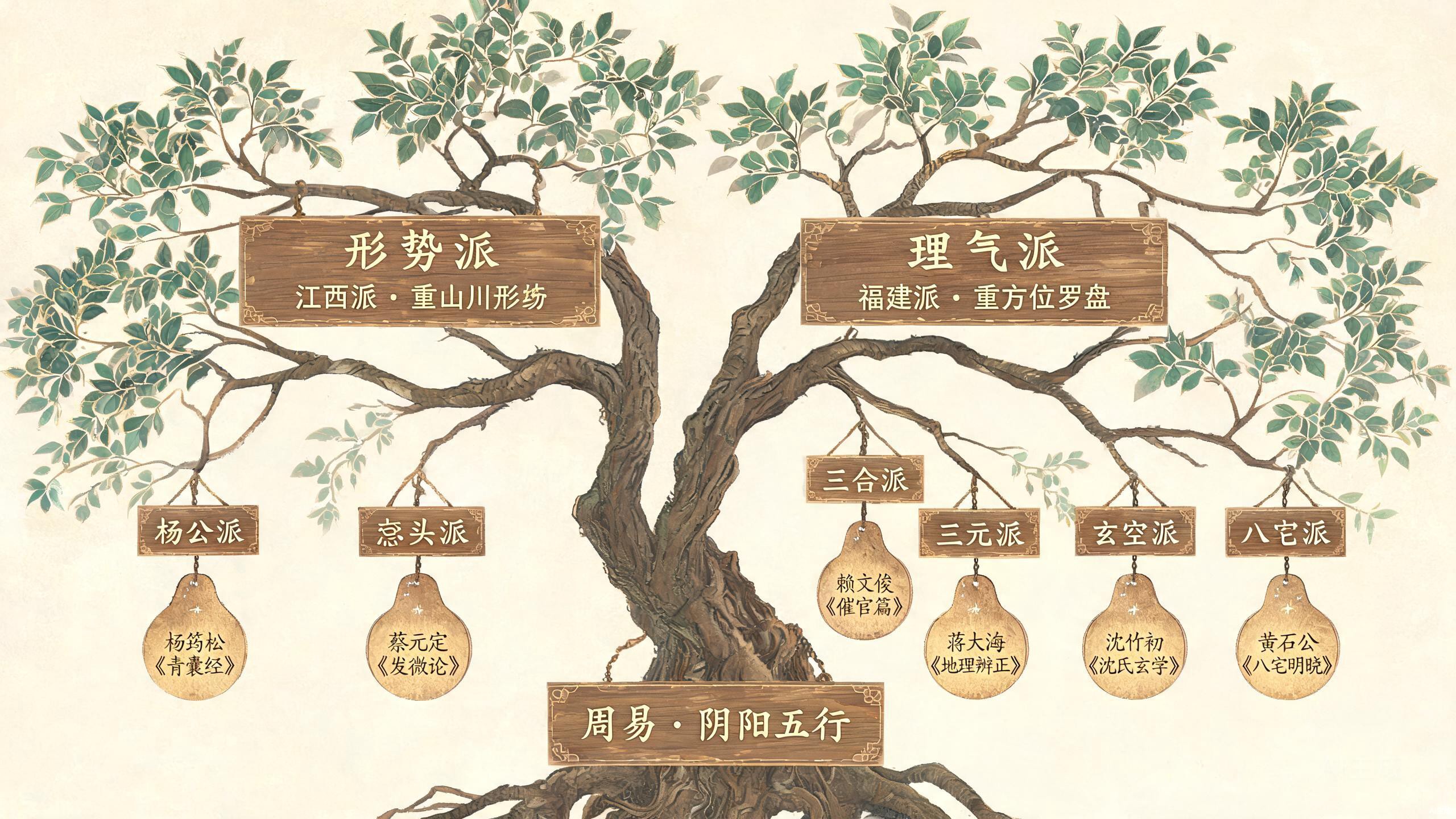
## I. The Overall Landscape of Feng Shui Schools After thousands of years of development, Chinese Feng Shui has given rise to numerous schools of thought. The two most influential and representative s
Feng Shui Schools Evolution: From Form School to Compass School Through History
I. The Overall Landscape of Feng Shui Schools
After thousands of years of development, Chinese Feng Shui has given rise to numerous schools of thought. The two most influential and representative schools are the Form School (形势派, also known as the Luan Tou School 峦头派) and the Compass School (理气派, also known as the Luopan School 罗盘派). Each school has its own emphasis, and together they complement one another to form the complete system of Feng Shui.
Cultural Context: The two main branches of Feng Shui developed in different eras for different reasons. The Form School emerged first, relying on direct observation of the natural landscape — much like an architect walking a site. The Compass School arose later, applying mathematical and cosmological calculations to determine precise orientations and timing — similar to how Western astrology uses precise calculations.
Core Differences Between the Two Schools
| Feature | Form School (Luan Tou) | Compass School (Luopan) |
|---|---|---|
| Core Method | Observing mountains and terrain | Calculations using the Luopan |
| Basis for Judgment | Shapes of dragon, acupoint, sand, and water | Direction, time, and numerology |
| Focus | Spatial forms | Space-time relationships |
| Tools | Primarily the naked eye | Luopan, Bagua, Heavenly Stems and Earthly Branches |
| Origin | Yang Yunsong in the Tang Dynasty | Lai Buyi and others in the Song Dynasty |
| Application | Site selection, Seeking Dragon and Pointing Acupoint | Layout, date selection, orientation |
II. The Historical Evolution of the Form School
Origin: Yang Yunsong and the Founding of the Form School
The Form School was founded by Yang Yunsong (杨筠松, 834–900 AD) during the Tang Dynasty (618–907 AD). Yang Yunsong, courtesy name Shumao, was reverently known as "Yang Gong" (杨公, "Lord Yang"). Originally serving as a court Feng Shui practitioner for the imperial Tang government, he managed the Bureau of Astronomy and Geography. After the rebel Huang Chao captured the Tang capital of Chang'an, Yang Gong fled south to Ganzhou in Jiangxi Province, where he introduced Royal Feng Shui (皇家风水) knowledge to the common people.
Quick Tip: Yang Gong's southward journey to Jiangxi was pivotal — the region became the birthplace of the Jiangxi School, which spread Feng Shui knowledge throughout China and remains influential today.
In Jiangxi, Yang Gong took on students and trained notable disciples including Zeng Wenchan (曾文辿), Liao Yu (廖瑀), and Liu Jiangdong (刘江东), forming the historically significant "Jiangxi School" that shaped generations of Feng Shui practitioners.
Core Theories of the Form School
The Form School centers on the "Four Essentials" — Dragon, Acupoint, Sand, and Water (龙、穴、砂、水):
Dragon (龙): The direction and undulation of mountain ranges, representing the pathway through which Qi arrives. Seeking the Dragon is the first step in Feng Shui site selection — you must trace the mountain range back to its origin (the Ancestral Mountain) to judge the strength and authenticity of the Dragon Vein.
Acupoint (穴): The point where the Dragon Vein concentrates its energy — the most ideal location for burial or building. Pointing the Acupoint is considered the highest skill in Feng Shui, requiring comprehensive assessment of how the Dragon, Sand, and Water work together.
Sand (砂): The hills surrounding the acupoint site, categorized into the Azure Dragon (青龙) on the left, White Tiger (白虎) on the right, Vermilion Bird (朱雀) in front, and Black Tortoise (玄武) behind. The shape and position of these surrounding hills determine how well the acupoint site is protected.
Water (水): Waterways near the acupoint site. Water serves as the carrier of Qi — "it settles where it meets water." The source, direction, shape, and clarity of water all relate to the auspicious or inauspicious nature of the site.
Branches of the Form School
As the Form School developed, it branched into several traditions:
San He School (三合派): Based on Yang Gong's theories, emphasizing "Dragon-Water coordination" and using the Triple Harmony combinations (Shen-Zi-Chen, Yin-Wu-Xu, Hai-Mao-Wei, Si-You-Chou) to assess the relationship between dragon veins and watercourses.
Luan Tou School (峦头派): Focused purely on judging auspiciousness through the forms of mountains and waters, without using the Luopan — relying solely on visual observation of terrain.
Fan Gua School (翻卦派): Combines the Bagua "flipping trigram" method with landform observation, serving as a transitional form between the Form School and the Compass School.
Representative Works of the Form School
- Han Long Jing (Classic of Shaking Dragon): Authored by Yang Yunsong, dedicated to the methods of seeking the Dragon
- Yi Long Jing (Classic of Doubting Dragon): Authored by Yang Yunsong, addressing difficult questions in dragon-seeking
- Qing Nang Ao Yu (Profound Words of the Green Satchel): Authored by Yang Yunsong, explaining the secrets of Feng Shui
- Tian Yu Jing (Classic of Heavenly Jade): Authored by Yang Yunsong, discussing Feng Shui compass energy
- Di Li Ren Zi Xu Zhi (Essential Geography for Human Sons): Written by Xu Shanji (徐善继) and Xu Shanshu (徐善述) during the Ming Dynasty, synthesizing the Form School's greatest insights
III. The Historical Evolution of the Compass School
Origin: The Rise of the Compass School in the Song Dynasty
The Compass School emerged during the Song Dynasty (960–1279 AD) as a development of and supplement to the Form School. Practitioners of the Compass School believed that judging Feng Shui based solely on the shapes of mountains and waters was insufficient — it was also necessary to incorporate factors such as orientation, time, and numerology for comprehensive assessment.
Key figures of the Compass School include Lai Buyi (赖布衣), Chen Tuan (陈抟), and Wu Jingluan (吴景鸾). Lai Buyi (approximately 1101–1126 AD) was a renowned Feng Shui master of the Song Dynasty. He integrated Yi Jing philosophy, the Bagua, and the Heavenly Stems and Earthly Branches, advancing the systematic development of the Compass School.
Core Theories of the Compass School
The Compass School revolves around "Orientation, Time, and Numerology":
Orientation (方位): Using the Luopan to measure exact directions precisely, combined with the Bagua and Twenty-Four Mountains to determine auspiciousness. Time (时间): Considering temporal factors such as Three Cycles and Nine Periods (三元九运) and Annual Flying Stars. Numerology (数理): Applying mathematical models like the Hetu Luoshu (River Diagram and Luo Script) and the Prenatal and Postnatal Bagua for calculations.
Major Branches of the Compass School
Eight Mansions School (八宅派): Uses the Life Gua (Life Gua of the East Four Life or West Four Life) combined with Eight Mansions classification (four auspicious and four inauspicious directions) to lay out Yang Dwellings. This method is simple, practical, and widely circulated.
Xuan Kong Flying Stars School (玄空飞星派): Based on the Three Cycles and Nine Periods, uses the Nine Palace Flying Stars to calculate spatial-temporal auspiciousness. Its theories are profound, making it the most complex branch of the Compass School. During the Qing Dynasty, Shen Zhuqi (沈竹祁) authored Shen's Xuan Kong Study (《沈氏玄空学》), synthesizing the school at its highest level.
San He School (三合派, Compass branch): Based on the Three Harmony Five Elements and the Twelve Growth Stages, primarily used for water method assessment.
Na Jia School (纳甲派): Uses the Bagua Na Jia technique combined with Feng Shui analysis, mapping the Heavenly Stems and Earthly Branches onto the Eight Trigrams.
Qi Men School (奇门派): Incorporates the Qi Men Dun Jia (奇门遁甲) strategic art into Feng Shui, combining Qi Men chart arrangements with direction analysis to judge auspiciousness.
Representative Works of the Compass School
- Qing Nang Xu (Preface to the Green Satchel): Authored by Lai Buyi, explaining the essential methods of Li Qi
- Tian Yu Jing (Classic of Heavenly Jade): Authored by Yang Yunsong (also revered by the Compass School as a classic text)
- Shen's Xuan Kong Study (《沈氏玄空学》): Authored by Shen Zhuqi in the Qing Dynasty, synthesizing Xuan Kong Flying Stars
- Ba Zhai Ming Jing (Eight Mansions Bright Mirror): The classic text of the Yang Dwelling Eight Mansions School
- Di Li Wu Jue (Five Essentials of Geography): Authored by Zhao Jiufeng (赵九峰) in the Qing Dynasty, systematically addressing the five essentials
IV. The Convergence of the Two Schools
Form as Substance, Compass as Function
From the Ming and Qing Dynasties onward, the Feng Shui community gradually reached a consensus: "Form as the substance, Compass as the function" (形势为体、理气为用). This means using the Form School's methods to select the broader environmental setting (Dragon, Acupoint, Sand, Water), and the Compass School's methods to determine specific orientation and timing. The two schools moved from opposition toward integration.
Key Figures of the Integration
Jiang Dahong (蒋大鸿, 1616–1714 AD): A Feng Shui master of the late Ming and early Qing periods, he integrated the Form and Compass Schools and was venerated as the "Earth Immortal" (地仙). He emphasized that both form and energy must be given equal weight and opposed any practice that neglected either side.
Shen Zhuqi (沈竹祁, 1849–1906 AD): A Feng Shui master of the Qing Dynasty, renowned for his expertise in Xuan Kong Flying Stars, he also emphasized the importance of form-based observation.
The Operational Workflow After Integration
- Observe the Form First: Use Form School methods to seek the Dragon, observe the Sand, examine the Water, and point the Acupoint
- Determine the Orientation: Use Compass School methods to establish the building's sitting direction and facing direction, plus internal layout
- Select an Auspicious Date: Use Compass School methods to choose a propitious date and time for construction
- Adjust the Layout: Use Compass School methods to arrange the orientation of each functional zone within the interior
How to Apply This Integrated Approach to Your Home
- Step back and observe the surroundings: Are there supportive structures behind your home (the "mountain")? Is the path in front gentle and curved (the "water")?
- Measure your home's orientation: Use a compass or smartphone app to identify your door's facing direction
- Determine your personal direction: Calculate your Life Gua to find your most auspicious and inauspicious directions
- Activate with timing: When possible, perform major home improvements during auspicious time periods according to your chosen school
Quick Tip: Modern homeowners can blend the two schools easily — use Form School thinking to assess your immediate surroundings (neighboring buildings, street layouts), then apply Compass School calculations to refine interior orientation and timing.
V. Other Feng Shui Schools
Beyond the Form School and Compass School, several smaller but distinctive schools have emerged:
| School | Characteristics | Application |
|---|---|---|
| Destiny Studies School (命理派) | Combines the BaZi (Eight Characters) of individuals with Feng Shui layout | Yang Dwelling |
| Golden Lock and Jade Gate (金锁玉关) | Judges auspiciousness based on water and sand flowing through Bagua directions | Yang Dwelling and Yin Dwelling |
| Passing Yin Yang School (过路阴阳) | Famous for allowing Feng Shui assessment by simply walking past the site | Quick assessment |
| Bagua Feng Shui (八卦风水) | Maps the Postnatal Bagua onto the residence's orientation | Yang Dwelling |
Cultural Context: Smaller schools like Passing Yin Yang are often passed down through family lineages rather than formal teachings — they represent a folk practitioner tradition that remains popular in rural China and among some modern enthusiasts.
Quick Tips:
- If you're a beginner, the Eight Mansions School is the most accessible starting point — it requires only your year of birth and compass direction
- For deeper study, Xuan Kong Flying Stars offers the most precise timing but demands years of dedicated practice
- Combining schools is common and effective — even Yang Gong himself was said to use both form observation and compass calculation
VI. Lessons from the Evolution of Feng Shui Schools
The historical evolution of Feng Shui schools offers important insights:
- Unity of Origin: All schools emerge from the same fundamental exploration — the relationship between humanity and the environment
- Differentiated Development: Each school researches Feng Shui from a different perspective
- Complementary Integration: Mature Feng Shui practice requires synthesizing the strengths of multiple schools
- Evolution with the Times: Every era's Feng Shui practitioners innovate upon previous foundations
- Practice as the Final Standard: Regardless of which school, all must ultimately be validated through real-world application
This content is compiled from sources including History of Chinese Feng Shui for cultural research reference.
Related Articles
- [[../01-风水入门/02-风水流派介绍.md|Introduction to Feng Shui Schools: Form School, Compass School, Eight Mansions, Xuan Kong]]
- [[../01-风水入门/39-Feng Shui Schools Comparison and Selection.md|Feng Shui Schools Comparison and Selection: Finding Your Ideal Practice Path]]
- [[../07-风水故事/05-杨筠松救贫传奇.md|The Legend of Yang Yunsong: The Life of the Jiangxi Form School Ancestor]]
- [[../07-风水故事/12-The Game Between Feng Shui Masters and Emperors.md|Feng Shui Masters and the Emperor: The Courtly Fate of Imperial Feng Shui practitioners]]