Nanjing Feng Shui Legend: King Wei of Chu Buries Gold to Suppress Royal Qi
## I. Historical Background Nanjing, anciently known as Jinling (金陵) and Jiankang (建康), is one of China's most celebrated ancient capitals — the fabled "Capital of Six Dynasties." Its geographic confi
Nanjing Feng Shui Legend: King Wei of Chu Buries Gold to Suppress Royal Qi — Lucky Energy & Wisdom
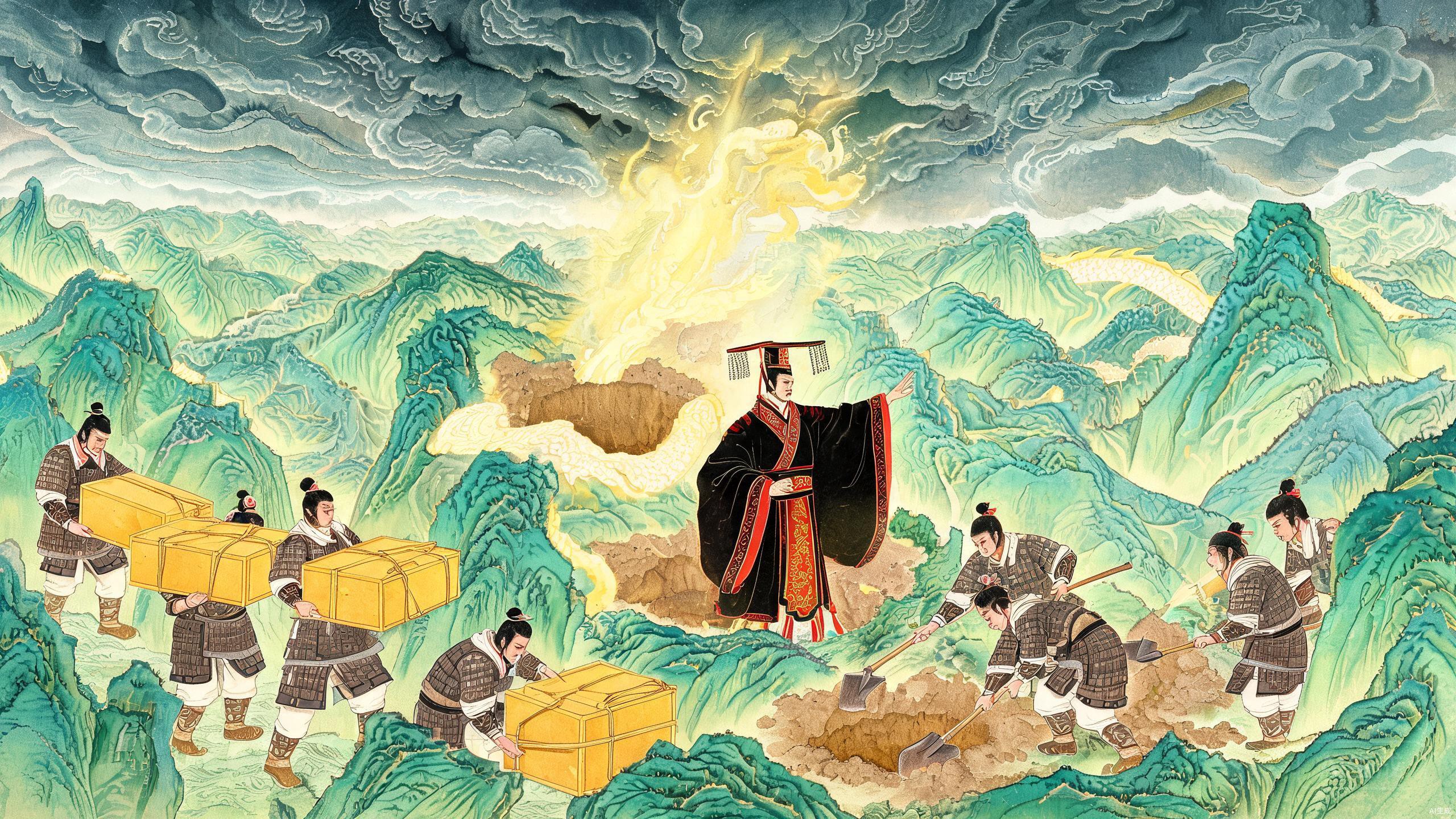
I. Historical Background
Nanjing, anciently known as Jinling (金陵) and Jiankang (建康), is one of China's most celebrated ancient capitals — the fabled "Capital of Six Dynasties." Its geographic configuration is nothing short of a Feng Shui treasure: backed by Zhongshan (Purple Gold Mountain), facing the Yangtze River, embraced by mountains on all sides, and interlaced with waterways. Generations of Feng Shui masters have regarded it as a "Land of Emperors."
Yet it was precisely this extraordinary Feng Shui pattern that triggered one of the most famous geomantic episodes in Chinese history — King Wei of Chu Buries Gold to Suppress Royal Qi.
II. The Burial of Gold by King Wei of Chu
What Happened
In 333 BCE, Xiong Shang (熊商), known as King Wei of Chu (楚威王), ruled the State of Chu. According to historical records such as the Jingding Jiankang Zhi (景定建康志) and the Zhizheng Jinling Xin Zhi (至正金陵新志), King Wei led his army to destroy the State of Yue and afterward conducted a巡视 (inspection tour) to the Jinling (present-day Nanjing) region.
From an elevated vantage point, King Wei gazed upon the towering Zhongshan and the mighty Yangtze, beholding a landscape of majestic grandeur. The accompanying Feng Shui practitioner — known at the time as a "Qi Reader" (望气者) — addressed the king: "This land possesses the Qi of a True King. Within a hundred years, a Son of Heaven shall arise here, threatening the State of Chu."
Alarmed that Jinling's Royal Qi might nurture a new emperor who could topple his dynasty, King Wei adopted the practitioner's counsel. In the vicinity of today's Purple Gold Mountain (Zhongshan) in Nanjing, he buried golden figures (or gold and silver treasures), using Metal to suppress Earth's Qi and shatter the site's auspicious Feng Shui configuration.
The Origin of the Name "Jinling"
Following King Wei's burial of gold to suppress the Royal Qi, this land came to be called "Jinling" (金陵). The character "金" (jin) refers to the buried golden figures, while "陵" (ling) refers to the mountain hills. This is the origin of Nanjing's ancient name "Jinling" — an elegant designation still proudly used by the city today.
Cultural Context: The name "Jinling" has carried a poetic, almost mystical resonance through two millennia of Chinese literature. From Tang poetry to modern media, the name evokes both imperial grandeur and a lingering sense of fate — as if the city itself remembers being "cursed" by golden metal.
III. Feng Shui Principles Behind the Legend
Why Nanjing Possessed "Royal Qi"
From a Feng Shui perspective, Nanjing's geographic layout genuinely embodies the qualities of an imperial capital:
- Distant, Mighty Dragon Vein (来龙远大): Nanjing is backed by Zhongshan, a continuation of the Mao Mountain range that traces back to the Ningzhen Mountains — its Dragon Vein stretches endlessly into the distance
- Sand and Water Embrace (砂水环抱): Zhongshan serves as the Black Tortoise (玄武) to the rear, Stone Mountain as the White Tiger (白虎) to the right, Qinglong Mountain as the Azure Dragon (青龙) to the left, and the Qinhuai River winds around the front — forming a complete Four Symbols configuration
- Expansive Bright Hall (明堂开阔): The Yangtze River stretches across the front, creating a vast, magnificent Bright Hall of imperial scale
- Tightly Locked Water Mouth (水口紧锁): Multiple narrow passages downstream lock in the Yangtze's Water Mouth, preventing Wealth Qi from escaping
Cultural Context: The Four Symbols (四象) — Azure Dragon, White Tiger, Vermilion Bird, and Black Tortoise — represent the four cardinal directions in Chinese cosmology. In Feng Shui, a perfect site must have protective "mountains" on all four sides. Nanjing's geography remarkably fulfills this pattern, which is why Feng Shui masters considered it supremely auspicious.
The Feng Shui Logic of Burying Gold to Suppress Qi
King Wei's strategy of burying gold to suppress Royal Qi draws upon the Five Elements cycle of Mutual Generation and Restriction (相生相克):
- Nanjing's Feng Shui is dominated by Earth Qi (mountain and hill terrain)
- Within the Five Elements, Metal drains Earth — Earth generates Metal, and an excess of Metal leaves Earth depleted
- By burying gold within the hills, the practitioners used Metal to leach out the "Royal Qi" hidden in the Earth, causing the land's energy to wither
- The Metal of the golden figures and the Earth of the hills formed a "child draining the mother's Qi" (子泄母气) configuration, weakening the overall Feng Shui energy of the site
Did the Suppression Work?
Judging by historical outcomes, King Wei's suppression achieved only limited success — Nanjing did indeed become the capital of multiple dynasties (Eastern Wu, Eastern Jin, Liu Song, Southern Qi, Liang, Chen, early Ming, Taiping Heavenly Kingdom, and the Republic of China). Yet nearly every regime that established its capital in Nanjing met an early end. Some attribute this to King Wei's suppression of Royal Qi, claiming it left Nanjing's Feng Shui "incomplete and damaged."
IV. Later Attempts to Damage Nanjing's Feng Shui
King Wei's burial of gold was not the last time Nanjing's Feng Shui was deliberately sabotaged. Several subsequent attempts followed:
Qin Shi Huang's Eastern Tour to Crush Imperial Qi
About a century after King Wei, after unifying China, the First Emperor Qin Shi Huang (秦始皇) made an eastern inspection tour to Jinling. Practitioners reported that Imperial Qi still lingered over the land. The emperor issued two orders:
- Sever the Dragon Vein (挖断龙脉): Excavate the Qinhuai River channel, diverting water into the Yangtze to "drain" the Earth's Qi
- Change the Place Name (改地名): Rename Jinling to "Moling" (秣陵) — "秣" meaning fodder for horses, deliberately demeaning
Historical Reflections
The repeated legends of Nanjing's Feng Shui being "damaged" across dynasties reveal a fascinating historical pattern: rulers feared the rise of Imperial Qi in other places, yet coveted it for themselves. Nanjing's Feng Shui was so powerful that it paradoxically invited deliberate sabotage.
V. The Cultural Significance of King Wei's Burial of Gold
The Politicization of Feng Shui
The King Wei incident represents one of the earliest and most typical examples of the politicization of Feng Shui in Chinese history. Thereafter, emperors across dynasties universally took Feng Shui seriously, employing it as a tool to consolidate rule:
- Capital cities were chosen with Feng Shui considerations
- Imperial tombs were placed at supreme Feng Shui sites
- Authorities monitored the populace for signs of emerging "Imperial Qi"
The Far-Reaching Influence of "Royal Qi" Belief
The concept of "Royal Qi" (王气) profoundly shaped Chinese political culture. Emperors not only attended to the Feng Shui of their own ancestral tombs but also watched vigilantly for new "Imperial Qi" rising anywhere in the empire. This belief spawned countless incidents of Feng Shui sabotage and elevated Feng Shui to an important role in ancient political life.
The Feng Shui Explanation for Nanjing's "Short-Lived Dynasties"
Although Nanjing served as the Capital of Six Dynasties, most regimes established there enjoyed brief reigns:
- Eastern Wu (东吴): 59 years
- Eastern Jin (东晋): 103 years
- Liu Song (刘宋): 60 years
- Southern Qi (南齐): 24 years
- Liang (梁): 56 years
- Chen (陈): 33 years
- Early Ming capital in Nanjing (明初): 53 years (later moved to Beijing)
- Taiping Heavenly Kingdom (太平天国): 12 years
Feng Shui interpreters argue that although King Wei's buried gold and Qin Shi Huang's severed Dragon Vein failed to completely destroy Nanjing's Feng Shui, they left its Royal Qi "incomplete." Thus, those who made Nanjing their capital possessed the fortune of emperors — yet could not reign long.
VI. A Modern Perspective
Viewed through a modern lens, the King Wei incident reflects several insights:
- Ancient recognition of geographic importance: Nanjing's strategic location is genuinely exceptional, and the ancients aptly described it as possessing "Royal Qi"
- The fusion of politics and Feng Shui: Feng Shui was wielded as a political instrument to serve ruling interests
- Retrofitting history to Feng Shui: The brevity of Nanjing-based regimes had many causes (geographic, military, economic), later attributed to Feng Shui factors
- The transmission of cultural memory: Although the burial of gold cannot be historically verified, the story has become an integral part of Nanjing's urban cultural identity
This article is compiled from sources including《水三千年:中国古代帝王的风水事件》, presented as a historical anecdote for cultural research reference.
Quick Takeaways
- Nanjing's name "Jinling" literally means "Golden Hill" — a reference to gold buried to suppress the city's Royal Qi
- The story illustrates how Five Elements theory (Metal draining Earth) was applied in ancient political Feng Shui
- Repeated "damage" attempts across dynasties paradoxically confirm how powerful Nanjing's natural Feng Shui was considered to be
- The legend offers a window into how Feng Shui and political power were intertwined throughout Chinese imperial history
Related Articles
- [[../07-风水故事/02-楚威王埋金镇王气.md|King Wei of Chu Buries Gold to Suppress Royal Qi — The Mysterious Origin of the Name Jinling]]
- [[../07-风水故事/03-Qin Shi Huang Severing Jinling's Dragon Vein.md|Qin Shi Huang Severs Jinling's Dragon Vein — The First Emperor's Feng Shui Panic]]
- [[../01-风水入门/42-皇家风水与民间风水.md|Royal Feng Shui vs. Commoner's Feng Shui: From the Forbidden City to Everyday Homes]]
- [[../06-风水文化与历史/04-秦始皇东游压天子气.md|Qin Shi Huang's Eastern Tour to Suppress Imperial Qi — The First Emperor's Feng Shui Sabotage]]
Remember: Feng Shui seeks to balance Yin and Yang energies — the dual forces that shape all existence.
How to Apply Historical Wisdom Today
- Study the classics: Read core texts like the Book of Burial to understand foundational principles
- Observe landscape patterns: Notice how natural landforms create different energy qualities
- Respect tradition: Honor the accumulated wisdom while adapting it to modern contexts
- Learn from masters: Study how historical Feng Shui experts applied principles in real cases
- Connect past to present: Use historical examples to inform your own space planning decisions