Royal Feng Shui Architecture Principles: Confucian Orthodoxy and Divine Right of Kings
## I. Core Philosophy of Royal Feng Shui Royal architecture Feng Shui represents the highest application of Chinese Feng Shui principles. Unlike folk Feng Shui, Royal Feng Shui must not only satisfy t
Royal Feng Shui Architecture Principles — Confucian Orthodoxy and Divine Right of Kings
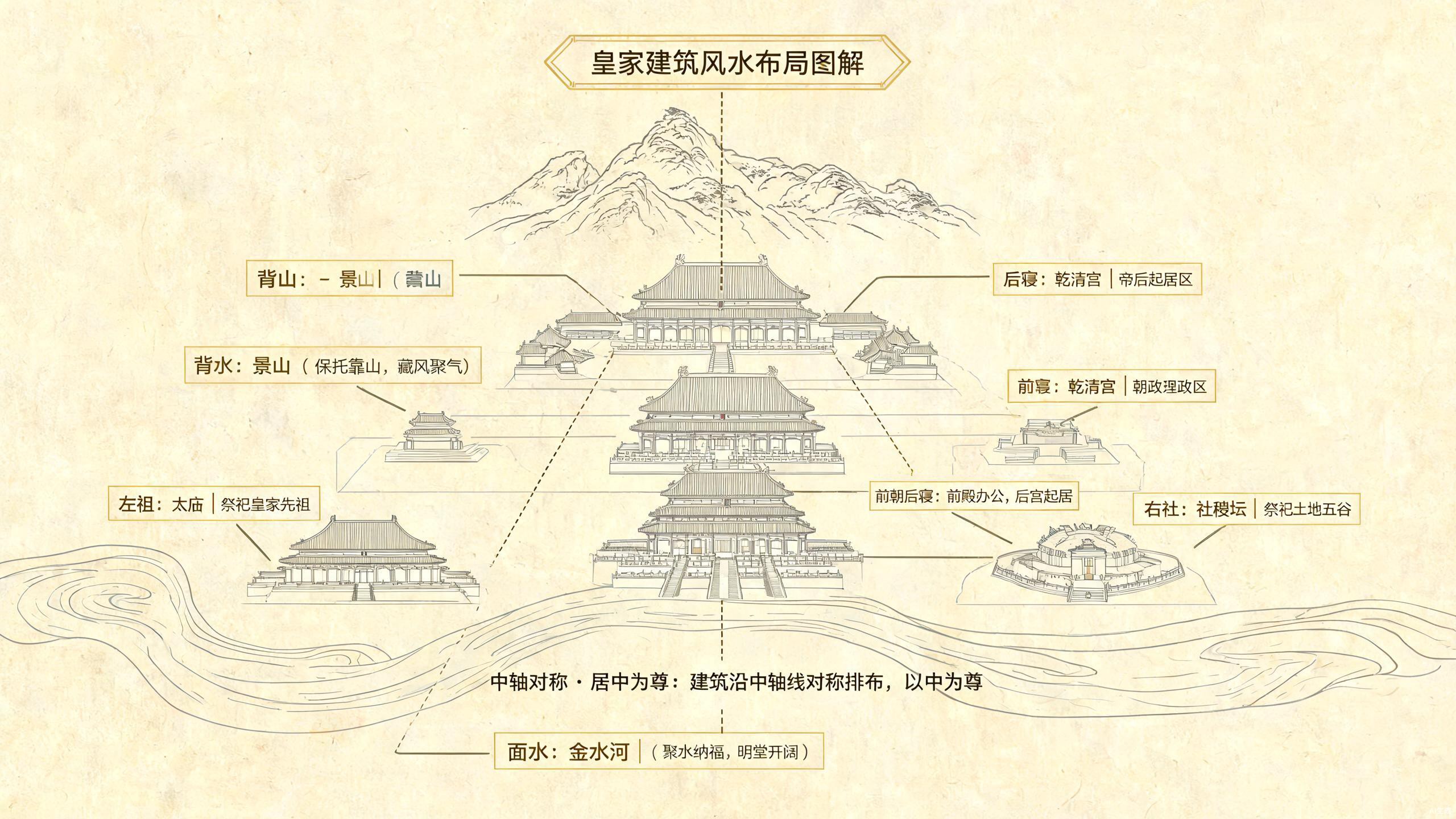
I. Core Philosophy of Royal Feng Shui
Royal architecture Feng Shui represents the highest application of Chinese Feng Shui principles. Unlike folk Feng Shui, Royal Feng Shui must not only satisfy the basic need to "seek auspiciousness and avoid inauspiciousness," but more importantly, it must serve the legitimacy of political power and the stability of rule. The core concept of Royal Feng Shui can be summed up in four characters: "Divine Right of Kings" (君权神授).
Through meticulously designed spatial layouts, Royal Feng Shui translates political ideals such as "Mandate of Heaven," "Orthodox Lineage," "Hierarchy," and "Order" into architectural language — maximizing the reinforcement and manifestation of imperial power in physical space.
II. The Five Principles of Royal Feng Shui Architecture
Principle 1: Central Axis Symmetry — The Center as Supreme
Theoretical Foundation: The ancient Chinese believed that the Qi (气) of Heaven and Earth converges at the center, and that "center" is the most honored position. As the Son of Heaven, the Emperor must dwell at the center of Heaven and Earth.
Implementation Methods:
- Imperial palaces and capital cities are organized around a north-south central axis
- All important buildings are aligned along this central axis
- Left and right structures are strictly symmetrical
- The central axis is the "Imperial Power Line" — it cannot deviate
Representative Examples:
- The central axis of the Forbidden City (紫禁城) in Beijing (from Yongding Gate to the Bell and Drum Towers, approximately 8 kilometers in total length)
- The central axis of Tang Dynasty Chang'an City (Zhuque Avenue)
- The central axis of Ming Dynasty Nanjing Imperial Palace
Cultural Context: In Chinese cosmology, the center is where cosmic Qi concentrates. Placing the ruler at the physical center mirrors his spiritual position as the cosmic axis between Heaven and Earth — a concept that shaped Chinese urban planning for over two millennia.
Feng Shui Significance:
- Being centered allows Qi to gather; gathered Qi generates powerful momentum
- Symmetry creates balance; balance ensures stability
- The central axis symbolizes the singularity and inviolability of imperial authority
Principle 2: Sitting North Facing South — Embracing Yin and Yang
Theoretical Foundation: The Yijing (Book of Changes) states: "The sage faces south to govern the world, facing the light to rule." Sitting North Facing South (坐北朝南) is the standard orientation for an emperor to claim supremacy from the south.
Implementation Methods:
- Main palace halls face south while sitting to the north
- The emperor's throne is positioned facing south
- The main gates of capital cities open to the south
- Important ceremonies are conducted facing south
Feng Shui Significance:
- The north represents Yin — the Black Tortoise (玄武, Xuan Wu); backing the north means "embracing Yin" (负阴)
- The south represents Yang — the Vermilion Bird (朱雀, Zhu Que); facing south means "embracing Yang" (抱阳)
- Embracing Yin and Yang achieves harmony between the two cosmic forces
- South-facing orientation provides optimal sunlight, symbolizing brightness, openness, and righteousness
Principle 3: Front Court, Rear Residence — Yin-Yang Zoning
Theoretical Foundation: Confucian ritual emphasizes "separation of public and private" and "distinction between inner and outer." Royal architecture must clearly divide state affairs (public) from personal life (private).
Implementation Methods:
- The front section serves as the "Court" — for governance, ceremonies, and official functions
- The rear section serves as the "Residence" — the living quarters for the emperor and his consorts
- Front court buildings are grand and imposing, expressing masculine Yang energy
- Rear residence buildings are refined and intimate, expressing feminine Yin energy
Representative Examples:
- The Forbidden City: Front Court = Three Great Halls; Rear Residence = Three Rear Palaces
- Tang Dynasty Daming Palace: Front = Hanyuan Hall; Rear = Zichen Hall
Feng Shui Significance:
- The front is Yang, the rear is Yin — creating clear Yin-Yang zoning
- The front opens wide to receive Qi; the rear closes to accumulate Qi
- Distinct levels prevent Qi from becoming chaotic or scattered
Principle 4: Ancestral Temple Left, Altar of Land and Grain Right — Ritual Pairings
Theoretical Foundation: The Kaogong Ji (Records of Craftsmen) chapter of the Zhou Li (Rites of Zhou) stipulates: "Ancestral temple on the left, Altar of Land and Grain on the right, court facing the front, market behind." This means imperial palaces should have the Imperial Ancestral Temple (for worshipping ancestors) to the left and the Altar of Land and Grain (for worshipping earth and harvest deities) to the right.
Implementation Methods:
- The Imperial Ancestral Temple is located to the east (left) of the palace
- The Altar of Land and Grain is located to the west (right) of the palace
- The Ancestral Temple symbolizes bloodline continuity
- The Altar of Land and Grain symbolizes the national foundation
Representative Examples:
- The Forbidden City in Beijing: Ancestral Temple on the left (today's Working People's Cultural Palace), Altar of Land and Grain on the right (today's Zhongshan Park)
Cultural Context: The Four Celestial Animals (四象) — Azure Dragon (青龙) on the left, White Tiger (白虎) on the right — divide space into complementary energies. The left (Azure Dragon, Wood) governs growth and life, perfect for ancestor veneration. The right (White Tiger, Metal) governs protection and stability, ideal for state rituals.
Feng Shui Significance:
- The left corresponds to the Azure Dragon (Wood), governing growth and reproduction — matching the Ancestral Temple's role
- The right corresponds to the White Tiger (Metal), governing protection and stability — matching the Altar of Land and Grain's role
- The two sides work together, balancing bloodline with national continuity
Principle 5: Five Gates, Three Courts — Progressive Layering
Theoretical Foundation: The ritual sequence stipulated in the Zhou Li creates a hierarchical spatial experience through layered gates and halls, reinforcing the order of rank and precedence.
Implementation Methods:
- Five city gates create progressive layers; passing through each gate represents deeper entry into imperial space
- Three Courts (Outer, Middle, Inner) have clearly differentiated functions
- The deeper one goes, the closer to the core of imperial power
- Space contracts layer by layer, Qi gathers with each step
Representative Examples:
- The Forbidden City's Five Gates: Daming Gate → Tiananmen Gate → Duanmen Gate → Wumen Gate → Taihemen Gate
- The Forbidden City's Three Courts: Taihe Hall (Grand Court) → Zhonghe Hall (Middle Court) → Baohe Hall (Inner Court)
Feng Shui Significance:
- Progressive layering causes Qi to gather with each step inward
- The deeper the space, the more honored and intimate
- Qi disperses outside the gates; Qi accumulates within — five gates create five accumulations
III. Confucian Orthodoxy in Royal Feng Shui
1. Ritual Hierarchy of Architecture
Royal architecture Feng Shui strictly embodies the Confucian hierarchical order:
| Architectural Rank | Roof Style | Used By | Feng Shui Meaning |
|---|---|---|---|
| Highest | Double-eaved Hip Roof (重檐庑殿顶) | Taihe Hall, etc. | Supreme dignity; symbol of imperial power |
| Second Highest | Double-eaved Hip-and-Gable Roof (重檐歇山顶) | Baohe Hall, etc. | Secondary honor; core imperial family |
| Middle | Single-eaved Hip Roof | Important side halls | Honorable; close imperial relatives |
| Lower | Single-eaved Hip-and-Gable Roof | General halls | Ordinary; daily use |
| Lowest | Flush Gable / Overhanging Gable Roof | Auxiliary buildings | Inferior; for servants |
2. Numerical Hierarchy
The number of bays (openings) in a building also reflects rank:
- Nine bays: Highest rank, reserved exclusively for the emperor's main halls
- Seven bays: Princes and lords of the highest rank
- Five bays: General officials
- Three bays: Common people
Nine is the ultimate Yang number, symbolizing supreme authority. The Hall of Supreme Harmony in the Forbidden City spans eleven bays (after Qing Dynasty reconstruction) — even surpassing the traditional nine-bay standard.
3. Color Hierarchy
| Color | Used By | Five Elements Meaning |
|---|---|---|
| Yellow | Emperor exclusively | Earth at the center — supreme |
| Red | Imperial palace, high officials | Fire generates Earth — supports imperial power |
| Green | Princes, Crown Prince | Wood governs growth — subordinate to center |
| Black | Library buildings, special structures | Water governs wisdom — literary fortune |
| Gray | Common people | Neutral; does not compete for prominence |
IV. Feng Shui Expression of Divine Right of Kings
1. Celestial Correspondence
Royal architecture corresponds to celestial phenomena in Feng Shui:
- The Forbidden City corresponds to the Purple Forbidden Enclosure (紫微垣, the North Star region)
- The emperor's sleeping chambers correspond to the Emperor Star
- The offices of the Three Dukes and Nine Ministers correspond to the Three Enclosures and Twenty-Eight Mansions
2. Orthodox Dragon Vein Lineage
Royal Feng Shui emphasizes the concept of "Orthodox Dragon Vein" (正统龙脉):
- Beijing's Dragon Vein originates from the Taihang Mountains and Yan Mountains
- When dynasties changed, new rulers would re-justify the orthodoxy of their capital's Dragon Vein
- The orthodoxy of the Dragon Vein served as the Feng Shui basis for political legitimacy
Cultural Context: The Dragon Vein (龙脉) is the underground mountain range believed to channel Earth's Qi from Kunlun Mountains across the land. Whoever controls the land where the Dragon Vein settles is believed to receive Heaven's mandate — making Feng Shui geography inseparable from political legitimacy.
3. Mandate of Heaven
Royal architecture Feng Shui expresses the "Mandate of Heaven" through several methods:
- Sites chosen at the "Center of the World" or at the "Dragon Vein's acupoint"
- Building dimensions secretly correspond to celestial measurements (e.g., nine zhang nine chi symbolizing the Nine Heavens)
- "Reporting to Heaven" (告天) ceremonies performed upon completion
V. Differences Between Royal Feng Shui and Folk Feng Shui
| Feature | Royal Feng Shui | Folk Feng Shui |
|---|---|---|
| Purpose | Consolidate imperial power, perpetuate dynastic prosperity | Seek luck, avoid misfortune, improve daily life |
| Scale | Capital cities, palaces, imperial tombs | Private residences, ancestral graves |
| Theory | Confucian ritual system + Feng Shui techniques | Pure Feng Shui techniques |
| Colors | Yellow and red dominant (imperial power) | Gray and green dominant (modest) |
| Central Axis | Absolute axial symmetry | Relative symmetry is sufficient |
| Numbers | Imperial numbers like Nine-Five Supreme | General auspicious numbers suffice |
| Water Methods | Golden Water River, moat | Natural water systems |
| Investment | Unlimited budget | According to one's means |
VI. Modern Lessons from Royal Architecture Feng Shui
- The Importance of Holistic Planning: Royal architecture emphasizes comprehensive layout — modern urban planning likewise requires a panoramic vision
- Harmony Between Humanity and Nature: Royal Feng Shui values backing mountains and facing water, Storing Wind and Gathering Qi — principles that still hold ecological value today
- Order and Efficiency: Central Axis Symmetry and progressive layering are not merely aesthetic needs; they also enhance spatial efficiency
- Cultural Heritage: Royal architecture Feng Shui carries profound cultural significance and represents an essential component of Chinese civilization
This article is compiled from sources including 《皇家风水:帝王文化的成功演绎》(Royal Feng Shui: The Successful Interpretation of Imperial Culture) for cultural research reference.
Related Articles
- [[../01-风水入门/09-Ten Principles of Modern Feng Shui.md|Top Ten Principles of Modern Feng Shui]]
- [[../01-风水入门/42-皇家风水与民间风水.md|Royal Feng Shui vs. Folk Feng Shui: From the Forbidden City to Common Homes]]
- [[../07-风水故事/03-Qin Shi Huang Severing Jinling's Dragon Vein.md|Emperor Qin Shi Huang Severing the Jinling Dragon Vein — The Feng Shui Panic of the First Emperor]]
- [[../07-风水故事/17-朱元璋祖坟传说.md|The Zhu Yuanzhang Ancestral Grave Legend — Feng Shui Secrets of the Fengyang Imperial Tombs]]