The Origins and Evolution of Feng Shui: From Primitive Shamanism to Modern Practice
## I. The Primitive Origins of Feng Shui The roots of Feng Shui (风水, feng shui) trace back to ancient shamanic practices and nature worship. Through long observation of how their environment affected
The Origins and Evolution of Feng Shui: From Primitive Shamanism to Modern Practice
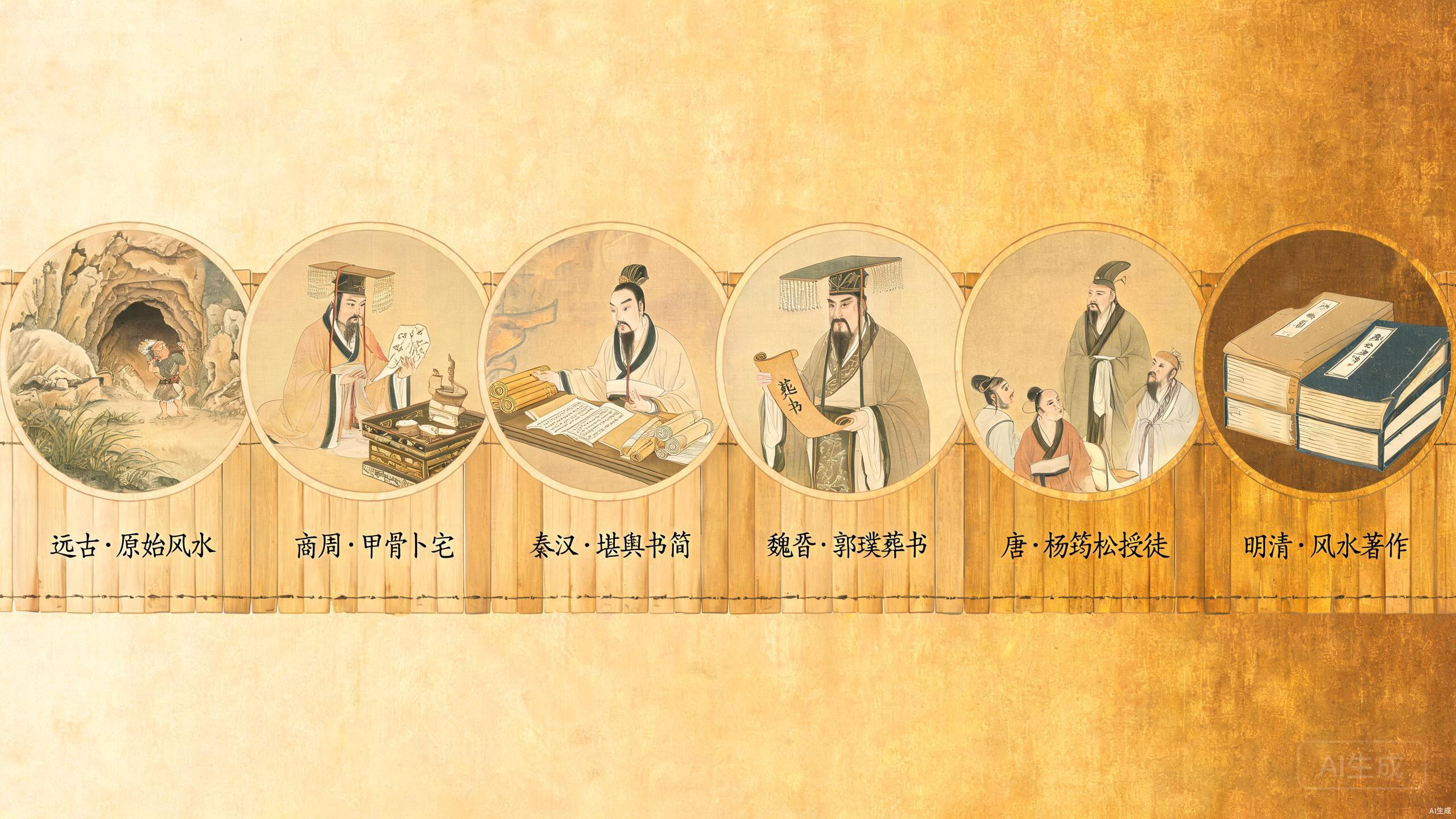
I. The Primitive Origins of Feng Shui
The roots of Feng Shui (风水, feng shui) trace back to ancient shamanic practices and nature worship. Through long observation of how their environment affected survival and prosperity, early peoples gradually developed an awareness of selecting beneficial dwelling sites.
Settlement Site Selection in Early Cultures
Archaeological discoveries reveal that as early as the Yangshao Culture period (6,000–7,000 years ago), the ancestors of Banpo Village had already chosen to build their settlement on a hillside featuring Back to Mountain Facing Water (背山面水), sheltered from wind and oriented toward the sun. This reflects the most primordial Feng Shui principle — the pursuit of Auspicious and Inauspicious (吉凶, ji xiong) outcomes.
Three defining characteristics of primitive Feng Shui awareness:
- Living near water: Easy access for drinking, irrigation, and fishing
- Back to wind, facing the sun: Avoiding cold northern winds while enjoying warmth and light
- High ground for flood protection: Choosing elevated terrain to escape flooding
Divination and Site Assessment
During the Shang and Zhou dynasties, selecting residences and burial sites involved formal divination ceremonies known as "divining the dwelling" (卜宅) or "divining the residence" (卜居). Oracle bone inscriptions contain extensive records of such practices — demonstrating that before building, relocating a capital, or conducting burials, people would perform divination to determine favorable outcomes.
The Shang Shu · Luo Gao (Book of Documents · Luo Pronouncement) records the Duke of Zhou's divination process when establishing the city of Luoyang: "I divined east of the Jian River and west of the Chan River — only Luo was auspicious." (我乃卜涧水东,瀍水西,惟洛食。) This stands as one of the earliest systematic records of Feng Shui practice in Chinese history.
II. The Qin and Han Dynasties — Theoretical Foundations
Integration of Yin-Yang and Five Elements Thought
During the Qin and Han dynasties, the theories of Yin and Yang (阴阳, yin yang) and the Five Elements (Wu Xing) matured and were absorbed into Feng Shui practice, elevating it from primitive experience into a theoretical system.
- Yin-Yang theory: Provided the core principle of Yin-Yang balance
- Five Elements theory: Offered the analytical framework of Mutual Generation and Restriction (相生相克)
- Bagua (Eight Trigrams) theory: Delivered the tools for evaluating direction-based fortune
Cultural Context: The integration of Yin-Yang and Five Elements transformed Feng Shui from folk wisdom into a systematic cosmology. This philosophical foundation is what distinguishes Feng Shui from mere superstition — it became a way of understanding how humans, environment, and cosmic forces interact.
The Kanyu Golden Cabinet and Palace-Dwelling Landform
The Han dynasty produced the earliest specialized Feng Shui texts — the Kan Yu Jin Gui (堪舆金匮, Kanyu Golden Cabinet) and the Gong Zhai Di Xing (宫宅地形, Palace-Dwelling Landform). The appearance of these works marked the formal establishment of Feng Shui as an independent discipline.
Qing Wuzi and the Professional Practitioners
The Han dynasty also saw the rise of professional Feng Shui practitioners. The most famous was "Qing Wuzi" (青乌子), after whom Feng Shui became alternatively known as "Qing Wu Shu" (the Art of Qing Wuzi).
III. The Wei, Jin, and Northern-Southern Dynasties — System Formation
Guo Pu and the Zang Shu
The Wei-Jin period was a pivotal era for Feng Shui's development. The Zang Shu (Book of Burial) authored by Guo Pu (郭璞, 276–324 AD) of the Jin dynasty stands as a milestone in Feng Shui history.
Cultural Context: Guo Pu is revered as the founding father of Feng Shui theory. His Zang Shu is to Feng Shui what Aristotle's Politics is to political philosophy — the text that defined an entire field of study and continues to shape it today.
Core contributions of the Zang Shu:
- First definition of "Feng Shui": "Qi rides the wind and scatters, but is retained when encountering water. The ancients gathered it so it would not disperse and guided it so it would stay — thus they called it Feng Shui." (气乘风则散,界水则止,古人聚之使不散,行之使有止,故谓之风水。)
- Establishing the principle of Storing Wind and Gathering Qi (藏风聚气): The essence of Feng Shui lies in finding sites that can shelter from wind and accumulate Qi
- Introducing the theory of Riding Vital Qi (乘生气): The core of Yin Dwelling Feng Shui (阴宅风水, yin zhai feng shui) is to harness the Vital Qi (生气, sheng qi) of heaven and earth
Guan Lu and Site Assessment Arts
Guan Lu (管辂) of the Three Kingdoms period was a master of the Yi Jing (Book of Changes) and the art of site assessment. He is honored as one of the Feng Shui patriarchs, having enriched Feng Shui methodology by combining divination with geographical observation.
IV. The Tang and Song Dynasties — The Golden Age
The Flourishing of Tang Dynasty Feng Shui
The Tang dynasty marked the golden age of Feng Shui, producing legendary masters including Yang Yunsong, Zeng Wenzhan, and Lai Buyi.
Yang Yunsong (杨筠松, 834–900 AD), respectfully called "Yang Gong," was one of the most influential figures in Feng Shui history. He founded the Form School (形势派, Xing Shi Pai) — also called the Luan Tou School (峦头派) — which evaluates fortune through the actual forms of mountains and waters. His major works include the Han Long Jing (Classic of Shaking Dragon), Yi Long Jing (Classic of Doubting Dragon), and Qing Nang Ao Yu (Hidden Words of the Green Satchel).
Core principles of Yang Yunsong's Feng Shui theory:
- Four foundational elements: Dragon, Acupoint, Sand, and Water
- Emphasis on the field method of Seeking Dragon and Pointing Acupoint (寻龙点穴)
- Direct visual judgment of mountain forms and water flow
The Rise of the Compass School in the Song Dynasty
During the Song dynasty, the Compass School (理气派, Li Qi Pai) — also called the "Luopan School" — emerged alongside the Form School.
Lai Buyi (赖布衣) was a renowned Song dynasty Feng Shui master who built upon the Form School by incorporating deeper Yi Jing (易理) principles and numerical arts, driving the development of the Compass School.
Characteristics of the Compass School:
- Emphasis on the relationship between direction and time
- Heavy reliance on the Luopan (Feng Shui Compass) and precise directional measurement
- Integration of Bagua (八卦), Heavenly Stems, and Earthly Branches
- Development of complex calculation methods such as Xuan Kong Flying Stars (玄空飞星)
V. The Ming and Qing Dynasties — Theoretical Synthesis
Proliferation of Feng Shui Texts
The Ming and Qing periods represented a phase of synthesis and compilation, with an abundance of Feng Shui literature emerging:
- Di Li Ren Zi Xu Zhi (Essential Geography for the Student, by Xu Shanji and Xu Shanshu of the Ming dynasty): The great compilation of the Form School
- Di Li Wu Jue (Five Essentials of Geography, by Zhao Jiufeng of the Qing dynasty): A systematic exposition of the five core elements
- Ba Zhai Ming Jing (Mirror of Eight Mansions): The classic text on Yang Dwelling (阳宅, yang zhai) Feng Shui
- Shen Shi Xuan Kong Xue (Shen's Xuan Kong Study, by Shen Zhuqi of the Qing dynasty): The definitive work on Xuan Kong Flying Stars
Social Popularization of Feng Shui
During the Ming and Qing, Feng Shui moved from royal exclusivity to popular adoption. Virtually every village and town had its Feng Shui master, and weddings, funerals, house-building, and relocations all required Feng Shui consultation. Feng Shui became deeply embedded in Chinese daily life and an inseparable part of traditional culture.
VI. Modern Era — The Transformation of Feng Shui
Questioning and Reflection in the Republican Era
During the Republican period (1912–1949), influenced by the spread of Western learning, Feng Shui faced severe criticism from scientific rationalist thought and was dismissed by some intellectuals as "superstition." At the same time, however, scholars began to reexamine Feng Shui through a modern academic lens, seeking to extract its rational components.
Contemporary Reassessment
Since the reform and opening-up era, Feng Shui has regained attention in China. The academic community has begun studying it with an objective and rational attitude, uncovering its reasonable elements related to geography, ecology, architecture, and psychology.
The Ten Principles of Modern Feng Shui include:
- Holistic systems principle
- Principle of adapting to local conditions
- Principle of Backing Mountain and Facing Water
- Principle of observing form and momentum
- Geological inspection principle
- Water quality analysis principle
- Principle of Sitting North Facing South (坐北朝南)
- Principle of moderation and centrality
- Principle of riding Vital Qi
- Principle of Feng Shui modification
How to Appreciate Feng Shui as a Modern Practitioner
Whether you are a homeowner or simply curious about Feng Shui, you can apply these historical insights:
- Start with observation: Walk through your living space and notice how natural light, airflow, and layout affect your mood and energy
- Honor ancient wisdom: Practices like Sitting North Facing South have stood the test of time because they align with sunlight patterns and climate realities
- Apply common sense: Feng Shui's emphasis on clean Qi, good light, stable ground, and flowing water reflects basic principles of healthy living
- Remain open-minded: Treat Feng Shui as a philosophical system for understanding human-environment harmony, not as superstition
Quick Tips:
- Even modern architects recognize that building orientation affects energy efficiency — Feng Shui codified this wisdom centuries ago
- The "back to mountain, facing water" principle simply recommends sheltered sites with good views and fresh airflow
- Feng Shui's emphasis on site selection anticipates modern fields like environmental psychology and sustainable design
VII. Historical Lessons from Feng Shui's Evolution
Looking across thousands of years of Feng Shui development, we can extract five key insights:
- Born from practice: Feng Shui originated from accumulated experience with living environments
- Matured through theory: Successive generations of scholars elevated it into a complete system
- Flourished through application: During the Tang, Song, Ming, and Qing periods, it was applied across all social classes
- Transformed by the times: Each era infused Feng Shui with new meaning
- Returning to rationality: Modernity calls for a scientific and rational approach to this tradition
The core wisdom of Feng Shui — harmony between humanity and nature — remains profoundly relevant today.
This article synthesizes material from "History of Chinese Feng Shui" and "The Ten Principles of Modern Feng Shui," provided for cultural research reference.
Related Articles
- [[../01-风水入门/11-河图洛book与风水起源.md|He Tu Luo Shu and the Origins of Feng Shui]]
- [[../01-风水入门/30-风水基础测试题100道.md|100 Essential Feng Shui Knowledge Questions]]
- [[../02-家居风水/33-阳台风水植物.md|Balcony Feng Shui Plants: Greenery for Wealth and Sha Dissolution]]
- [[../02-家居风水/37-植物与风水.md|Plants and Feng Shui: Five Elements Harmony and Wealth Activation Through Home Greenery]]