Dragon Vein Legend: The Ancient Art of Seeking Dragon and Pointing Acupoint for Feng Shui
"Read ten thousand mountains wrapped around the spine — each fold reveals another gate." Among all Feng Shui concepts, the Dragon Vein (龙脉, lóng mài) is undeniably the most central, the most mysteriou
Dragon Vein Legend: The Ancient Art of Seeking Dragon and Pointing Acupoint for Feng Shui
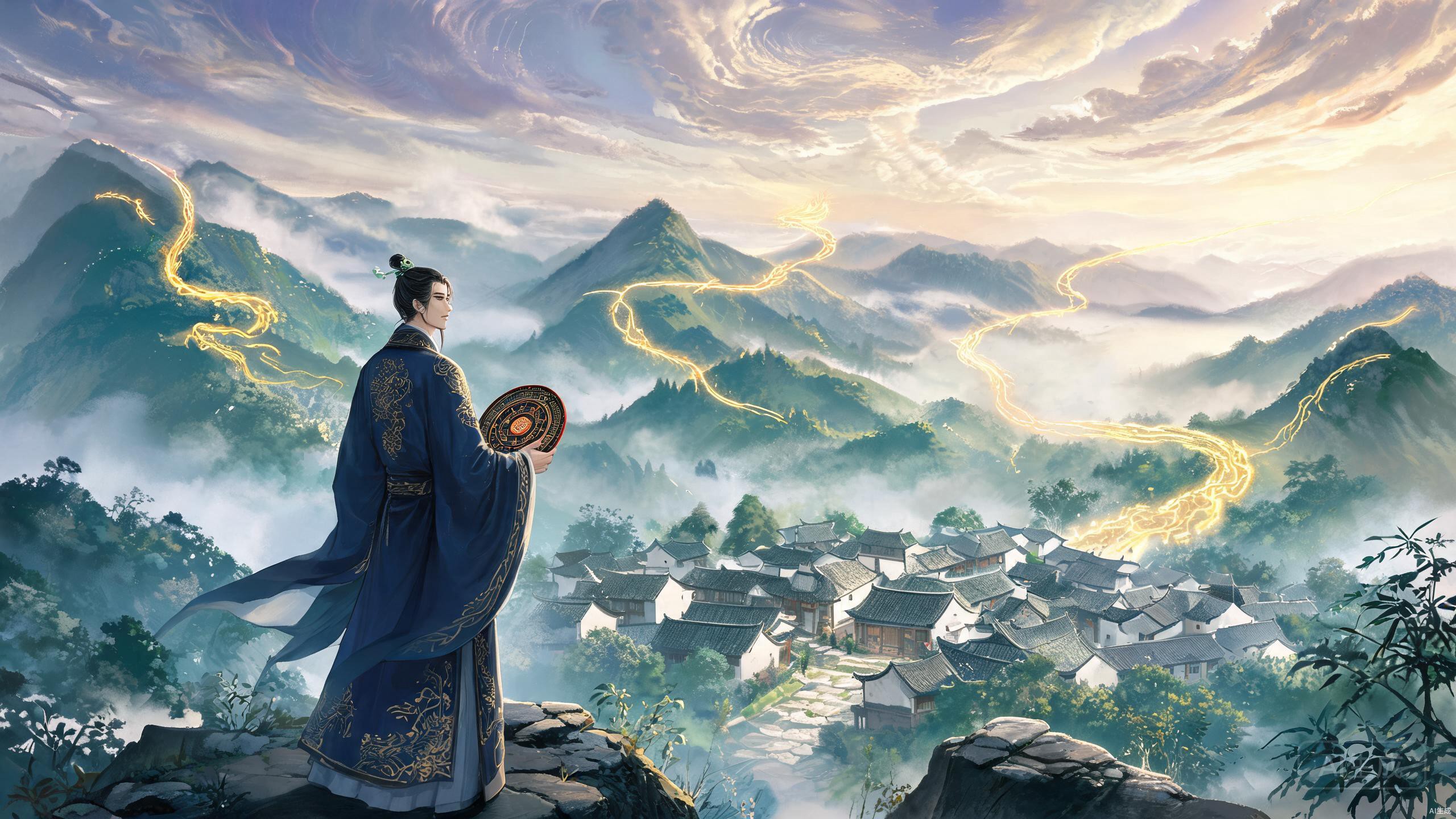
"Read ten thousand mountains wrapped around the spine — each fold reveals another gate." Among all Feng Shui concepts, the Dragon Vein (龙脉, lóng mài) is undeniably the most central, the most mysterious, and the most legendary. Stories of Dragon Veins stretch from the Kunlun Mountains to the Eastern Sea, from emperors to common folk, threading through the entire history of Chinese Feng Shui.
What Is a Dragon Vein
The term "Dragon Vein" is the Feng Shui designation for the flowing patterns of mountain ranges. Feng Shui views the earth as a living body, complete with "meridians" through which Vital Qi (生气, shēng qì) circulates. Mountain ranges are the visible expression of these terrestrial meridians — their rises and falls resemble a dragon in motion, hence the name "Dragon Vein."
Dragon Veins are classified into "trunk" and "branch" categories, much like a river system has its main stream and tributaries:
| Dragon Vein Type | Characteristics | Acupoint Formation |
|---|---|---|
| Major Trunk Dragon | Stretches thousands of miles, overwhelmingly grand | Suitable for capitals and imperial tombs |
| Minor Trunk Dragon | Several hundred miles, impressively solid | Suitable for prefectures and major cities |
| Major Branch Dragon | Dozens of miles, moderate scale | Suitable for towns and prominent family graves |
| Minor Branch Dragon | A few miles or shorter, slender | Suited for ordinary households and small graves |
Cultural Context: In Chinese cosmology, the earth is a microcosm of the human body. Just as Qi flows through our meridians, it flows through the earth's mountain "veins." This metaphor connects personal health to landscape geography — making Feng Shui, at its core, a practice of harmonizing human life with the natural world.
Chinese Feng Shui holds that all Dragon Veins under heaven originate from the Kunlun Mountains, revered as the "Ancestor of Ten Thousand Mountains" and the "Origin of Dragon Veins." From Kunlun, three great Dragon Veins branch eastward:
- Northern Dragon: Passes through the Qilian, Yin, Taihang, and Yan Mountains, forming its acupoint around the Beijing region
- Central Dragon: Passes through the Qinling, Songshan, and Mount Tai, forming its acupoint across the Central Plains
- Southern Dragon: Passes through the Min Mountains, Nanling, Wuyi, and Tianmu Mountains, forming its acupoint in the Jiangnan region
| Three Great Trunk Dragons | Route | Acupoint Region | Representative Capitals |
|---|---|---|---|
| Northern Dragon | Kunlun → Qilian → Yin → Taihang → Yan | North China | Beijing |
| Central Dragon | Kunlun → Qinling → Songshan → Tai | Central Plains | Chang'an, Luoyang |
| Southern Dragon | Kunlun → Min → Nanling → Wuyi → Tianmu | Jiangnan | Nanjing, Hangzhou |
Legends of Seeking the Dragon
"Dragon seeking" is the first — and most difficult — step in Form School Feng Shui. Legend says the true master can "read Qi to know the dragon and observe form to locate its acupoint," as if gifted with a heavenly eye.
One widely circulated story tells of a Feng Shui master and his disciple seeking a Dragon Vein in the mountains for three days. The disciple asked: "Master, where is the dragon?" The master pointed to the cloud-wrapped peaks ahead and said: "See those mountains, rising and falling like a dragon moving through clouds? Its rises are the dragon's spine, its falls are its joints, its bends are the dragon turning, and where it stops is where the dragon forms its acupoint."
The disciple then asked: "How can we know if a dragon is true or false?" The master answered: "A true dragon has 'Four Truths' — a clear source (来龙真), a powerful constriction (过峡真), a tent-like opening (开帐真), and a distinct acupoint (结穴真). A false dragon has an unclear origin, a weak constriction, a scattered opening, and a blurred acupoint."
The disciple asked further: "How can we know if a dragon is auspicious or inauspicious?" The master replied: "An auspicious dragon has 'Five Auspicities' — it is alive (vividly undulating), powerful (grandly solid), affectionate (embracing and protective), measured (neither excessive nor lacking), and at rest (gathering to form an acupoint). An inauspicious dragon is dead, weak, turned away, excessive, or running — rigid and lifeless, weak and scattered, turning its back coldly, overextended without closure, or fleeing without pause."
| Four Truths of the Dragon | Meaning |
|---|---|
| Clear Source (来龙真) | The Dragon Vein's origin is clearly traceable |
| Powerful Constriction (过峡真) | The Dragon Vein's narrowing is forceful |
| Tent-like Opening (开帐真) | The Dragon Vein opens like a canopy |
| Distinct Acupoint (结穴真) | The Dragon Vein's gathering point is unmistakable |
| Five Auspicities of an Auspicious Dragon | Five Inauspicities of an Inauspicious Dragon |
|---|---|
| Alive (rhythmically undulating) | Dead (rigid, without rise or fall) |
| Powerful (grandly solid) | Weak (frail and scattered) |
| Affectionate (embracing and protective) | Turned Away (cold and unresponsive) |
| Measured (neither excessive nor lacking) | Excessive (overextended without closure) |
| At Rest (gathering to form an acupoint) | Fleeing (running endlessly without pause) |
Legends of Pointing the Acupoint
After "seeking the dragon" comes "pointing the acupoint" — locating the precise spot on the Dragon Vein where Vital Qi concentrates most powerfully. Legend holds that the difficulty lies in how "a hair's breadth of error can mean a thousand miles of consequence."
There is a story of a Feng Shui master who identified a spot for a family and declared: "A person of distinction shall emerge in three generations if buried here." His disciple, watching from the side, secretly memorized the orientation. Years later, when pointing an acupoint for another family, the disciple copied the same orientation exactly. Yet the family he served saw no honored descendants in three generations — instead, their fortunes declined.
Puzzled beyond measure, the disciple returned to his master and asked for an explanation. The master said: "Pointing an acupoint is not only about direction — it is about reading the Qi. Where I pointed, the dragon's Qi was gathered precisely at that spot. Where you pointed, the dragon's Qi had already shifted by several feet. The same form, different Qi — the difference between fortune and misfortune is as vast as heaven and earth."
Cultural Context: This story captures a core principle of Feng Shui practice: form can be replicated, but Qi cannot be faked. This is why traditional masters insist on years of apprenticeship — the subtle perception of Qi cannot be taught through books or formulas alone, only through patient observation and embodied experience.
This tale illustrates that acupoint-pointing cannot rely on form alone — it must read the Qi. Form may be imitated, but Qi resists imitation. It is precisely this quality that gives Feng Shui its reputation as an art "beyond words, understood only through intuition."
Dragon Veins and the Rise and Fall of Dynasties
In traditional belief, Dragon Veins are intimately connected to the prosperity and decline of dynasties. The fortunes of a dynasty were thought to mirror the vitality of its Dragon Vein:
| Dynasty | Dragon Vein Location | Corresponding Fortunes |
|---|---|---|
| Qin | Qinling Mountains of Guanzhong | Vein flourishing led to unification; its decline brought swift collapse |
| Han | Guanzhong and Nanyang | Two branches of the vein — Eastern and Western Han stood apart |
| Tang | Guanzhong | Vein prospered, dynasty endured for centuries |
| Song | Central Plains (Bianjing) | Vein ran gently, imperial power leaned weak |
| Ming | Nanjing → Beijing | Relocation borrowed the Northern Dragon, extending dynastic fate |
| Qing | Changbai Mountains of the Northeast | A Dragon Vein beyond the pass entered China and replaced the Ming |
Of course, this "theory of Dragon Vein prosperity and decline" is a retrospective attribution. Yet it reflects a profound cultural psychology: people have always longed to find a "transcendent" explanation for the turning of history — and the Dragon Vein became the most ready-made symbol of "heavenly mandate."
Folk Tales of Dragon Veins
Beyond imperial Dragon Veins, the common folk have produced many stories about "minor Dragon Veins":
1. The Village Dragon Severed
A certain village suffered years of misfortune. After surveying the area, a Feng Shui master discovered that the mountain behind the village undulated like a small dragon, but a newly built road had "severed" the dragon's neck. The master advised either rerouting the road or building a bridge to "reconnect the dragon." The villagers followed his advice, and the village's fortunes gradually recovered.
2. The Family Dragon Wounded
In one household, the hill containing their ancestral grave was being quarried for stone, and the "dragon's body" was damaged. After that, misfortune struck the family in quick succession. The Feng Shui master advised them to relocate the grave to a new burial site, and only then did the family's fortunes stabilize.
3. The Dragon Vein Yields Water
During a severe drought, a Feng Shui master discovered that the "dragon's mouth" of a local Dragon Vein had been blocked with earth, cutting off the flow of dragon Qi. He instructed the villagers to clear the mouth, and a spring of clear water burst forth — resolving the drought.
| Folk Dragon Vein Tale | Problem | Remedy |
|---|---|---|
| Village Dragon Severed | Road cut through the dragon's neck | Reroute road or build a connecting bridge |
| Family Dragon Wounded | Quarrying damaged the dragon's body | Relocate the ancestral grave |
| Dragon Vein Yields Water | The dragon's mouth was blocked | Clear the mouth to release water |
Modern Lessons from Dragon Vein Legends
Although Dragon Vein legends carry a thick veil of mystery, they rest on a sensible geographical foundation:
First, mountains and water systems. Dragon Veins are, at their essence, mountain ranges — and mountain ranges determine water systems, which in turn shape human settlement. A "good Dragon Vein" often means good water, fertile soil, and a favorable climate — conditions that support human flourishing.
Second, geology and resources. Different "Dragon Veins" (geological zones) contain different mineral and groundwater resources. Where the "Dragon Vein thrives," resources tend to be abundant, supporting development.
Third, ecology and environment. The tradition of protecting Dragon Veins has objectively served to preserve mountains, vegetation, and water systems — a principle that resonates strongly with modern environmental conservation values.
Key Feng Shui Concepts
- Dragon Vein (龙脉): The Feng Shui term for the flowing patterns of mountain ranges, believed to resemble dragons winding across the earth and channeling Vital Qi.
- Three Great Trunk Dragons: China's Dragon Veins divide into Northern, Central, and Southern routes — all originating from the Kunlun Mountains and forming acupoints in different regions.
- Four Truths of the Dragon: Clear Source, Powerful Constriction, Tent-like Opening, and Distinct Acupoint — the four standards for judging a genuine Dragon Vein.
- Five Auspicities of an Auspicious Dragon: Alive, Powerful, Affectionate, Measured, and At Rest — the five qualities of a lucky Dragon Vein.
- Pointing the Acupoint: The practice of locating the precise spot where Vital Qi concentrates most powerfully on a Dragon Vein — where "a hair's breadth of error can mean a thousand miles of consequence."
How to Apply These Lessons in Modern Life
You don't need a mountain range to benefit from Dragon Vein wisdom. Here's how to translate these ancient principles into your own home and surroundings:
- Seek your "backing mountain": Choose a home with a solid structure — a taller building, hill, or dense trees — behind it for energetic support
- Read the flow around you: Notice how roads, pathways, and landscaping direct movement. Curved, gentle flow gathers Qi; straight, rushing paths scatter it
- Protect the "neck" of your space: Identify narrow chokepoints — long hallways, gaps between buildings, exposed entrances — and soften them with plants, screens, or wind chimes
- Mind your "dragon's mouth": Keep your entryway and main gathering areas clean, clear, and welcoming. Cluttered thresholds block Qi from entering your home
- Honor the "four truths": Choose a location with a clear history, a defined sense of arrival, an open and welcoming feel, and a natural focal point where energy settles
Quick Tips:
- Walk around your neighborhood and notice which homes feel sheltered versus exposed — the sheltered ones are following Dragon Vein principles intuitively
- If you live near a road that "cuts" through your space, consider adding a hedge, fence, or row of tall plants to symbolically "reconnect" the flow
- The entry to your home is the "dragon's mouth" — keep it well-lit, uncluttered, and inviting to invite prosperity inside
Related Articles
- [[../09-Yin Dwelling风水/04-寻龙点穴入门-什么是龙脉.md|Seeking Dragon and Pointing Acupoint: What Is a Dragon Vein?]]
- [[../01-风水入门/06-风水基础概念词典.md|Feng Shui Glossary: 18 Core Terms Explained]]
- [[../01-风水入门/31-Xing Shi School (Luan Tou School) Detailed Guide.md|Form School (Luan Tou School) Explained: The Thousand-Year Legacy of Dragon Vein, Sand, and Water]]
- [[../02-家居风水/09-庭院与外部环境.md|Garden and Outdoor Environment: Four Celestial Animals, Dragon Vein Backing, Road Patterns, and Trees]]