Feng Shui Masters and the Emperor: Power Struggles of Imperial Kanyu (Feng Shui) Through the Dynasties
Throughout China's long history, a delicate relationship has always existed between Feng Shui masters and the emperor. The emperor needed these practitioners to select capital cities, plan palaces, an
Feng Shui Masters and the Emperor: Power Struggles of Imperial Kanyu (Feng Shui) Through the Dynasties
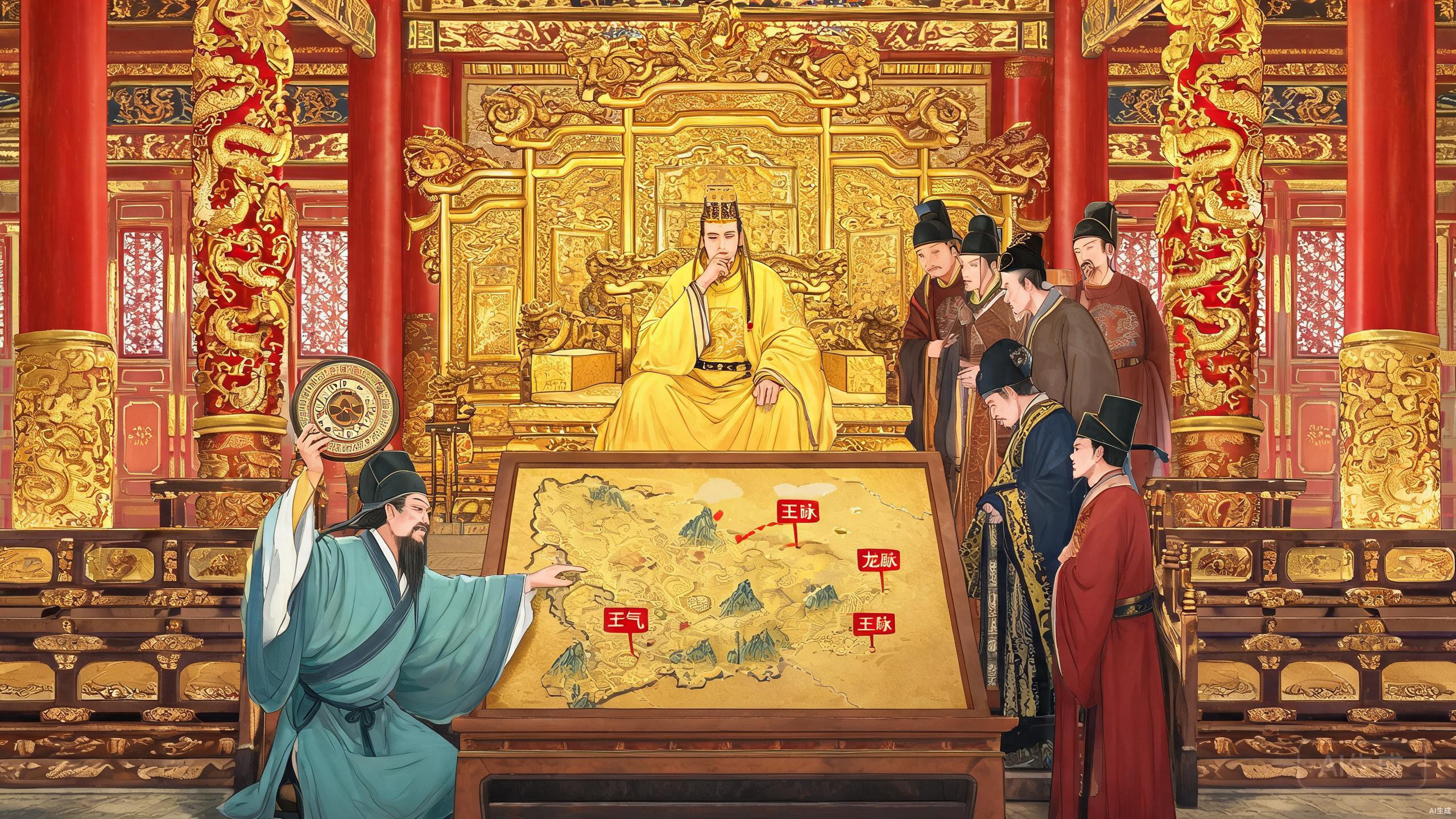
Throughout China's long history, a delicate relationship has always existed between Feng Shui masters and the emperor. The emperor needed these practitioners to select capital cities, plan palaces, and arrange ancestral burials — yet he also feared that any Feng Shui master who knew too much of heaven's secrets (天机) might leak that knowledge to rivals, with unthinkable consequences. This dual attitude of using yet guarding produced many fascinating historical stories.
Cultural Context: Kanyu (堪舆, kǎn yú) is the classical Chinese term for Feng Shui, used exclusively in scholarly and imperial contexts. Think of it as the "official" title of the practice — the emperor's own brand of Feng Shui, distinct from the folk traditions practiced by common people.
Qin Shi Huang and the Qi Observers
Qin Shi Huang (秦始皇) was one of the earliest emperors to employ Feng Shui masters on a grand scale. After unifying the six warring states, he commanded his court alchemists and geomancers to "observe Qi" (望气) across the entire realm — searching for any location where a new emperor's Qi (天子气) might emerge, so he could destroy it at any cost.
Cultural Context: "Observing Qi" (望气) is an ancient Feng Shui technique where trained practitioners gaze at the sky and landscape to detect auspicious or ominous energy fields. The emperor believed that new dynasties would emerge wherever Heaven concentrated its mandate — and where such Qi appeared, a rival claimant to the throne could be born.
During his eastern inspection tour, a court alchemist reported that imperial Qi was gathering in the southeast. Qin Shi Huang immediately ordered his men to split mountains, sever the Qi Dragon Vein (龙脉), redirect waterways, and even demote the place names to weaken their power. Yet the fate of these alchemants was far from rosy — Qin Shi Huang was deeply suspicious by nature. The moment he sensed that any practitioner was "incompetent" or "hiding the truth," he would have them executed without mercy.
According to historical records, during Qin Shi Huang's reign, hundreds of alchemants and mystics were killed for "incorrect Qi observations" or "spreading heretical speech." The most notorious incident was the infamous "Burning of Books and Burying of Scholars" (坑儒) — although this event primarily targeted Confucian scholars, large numbers of alchemants and occult practitioners were also caught in the purge.
The Feng Shui masters quickly learned a harsh lesson: serving Qin Shi Huang required not only exceptional skill, but also the wisdom to "report only good news, never bad." Unfortunately, a tyrant's suspicion can never truly be satisfied.
Liu Bowen and Zhu Yuanzhang's "Duel of Wits"
In the early Ming Dynasty, the story of Liu Bowen (刘伯温) — one of the most celebrated Feng Shui masters in Chinese history — became legendary.
Cultural Context: Liu Bowen (刘伯温, also known as Liu Ji 刘基) is revered as both a brilliant military strategist and a master of Kanyu (Feng Shui). He is often compared to Zhuge Liang (诸葛亮) of the Three Kingdoms era — a scholar-statesman whose wisdom shaped an entire dynasty.
Liu Bowen served as Zhu Yuanzhang's (朱元璋) chief strategist and was also a master practitioner of Kanyu. According to legend, when helping Zhu Yuanzhang select Nanjing as the new Ming capital, he conducted an exhaustive survey of the city's Feng Shui layout.
One famous tale concerns the selection of the Ming Xiaoling Mausoleum (明孝陵) — Zhu Yuanzhang's final resting place. Liu Bowen reportedly chose the Feng Shui Point (穴位) on "Dulong Fu" (独龙阜), a peak in Nanjing's Purple Mountain. The legend holds that this Dragon Vein (龙脉) was a "solitary dragon" — unique and unmatched. If used for a Yang Dwelling (阳宅, the imperial palace), it would mean "a dragon without a mate brings isolation," suggesting an emperor who would rule alone without heirs. But if used for a Yin Dwelling (阴宅, the tomb), it would mean "a solitary dragon finds peace," promising descendants who, though few, would be blessed with fortune.
| Dwelling Type | Chinese Name | Feng Shui Focus | Key Principle |
|---|---|---|---|
| Yang Dwelling | Yang Dwelling (yáng zhái) | Living spaces | Emphasizes Vital Qi flow and abundant sunlight |
| Yin Dwelling | Yin Dwelling (yīn zhái) | Tombs and graves | Emphasizes Storing Wind and Gathering Qi (藏风聚气) |
When Zhu Yuanzhang once asked Liu Bowen, "How many generations will my dynasty endure?" Liu Bowen replied evasively: "Your Majesty will live ten thousand years without limit; the Ming Dynasty's mandate will stretch long and glorious." But folk legend claims that Liu Bowen privately predicted the Ming Dynasty would last only 276 years — he simply dared not speak the truth aloud in front of the emperor.
This story, though partly dramatized, reveals an interesting truth: even the most trusted Feng Shui master at the emperor's side often faced the agonizing choice between brutal honesty and comforting diplomacy.
The Qing Dynasty's Feng Shui Prohibition
By the Qing Dynasty, the emperor's attitude toward Feng Shui masters had grown even more complex. On one hand, the selection of imperial tomb sites was treated with the utmost care — several Qing emperors personally participated in choosing the locations of the Eastern Qing Tombs (清东陵) and Western Qing Tombs. On the other hand, the Qing court imposed strict controls on folk Feng Shui activities — common people were forbidden from practicing Seeking Dragon and Pointing Acupoint (寻龙点穴) on their own, and absolutely prohibited from surveying the imperial Dragon Veins (龙脉).
The Qing court even enacted specific laws prohibiting mining, logging, and burial within "areas where Dragon Veins pass through." Violators faced exile for minor offenses and execution for severe ones. Behind these laws lay the rulers' deep fear of Feng Shui's power — they both believed in its force and dreaded its potential misuse by others.
Quick Tip: Even today, the protection of historical imperial sites in China continues to reflect these ancient principles. Many former imperial tomb locations remain protected cultural zones where construction is tightly restricted.
The Survival Wisdom of Feng Shui Masters
Looking back across history, the Feng Shui masters who lived to a peaceful old age in the service of emperors all shared one quality: they mastered the art of staying low-profile. They understood that Feng Shui knowledge could stabilize a nation — or cost a person their head. The wisest approach was not to flaunt one's abilities, but to occasionally "play dumb."
As the ancients said: "Know the white, keep the black." (知其白,守其黑) In the presence of an emperor, occasional ignorance and humility may be the greatest wisdom of all.
Cultural Context: The phrase "Know the white, keep the black" (知其白,守其黑) comes from the Dao De Jing (道德经), the foundational text of Daoism. It encourages embracing the hidden, humble, and shadowy aspects of life rather than always displaying the bright and obvious. In Feng Shui — and in politics — this principle has saved many lives.
How to Apply These Lessons in Modern Life
While none of us negotiate with emperors today, the wisdom of the ancient Feng Shui masters still applies to modern decision-making:
- Master your craft before anything else: Like Liu Bowen, become genuinely excellent at what you do — reputation is your first protection
- Choose your words with care: Not every truth needs to be spoken aloud; diplomacy is a form of wisdom
- Stay humble in positions of success: The higher you rise, the more quietly you should walk
- Understand power dynamics: Whether in an office, a family, or a community, knowing when to speak and when to stay silent is invaluable
Key Feng Shui Knowledge Points
-
Wang Qi (望气) — Observing Qi: An ancient Feng Shui technique of reading the Qi of mountains and skies to judge auspicious and inauspicious signs. Emperors used this method to monitor shifts in "imperial Qi" across the realm.
-
Dulong Fu (独龙阜): An alternate name for Purple Mountain (紫金山) in Nanjing, so called because its mountain ridge resembles a solitary dragon winding through the landscape. The Ming Xiaoling Mausoleum was deliberately positioned here according to Feng Shui principles.
-
Yin Dwelling vs. Yang Dwelling: Yin Dwelling (阴宅, tomb) Feng Shui emphasizes Storing Wind and Gathering Qi (藏风聚气) — focusing on the convergence of vital energy and peaceful stillness. Yang Dwelling (阳宅, residence) Feng Shui emphasizes Vital Qi flow — focusing on smooth circulation and abundant sunlight. The layout principles for each differ significantly.
-
Dragon Vein (龙脉) Protection: Ancient rulers often used the force of law to protect Dragon Veins believed to govern a nation's fortune, prohibiting any destructive activity within these sacred zones.
Related Articles
- [[../01-风水入门/42-皇家风水与民间风水.md|Royal Feng Shui vs. Folk Feng Shui: From the Forbidden City to Common Homes]]
- [[../06-风水文化与历史/54-风水师的历史地位变迁.md|The Historical Status of Feng Shui Masters Through the Ages]]
- [[../06-风水文化与历史/02-风水流派演变史.md|Evolution of Feng Shui Schools: The Historical Development of Form School and Compass School]]
- [[../07-风水故事/50-蒋大鸿传奇.md|Legend of Jiang Dahong: The Grand Master of Xuan Kong in Late Ming and Early Qing]]