Forbidden City Feng Shui Secrets: Zhu Di's Imperial Layout for Moving China's Capital to Beijing
In 1402 AD, the Yan Prince Zhu Di (朱棣) seized the throne from his nephew, Emperor Jianwen, through the "Jingnan Campaign" (a civil war known as the "Pacification of the Rebellion"). Yet seated in the
Forbidden City Feng Shui Secrets: Zhu Di's Imperial Layout for Moving China's Capital to Beijing
In 1402 AD, the Yan Prince Zhu Di (朱棣) seized the throne from his nephew, Emperor Jianwen, through the "Jingnan Campaign" (a civil war known as the "Pacification of the Rebellion"). Yet seated in the Nanjing palace, he remained restless — Nanjing was the power base of his rivals, with hidden factions still opposing him. More importantly, Beijing was where his destiny had taken root. From a Feng Shui perspective, only by returning to Beijing could he fully embody the destiny of a "True Dragon Son of Heaven."
Cultural Context: In Chinese imperial tradition, a "True Dragon Son of Heaven" (真龙天子) is an emperor whose personal fate harmonizes with the land's Dragon Vein. The location of the capital must align with the ruler's cosmological destiny — otherwise, both the dynasty and the empire suffer.
Seeking Dragon and Pointing Acupoint to Establish the Capital
Zhu Di's decision to move the capital to Beijing was an unprecedented undertaking. But choosing a capital was far more complex than constructing palaces — in ancient China, the selection of a dynastic capital involved the rise and fall of an entire nation's fortune and required rigorous Kanyu (Feng Shui) analysis.
Zhu Di assembled the era's most elite Feng Shui masters to conduct a detailed survey of the mountains and waterways surrounding Beijing. Their conclusion delighted the emperor:
Beijing sits at the northern edge of the North China Plain, backed by the Yan Mountains to the north, supported by the Taihang Mountains to the west, opening toward the Bohai Sea to the east, and overlooking the Central Plains to the south. On a grand scale, the Yan Mountains seem to thunder across the land — thousands of peaks galloping from the northwest, finally forming a "descending vein culminating in an acupoint" near Beijing. The Tianshou Mountain (天寿山) area in Changping is especially remarkable: emerald peaks layered one upon another, like screens and canopies, perfectly fulfilling the Feng Shui principle of "having a mountain at one's back."
Cultural Context: The phrase "Backing Mountain" (靠山, kao shan) refers to the protective landform behind a structure — in classical Feng Shui, the Black Tortoise (玄武) of the north. This solid support symbolizes reliable backing in career, health, and authority.
In front lies the vast North China Plain — flat and open, like a giant "Bright Hall." The Yongding River and Chaobai River flow from the northwest to the southeast, forming the classic "Jade Belt Encircling the Waist" (玉带环腰) water pattern. This layout — "Back to Mountain Facing Water" and "Storing Wind and Gathering Qi" — was precisely the ideal terrain for an imperial capital.
Cultural Context: "Bright Hall" (明堂, ming tang) in Feng Shui refers to the open, flat space directly in front of a building or acupoint — symbolically the space where opportunities and fortune gather. A wider, clearer Bright Hall suggests a broader future.
The Finishing Touch of Wansui Mountain
The construction of the Forbidden City itself followed Feng Shui principles at every turn.
The Feng Shui masters observed that although the Yan Mountains supported the palace from the north, the distance was too great — the energy felt indirect, not commanding. So Zhu Di ordered an artificial hill built directly north of the palace: this became the famous Jingshan (景山), originally named "Wansui Mountain" (万岁山, Mountain of Ten Thousand Years).
Though only about 50 meters tall, Wansui Mountain perfectly filled the gap behind the palace, becoming the Forbidden City's "Backing Mountain" at the Black Tortoise position. Viewed from above, the entire mountain resembles a person seated on a throne — cleverly symbolizing "firmly seated upon the golden throne."
Quick Tip: The concept of "human-assisted environmental transformation" appears throughout imperial Feng Shui. When natural landforms are imperfect, the ancients believed carefully designed artificial hills and waterways could "complete" the Feng Shui pattern.
Fascinatingly, later archaeological research on Jingshan's vegetation distribution revealed that the trees on Wansui Mountain form the pattern of a human figure. Whether this was coincidence or intentional design remains an intriguing mystery to this day.
The Central Axis and Beauty of Symmetry
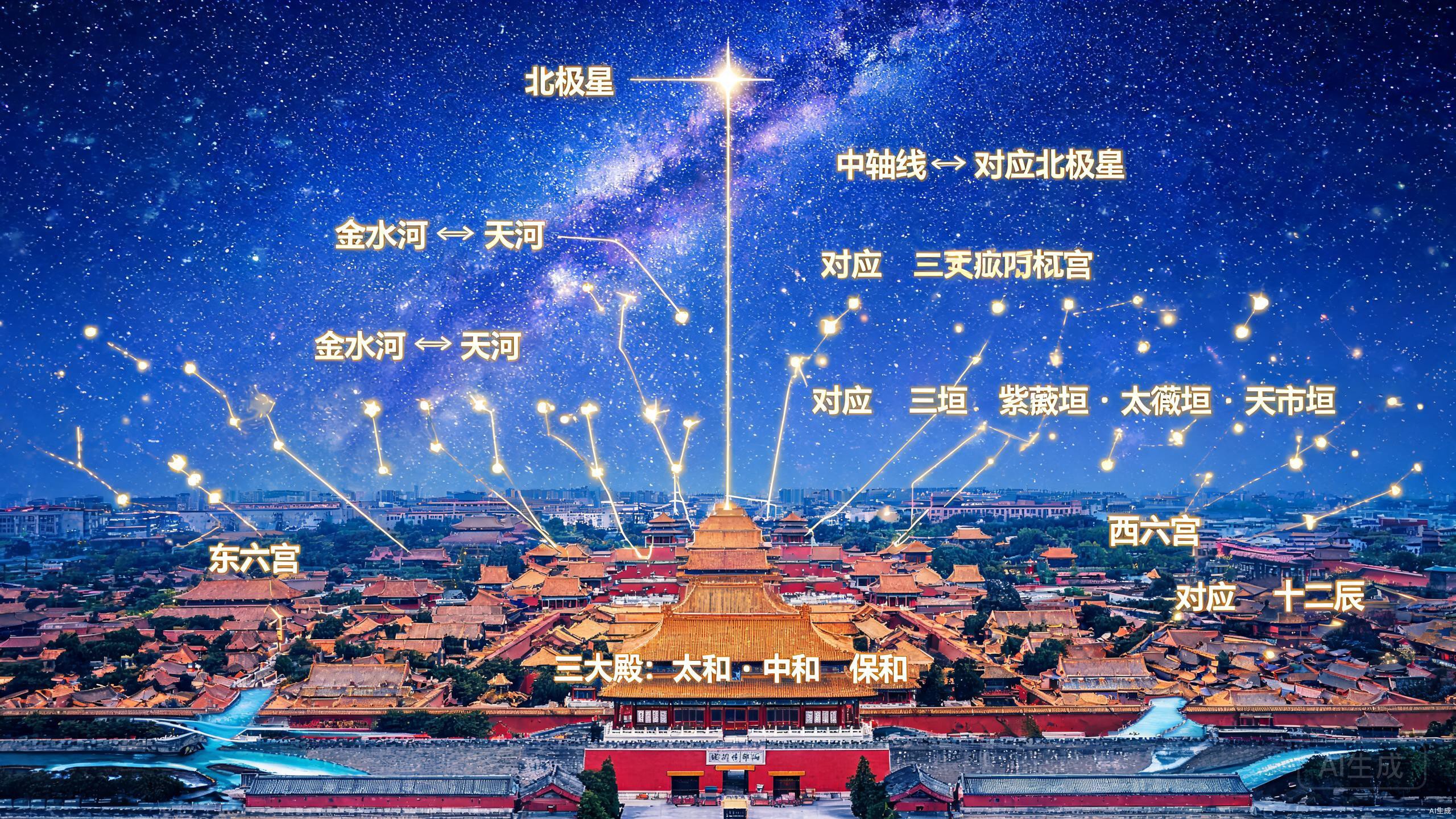
The Forbidden City strictly follows a Central Axis (中轴线) symmetrical layout, stretching approximately 8 kilometers from Yongding Gate in the south to the Bell and Drum Towers in the north. In Feng Shui theory, the Central Axis represents the main channel for Qi — Vital Qi flows down from the north (Black Tortoise), passes through the entire city along this axis, gathers and condenses within the Forbidden City, then gently flows out toward the Vermilion Bird in the south.
Cultural Context: The Vermilion Bird (朱雀, zhu que), one of the Four Celestial Animals in Chinese cosmology, governs the south and represents transformation, warmth, and renewed growth. Qi exiting through this direction is meant to bless the empire and its people.
The Forbidden City's architectural layout also embodies the Feng Shui principle of "Front Court, Rear Residence, Ancestral Temple Left, Altar of Land and Grain Right" (前朝后寝、左祖右社): in front stand the three great halls — Taihe (Hall of Supreme Harmony), Zhonghe, and Baohe (Yang energy); behind lie the three palaces — Qianqing, Jiaotai, and Kunning (Yin energy); to the left is the Ancestral Hall (太庙) and to the right the Altar of Land and Grain (社稷坛). This arrangement honors the balance of Yin and Yang while expressing the supreme authority of imperial power.
Cultural Context: Yin and Yang (阴阳) are the two complementary forces in Chinese cosmology — Yin representing stillness, inwardness, and the earth; Yang representing activity, outwardness, and heaven. In imperial architecture, placing the active governance halls (Yang) in front and the restful residential quarters (Yin) behind was believed to create cosmic harmony and stable rule.
Even the Jinshui River (金水河) flowing through the Forbidden City's entrance was not randomly designed — it curves in a bow shape from west to east, known in Feng Shui as "Jade Belt Encircling the Waist," symbolizing good fortune and imperial favor.
Feng Shui Knowledge Points
- Back to Mountain Facing Water (背山面水): The ideal pattern for both Yang Dwelling (living spaces) and Yin Dwelling (burial sites) — a mountain behind serving as support (Black Tortoise), water in front for embrace (Vermilion Bird), and protective features on both sides (Azure Dragon and White Tiger).
- Bright Hall (明堂): The flat, open space directly in front of an acupoint, like a natural "Wealth Bowl." The wider the Bright Hall, the greater the prospect for achievement.
- Jade Belt Encircling the Waist (玉带环腰): When water flows in an arched or crescent shape around the front of a structure, embracing it like a belt — considered one of the most auspicious water patterns.
- Artificial Luck Enhancement: Improving Feng Shui through human-made hills or excavated rivers. This technique was frequently employed in imperial palaces and royal gardens throughout Chinese history.
How to Apply These Imperial Feng Shui Principles
Even without imperial resources, you can draw inspiration from these ancient techniques:
- Create your "Backing Mountain": Place a solid headboard, tall bookcase, or substantial piece of furniture against the wall behind your bed or desk to provide energetic support
- Honor the Central Axis principle: Arrange your home so that the main door does not align directly with a back door — this prevents Qi from rushing straight through your living space
- Add your "Jade Belt" water feature: A curved pathway, gently meandering indoor fountain, or arched doorway mimics the auspicious flowing water pattern of the Forbidden City
- Balance Yin and Yang in your layout: Place active areas (living room, office) toward the front of your home and restful areas (bedroom) toward the back for natural harmony
Quick Tips:
- Even modest homes benefit from the "Back to Mountain Facing Water" principle — a sturdy wall or fence behind your home serves as a modern "Backing Mountain"
- If your front door and back door align (the "Piercing Hall Sha" pattern), place a Folding Screen or a tall plant between them to slow and redirect energy flow
- The Forbidden City's 8-kilometer Central Axis reminds us that clear, unobstructed pathways — both physical and energetic — allow blessings to flow freely into our spaces
Related Articles
- [[../01-风水入门/42-皇家风水与民间风水.md|Royal Feng Shui vs. Folk Feng Shui: From the Forbidden City to Everyday Homes]]
- [[../06-风水文化与历史/14-古代都城风水:北京——燕京龙脉与紫禁城.md|Ancient Capital Feng Shui: Beijing — The Yan Capital Dragon Vein and the Forbidden City]]
- [[../06-风水文化与历史/05-紫禁城风水解读.md|Forbidden City Feng Shui Analysis — Site Selection, Layout, and Core Principles]]
- [[../07-风水故事/18-朱棣迁都北京.md|Zhu Di Moves the Capital to Beijing — Laying the Feng Shui Foundation of the Forbidden City]]