King Wei of Chu Buried Gold to Suppress Imperial Qi: The Mysterious Origin of Nanjing's Name Jinling
Nanjing, the ancient capital of the Six Dynasties, was historically known as Jinling (金陵). The origin of this name is tied to a fascinating Feng Shui suppression event that occurred over two thousand
King Wei of Chu Buried Gold to Suppress Imperial Qi Feng Shui: The Mysterious Origin of Nanjing's Name Jinling — Lucky Energy & Wisdom
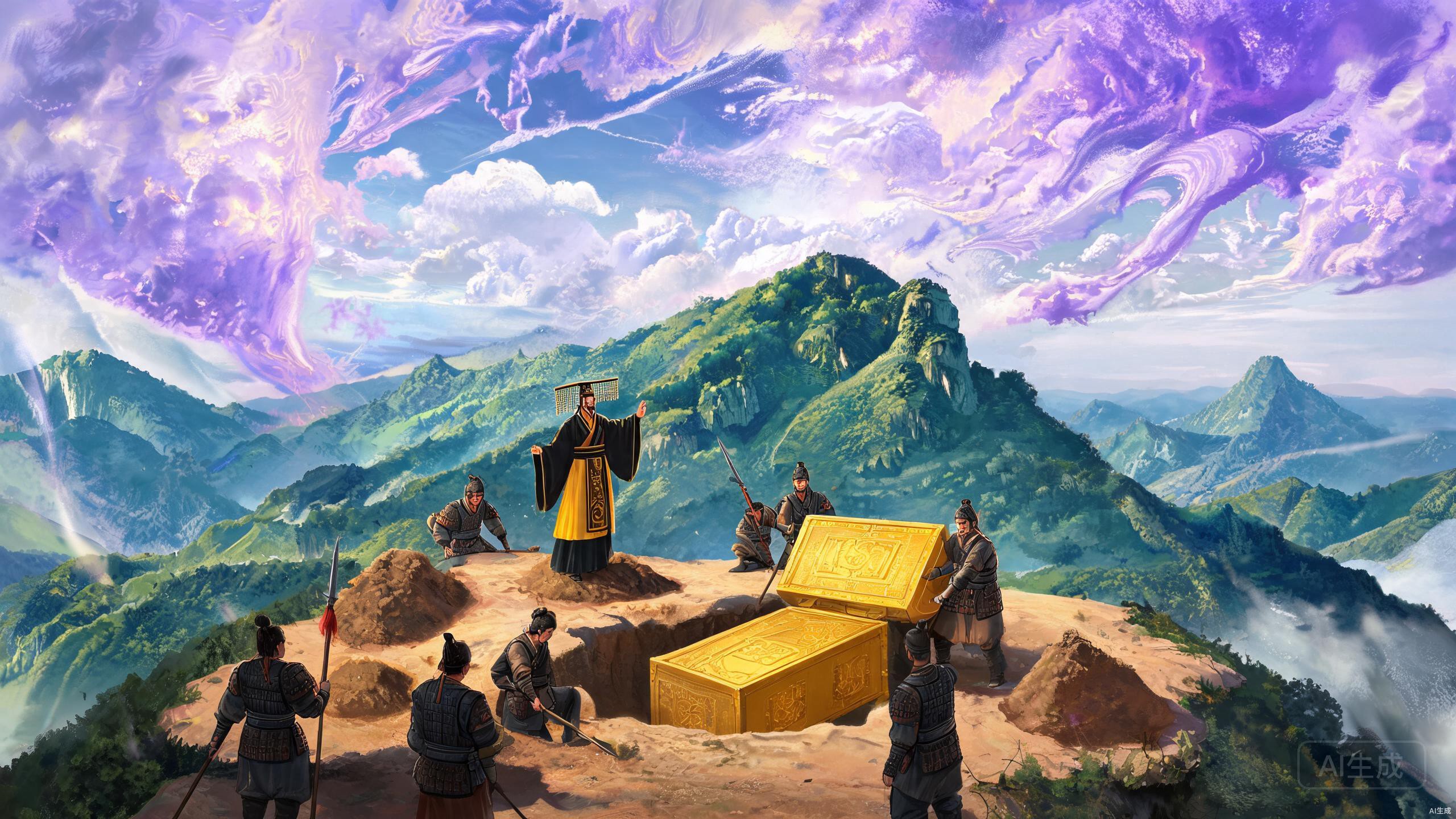
Nanjing, the ancient capital of the Six Dynasties, was historically known as Jinling (金陵). The origin of this name is tied to a fascinating Feng Shui suppression event that occurred over two thousand years ago.
The Qi Observer Discovers Imperial Qi
During the Warring States period (475–221 BC), the State of Chu was at the height of its power. During the reign of King Wei of Chu, Xiong Shang (熊商, r. 339–329 BC), a mystic skilled in the art of Wang Qi (望气, observing Qi) arrived at the Chu court and reported a startling discovery to the king:
"I have observed the celestial signs and seen Imperial Qi (天子之气) rising in the southeast. Its color is a pale yellow, shaped like dragons and canopies, stretching for hundreds of miles. This Qi corresponds to the mountains and rivers of the Jinling region. If left unaddressed, a true Son of Heaven will one day emerge from this land — a grave threat to the State of Chu."
Wang Qi (望气, observing Qi) is an advanced technique in classical Feng Shui (风水). Practitioners believed that different types of Qi (气) are concealed within the mountains and rivers of the earth — Imperial Qi manifests as multicolored cloud formations resembling dragons and phoenixes; the Qi of ministers and generals appears thinner and less vibrant; while the Qi of decline and destruction appears murky and gray.
King Wei was greatly alarmed. He well understood that the Jinling region (modern-day Nanjing) possessed exceptional natural beauty — backed by the mighty Yangtze River to the north, embraced by layered green mountains to the south, with Zhongshan curling like a coiling dragon and Stone Town crouching like a tiger guarding the western approach. In the eyes of Feng Shui masters, this was the quintessential "Coiling Dragon and Crouching Tiger" imperial capital terrain — a landform of supreme auspiciousness.
Burying Gold to Suppress the Qi
To eliminate this potential threat, King Wei immediately took decisive action. He ordered his men to dig deep pits at the crucial acupoint of the Dragon Vein (龙脉) in Jinling, where vast quantities of gold were buried to "suppress the Imperial Qi."
According to legend, King Wei specifically chose the area around modern-day Nanjing's Qingliang Mountain (清凉山), where workers excavated several zhang deep (a zhang equals roughly 3.3 meters), burying golden figures and golden tripods, then constructed a fortress above the burial site. The ancients believed that since gold belongs to the Metal element, and Metal controls Wood (while Dragon Veins belong to Wood), using gold to suppress the site could interrupt the flow of Imperial Qi within the earth's veins.
Furthermore, the name "Jinling" (金陵) itself derives from this event — gold (金) buried upon hill (陵) gave the place its name: Jinling, meaning "Golden Hill."
King Wei also ordered checkpoints established at the burial site, with soldiers stationed there to prevent anyone from digging up the gold. It is said he even invited ritual specialists to lay down protective formations, ensuring the suppression would remain effective over time.
Suppressed but Not Extinguished
Yet history unfolded in unexpected ways. After King Wei buried the gold, the fortune of Chu did not last much longer. Barely a century later, the Qin conquered the Six States, and Chu was inevitably swept away in the tide of unification.
Meanwhile, the supposedly suppressed Jinling did indeed become the capital of the Six Dynasties. During the Three Kingdoms period, Sun Quan established his capital here. Subsequently, the Eastern Jin, Liu Song, Southern Qi, Liang, and Chen dynasties all made Jinling their capital in succession. For over three hundred years, Jinling remained the political and cultural heart of southern China.
By the Ming Dynasty, Zhu Yuanzhang (朱元璋) founded his empire here, creating the great Ming realm. During the Republican era, Nanjing once again became the national capital. The Imperial Qi of this city, it seems, was never truly subdued.
When later Feng Shui masters reflected on this episode, they remarked with a sense of wonder:
"Where Imperial Qi gathers, no human force can suppress it. Though King Wei of Chu exhausted every stratagem, he did not understand that Heaven has its own designs. How could mere gold restrain the spiritual Qi of the earth's veins?" (王气所钟,非人力所能压制。楚威王虽费尽心机,却不知天道自有安排。地脉灵气,岂是区区黄金所能镇压?)
Cultural Context: This story captures a core tension in Feng Shui philosophy — the relationship between human action and cosmic destiny. While Feng Shui masters seek to work with Qi through proper placement and orientation, this tale suggests that true Imperial Qi transcends any earthly attempt to control it. For modern practitioners, the lesson is humility: align your space with natural energy flow rather than trying to forcefully manipulate it. The interplay of Yin and Yang — the dual forces of dark/light, passive/active — governs all Feng Shui applications.
Feng Shui Knowledge Points
- Wang Qi (望气之术): The classical Feng Shui technique of observing the mist and cloud formations above mountains and rivers to determine the auspicious or inauspicious nature of the underlying Dragon Vein. Different Qi fields are believed to manifest in distinct colors and forms.
- Coiling Dragon and Crouching Tiger (龙蟠虎踞): Nanjing's classic Feng Shui configuration — Zhongshan (Purple Gold Mountain) coils like a great dragon to the southeast, while Stone Town (Qingliang Mountain) crouches like a fierce tiger to the northwest, naturally forming the auspicious Azure Dragon (left) and White Tiger (right) protective formation.
- Mutual Generation and Restriction (相生相克): The application of the Metal controls Wood principle in Feng Shui suppression techniques. The ancients believed that Dragon Vein Qi belongs to Wood, so Metal objects could be used to restrain the Wood Qi.
- Imperial Qi / Royal Qi (天子气/王气): In Feng Shui theory, the capital of an emperor must possess a special energy field, manifesting as multicolored, radiant cloud formations — the ultimate symbol of Dragon Vein spiritual Qi reaching its concentrated peak.
Quick Tips:
- The concept of "Coiling Dragon and Crouching Tiger" applies to modern homes too: seek a solid, protective structure behind your residence (the dragon) and a stable, grounded feature in front (the tiger)
- When choosing a home, observe the surrounding landscape for balanced natural protection on multiple sides — this mimics the imperial terrain formation
- Remember that the Nanjing story teaches balance, not fear: if you sense powerful energy in your space, work with it through proper arrangement rather than attempting to suppress it
Related Articles
- [[../06-风水文化与历史/03-楚威王埋金镇王气.md|King Wei of Chu Buried Gold to Suppress Imperial Qi — Nanjing Feng Shui Legend]]
- [[../01-风水入门/42-皇家风水与民间风水.md|Royal Feng Shui vs. Folk Feng Shui: From the Forbidden City to Common Homes]]
- [[../06-风水文化与历史/04-秦始皇东游压天子气.md|Emperor Qin Shi Huang's Eastern Tour to Suppress Imperial Qi — The First Emperor's Feng Shui Disruption]]
- [[../07-风水故事/03-Qin Shi Huang Severing Jinling's Dragon Vein.md|Emperor Qin Shi Huang Cut Through Jinling's Dragon Vein — The Legendary Emperor's Feng Shui Panic]]