Qi Men Dun Jia Cow Hunt: A Village Story That Reveals the Power of Ancient Chinese Divination
On a scorching summer day, two powerful families in a southern Chinese village nearly came to blows over a missing plow ox. With two to three hundred armed villagers wielding hoes and pitchforks, the
Qi Men Dun Jia Cow Hunt: A Village Story That Reveals the Power of Ancient Chinese Divination
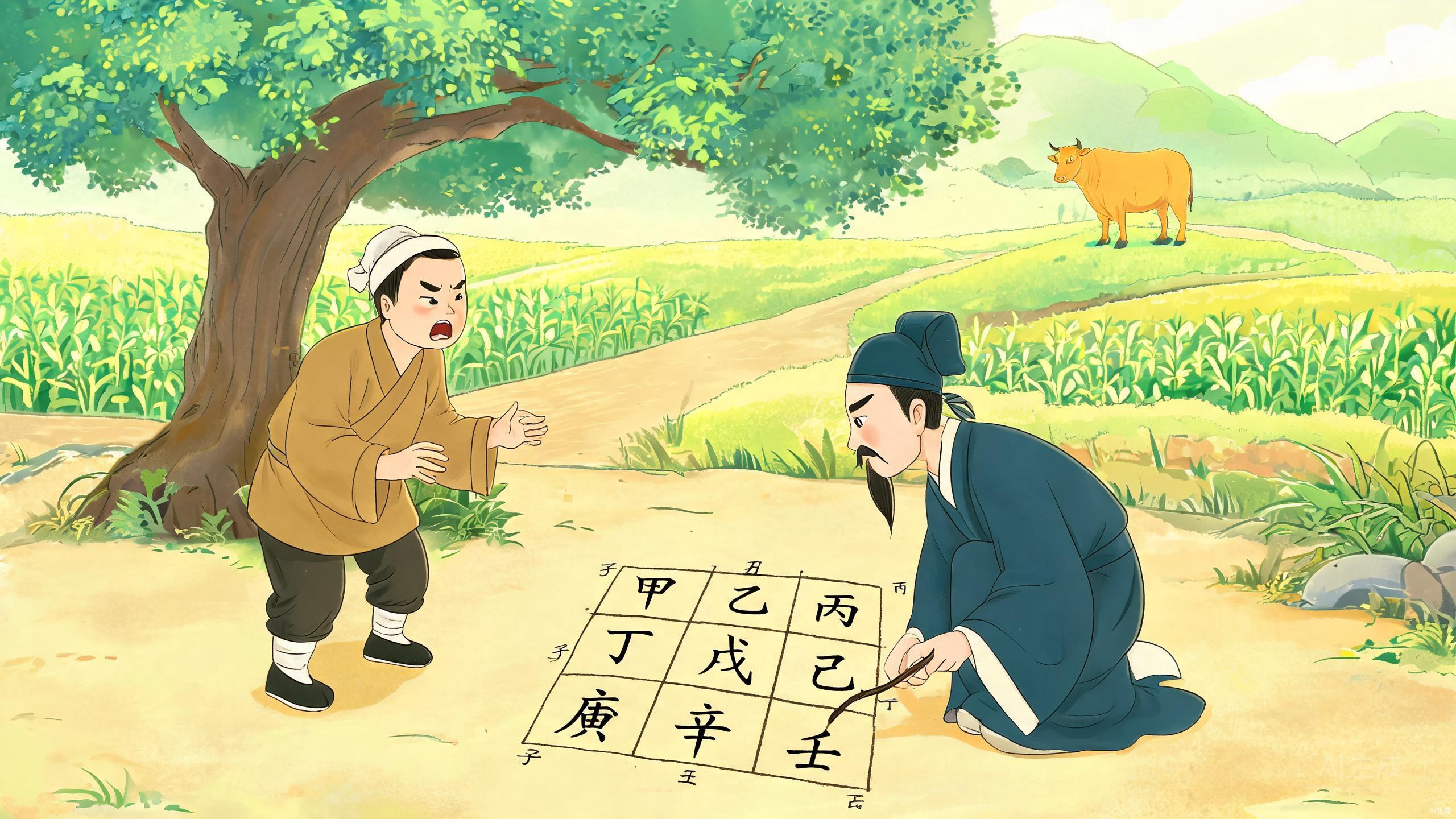
On a scorching summer day, two powerful families in a southern Chinese village nearly came to blows over a missing plow ox. With two to three hundred armed villagers wielding hoes and pitchforks, the standoff was about to erupt into full-scale violence. Just when disaster seemed inevitable, a young security chief stepped forward — claiming he could use Qi Men Dun Jia (奇门遁甲) calculations to locate the missing animal.
A Village on the Brink of War
Here's what happened: a large water buffalo belonging to the Su family had vanished. The Su family suspected the Luo family of theft; the Luo family denied everything. What began as heated arguments escalated into cursing, and finally into two hundred to three hundred villagers facing off with improvised weapons.
Even the local police chief's warning shots failed to restore order. When everyone else stood helpless, twenty-three-year-old security chief Luo Fei (洛飞) stepped forward and volunteered to find the lost ox.
In his heart, he thought: after years of dedicated study of Qi Men Dun Jia divination, I have never had a chance to practice it. Today is the perfect opportunity.
Casting the Divination Chart
Luo Fei found a quiet corner, and using a tree branch, he quickly drew a Qi Men Dun Jia (奇门遁甲) chart on the ground.
Cultural Context: Qi Men Dun Jia (奇门遁甲) is often called the "number one metaphysical art" (术数之首) among ancient Chinese divination systems. It synthesizes astronomy, geography, mathematics, and military strategy into a sophisticated framework for analyzing time, space, and the outcomes of events. Masters of Qi Men Dun Jia are sometimes called "divination generals" (遁甲神) in historical texts.
Qi Men Dun Jia uses the Nine Palaces and Bagua (九宫八卦) as its foundation. It arranges the Heavenly Stems, Earthly Branches, Nine Stars, Eight Doors, and Eight Deities into a 3×3 grid (the Nine Palaces), following specific rules. By analyzing the relationships between these elements, practitioners can determine auspicious and inauspicious directions as well as the likely outcomes of events.
Luo Fei noted the approximate time when the buffalo went missing and cast a "Shi Jia Qi Men" (时家奇门, Hour-Based Qi Men) chart. He carefully analyzed the position of the "Shang Men" (伤门, Injury Door — representing lost objects) and "Wu" (戊 — representing valuable property), then cross-referenced the position of the "Horse Star" (马星 — representing movement and direction) to work out his prediction.
After several minutes, Luo Fei stood up and made a surprising announcement: the ox had not been stolen. It had simply broken free of its rope and wandered into a mountain hollow behind the village.
The Buffalo Found in the Mountain Hollow
The villagers were skeptical, but they followed Luo Fei to the mountain hollow behind the village. Sure enough, the large water buffalo was grazing peacefully beside a cave — its rope had snagged on thorns, and the animal had simply wandered off on its own.
What could have become a large-scale clan battle was defused in an instant.
The Su family recovered their ox, and the Luo family's name was cleared. From that day on, the story of "Luo Fei's Qi Men Cow Hunt" spread throughout the surrounding villages for miles.
The Metaphysical Logic Behind the Story
Although this tale comes from a novel, the Qi Men Dun Jia divination methods it describes are based on authentic traditional practices:
When searching for lost items using Qi Men Dun Jia, practitioners typically examine the following key indicators:
- Shang Men (伤门, Injury Door): Represents the lost object. The Palace where Shang Men falls gives the initial direction in which to search.
- Wu (戊): Represents valuables and property. The relationship between Wu's Palace and Shang Men reveals the current state of the lost item.
- Horse Star (马星): Represents movement and direction. If the Horse Star shares a Palace with Shang Men or is in direct opposition, the item has already moved.
- Day Stem or Hour Stem (日干/时干): Represents the owner. The relationship between the owner's Palace and the lost object's Palace reveals whether the item can be recovered.
Cultural Context: Of course, whether Qi Men Dun Jia can truly "find a lost ox" is largely a dramatic literary device. In real life, metaphysical divination is better understood as a thinking framework and a decision-support tool — a way to organize information, reduce uncertainty, and approach problems with greater clarity.
How to Apply Qi Men Dun Jia Principles in Everyday Life
You don't need to master the full system to benefit from its underlying philosophy. Here are practical ways to channel Qi Men Dun Jia thinking when searching for lost items:
- Time it carefully: Note the exact time an item was lost — timing provides the framework for analysis
- Identify the "direction": What does your intuition say about where the item might be? (Indoors? Outdoors? A specific room?)
- Check the "movement": Did the item move on its own, or was it taken by someone? This shapes your search strategy
- Consider the owner's state: Often, a calm and focused mind finds lost items more quickly than a panicked one
- Use systematic searching: Divide your space into a 3×3 grid mentally and check each section methodically
Quick Tips:
- Before searching, take three slow breaths and visualize the item — this resets your attention and often triggers a memory
- Retracing your exact steps from the last time you remember having the item is the single most effective lost-item technique
- Items most often are found in the last place you'd think to look — so check "obvious" locations twice
Feng Shui Knowledge Points
Cultural Context: Each of the following concepts is a core component of the Qi Men Dun Jia system. Understanding them gives you insight into how one of China's most sophisticated metaphysical frameworks operates.
-
Qi Men Dun Jia (奇门遁甲): Known as the "crown jewel" of ancient Chinese divination systems. It is built on the Nine Palaces and Bagua framework and integrates the Heavenly Stems, Earthly Branches, Nine Stars, Eight Doors, and Eight Deities to perform time-space analysis and predict outcomes.
-
Shi Jia Qi Men (时家奇门, Hour-Based Qi Men): A method of casting a Qi Men Dun Jia chart based on the Heavenly Stems and Earthly Branches of the current hour. It is used to determine auspicious and inauspicious directions within a specific time window.
-
Shang Men (伤门, Injury Door): One of the Eight Doors in Qi Men Dun Jia, associated with the Zhen Trigram (震卦). It governs loss, damage, and disappearance. When searching for lost items, Shang Men is the primary reference point.
-
Nine Palaces and Bagua (九宫八卦): The foundational framework of Qi Men Dun Jia — the eight trigrams are distributed across nine directions (palaces) in a 3×3 grid, used to position and analyze the relationships between metaphysical elements.
Related Articles
- [[../07-风水故事/50-蒋大鸿传奇.md|The Legend of Jiang Dahong — The Xuan Kong Master of Late Ming and Early Qing]]
- [[../07-风水故事/58-风水与丧葬.md|Feng Shui and Burial — The Ancient Tradition of Yin Dwelling Feng Shui]]
- [[../01-风水入门/10-风水常见误区澄清.md|Feng Shui Myths Debunked: Separating Superstition from Science]]
- [[../01-风水入门/51-风水测量工具大全.md|Feng Shui Measurement Tools: A Complete Guide from Traditional to Modern]]