Three Real-World Eight Mansions Feng Shui Case Studies: Lessons for Wealth, Health, and Harmony
The Eight Mansions School (八宅派, Ba Zhai Pai) is one of the most widely practiced branches of Feng Shui, valued for its clear and practical framework. Its core principle is straightforward: by analyzin
Eight Mansions Feng Shui Case Studies: Three Real-World Examples for Wealth and Harmony
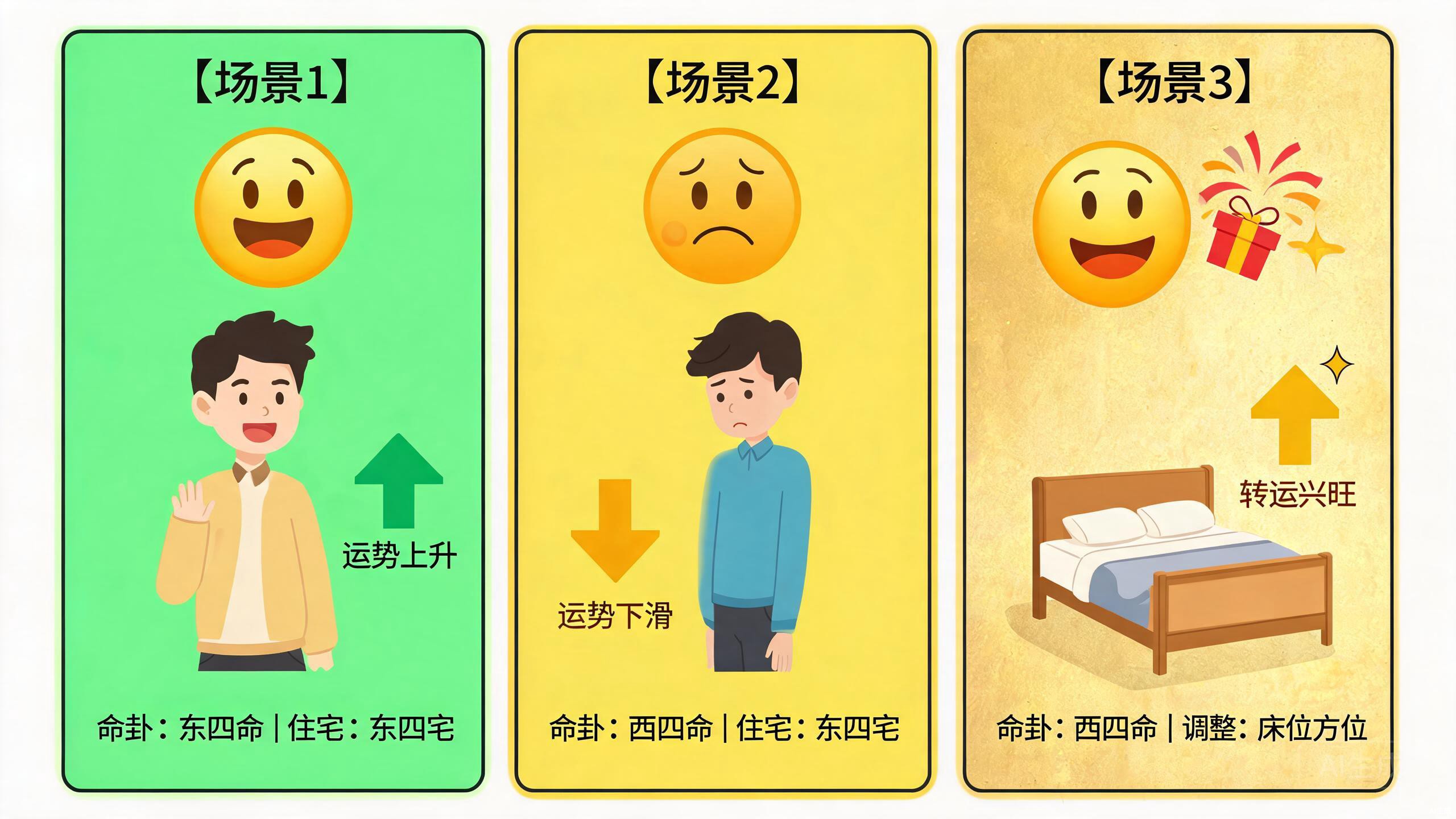
The Eight Mansions School (八宅派, Ba Zhai Pai) is one of the most widely practiced branches of Feng Shui, valued for its clear and practical framework. Its core principle is straightforward: by analyzing your home's orientation (sitting and facing direction) and your personal Life Gua (命卦), you can classify any dwelling as an East Four Mansion (东四宅) or West Four Mansion (西四宅) — then arrange your most important rooms according to the auspicious and inauspicious directions that correspond to your birth energy.
Cultural Context: The Eight Mansions system divides the eight cardinal and inter-cardinal directions into four "lucky" positions and four "unlucky" positions based on your Life Gua. These eight directional energies — known as Sheng Qi (Vital Qi), Yan Nian (Longevity), Tian Yi (Heavenly Doctor), Fu Wei (Stability), Huo Hai (Mishap), Liu Sha (Six Sha), Wu Gui (Five Ghost), and Jue Ming (Life-Ending) — influence everything from health to finances. The genius of the system is its simplicity: once you know your Life Gua and your home's orientation, the best placement for your bed, stove, and front door becomes mathematically clear.
Below are three classic case studies drawn directly from Eight Mansions practice — real problems, real diagnoses, and real solutions.
Case Study 1: When the Kitchen Killed the Business — A Merchant's Mysterious Decline
A merchant running a successful foreign trade company had enjoyed steady profits for years. But after moving into a new home three years prior, his business began a puzzling decline — major clients defected one after another, and conflicts erupted constantly between business partners.
When a Feng Shui practitioner visited the property, the diagnosis became clear. The merchant's Life Gua was Kan (坎) — belonging to the East Four Life (东四命). His new home faced south (a sitting-north-facing-south orientation), which made it an East Four Mansion — so the house structure itself posed no problem.
However, the kitchen was located in the southwest corner of the home. For someone with a Kan Life Gua, the southwest direction is the "Jue Ming" (绝命, Life-Ending) position.
Cultural Context: In Eight Mansions theory, "Jue Ming" is the most severe of the four inauspicious directions. It symbolizes abrupt cutoffs — broken relationships, collapsed ventures, and severed connections. Because the kitchen is the primary source of Fire Qi (火气) in a home, placing it on a Jue Ming position supercharges the negative energy, accelerating whatever loss the direction represents.
The practitioner's recommendation was decisive: relocate the kitchen to the southeast (the Sheng Qi position for a Kan Life person), or at minimum keep the kitchen door closed constantly and adjust the stove's facing direction.
Within several months of the adjustment, the merchant's business gradually recovered.
How to Apply This Lesson to Your Home
- Calculate your Life Gua using your birth year — Kan, Li, Zhen, and Xun belong to the East Four Life group
- Identify your Jue Ming position based on your Life Gua (it's the most dangerous of the four inauspicious directions)
- Check your kitchen placement — if it sits on your Jue Ming, Liu Sha, Wu Gui, or Huo Hai position, plan a relocation or buffering remedy
- Use the stove door as a safeguard — when relocation isn't possible, keeping the kitchen door closed reduces Fire Qi from spilling into the inauspicious corner
Quick Tip: The kitchen is considered the "heart of Fire" in your home. Never place it lightly — its Fire energy amplifies whatever directional energy it sits upon, for better or worse.
Case Study 2: The Mystery of Insomnia — A Bedroom Facing the Wrong Direction
A young white-collar professional had suffered from chronic insomnia for years, trying every remedy imaginable with no success. After moving into a new rental apartment, the condition worsened dramatically — she could sleep only two or three hours per night, leaving her disoriented during the day and making frequent mistakes at work.
The Eight Mansions analysis revealed the cause. This woman's Life Gua was Li (离) — an East Four Life. Her bedroom was located in the northwest corner of her apartment — and the northwest direction corresponds to the "Liu Sha" (六煞) position for a Li Life person. Liu Sha governs disputes, gossip, and inner turmoil.
To make matters worse, her bed's headboard faced west — and the west direction is her "Huo Hai" (祸害, Mishap) position. Two inauspicious directions stacked on top of each other made restful sleep nearly impossible.
The solution was elegantly simple:
- Reposition the bed to face due south or due east (the Sheng Qi and Tian Yi positions for a Li Life person)
- Reorient the headboard to face east or south
- Add a living green plant in the northwest corner of the bedroom — the Wood element helps drain away some of the harsh energy from the Liu Sha position
Within one month of these adjustments, her insomnia improved significantly.
How to Apply This Lesson to Your Home
- Find your bedroom's compass direction using a smartphone compass app or a Luopan (Feng Shui Compass)
- Check your Life Gua's Liu Sha and Huo Hai positions — if your bedroom falls on either, consider repositioning
- Prioritize the headboard direction — even if you can't move the bed, rotating which wall the headboard faces can shift the influence
- Add Wood element remedies (plants, green décor) to absorb Fire and Earth Sha Qi in troubled corners
Quick Tip: Sleep quality is one of the most reliable indicators of your home's Qi. If you sleep deeply in some rooms but poorly in others, pay attention — directional energy is likely at work.
Case Study 3: A Restaurant Reborn — Realigning a Failing Shop
A restaurant owner opened a small noodle shop on a busy commercial street, but business was dismal for six straight months. Neighboring shops came and went, yet his struggling establishment stubbornly held on.
The Feng Shui practitioner's on-site analysis uncovered a clear issue: the noodle shop's front door faced northwest, but the owner's Life Gua was Zhen (震) — an East Four Life. For a Zhen Life person, a northwest-facing entrance corresponds to the "Wu Gui" (五鬼, Five Ghost) position — an inauspicious direction associated with trouble, losses, and hidden obstacles.
Rather than rebuilding the entrance, the practitioner recommended adjustments that worked within the existing structure:
- Move the cash register to due east — the Sheng Qi position for a Zhen Life person
- Add bright lighting to the due south area — the Yan Nian position, which strengthens longevity energy and customer loyalty
- Install a foyer partition or folding screen near the northwest entrance — this slows the direct rush of Wu Gui Sha Qi into the dining area
The owner implemented every suggestion. Gradually, foot traffic to the noodle shop increased. Within three months, daily revenue had nearly doubled.
While not every improvement can be attributed solely to Feng Shui (seasonality and word-of-mouth certainly play a role), the owner remained convinced of the transformation.
How to Apply This Lesson to Your Business
- Don't assume you need to relocate — most commercial lease contracts make moving impractical, but internal adjustments can shift energy significantly
- Identify the Four Auspicious Positions for your Life Gua and place income-related functions (cash register, owner's desk, main entrance if possible) there
- Use partitions and screens strategically to buffer doors that face your inauspicious directions
- Boost Yan Nian energy with lighting — bright, warm light in your Yan Niu position attracts steady customers and repeat business
Quick Tip: A folding screen (屏风) is one of the most versatile Feng Shui remedies in commercial settings — it costs little, requires no renovation, and can be repositioned as your business needs evolve.
Key Feng Shui Concepts from These Cases
-
East Four Life / West Four Life (东四命 / 西四命): The Eight Mansions School calculates your Life Gua from your birth year. Zhen, Xun, Kan, and Life Gua people belong to the East Four Life group; Qian, Kun, Gen, and Dui Life Gua people belong to the West Four Life group. Each group thrives in different directional environments.
-
Four Auspicious and Four Inauspicious Directions (四吉四凶方): In an East Four Mansion, the four auspicious directions are Sheng Qi, Yan Nian, Tian Yi, and Fu Wei; the four inauspicious directions are Huo Hai, Liu Sha, Wu Gui, and Jue Ming. In a West Four Mansion, the auspicious and inauspicious assignments are reversed.
-
Sheng Qi Position (生气位): The single most auspicious direction in Eight Mansions theory, representing vitality and growth. This is the ideal location for your main entrance, master bedroom, and kitchen stove.
-
Kitchen Placement (厨房方位): As the primary source of Fire energy in a Yang Dwelling, the kitchen holds special importance in Eight Mansions practice. It should never be placed on an inauspicious direction, as its Fire element amplifies whatever negative energy is present.
Related Articles
- [[../08-百科问答库/16-什么是八宅风水?东四命和西四命怎么算?.md|What Is Eight Mansions Feng Shui? How to Calculate East Four Life and West Four Life]]
- [[../03-财运风水/25-财运与命卦.md|Wealth Fortune and Life Gua: Wealth-Enhancing Directions for East Four Life and West Four Life]]
- [[../05-命理与运势/01-东四命与西四命.md|East Four Life and West Four Life — Life Gua Calculation and Directional Auspiciousness]]
- [[../01-风水入门/17-玄空飞星与八宅风水的区别.md|Xuan Kong Flying Stars vs. Eight Mansions Feng Shui: Key Differences]]