Yang Yunsong and the Legend of Saving the Poor: The Humanitarian Feng Shui Legacy of Yang Gong
In the world of Feng Shui, almost everyone knows the name "Yang Gong." Yang Yunsong (杨筠松) — reverently called "Yang Jiu Pin" (杨救贫), meaning "Yang Who Saves the Poor" — was the founding patriarch of th
Yang Yunsong and the Legend of Saving the Poor: The Humanitarian Feng Shui Legacy of Yang Gong
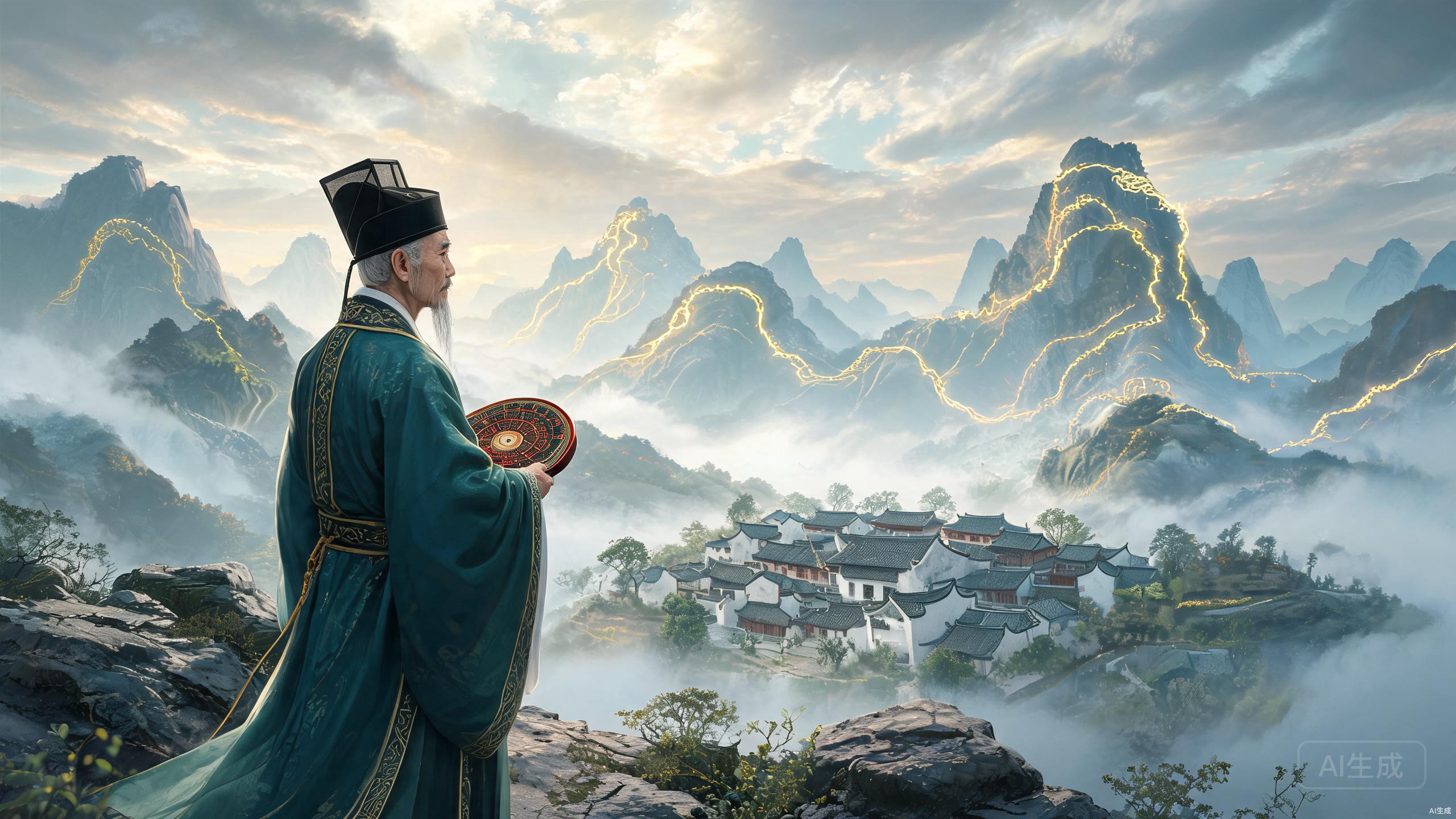
In the world of Feng Shui, almost everyone knows the name "Yang Gong." Yang Yunsong (杨筠松) — reverently called "Yang Jiu Pin" (杨救贫), meaning "Yang Who Saves the Poor" — was the founding patriarch of the Jiangxi Form School (赣派) of Feng Shui. He dedicated his life to using Feng Shui to help the impoverished, and the name "Saves the Poor" has been celebrated for a thousand years. It remains one of the most touching chapters in Feng Shui history.
From Chang'an to Ganzhou
Yang Yunsong, courtesy name Yi, styled Shu Mao, art name Yunsong, was a native of Douzhou in the Tang Dynasty (present-day Xinyi, Guangdong), though some accounts claim he was from Shandong. He was born during the Taihe era of Emperor Wenzong (around 834 AD) and passed away during the Guanghua era of Emperor Zhaozong (around 900 AD).
In his youth, he traveled to Chang'an (the Tang capital, present-day Xi'an). Because of his mastery of Kanyu (堪舆, the traditional art of Feng Shui), he was selected to serve in the imperial court, rising to the prestigious rank of Golden Purple Light Grand Master (金紫光禄大夫). He was put in charge of the Imperial Astronomical Bureau's geography department, overseeing Feng Shui planning for royal tombs and palaces. While in the palace, he gained access to a vast collection of secret Feng Shui texts, and his skills grew ever more refined.
In the first year of Guangming during Emperor Xizong's reign (880 AD), the Huang Chao Rebellion broke through Chang'an, plunging the realm into chaos. Yang Yunsong seized the opportunity to carry away the court's treasured Feng Shui manuscripts as he fled southward. After passing through Hunan and Hubei, he eventually settled in the Ganzhou region of Jiangxi. This marked the beginning of his second life — teaching, transmitting knowledge, and saving lives among the common people.
The Origin of the Name "Saves the Poor"
After arriving in Ganzhou, Yang Yunsong did not use his skills to pursue wealth. Instead, he specifically sought out struggling families to help. He would wander from village to village, and whenever he saw a household in decline, he would voluntarily visit to adjust their Feng Shui — changing the door's direction, relocating the stove, digging channels to redirect water, planting trees to block Sha Qi (harmful energy). After completing his work, he would leave without accepting a single coin.
One particularly famous story has been passed down for generations: In the southern part of Ganzhou city, there lived a poverty-stricken farmer surnamed Liu. His home was empty, his harvests failed year after year, his wife was constantly ill, and his children died young. When Yang Yunsong passed by, he observed that the house sat in a low-lying depression and its door faced a desolate direction — he declared that the family's fortune had already declined. He instructed the Liu family to change the main door to face southeast, plant three clusters of bamboo behind the house to block the northern wind, and move the stove to the direction of Vital Qi (Sheng Qi).
One year later, the Liu family's fortunes had completely transformed — abundant harvests, the wife recovered her health, and a new child was born. When the family came bearing gifts to thank him, Yang Yunsong had already vanished. From that moment, the title "Yang Jiu Pin" (Saves the Poor) spread throughout southern Jiangxi, and the impoverished all vied to invite him to their homes.
| Case of Yang Gong Saving the Poor | Adjustment Method | Result |
|---|---|---|
| The Liu Family's Door Change | Main door redirected to southeast; bamboo planted behind house | Abundant harvest, wife recovered, new child born |
| The Zhang Family's Stove Move | Stove relocated to the Vital Qi direction | Family harmony and prosperity |
| The Li Family's Water Channel | Water channel guided around the Bright Hall | Wealth gradually increased |
| The Wang Family's Grave Relocation | Reburied on a gentle Dragon Vein slope | Descendants entered officialdom |
Cultural Context: The name "Yang Jiu Pin" reflects a core ethical ideal in traditional Chinese Feng Shui culture — that metaphysical knowledge should serve humanitarian purposes, not personal enrichment. This contrasts sharply with the modern stereotype of Feng Shui as a tool for the wealthy, and explains why Yang Yunsong remains beloved by practitioners today.
Personally Designing Ganzhou City
Yang Yunsong's contributions to Ganzhou city were especially remarkable. According to the Ganzhou Prefecture Records (《赣州府志》), the layout of the ancient Ganzhou city owes much to Yang Gong's Kanyu planning.
Ganzhou sits where the Zhang River and Gong River merge to form the Gan River. The city is surrounded by water on three sides and backed by mountains on one — shaped like "a tortoise and snake locking the great river." Working with this natural configuration, Yang Yunsong determined the wall alignments and city gate positions:
| Planning Element | Yang Gong's Design | Feng Shui Meaning |
|---|---|---|
| City Wall Layout | Followed the river's curves rather than rigid squares | Adapted to the Dragon Vein; Qi flows continuously |
| City Gate Positions | Eight gates staggered; none facing each other directly | Avoids Sha Qi and leaking prosperity |
| Government Office | Placed on a central high ground | Symbolizes the center controlling all directions |
| Confucian Academy | Located in the southeast Wenchang direction | Boosts literary fortune and scholarly success |
| Temple Distribution | Placed according to auspicious and inauspicious zones | Subdues Sha, balances Yin and Yang |
Even today, the old city of Ganzhou still preserves the layout traces that Yang Gong designed a thousand years ago. For this reason, Ganzhou is honored in the Feng Shui world as the "Ancestral Home of the Form School."
Authoring Classics That Endured for Generations
During his time in Ganzhou, Yang Yunsong organized his lifetime of knowledge into a series of texts, leaving behind several Feng Shui classics:
| Work | Core Content | Significance |
|---|---|---|
| Han Long Jing (Classic of Shaking Dragon) | Treats mountain range patterns and Dragon Vein forms | Foundational text on Seeking Dragon for the Form School |
| Yi Long Jing (Classic of Doubting Dragon) | Distinguishes true Dragon Veins from false ones | Essential classic for locating acupoints |
| Qing Nang Ao Yu (Mysteries of the Green Satchel) | Elucidates secret Feng Shui formulas | Core esoteric text of the Jiangxi School |
| Tian Yu Jing (Classic of Heavenly Jade) | Discusses Compass Energy (Li Qi) and directions | A work integrating Form and Compass schools |
| Du Tian Bao Zhao Jing | Treats Yang Dwelling and auspicious date selection | Key reference for Yang Dwelling Feng Shui |
These works formed the theoretical foundation of the Jiangxi Form School, and every subsequent Feng Shui practitioner has studied them. Among them, the "Five Steps" method — Seeking Dragon, Pointing Acupoint, Observing Sand, Inspecting Water, and Setting Direction (寻龙、点穴、观砂、察水、立向) — remains the standard procedure of Form School Kanyu to this day.
Cultural Context: The "Five Essentials" (龙穴砂水向) represent the core diagnostic framework of the Form School. Even though modern urban environments lack dramatic mountain ranges, Feng Shui practitioners translate these principles into contemporary equivalents — tall buildings become "mountains," roads become "water," and so on.
How to Apply the Form School's Five Steps in Modern Settings
- Seeking Dragon: Identify the tallest, most stable structures behind your home (tall buildings, hills, or solid walls) — these provide your "Dragon" support
- Pointing Acupoint: Locate the central energy point of your living space (often the center of your living room) — keep this area open and uncluttered
- Observing Sand: Assess neighboring structures and fences — they should embrace your space protectively without pressing in too close
- Inspecting Water: Look at roads, pathways, and any water features — gentle, curving flow is auspicious; harsh, straight lines create Sha Qi
- Setting Direction: Determine which direction your front door faces — this determines the quality of energy entering your home
Quick Tips:
- Even in an apartment, the building across the street can serve as your "backing mountain" if it is taller and wider than yours
- Avoid homes where roads approach in a straight line aimed directly at your door — this creates "Road Rushing Sha" (路冲煞)
- A gentle curve in the path leading to your entrance is more auspicious than a harsh angle
The Death of Yang Gong and His Legacy
Accounts of Yang Yunsong's death differ. One version says he was performing a Feng Shui consultation in the Yudu area near Ganzhou when he died from excessive drinking (possibly poisoned) at the age of about sixty-six. His tomb in Yudu still receives visitors who come to pay their respects today.
Another version carries a more legendary tone: On his deathbed, Yang Gong told his disciples, "I have spent my whole life using this art to help people without taking a single coin. Heaven's Way shall not be unkind to me." He then sat upright and passed away. On the day of his burial, sweet rain fell from the sky — ending a long drought that had plagued Ganzhou. The people all said Yang Gong had "used his body after death to save an entire city from poverty once more."
Yang Yunsong had many disciples, the most famous being Zeng Wenzhan (曾文辿), Liao Yu (廖瑀, also known as Liao Jinjing 廖金精), and Liu Jiangdong (刘江东). Each inherited part of his teachings and spread the Form School throughout the Jiangnan region. Since then, famous Feng Shui masters across the dynasties have often claimed to be "Yang Gong's descendants," demonstrating the depth of his influence.
The Millennium-Old Yang Gong Festival
Today, every year on the eighth day of the third lunar month (Yang Yunsong's birthday), Ganzhou holds the "Yang Gong Festival" (杨公祭). Feng Shui practitioners from across China and overseas gather in Ganzhou to honor the patriarch, share knowledge, and exchange techniques. This tradition has continued for a thousand years, becoming a unique cultural phenomenon in Chinese Feng Shui heritage.
What Yang Yunsong left to posterity is far more than a few classic texts — it is a spirit of "using one's art to serve the world." He devoted his entire life to the belief that "Feng Shui, on a small scale, can bring peace to oneself; on a grand scale, it can save the world." This is the most moving interpretation of the two characters "Jiu Pin" — Saves the Poor.
Key Feng Shui Concepts
- Form School (形势派): One of the two major branches of Chinese Feng Shui, founded by Yang Yunsong. Emphasizes field investigation of landscape and terrain, with the "Dragon, Acupoint, Sand, Water, Direction" Five Essentials at its core.
- Seeking Dragon and Pointing Acupoint (寻龙点穴): The fundamental skill of the Form School. "Seeking Dragon" means tracing the path of a Dragon Vein; "Pointing Acupoint" means finding the optimal spot where Vital Qi concentrates.
- Han Long and Yi Long: Yang Gong's two classics. Han Long discusses the momentum of Dragon Veins, while Yi Long distinguishes truth from illusion. Together they form the core curriculum for Seeking Dragon and Pointing Acupoint.
- Five-Step Kanyu Method: Seeking Dragon, Pointing Acupoint, Observing Sand, Inspecting Water, and Setting Direction — the standard operating procedure of the Form School.
- Yang Gong Saves the Poor (杨公救贫): The spirit of using Feng Shui without compensation to help the impoverished, reflecting the traditional value of Feng Shui as a humanitarian practice.
Related Articles
- [[../01-风水入门/38-杨公风水秘传.md|Yang Gong Feng Shui Secrets: The True Teachings of the Poverty-Saving Master]]
- [[../01-风水入门/02-风水流派介绍.md|Feng Shui Schools Explained: Form, Compass, Eight Mansions, and Xuan Kong]]
- [[../06-风水文化与历史/44-唐代风水:杨筠松与形势派的确立.md|Tang Dynasty Feng Shui: Yang Yunsong and the Establishment of the Form School]]
- [[../06-风水文化与历史/17-风水典籍解析:《撼龙经》——杨筠松的寻龙诀.md|Classic Text Analysis: Han Long Jing — Yang Yunsong's Secrets of Seeking Dragon]]