Yang Yunsong: The Legend of the Poverty-Relief Feng Shui Master and Founder of the Jiangxi Form School
In the long history of Chinese Feng Shui (风水), one figure stands above all others as the revered founding patriarch: Yang Yunsong (杨筠松), a Tang Dynasty Feng Shui master affectionately known as "Yang J
Yang Yunsong: The Legend of the Poverty-Relief Feng Shui Master and Founder of the Jiangxi Form School — Attract Harmony & Good Energy
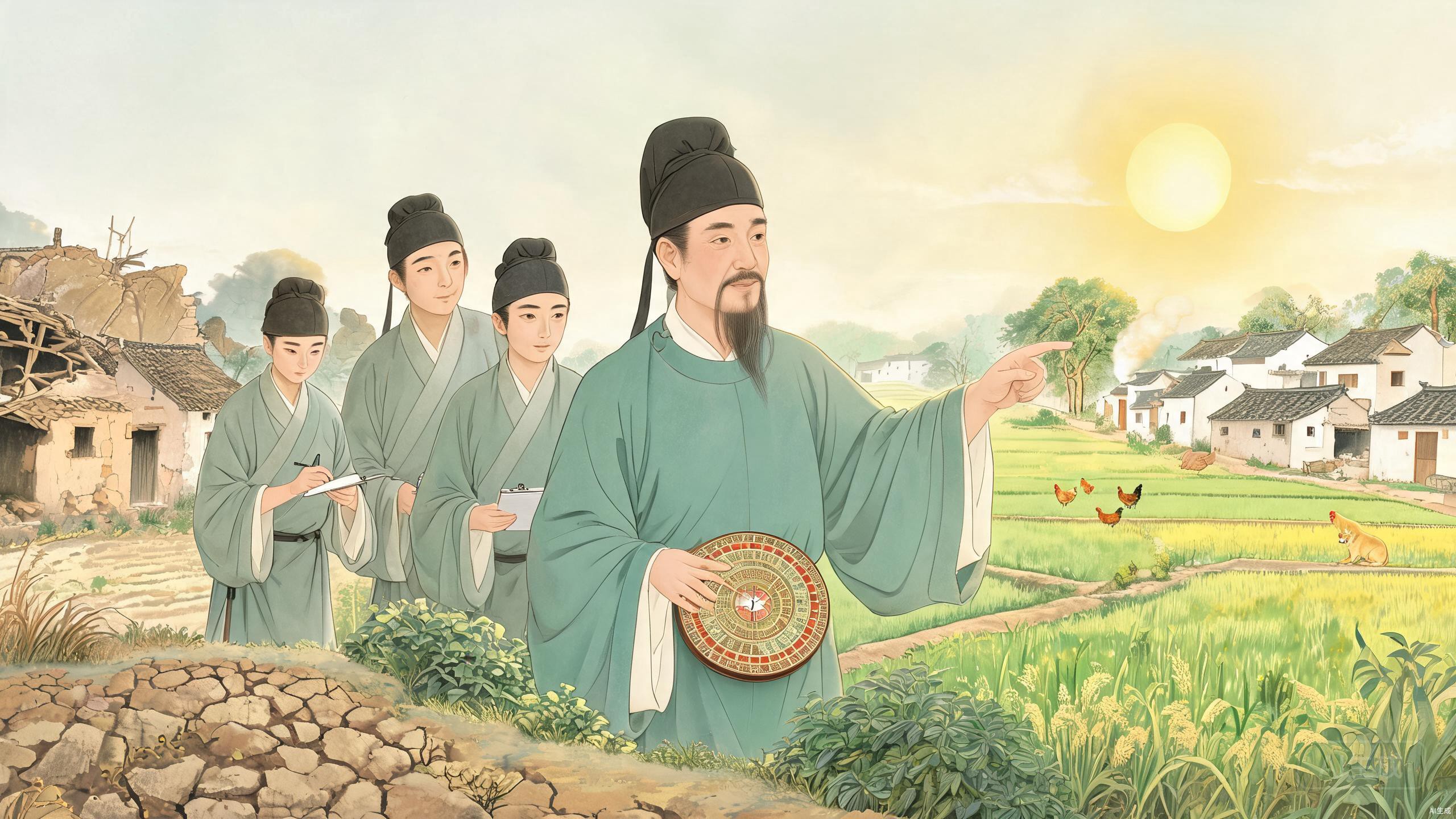
In the long history of Chinese Feng Shui (风水), one figure stands above all others as the revered founding patriarch: Yang Yunsong (杨筠松), a Tang Dynasty Feng Shui master affectionately known as "Yang Jiu Pin" (杨救贫) — literally "Yang who Relieves the Poor."
From Imperial Court to the Common People
Yang Yunsong lived during the Tang Dynasty (834–900 AD). He originally served as a court Feng Shui consultant, holding the prestigious title of "Golden Purple Grand Master of Palace Leisure" (金紫光禄大夫) — overseeing all Feng Shui matters for the imperial household.
From a young age, Yang was a prodigy of extraordinary intellect. He devoured the classics and became especially accomplished in the Yi Jing (Classic of Changes) and the art of Kanyu (堪舆, the formal name for Feng Shui). In his court role, he was responsible for selecting auspicious sites for imperial tombs, planning palace layouts, and conducting Feng Shui assessments for major state construction projects — accumulating a wealth of practical experience.
Cultural Context: Before Yang Yunsong's time, Feng Shui was a closely guarded imperial secret, accessible only to emperors and their court advisors. His decision to bring this knowledge to common people was revolutionary — much like how ancient medical knowledge eventually moved from royal physicians to village healers. The interplay of Yin and Yang — the dual forces of dark/light, passive/active — governs all Feng Shui applications.
However, his peaceful life at court was soon disrupted. In the late 9th century, the Huang Chao Rebellion erupted (874–884 AD), plunging China into chaos and shaking the Tang Dynasty to its foundations. Yang foresaw the coming turmoil and made a bold decision: he left the imperial capital of Chang'an and traveled south, carrying with him precious Feng Shui manuscripts from the imperial archives.
His journey eventually brought him to Ganzhou (赣州) in Jiangxi province. There, he poured out his lifetime of knowledge, founded the influential Jiangxi Form School (江西形势派) of Feng Shui, and opened an entirely new chapter in Chinese metaphysical practice.
The Origin of His Name: "Yang Who Relieves the Poor"
Yang Yunsong earned his beloved nickname "Yang Jiu Pin" (杨救贫, "Yang the Poverty Reliever") because of one remarkable habit: he offered his Feng Shui services free of charge to the poor.
Cultural Context: In traditional Chinese society, masters of esoteric arts often charged substantial fees, reserving their knowledge for the wealthy. Yang's refusal to do so — and his active outreach to impoverished villagers — was considered extraordinarily generous and earned him folk-hero status for over a thousand years. The interplay of Yin and Yang — the dual forces of dark/light, passive/active — governs all Feng Shui applications.
During his years in Ganzhou, Yang would travel deep into the countryside, where he saw countless families living in crumbling houses and struggling through life. He would proactively help them: adjusting their home orientation, repositioning their stoves, and teaching them simple Feng Shui layout techniques.
One year, a severe drought struck Ganzhou. Crops failed and the people faced starvation. After surveying the local terrain, Yang identified a hidden water source deep within a mountain valley. He instructed the villagers to dig a well at a specific location — and sure enough, clean spring water gushed forth, solving the water crisis for the entire village.
He often told his disciples: "The art of Feng Shui can, on a small scale, help a person establish their life and destiny; on a grand scale, it can bring prosperity to an entire region. If it is used only for personal gain, it loses the Way of Heaven." (风水之术,小可以安身立命,大可以造福一方。若只用来为自己谋利,便失了天道。)
It was this spirit of service and compassion that made the name "Yang Jiu Pin" echo through the Ganzhou region for over a millennium.
Personally Surveying the City of Ganzhou
Yang Yunsong's contributions to Ganzhou went far beyond helping individual families. Historical records show he personally designed a comprehensive Feng Shui plan for the entire city.
Ganzhou sits in a remarkable natural setting — water on three sides and mountains to the back. Working with this terrain, Yang determined the alignment of the city walls and the placement of the city gates. The ancient Ganzhou city wall was built along the river in an irregular shape — this was not random but a deliberate design based on Yang's careful reading of the local mountain ranges and waterways.
He also selected sites for many important structures, including temples, government offices, and the Confucian Academy. Even today, the layout of Ganzhou's old city still bears traces of Yang's original planning.
During his years in Ganzhou, Yang authored several Feng Shui classics. The two most celebrated are the Yi Long Jing (Classic of Doubting Dragon) and the Han Long Jing (Classic of Shaking Dragon). Together, these works systematically explain the Form School's methods of "Seeking Dragon and Pointing Acupoint" (寻龙点穴), observing Sand (surrounding hills), and inspecting Water — earning a permanent place as required reading for Feng Shui practitioners ever since.
A Thousand Years of Lineage
The Jiangxi Form School (江西形势派) founded by Yang Yunsong remains one of the most influential schools of Feng Shui to this day. Unlike the Fujian Compass School (福建理气派), which emphasizes mathematical calculations and compass-based energy readings, the Form School focuses on direct observation of mountains, rivers, and terrain — judging auspicious and inauspicious energy by tracking Dragon Veins (龙脉, the energetic mountain ranges), examining Sand formations, and reading the flow of water.
Quick Tips:
- The Form School's strength lies in its earthy, practical approach — perfect for those who prefer hands-on landscape reading over abstract calculations
- Today, the Form School has the largest number of practitioners among Chinese Feng Shui communities worldwide
- Because of Yang Yunsong's legacy, Ganzhou is considered a sacred site for Feng Shui practitioners — many modern masters make pilgrimages there to study the original terrain he analyzed
Feng Shui Knowledge Points
-
Jiangxi Form School (江西形势派): One of the two major schools of Chinese Feng Shui, founded by Yang Yunsong. It emphasizes field observation of mountains and landforms, using the five essentials — Dragon, Acupoint, Sand, Water, and Direction — as its core framework.
-
Seeking Dragon and Pointing Acupoint (寻龙点穴): The fundamental skill of the Form School. "Seeking Dragon" means tracing the path and flow of a Dragon Vein (a mountain range channeling Qi); "Pointing Acupoint" means identifying the exact spot along that vein where Vital Qi (生气) concentrates most powerfully — the ideal location for building.
-
The Five Essentials — Dragon, Acupoint, Sand, Water, Direction (龙、穴、砂、水、向): The five core elements of Feng Shui assessment. Dragon (龙) refers to mountain ranges and their flow; Acupoint (穴) is the point where Vital Qi gathers; Sand (砂) refers to the protective hills flanking the site; Water (水) is the carrier of Qi; and Direction (向) is the orientation the structure faces.
-
Han Long Jing and Yi Long Jing (《撼龙经》《疑龙经》): Yang Yunsong's masterworks and the foundational textbooks of the Form School. They remain essential reading for serious Feng Shui students today.
Related Articles
- [[../01-风水入门/02-风水流派介绍.md|Feng Shui Schools Explained: Form School, Compass School, Eight Mansions School, and Xuan Kong School]]
- [[../06-风水文化与历史/44-唐代风水:杨筠松与形势派的确立.md|Tang Dynasty Feng Shui: Yang Yunsong and the Establishment of the Form School]]
- [[../06-风水文化与历史/17-风水典籍解析:《撼龙经》——杨筠松的寻龙诀.md|Classic Text Analysis: Han Long Jing — Yang Yunsong's Dragon-Seeking Secrets]]
- [[../01-风水入门/39-Feng Shui Schools Comparison and Selection.md|Comparing Feng Shui Schools: Finding the Path That Suits You Best]]