Zeng Guofan's Burial Site Choice: The Feng Shui Wisdom of 'Heaven Dislikes Cunning'
Zeng Guofan (曾国藩), the renowned statesman of late Qing Dynasty, left behind a legendary legacy — he suppressed the Taiping Rebellion, spearheaded the Self-Strengthening Movement, and earned the honori
Zeng Guofan's Burial Site Choice: The Feng Shui Wisdom of "Heaven Dislikes Cunning" — Lucky Energy Guide
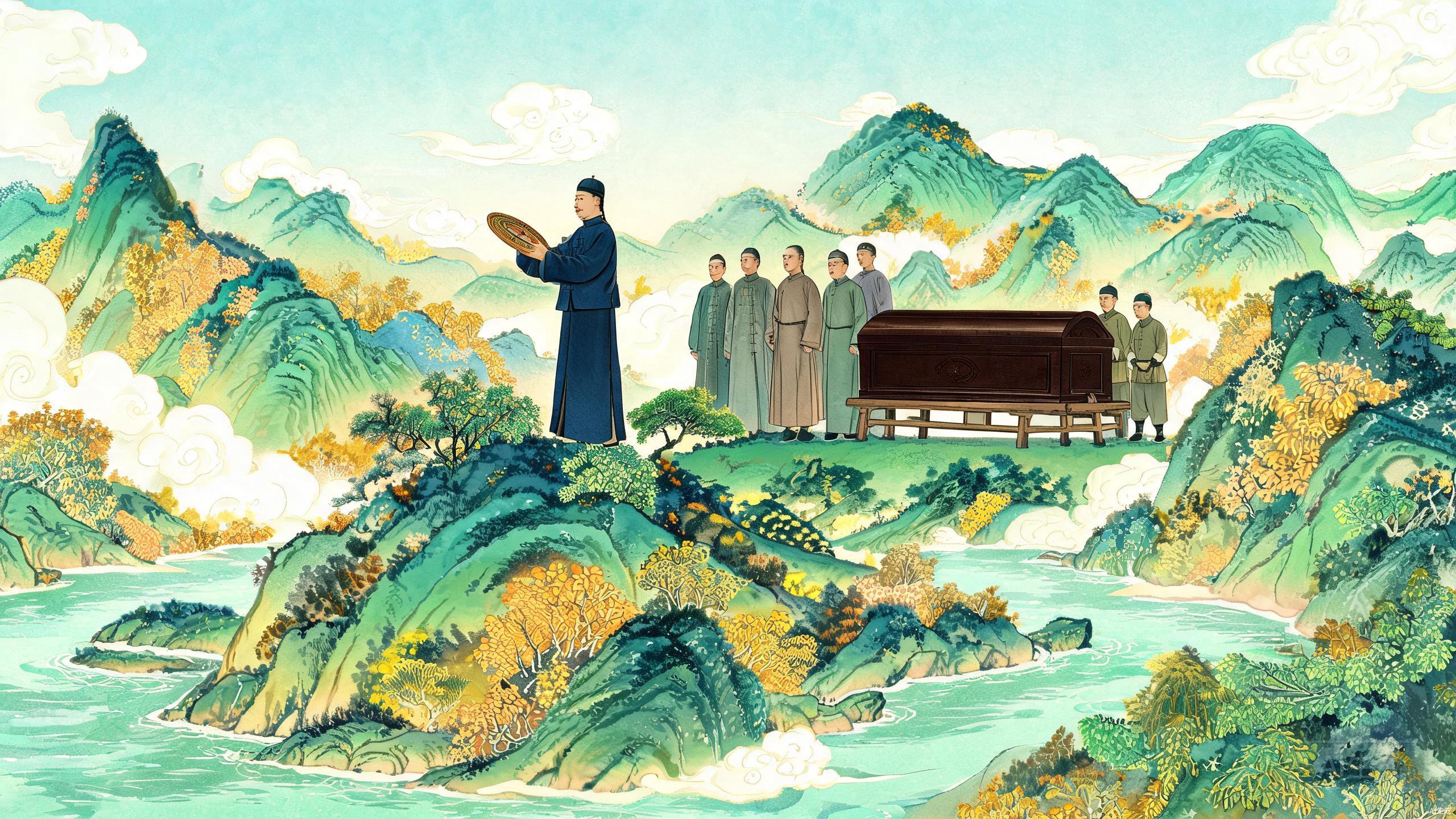
Zeng Guofan (曾国藩), the renowned statesman of late Qing Dynasty, left behind a legendary legacy — he suppressed the Taiping Rebellion, spearheaded the Self-Strengthening Movement, and earned the honorific "Half Saint" from later generations. Yet few people know that this great Confucian scholar also possessed deep knowledge of Feng Shui. What truly sets him apart, however, was his remarkably different attitude toward the practice compared to most people.
The Feng Shui Treasure of Dongtai Mountain
During the Tongzhi era, Zeng Guoquan (曾国荃), Zeng Guofan's younger brother, set out to find a suitable burial site for the family in their hometown of Xiangxiang, Hunan. After extensive searching, a well-known local geomancer finally identified an exceptional Yin Dwelling Feng Shui treasure — Dongtai Mountain (东台山).
Dongtai Mountain lies east of Xiangxiang city, with ridgelines winding like a coiling Dragon. Protective Sand formations embrace the site on both sides, an expansive Bright Hall stretches before it, the Water Mouth is tightly sealed, and a golden summit rises behind while jade-green waters meander in front. By Feng Shui standards, this location perfectly embodied the requirements of "an authentic Dragon with a precise Acupoint, surrounded by Sand and embraced by Water" (龙真穴的、砂环水抱). The geomancer declared with confidence: burying ancestors here would surely produce descendants of extraordinary nobility — officials governing entire provinces would be but a small expectation.
Delighted by the news, Zeng Guoquan immediately wrote to his elder brother Zeng Guofan in Jinling (present-day Nanjing), recommending that the family's ancestral graves be relocated to this site.
"Heaven Dislikes Cunning" — The Reply Letter
However, Zeng Guofan did not reply for several days. When his letter finally arrived back in Xiangxiang, its tone was calm but resolute — he firmly declined the proposal.
He wrote: "As for the theories of Feng Shui, I have never deeply believed in them, yet I也不敢断言其全然无理. However, Heaven dislikes cunning (天道忌巧), Heaven dislikes excess (天道忌盈), Heaven dislikes divided loyalty (天道忌贰). To deliberately seek out a Feng Shui treasure through human effort reveals a cunning heart — and thereby loses Heaven's favor."
Zeng Guofan believed that true good Feng Shui lies not in mountains and rivers, but in a person's moral cultivation. He often told his staff: "When the land is excellent, the spirits guard it; when the person is excellent, Heaven blesses them" (地之美者,神其主之;人之美者,天其佑之). In other words, truly outstanding places are protected by the divine — they cannot be seized through human scheming.
He also invoked the ancient principle "Fortunate Land for Fortunate People" (福地福人居) — meaning it is not good Feng Shui that brings fortune to people, but rather that virtuous people naturally transform wherever they dwell into good Feng Shui. A person of insufficient virtue, even if occupying the finest Feng Shui treasure on earth, may not be able to bear such fortune.
Choosing Virtue Over Feng Shui
Zeng Guofan not only rejected the proposal to relocate the ancestral graves to Dongtai Mountain, but also instructed his brother in his family letter to keep the father's burial simple — no need for excessive emphasis on Feng Shui topography. A site with dry soil, good drainage, and protection from Water Rushing Sha and Sand Flying Sha would suffice.
He even cautioned his descendants in the family instructions: "Most wealthy and noble families owe their fortune to the accumulated virtue of their ancestors — Feng Shui merely aligns with Heaven and responds to humanity. To focus solely on Feng Shui while neglecting moral cultivation is to abandon the root while chasing the branches."
History later proved that Zeng family descendants indeed flourished across generations — Zeng Jize (曾纪泽) became a famous diplomat, and among the great-grandsons were many scholars and scientists. While this cannot be entirely attributed to the "choice against Feng Shui," Zeng Guofan's family philosophy of "valuing virtue over technique" undeniably laid a foundation for the family's long-term prosperity.
Cultural Context: Zeng Guofan's stance represents a philosophical thread deeply woven into Chinese culture — the belief that human virtue outweighs environmental manipulation. This echoes the Confucian principle that "those who move with Heaven's will prosper" (天人合一), reminding Feng Shui practitioners that aligning with Heaven's Way means cultivating inner worth, not merely rearranging external symbols. The interplay of Yin and Yang — the dual forces of dark/light, passive/active — governs all Feng Shui applications.
Feng Shui Knowledge Points
-
Fortunate Land for Fortunate People (福地福人居): A core concept in Feng Shui suggesting that true good Feng Shui is intimately connected to the moral character of its inhabitants, rather than relying solely on geographical advantages.
-
Authentic Dragon, Precise Acupoint (龙真穴的): The fundamental requirement of Yin Dwelling Feng Shui. "Dragon" refers to the flow and pulse of mountain ranges; "Acupoint" refers to the auspicious location where Vital Qi converges. Both must be genuine and accurately identified.
-
Mountains Embracing, Water Surrounding (砂环水抱): An ideal Feng Shui pattern where protective Sand formations (Azure Dragon on the left, White Tiger on the right) guard the site, while a curving waterway flows around the front — creating a configuration that achieves Storing Wind and Gathering Qi.
-
Heaven Dislikes Cunning (天道忌巧): Zeng Guofan's family philosophy asserting that one must never scheme or take shortcuts in any endeavor. This resonates with the Feng Shui principles that "Heaven's secrets cannot be revealed" and "Earth spirits cannot be forcefully summoned."
Quick Tips:
- When selecting a home or burial site, prioritize locations that feel naturally protected — avoid forcefully engineered "perfect" spots
- Remember that maintaining a clear conscience often creates better luck than the most expensive Feng Shui cures
- Simplicity and proper function (good drainage, solid construction) often outweigh elaborate symbolic remedies
Related Articles
- [[../05-命理与运势/09-面相断Yin Dwelling风水.md|Face Reading and Yin Dwelling Feng Shui — Reading Burial Sites from the Nose and Facial Features]]
- [[../06-风水文化与历史/07-曾国藩的风水观.md|Zeng Guofan's Feng Shui Philosophy — From Obsession with Feng Shui to Faith in Destiny]]
- [[../08-百科问答库/50-墓碑有什么风水讲究?墓碑朝向怎么定?.md|What Are the Feng Shui Considerations for Tombstones? How to Determine Tombstone Orientation?]]
- [[../08-百科问答库/29-什么是穴位?点穴是什么意思?.md|What Is a Feng Shui Acupoint? What Does Pointing Acupoint Mean?]]
Note on the Five Elements: The Five Elements (Wu Xing) — Wood, Fire, Earth, Metal, and Water — form the foundation of Feng Shui energy theory. Each element interacts with the others in cycles of generation and control, influencing the Qi flow in your environment.