Bagua Mirror Feng Shui: Powerful Uses, Types, and Critical Taboos to Avoid
A: The Bagua Mirror (八卦镜) is one of the most iconic tools for dissolving Sha Qi (harmful energy) in Feng Shui. It combines the metaphysical power of the Bagua (Eight Trigrams) with the reflective prop
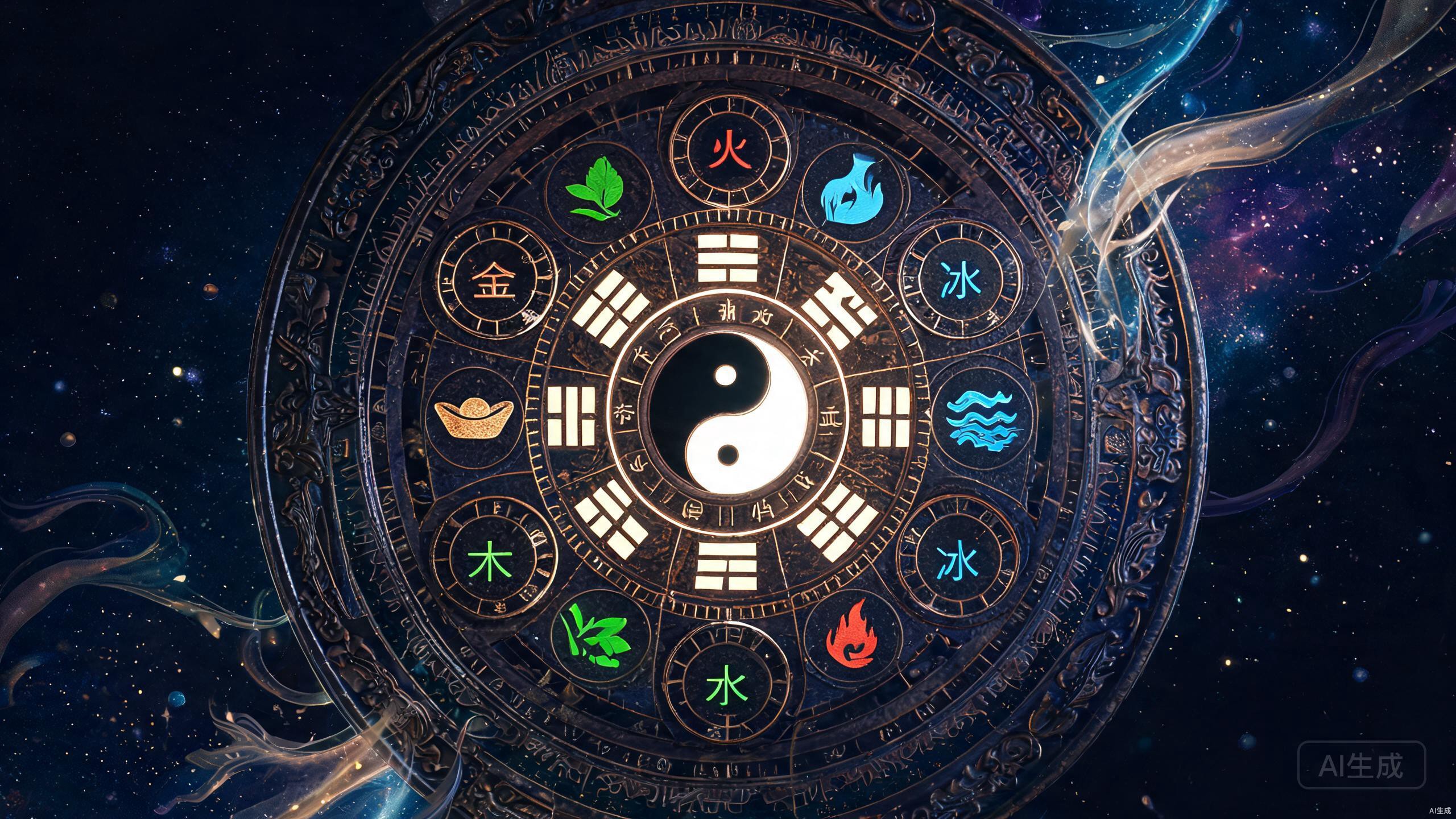
Q: What Is a Bagua Mirror? What Role Does It Play in Feng Shui?
A: The Bagua Mirror (八卦镜) is one of the most iconic tools for dissolving Sha Qi (harmful energy) in Feng Shui. It combines the metaphysical power of the Bagua (Eight Trigrams) with the reflective properties of a mirror, creating a potent instrument for neutralizing negative energy and stabilizing a home's energy field.
Structure of a Bagua Mirror
A Bagua Mirror consists of two essential components:
1. The Bagua Diagram (八卦图)
At the center of the mirror sits the Bagua diagram, containing all eight trigrams — Qian (乾), Dui (兑), Li (离), Zhen (震), Xun (巽), Kan (坎), Gen (艮), and Kun (坤). Together, they represent the fundamental patterns through which heaven and earth operate.
Cultural Context: In Feng Shui, the Eight Trigrams are the building blocks of reality — each trigram symbolizes a natural force (Heaven, Lake, Fire, Thunder, Wind, Water, Mountain, Earth). When engraved on a mirror, these symbols amplify the mirror's power to harmonize and protect a space.
2. The Mirror Surface
The mirror itself can be flat, convex, or concave — and each shape produces a completely different energetic effect.
Feng Shui Functions of the Bagua Mirror
1. Dissolving Sha (化煞)
The Bagua Mirror's primary function is neutralizing harmful Sha Qi (煞气), especially Form Sha (形煞, xíng shà) — negative energy created by hostile physical structures. The mirror reflects, scatters, or transforms incoming Sha to protect your home's interior atmosphere.
2. Stabilizing the Home (镇宅)
The Bagua Mirror anchors and stabilizes a home's energy field, preventing disturbing Qi from entering the living space.
3. Repelling Negative Energy (辟邪)
Traditionally believed to repel negativity, the Bagua Mirror disperses unwanted energetic influences and clears stagnant atmospheres.
4. Harmonizing Surrounding Qi (调节气场)
Beyond defense, the Bagua Mirror fine-tunes the surrounding environment, promoting balance and stability throughout your home.
Q: What Types of Bagua Mirrors Exist? How Do They Differ?
A: Bagua Mirrors are classified by the shape of their reflective surface, with three main types:
1. Flat Bagua Mirror (平面八卦镜)
Characteristics: The mirror surface is perfectly flat, with no curvature.
Function: The flat mirror reflects Sha Qi directly back along its incoming path. Think of it as an ordinary mirror supercharged with Bagua energy.
Best for: Neutralizing Sha aimed directly at your home — such as Road Rushing Sha (路冲煞) or Sharp Corner Sha (尖角煞).
Important Note: Flat Bagua Mirrors produce intense reflection. Careless use can bounce harmful energy straight onto a neighbor's property — so position with caution.
2. Convex Bagua Mirror (凸面八卦镜)
Characteristics: The mirror surface bulges outward.
Function: The convex mirror scatters Sha Qi, dispersing it in multiple directions rather than sending it back as a single beam. This dilutes concentrated negative energy and reduces its impact.
Best for: Neutralizing powerful Sha such as Heaven Chopping Sha (天斩煞) or Reverse Bow Sha (反弓煞).
Advantage: Gentler than the flat mirror — it disperses energy broadly rather than reflecting it back onto one specific target.
3. Concave Bagua Mirror (凹面八卦镜)
Characteristics: The mirror surface curves inward.
Function: The concave mirror absorbs Sha Qi, drawing it into the mirror where it can be transformed or neutralized.
Best for: Situations where your home sits at the convergence point of multiple Sha sources.
Important Note: Concave Bagua Mirrors require professional guidance. They are not recommended for casual or untrained use.
4. Classification by Material
Copper Bagua Mirror: The traditional choice. Copper belongs to the Metal element in the Five Elements (Wu Xing) system and delivers the strongest dissolving power with excellent durability.
Wooden Bagua Mirror: Belongs to the Wood element. Suitable for Wood-aligned placements.
Plastic Bagua Mirror: A modern, mass-produced option with weaker energetic effect — not recommended for long-term or serious applications.
Q: How Should a Bagua Mirror Be Used? Where Should It Be Hung?
A: Proper placement of a Bagua Mirror is essential. Here are the fundamental guidelines:
Hanging Locations
1. Above the Main Door
If your home faces a direct Sha source — such as Road Rushing Sha, Heaven Chopping Sha, or Reverse Bow Sha — hang a Bagua Mirror above your main entrance.
How to hang: Use a red cord to suspend the mirror above the door lintel, with the reflective surface facing outward toward the Sha source.
2. Above Windows
When a window faces a hostile structure — sharp corners, roof eaves, chimneys — place a Bagua Mirror above that window.
3. On the Balcony
If your balcony overlooks an unfavorable environment, hang a Bagua Mirror on the balcony railing.
4. On the Roof
In severe cases, a Bagua Mirror may be mounted on the rooftop.
Best Time to Hang a Bagua Mirror
Optimal hours: Hang your mirror during the most Yang (阳) hours of the day — typically between 9:00 AM and 11:00 AM, when solar energy is at its peak.
Auspicious timing: Consult a traditional Chinese almanac (黄历) to select a lucky day and hour for installation. This aligns your remedy with favorable cosmic energy.
Proper Hanging Height
The mirror should be positioned at a height that allows its surface to "see" the Sha source — usually mounted above a door lintel or window lintel.
Correct Orientation
The reflective surface must always face outward toward the Sha source. Never angle it toward your own home or toward a neighbor's property.
Quick Tips:
- Always use a red cord or red ribbon to hang a Bagua Mirror — red is considered a protective and activating color in Feng Shui
- Before hanging, clean the mirror surface thoroughly — dust and grime are believed to weaken its energetic effect
- If using multiple mirrors, space them apart to avoid creating chaotic, competing energy fields
Q: What Are the Taboos of Using a Bagua Mirror? When Should You Avoid It?
A: The Bagua Mirror comes with strict usage rules. The following taboos are the most important to observe:
Taboo 1: Never Aim It Directly at a Neighbor
The Bagua Mirror — especially the flat variety — produces powerful reflective energy. Pointing it at a neighbor's door or windows reflects Sha directly back onto them, which is both inconsiderate and likely to spark disputes.
Correct approach: If a Sha source is unavoidable, choose a convex Bagua Mirror, which disperses energy broadly rather than targeting one specific property.
Taboo 2: Never Aim It Inside Your Home
The Bagua Mirror belongs outside, never indoors facing your own door or windows. Indoors, its reflection would bounce your own auspicious Qi right back out — undermining the harmony you are trying to create.
Taboo 3: Never Aim It at a Shrine or Deity
Never point a Bagua Mirror at a household altar or deity statue (such as the God of Wealth (财神) or Guanyin). This is considered disrespectful to the spiritual realm.
Taboo 4: Never Aim It at Your Own Front Door
Pointing a Bagua Mirror at your own entrance reflects the incoming wealth and lucky Qi right back outside — the opposite of what you want.
Taboo 5: Never Use a Damaged Mirror
If a Bagua Mirror cracks, chips, or breaks in any way, replace it immediately. A damaged mirror loses its dissolving power and may actually generate negative energy.
Taboo 6: Never Use It Casually
The Bagua Mirror is the "heavy artillery" of Feng Shui tools. It should never be deployed lightly. Confirm that a genuine Sha problem exists before considering its use.
Taboo 7: Keep Away from Children and Pregnant Women
The Bagua Mirror's energy is strong. Children and pregnant women — whose bodies are considered more energetically sensitive — should avoid direct contact or prolonged gazing into the mirror.
Taboo 8: Avoid Using Too Many
A single home should not display more than one or two Bagua Mirrors. Excessive mirrors create chaotic, conflicting energy fields that disturb rather than protect.
Quick Tips:
- The guiding principle is: avoid use if possible; use lightly when necessary
- When in doubt, start with gentler remedies (plants, Five Emperor Coins, crystals) before escalating to a Bagua Mirror
- Periodically check your Bagua Mirror for dust, damage, or shifted position — maintenance preserves its power
Q: How Does a Bagua Mirror Differ from an Ordinary Mirror? When Should You Use Each?
A: This is a very practical question. Here is a clear comparison:
Bagua Mirror vs. Ordinary Mirror
| Feature | Bagua Mirror | Ordinary Mirror |
|---|---|---|
| Energy | Charged with Bagua power — extremely strong | Reflective function only |
| Purpose | Specifically designed for dissolving Sha and protecting homes | Daily grooming and decoration |
| Power | Powerful — must be used with caution | Gentle — safe for daily use |
| Appearance | Features Bagua symbols | No symbolic decoration |
Cultural Context: In Chinese tradition, ordinary mirrors are still considered to have subtle energetic effects — they can brighten a space, redirect light, and symbolically "expand" a room. But without the Bagua symbols engraved on its surface, an ordinary mirror lacks the metaphysical charge needed to neutralize serious Sha.
When to Use a Bagua Mirror
1. Severe Form Sha (形煞): Powerful negative configurations such as Heaven Chopping Sha, Reverse Bow Sha, or Road Rushing Sha — these overwhelm ordinary mirrors and require Bagua-level intervention.
2. Unstable Home Energy: When your home's atmosphere feels unsettled or persistently uncomfortable, a Bagua Mirror can help anchor the space.
3. After Other Remedies Have Failed: When gentler methods — plants, Five Emperor Coins (五帝钱), crystals — have proven insufficient, escalating to a Bagua Mirror becomes appropriate.
When to Use an Ordinary Mirror
1. Indoor Adjustments: For refining Feng Shui inside your home, an ordinary mirror is usually sufficient and safer.
2. Mild Sha: Minor negative influences respond well to gentler tools like plants, ordinary mirrors, or natural decor.
3. Decorative Purposes: When the mirror serves mainly as a design element, an ordinary mirror is the right choice.
How to Choose Wisely
- Assess severity first: Observe the Sha source. Is it direct, powerful, and persistent — or subtle and occasional?
- Start gentle: Always begin with the lightest remedy that addresses the problem.
- Escalate gradually: Move to stronger tools only when gentler methods fail.
- Consult a practitioner: For serious Sha conditions, seek guidance from an experienced Feng Shui consultant before deploying a Bagua Mirror.
Q: Can the Bagua Mirror Be Combined with Other Feng Shui Tools?
A: Yes — the Bagua Mirror works well alongside other Feng Shui items to amplify its effects:
Bagua Mirror + Five Emperor Coins (五帝钱)
Hang a string of Five Emperor Coins beneath the Bagua Mirror to double its dissolving power while activating wealth energy simultaneously.
Bagua Mirror + Crystals (水晶)
Placing crystals beside the Bagua Mirror helps transform and purify Sha Qi into neutral or beneficial energy.
Bagua Mirror + Shi Gan Dang (泰山石敢当, Taishan Stone Tablet)
Positioning a Shi Gan Dang beneath the Bagua Mirror strengthens the stabilizing and protective function of both items together.
Bagua Mirror + Living Plants
Green plants near the Bagua Mirror soften and balance the powerful reflective energy, creating a more harmonious overall atmosphere.
How to Layer Remedies Safely
- Choose one primary tool: Select the Bagua Mirror as your main remedy
- Add one or two supporting items: Don't over-stack — too many remedies create energetic clutter
- Maintain visual harmony: Each item should have breathing room and not crowd the others
- Reassess periodically: If conditions improve, consider whether some remedies can be retired
Special Reminder: The Bagua Mirror is the "heavy weapon" of Feng Shui. Always confirm that its use is truly necessary before deploying it. For mild Feng Shui concerns, start with gentler methods — plants, Five Emperor Coins, or crystals. The guiding principle: avoid use if possible; use lightly when necessary. And if you must use it, do so thoughtfully to avoid harming neighbors or disrupting the natural harmony of your surroundings.
Quick Reference: Remedy Strength Comparison
| Tool | Strength | Best For |
|---|---|---|
| Plants | Gentle | Mild Sha, indoor harmony |
| Ordinary Mirror | Gentle | Indoor light adjustments |
| Five Emperor Coins | Moderate | Moderate Sha, wealth activation |
| Crystals | Moderate | Energy purification, mild Sha |
| Bagua Mirror (Convex) | Strong | Medium-to-large Sha, safe reflection |
| Bagua Mirror (Flat) | Very Strong | Direct Sha, use with extreme caution |
| Bagua Mirror (Concave) | Specialized | Professional use only |
Related Articles
- [[../02-家居风水/43-山海镇与八卦镜.md|Shan Hai Zhen and Bagua Mirror: Powerful Feng Shui Tools for Dissolving Sha]]
- [[../02-家居风水/40-风铃与化煞.md|Wind Chimes and Sha Dissolution: Attracting Wealth and Harmonizing the Five Elements]]
- [[../07-风水故事/45-风水法宝.md|Feng Shui Treasures — Mysterious Protective Objects for Homes]]
- [[../01-风水入门/54-风水布局常用工具清单.md|Essential Feng Shui Layout Tools: Must-Have Items for a Lucky Home]]