Feng Shui Basics: Essential Foundations Every Beginner Must Learn
Answer: Mastering Feng Shui (风水) requires building a solid foundation in the following areas: ### 1. Theoretical Foundations 1. Yin and Yang Theory (阴阳学说): Understand the principle of Yin and Yang bal
Question: What foundational knowledge do I need to learn as a Feng Shui beginner?
Answer: Mastering Feng Shui (风水) requires building a solid foundation in the following areas:
1. Theoretical Foundations
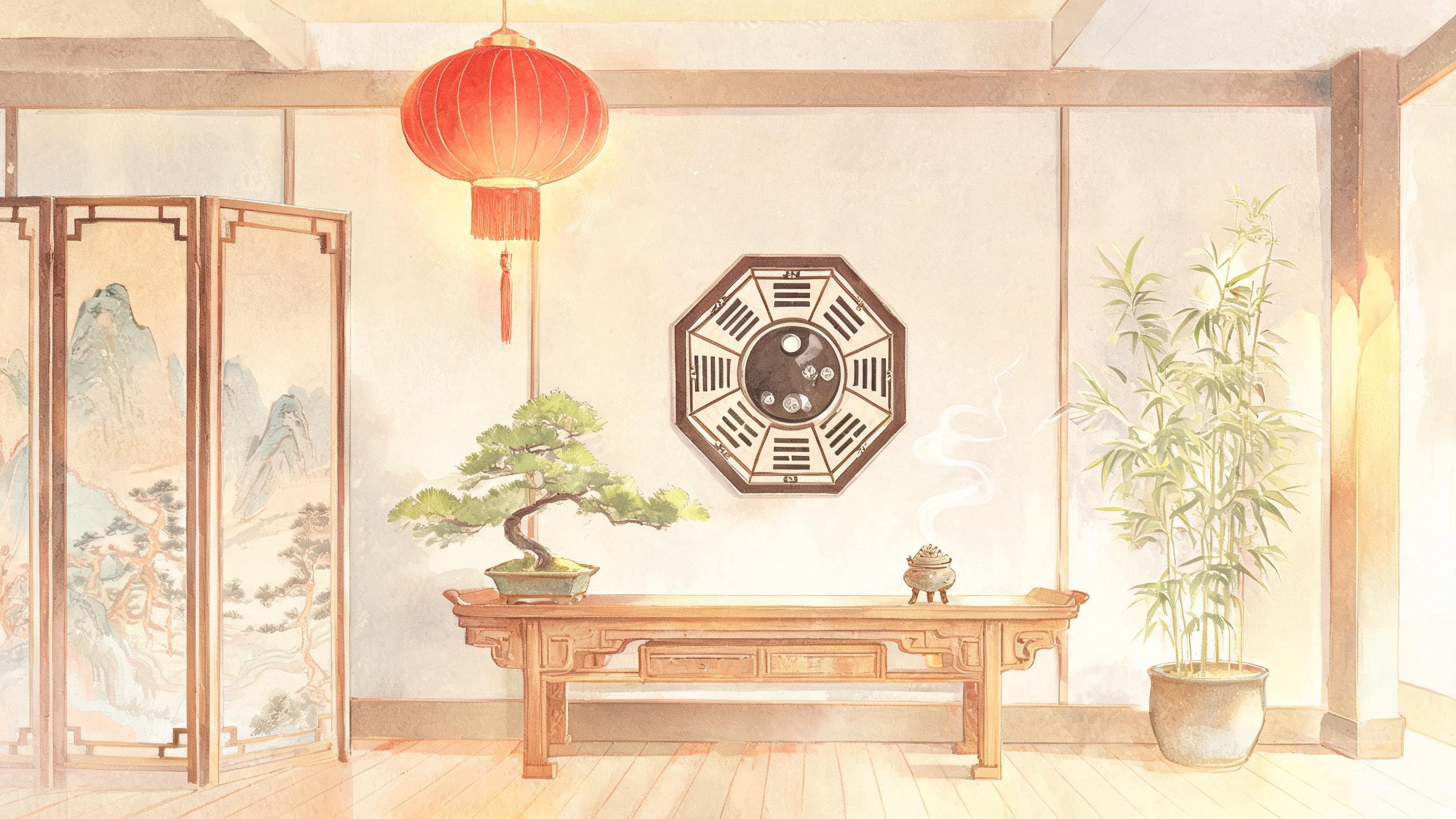
1. Yin and Yang Theory (阴阳学说): Understand the principle of Yin and Yang balance — the complementary forces that shape all phenomena. 2. Five Elements Theory (五行学说): Learn the Five Elements (Wu Xing) — Wood, Fire, Earth, Metal, and Water — and their Mutual Generation and Restriction (相生相克) relationships. 3. Bagua Theory (八卦理论): Study the Bagua (Eight Trigrams) and the meaning of each of the eight trigrams. 4. Heavenly Stems and Earthly Branches (天干地支): Learn the basics of this ancient calendrical system used in Feng Shui calculations. 5. Luopan Basics (罗盘基础): Understand how to use a Luopan (Feng Shui Compass), the essential instrument of Feng Shui practice.
2. Feng Shui Schools
1. Form School (形势派): Focuses on observing physical landforms — Dragon Veins (龙脉), Acupoints, surrounding Sand, and Water features. 2. Compass School (理气派): Emphasizes directional and time-based calculations, including the Eight Mansions (八宅) and Xuan Kong Flying Stars (玄空飞星) systems. 3. Comprehensive School (综合派): Integrates both Form School observation and Compass School calculations for a holistic approach.
Cultural Context: The three main schools of Feng Shui represent different philosophical approaches to the same goal — harmonizing human spaces with natural energy. The Form School is like reading the "body language" of the landscape, while the Compass School is like decoding its "mathematical DNA." Most modern practitioners draw from both.
Question: Which classic texts should I read to learn Feng Shui?
Answer: The following foundational texts are highly recommended for serious students:
1. Zang Shu (Book of Burial, 《葬书》): Written by Guo Pu (郭璞) of the Eastern Jin Dynasty, this is the founding masterpiece of Feng Shui theory.
2. Han Long Jing (Classic of Shaking Dragon, 《撼龙经》): Authored by Yang Yunsong (杨筠松) of the Tang Dynasty, this is the essential classic of the Form School.
3. Yi Long Jing (Classic of Doubting Dragon, 《疑龙经》): Also by Yang Yunsong, this text details the art of Seeking Dragon and Pointing Acupoint (寻龙点穴).
4. Qing Nang Xu (Preface to Green Satchel, 《青囊序》): Written by Zeng Wencheng (曾文辿) during the Tang Dynasty, this is a foundational text for Xuan Kong (Mysterious Void) Feng Shui.
5. Ba Zhai Ming Jing (Eight Mansions Bright Mirror, 《八宅明镜》): The classic treatise on Eight Mansions Feng Shui (八宅风水).
6. Shen's Xuan Kong Study (《沈氏玄空学》): An essential introduction to the Xuan Kong Flying Stars system.
Recommended Reading Order for Beginners
- Start with: Zang Shu (Book of Burial) — to understand the philosophical foundation
- Then explore: Han Long Jing and Yi Long Jing — for practical landscape analysis
- Finally study: Shen's Xuan Kong Study — for advanced time-based calculations
Quick Tip: Many of these classical texts have modern English commentaries that make the archaic language more accessible. Look for annotated editions with explanatory footnotes.
Question: What practical methods can help me learn Feng Shui effectively?
Answer: Six proven approaches will accelerate your learning:
1. Theoretical Study: Systematically study Feng Shui foundational theory — start with Yin-Yang and Five Elements before advancing to more complex systems. 2. Field Observation: Observe real environments regularly to develop your "Feng Shui eye" — visit parks, old towns, and traditional buildings to study how Qi flows. 3. Practical Application: Begin by adjusting the Feng Shui of your own home — this gives you immediate feedback on what works. 4. Mentorship: If possible, find an experienced teacher (师父) for systematic, personalized instruction. 5. Community Discussion: Engage with fellow Feng Shui enthusiasts to exchange insights and deepen your understanding. 6. Continuous Learning: Feng Shui is vast and profound — commit to lifelong study and practice.
How to Start Your Feng Shui Practice Today
- Walk through your home slowly: Notice how light, air, and movement flow through each room
- Identify the Bagua zones: Map the eight life areas (wealth, family, career, etc.) onto your floor plan
- Make one small change: Choose one principle from the theory section and apply it to your space this week
- Document results: Keep a simple journal of changes and observations to track what improves your space's energy
Learning Recommendations
1. Start from the Foundation: Don't rush — begin with basic theory and build your knowledge systematically.
2. Combine Theory with Practice: Always pair your reading with real-world observation and application.
3. Maintain an Open Mind: Respect traditional wisdom while embracing insights from modern environmental science and design.
4. Keep a Rational Perspective: Feng Shui is a practical tool for creating harmony — not superstition or magic.
Cultural Context: Feng Shui works best when approached as an integrated design philosophy — similar to how architects use principles of light, proportion, and flow to create livable spaces. Its value lies in thoughtful application, not blind belief.
Summary: Feng Shui is a vast and profound discipline. Beginners should systematically study the foundational theories of Yin and Yang, Five Elements, and Bagua, while practicing regular observation, hands-on application, and community engagement. Maintaining an open yet rational mindset is the key to truly learning and benefiting from Feng Shui.
Quick Tips for Beginners:
- Spend at least 15 minutes daily observing Qi (气) flow in your living space
- Join a local Feng Shui study group or online community for support and feedback
- Keep a dedicated notebook for theories, diagrams, and case studies you encounter
Related Articles
- [[../01-风水入门/05-天干地支与风水.md|Heavenly Stems, Earthly Branches, and Feng Shui]]
- [[../03-财运风水/01-财位基础知识.md|Wealth Position Fundamentals: Bright vs. Hidden Wealth Positions Explained]]
- [[../09-Yin Dwelling风水/07-观水入门-风水中的水法详解.md|Reading Water: A Beginner's Guide to Water Methods in Feng Shui]]
- [[../09-Yin Dwelling风水/01-什么是Yin Dwelling风水Yin Dwelling风水的基本概念.md|What Is Yin Dwelling Feng Shui? Core Concepts Explained]]