How to Determine Tombstone Facing Direction: A Complete Feng Shui Guide for Yin Dwelling
The facing direction of a tombstone is one of the most critical factors in Yin Dwelling Feng Shui (阴宅风水). It directly determines whether the grave can effectively receive and channel the auspicious en
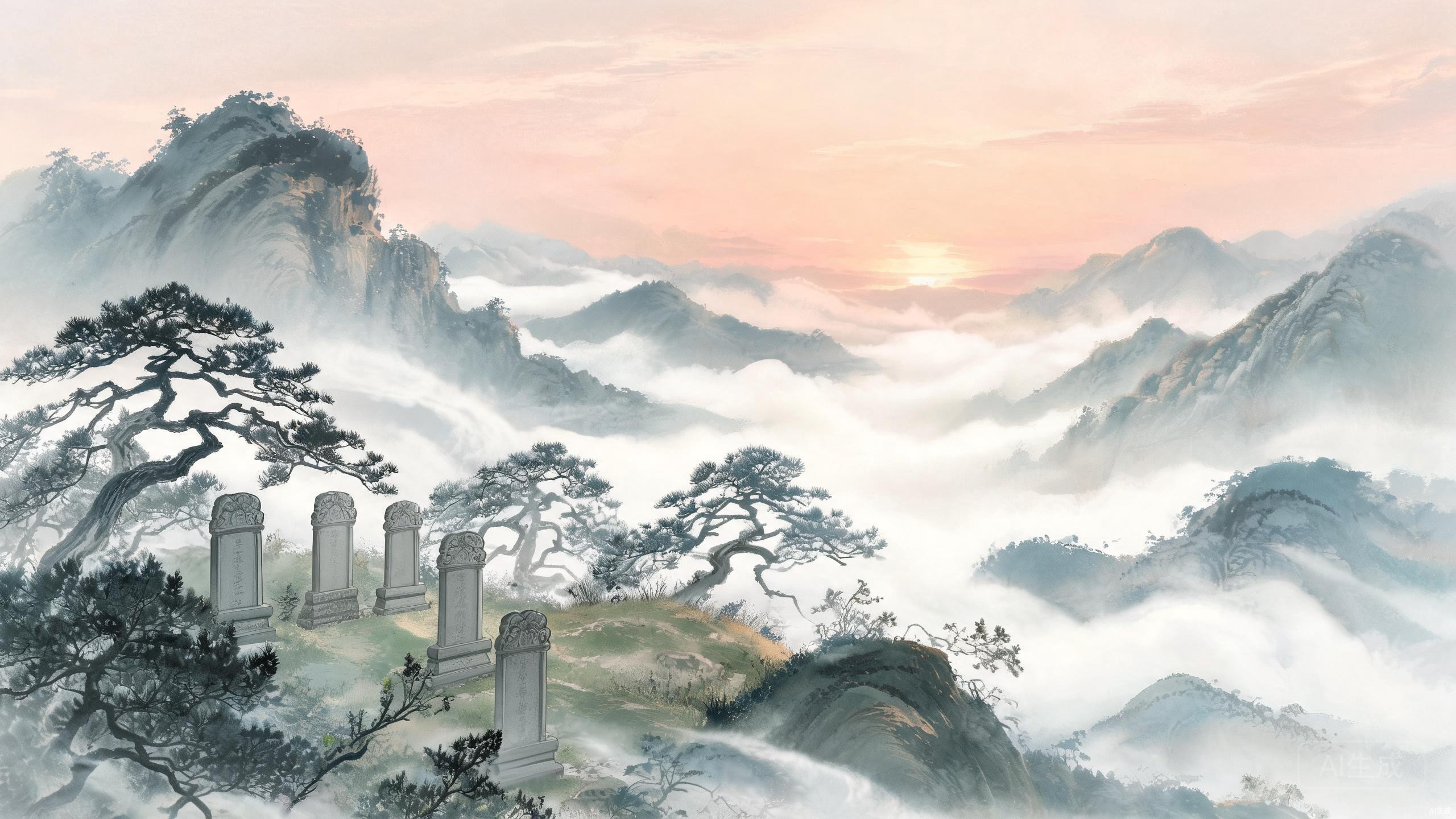
The Importance of Tombstone Facing Direction
The facing direction of a tombstone is one of the most critical factors in Yin Dwelling Feng Shui (阴宅风水). It directly determines whether the grave can effectively receive and channel the auspicious energies of the natural world. In Feng Shui philosophy, direction is considered the key to receiving Qi — a well-chosen facing direction allows the grave to absorb Vital Qi (生气) to the fullest, bringing blessings to descendants.
Determining a tombstone's facing direction is a complex process that requires careful consideration of multiple factors: the flow of the Dragon Vein (龙脉), the direction of water flow, the protective embrace of surrounding Sand (砂), the deceased's BaZi (八字) birth chart, and the timing of burial.
Core Principles for Determining Facing Direction
The Principle of Riding Vital Qi
The principle of Riding Vital Qi (乘生气) is the foremost rule for determining facing direction. The grave's orientation should align with the flow direction of Vital Qi along the Dragon Vein, maximizing the absorption of nature's auspicious energy. In practice, you must first assess the path of the Dragon Vein and the direction of Qi flow, then set the grave's facing accordingly.
The Principle of Avoiding Inauspicious and Embracing Auspicious
When determining facing direction, you must avoid unfavorable positions and select auspicious ones. On the Luopan (Feng Shui Compass), each direction carries its own auspicious and inauspicious meanings that must be evaluated according to the specific situation. Common inauspicious positions include the Five Yellow (五黄), Two Black (二黑), and Three Sha (三煞) positions.
The Principle of Harmony and Unity
The grave's facing direction should harmonize with its surrounding environment, forming a unified whole. The chosen orientation should not conflict with the surrounding terrain, landforms, or structures. In public cemeteries, the grave's direction typically must align with the cemetery's overall master plan.
Cultural Context: Unlike Yang Dwelling (阳宅) Feng Shui, which primarily benefits the living occupants, Yin Dwelling Feng Shui is believed to influence the fortune of entire family lines across generations. This is why the Chinese tradition places enormous reverence on proper grave orientation — it is considered an act of filial duty that shapes descendants' destiny.
Practical Methods for Determining Facing Direction
Step 1: Measure with a Luopan (Feng Shui Compass)
The first step is to take measurements using a Luopan. Place the compass at the center of the grave site, keep it level, and read the directional data. When using a Luopan, ensure it remains perfectly horizontal, keep it away from metallic objects, and conduct measurements during times when the local energy field is stable.
Step 2: Analyze the Dragon Vein
After obtaining the basic directional reading, analyze it in relation to the Dragon Vein's path. The grave's facing should align with the Dragon Vein's flow — never facing against it. If the Dragon Vein runs from west to east, the grave's orientation should primarily favor the east.
Cultural Context: The Dragon Vein (龙脉) refers to the continuous flow of Qi through mountain ranges and terrain features. Ancient Feng Shui masters spent lifetimes learning to trace these invisible energy arteries — much like how a traditional Chinese medicine doctor maps the body's meridian channels.
Step 3: Consider Water Flow
The direction of water flow is another crucial determinant. The grave should face toward auspicious water and away from inauspicious water. Generally, the grave should face either the direction from which water flows in, or toward where water curves around in a protective embrace. Facing the direction where water flows away is considered inauspicious.
Step 4: Evaluate the Sand Embrace
The configuration of surrounding Sand (砂) — meaning protective hills and surrounding landforms — also influences the choice of facing direction. The grave should face toward the open mouth of the Sand embrace, with an expansive view ahead. The Azure Dragon (青龙) Sand on the left and White Tiger (白虎) Sand on the right should also harmonize with the grave's orientation.
How to Apply This: A Step-by-Step Walkthrough
- Survey the site: Stand at the proposed grave location and observe the surrounding mountains, water features, and structures
- Take Luopan readings: Measure at least three times to confirm accuracy, ideally on different days
- Map the Dragon Vein: Trace the mountain ridges leading to the site and identify the Qi flow direction
- Check water patterns: Note where water enters, curves, and exits the surrounding area
- Evaluate the Sand: Confirm protective formations on both sides and an open Bright Hall (明堂) in front
- Cross-reference with the deceased's BaZi: Match the final direction with the deceased's favorable elements
- Consult the Twenty-Four Mountains: Fine-tune the direction within the chosen sector
Quick Tips:
- Always take Luopan readings at dawn or dusk when electromagnetic interference is minimal
- If the Dragon Vein runs north-south, east-facing orientations generally work best
- Never select a grave site where water flows directly away from the front — this is called "wealth leakage" (漏财)
Auspicious and Inauspicious Directions
On the Luopan compass, the full circle is divided into 24 equal segments of 15 degrees each, known as the Twenty-Four Mountains (二十四山). Each mountain direction carries its own auspicious and inauspicious qualities that must be evaluated according to the specific context.
The Twenty-Four Mountains are named: Ren, Zi, Gui, Chou, Gen, Yin, Jia, Mao, Yi, Chen, Xun, Si, Bing, Wu, Ding, Wei, Kun, Shen, Geng, You, Xin, Xu, Qian, Hai.
Among these 24 directions, some are considered auspicious while others are considered challenging. However, the judgment of auspicious and inauspicious is never absolute — it must be assessed in combination with specific timing, location, and the person involved. Generally speaking:
- Facing South (午向) is considered auspicious because the south represents light and warmth
- Facing East (卯向) is also considered auspicious because the east represents vitality and new beginnings
The auspiciousness of a direction is also tied to its Five Elements (五行) attribute. Different directions carry different elemental properties, which must match the deceased's elemental preferences and taboos. For example:
- A person with a favorable Wood element is suited to face east
- A person with a favorable Fire element is suited to face south
| Element | Auspicious Direction | Symbolic Meaning |
|---|---|---|
| Wood | East | Growth, vitality, new beginnings |
| Fire | South | Passion, brightness, fame |
| Earth | Center | Stability, nourishment, grounding |
| Metal | West | Clarity, righteousness, completion |
| Water | North | Wisdom, adaptability, depth |
Choosing Direction in Modern Public Cemeteries
In most modern public cemeteries, the grave orientations are uniform and dictated by the cemetery's overall design. In these cases, personal choice is limited, but you can still optimize the Feng Shui by selecting a specific plot within the cemetery. In uniformly-oriented cemeteries, choose a plot that:
- Is backed by higher ground or a major structure within the cemetery
- Has an open, expansive view in front
- Features good drainage and avoids low-lying areas prone to water accumulation
Some cemeteries allow free choice of grave orientation. In these cases, prioritize the following:
- Open and bright directions with abundant natural light
- Directions facing auspicious water features
- Directions with beautiful scenic views
- Avoid all inauspicious positions identified through Luopan reading
Important Practical Considerations
In real Feng Shui practice, you must adapt theory to the specific geographical environment and actual conditions. Never apply textbook knowledge rigidly, nor rely too heavily on any single method. A skilled Feng Shui practitioner combines theory with practice, tradition with modernity.
During the process, keep these principles in mind:
- Respect nature: Never forcefully alter the natural environment
- Make comprehensive judgments: Avoid decisions based on a single factor alone
- Consider practical feasibility: Theoretical perfection does not always equal practical viability
Quick Tip: The best Feng Shui solutions work with the environment, not against it. If a site's natural features contradict an ideal formula, trust the land's intelligence over the textbook.
A Modern Scientific Perspective
From a modern scientific viewpoint, many traditional Feng Shui principles contain reasonable, evidence-based wisdom. For example:
- Choosing a site backed by mountains and facing water uses terrain to block cold winds while leveraging water bodies to moderate temperature — creating an ideal microclimate
- Selecting well-drained elevated ground prevents moisture damage and protects the grave's structural integrity
These Feng Shui principles are actually the result of ancient people's long-term observation and synthesis of natural environments — reflecting the wisdom of harmonious coexistence between humanity and nature. In modern society, we should inherit and develop these traditional wisdoms with a scientific attitude.
The Inheritance and Evolution of Feng Shui Culture
As an important component of Chinese traditional culture, Feng Shui retains significant cultural value in modern society. It represents not only the ancient understanding of natural environments but also a crystallization of Chinese civilizational wisdom. Studying Feng Shui culture helps us better understand the essence of Chinese traditional heritage.
While preserving Feng Shui tradition, we must also evolve with the times — integrating the rational core of classical Feng Shui with modern science, allowing this ancient wisdom to radiate new vitality in the contemporary era.
Adjusting Tombstone Direction
In practice, if a tombstone's facing direction is suboptimal, several adjustment methods can help optimize the Feng Shui. Adjusting a tombstone's direction requires professional knowledge and skill, and should be performed under the guidance of an experienced Feng Shui practitioner.
Common adjustment methods include:
- Repositioning the tombstone: Changing its angle to better align with auspicious directions
- Installing a Screen Wall (照壁): Placing a barrier in front of the grave to redirect energy flow
- Strategic planting: Adding trees or landscape features to shift visual focus and energy pathways
These methods can optimize the facing direction's Feng Shui effect to a certain degree without altering the grave's fundamental layout.
Related Articles
- [[../08-百科问答库/50-墓碑有什么风水讲究?墓碑朝向怎么定?.md|What Feng Shui Considerations Apply to Tombstones? How to Determine Tombstone Direction?]]
- [[../05-命理与运势/09-面相断Yin Dwelling风水.md|Face Reading for Yin Dwelling Feng Shui — Reading Graves Through the Nose and Facial Features]]
- [[../07-风水故事/58-风水与丧葬.md|Feng Shui and Burial Customs — The Ancient Tradition of Yin Dwelling Feng Shui]]
- [[../07-风水故事/01-曾国藩葬地择选记.md|The Burial Site Selection of Zeng Guofan — The Feng Shui Wisdom of "Heaven Dislikes Cunning"]]