Yin Dwelling Feng Shui Schools: San He vs San Yuan — Key Differences Explained
Yin Dwelling Feng Shui (阴宅风水, the practice of placing and arranging ancestral graves for the well-being of descendants) has evolved into several distinct schools over centuries of development. Among t
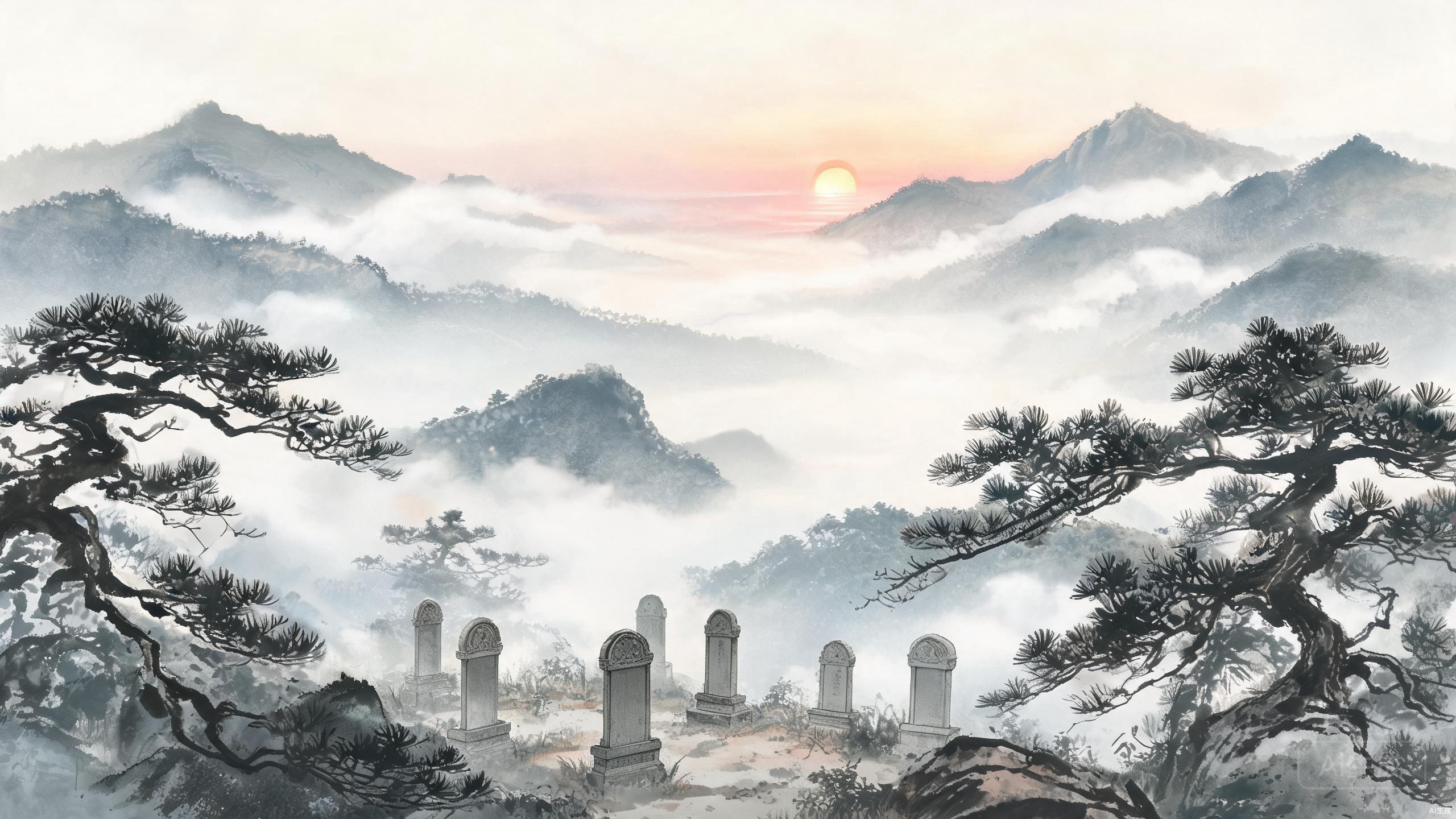
Feng Shui Schools Overview
Yin Dwelling Feng Shui (阴宅风水, the practice of placing and arranging ancestral graves for the well-being of descendants) has evolved into several distinct schools over centuries of development. Among these, the two most influential are the San He School (三合派) and the San Yuan School (三元派). These schools differ significantly in their theoretical foundations, analytical methods, and practical applications — understanding their differences is essential for anyone serious about mastering Yin Dwelling Feng Shui.
Although both belong to the broader discipline of Feng Shui, their emphases are quite different. The San He School focuses on form analysis (形势), emphasizing the harmony of the Five Essentials: Dragon, Acupoint, Sand, Water, and Direction. The San Yuan School places greater weight on compass energy (理气, Li Qi), emphasizing how time cycles affect Feng Shui outcomes.
Cultural Context: In Feng Shui, "Yin Dwelling" (阴宅) refers to burial sites and ancestral graves, as opposed to "Yang Dwelling" (阳宅), which refers to homes for the living. Classical Chinese tradition holds that properly placed ancestral graves create Bloodline Resonance (血脉感应) — a beneficial energetic influence on descendants. This belief is why grave site selection has been treated with such care throughout Chinese history.
San He School (Triple Harmony School) — Core Theory
The Meaning of "San He"
The term "San He" (三合, Triple Harmony) refers to the Three Harmony combinations of Earthly Branches in Chinese metaphysics:
| Branch Combination | Harmony Element |
|---|---|
| Shen, Zi, Chen | Water (申子辰合水) |
| Hai, Mao, Wei | Wood (亥卯未合木) |
| Yin, Wu, Xu | Fire (寅午戌合火) |
| Si, You, Chou | Metal (巳酉丑合金) |
The San He School uses these Triple Harmony combinations as its foundation, analyzing the relationships between Dragon Veins, water flow, and orientation.
Characteristics of the San He School
Form-Focused Analysis: The San He School places great emphasis on observing natural terrain and landforms — analyzing Dragon Vein patterns, the protective embrace of surrounding hills, and the direction of water flow.
Five Elements Framework: Built on the theory of Mutual Generation and Restriction (相生相克), this school analyzes the Five Elements relationships between Dragon, Acupoint, Sand, Water, and Direction.
Harmony of the Five Essentials: The school insists that all five elements must work in concert. Only when Dragon, Acupoint, Sand, Water, and Direction are properly coordinated can a site be considered truly auspicious.
Analytical Method of the San He School
The San He methodology consists of five sequential steps:
- Seeking the Dragon (寻龙) — Analyzing the Dragon Vein's course and form, requiring it to be vigorous, meandering, and full of life
- Observing the Sand (察砂) — Evaluating surrounding hills for their position and shape, requiring protective embrace
- Reading the Water (观水) — Studying water flow direction and form, requiring gentle, embracing curves
- Pointing the Acupoint (点穴) — Identifying the precise Feng Shui Point where Qi converges
- Setting the Direction (定向) — Determining the optimal orientation using the Twenty-Four Mountains
Quick Tip: Each step has specific quality criteria. A Dragon Vein that runs in a straight line is considered "dead"; one that meanders energetically is considered "alive" and powerful.
San Yuan School (Three Cycles School) — Core Theory
The Meaning of "San Yuan"
The "San Yuan" (三元, Three Cycles) refers to three time periods: the Upper Cycle (上元), Middle Cycle (中元), and Lower Cycle (下元). Each cycle lasts 60 years, making a complete Three Cycles period 180 years. This framework is known as the Three Cycles and Nine Periods (三元九运) system.
The San Yuan School uses the theory of time cycles to analyze how temporal factors influence Feng Shui outcomes.
Characteristics of the San Yuan School
Time-Centered Approach: The San Yuan School places enormous weight on time, holding that the quality of any Feng Shui location changes over time. The same site can be highly auspicious in one period and completely inauspicious in another.
Compass Energy Analysis: This school emphasizes compass-based Li Qi analysis, using the Luopan (Feng Shui Compass) to measure precise directions and combining readings with the current time period to determine fortune.
Bagua-Based Framework: Built on the Bagua (Eight Trigrams) theory, the San Yuan School uses trigram analysis to evaluate auspicious and inauspicious patterns within a space.
Cultural Context: The Bagua (八卦) is a system of eight trigrams — Qian (Heaven), Kun (Earth), Zhen (Thunder), Xun (Wind), Kan (Water), Li (Fire), Gen (Mountain), and Dui (Lake) — that maps fundamental forces of nature. The San Yuan School weaves these trigrams into its time-based calculations, producing remarkably precise directional analysis.
Analytical Method of the San Yuan School
The San Yuan methodology involves four key steps:
- Measuring Direction (测量方位) — Using the Luopan to precisely divide directions into the Twenty-Four Mountains (二十四山)
- Calculating the Time Period (计算元运) — Determining the current Yuan Yun (time period) based on the present date
- Analyzing Trigrams (分析卦象) — Calculating trigram patterns based on direction and time period
- Judging Auspicious and Inauspicious (判断吉凶) — Drawing conclusions about fortune and misfortune
Key Differences Between San He and San Yuan Schools
| Aspect | San He School | San Yuan School |
|---|---|---|
| Theoretical Foundation | Triple Harmony theory + Five Elements | Yuan Yun theory + Bagua theory |
| Primary Method | Form analysis (observing natural terrain) | Compass energy analysis (Luopan measurements + time calculations) |
| Core Focus | Spatial factors (landscape) | Temporal factors (time cycles) |
| Best Suited For | Natural environments (mountains, hills) | Built environments (cities, structures) |
| Key Tools | Visual observation, landform analysis | Luopan, time-period charts |
Different Theoretical Foundations
The San He School rests on Triple Harmony theory and the Mutual Generation and Restriction of the Five Elements. The San Yuan School rests on Yuan Yun theory and Bagua theory.
Different Analytical Methods
The San He School judges Feng Shui quality through visual analysis of natural terrain. The San Yuan School judges through compass measurements combined with time-period calculations.
Different Areas of Emphasis
The San He School prioritizes space — the harmonious arrangement of Dragon, Acupoint, Sand, Water, and Direction. The San Yuan School prioritizes time — how shifting cycles of fortune affect each location.
Different Application Scenarios
The San He School is best suited for analyzing natural environments — mountains, hills, and wilderness. The San Yuan School excels in built environments — cities, buildings, and developed landscapes.
Integration of Both Schools
In practice, the San He and San Yuan Schools are not mutually exclusive. Many Feng Shui masters combine the strengths of both, creating more comprehensive analytical methods.
Remember: Feng Shui seeks to balance Yin and Yang energies — the dual forces that shape all existence.
How to Apply the Integrated Approach
- Start with form analysis (San He): Examine the Dragon Vein, surrounding hills, and water flow to assess the basic spatial quality of the site
- Add compass energy analysis (San Yuan): Measure directions with the Luopan and calculate the current Yuan Yun to determine time-based fortune
- Synthesize both findings: Consider spatial factors and temporal factors together for a complete picture
This integrated approach — weighing both space and time — produces far more accurate and reliable Feng Shui judgments than relying on either school alone.
Quick Tip: When consulting a Feng Shui practitioner, ask whether they use both schools. A practitioner who only uses one may miss half the picture.
Learning Recommendations
For beginners, the San He School is generally recommended first because its principles are more intuitive and easier to visualize and practice. Once you have a solid grasp of the San He fundamentals, you can move on to the San Yuan School for deeper analysis.
Regardless of which school you study, practice is essential. Theoretical knowledge must be combined with real-world case studies to develop true competence. Reading books alone will never make a skilled practitioner.
Learning the schools of Yin Dwelling Feng Shui is one of the most important paths to mastering the deeper dimensions of Feng Shui theory. By understanding the differences and connections between the San He and San Yuan Schools, you can build a more complete and versatile skill set.
Important Considerations in Practice
In real-world Feng Shui practice, you must adapt theory to specific geographic conditions and actual circumstances. Rigidly applying textbook rules — or over-relying on a single method — leads to poor results. A skilled Feng Shui practitioner is a comprehensive professional who combines theory with practice, and tradition with modernity.
Three key principles to remember:
- Respect Nature — Never attempt to forcibly alter the natural environment
- Make Holistic Judgments — Never decide based on a single factor alone
- Consider Practical Feasibility — Theoretical perfection does not always equal real-world practicality
A Modern Scientific Perspective
From a modern scientific viewpoint, many traditional Feng Shui principles contain genuine practical wisdom:
- Backing Mountain, Facing Water (背山面水) — Mountains block cold winds; water bodies regulate temperature, creating favorable microclimates
- Elevated, Well-Drained Sites — Higher ground with good drainage prevents moisture damage and protects burial sites from decay
- Open Bright Hall (明堂) — Wide, open spaces in front of a site allow sunlight and air circulation, which modern environmental science confirms improves health conditions
Cultural Context: These principles are not mystical beliefs — they are the accumulated observations of generations who studied how terrain affects health, agriculture, and daily life. Feng Shui can be understood as a sophisticated system of traditional environmental science, refined over thousands of years.
The Heritage and Evolution of Feng Shui Culture
As an important component of traditional Chinese culture, Feng Shui retains significant cultural value in modern society. It represents not only ancient observations about the natural environment but also the wisdom of Chinese civilization itself. Studying Feng Shui helps us better understand the essence of Chinese traditional culture.
While preserving this heritage, we must also move forward — integrating the rational core of traditional Feng Shui with modern science, allowing this ancient wisdom to flourish in a new era.
Related Articles
- [[../08-百科问答库/27-什么叫山管人丁水管财?.md|What Does "Mountain Governs People, Water Governs Wealth" Mean?]]
- [[../01-风水入门/39-Feng Shui Schools Comparison and Selection.md|Feng Shui Schools Compared: Finding the Right Path for You]]
- [[../01-风水入门/44-风水流派的现代演变.md|The Modern Evolution of Feng Shui Schools: Traditional Wisdom for a New Era]]
- [[../05-命理与运势/09-面相断Yin Dwelling风水.md|Face Reading for Yin Dwelling Feng Shui: Reading Burial Sites Through Facial Features]]