Yin Dwelling Feng Shui: Setting Direction for Graves — Principles and Methods
In Yin Dwelling Feng Shui (阴宅风水, yín zhái fēng shuǐ), Setting Direction (立向, lì xiàng) refers to determining the orientation of a grave or tombstone. It is the fifth and final essential of the Five Es
What Is Setting Direction?
In Yin Dwelling Feng Shui (阴宅风水, yín zhái fēng shuǐ), Setting Direction (立向, lì xiàng) refers to determining the orientation of a grave or tombstone. It is the fifth and final essential of the Five Essentials: Dragon, Acupoint, Sand, Water, and Direction (龙穴砂水向, long xue sha shui xiang) — and it serves as the critical step where the previous four are integrated into a unified result. A well-chosen direction maximizes the Feng Shui effect of the Acupoint, transmitting auspicious Qi effectively to descendants.
Cultural Context: Yin Dwelling Feng Shui focuses on graves and ancestral tombs, based on the principle of "Bloodline Resonance" (血脉感应) — the idea that the Qi of a properly laid resting place flows through the family line to influence descendants' fortune, health, and prosperity for generations.
The core principle of Setting Direction is Riding Vital Qi (乘生气, chéng shēng qì) — aligning the grave's orientation with the flow direction of the Dragon Vein's (龙脉) Vital Qi, so the burial site can receive and utilize nature's auspicious energy to the fullest extent.
Core Principles of Setting Direction
Direction Based on the Dragon
The course of the Dragon Vein is the primary basis for Setting Direction. The grave's orientation should coordinate with the Dragon Vein's path, conforming to the direction of its Vital Qi flow. Generally, the grave should align with or sit at an appropriate angle to the Dragon Vein — never facing against it.
Quick Tip: In the Form School (形势派) tradition, think of the Dragon Vein as a river of energy flowing through the landscape. Your job is to position the grave so it "drinks" from this current rather than turning its back on it.
Direction Based on Water
The flow of water is another crucial factor. In Feng Shui theory, water symbolizes wealth. The grave's orientation should coordinate with the water's course to welcome incoming wealth energy. Generally, the grave should face the direction from which water flows, or face the curve of an embracing waterway.
Direction Based on Sand
The configuration of surrounding "Sand" (砂, shā) — the protective hills and structures around the site — also influences direction selection. The grave should face toward the opening of the Sand's embrace, with open space in front rather than being blocked by surrounding elevations.
Practical Methods for Setting Direction
Measuring the Orientation
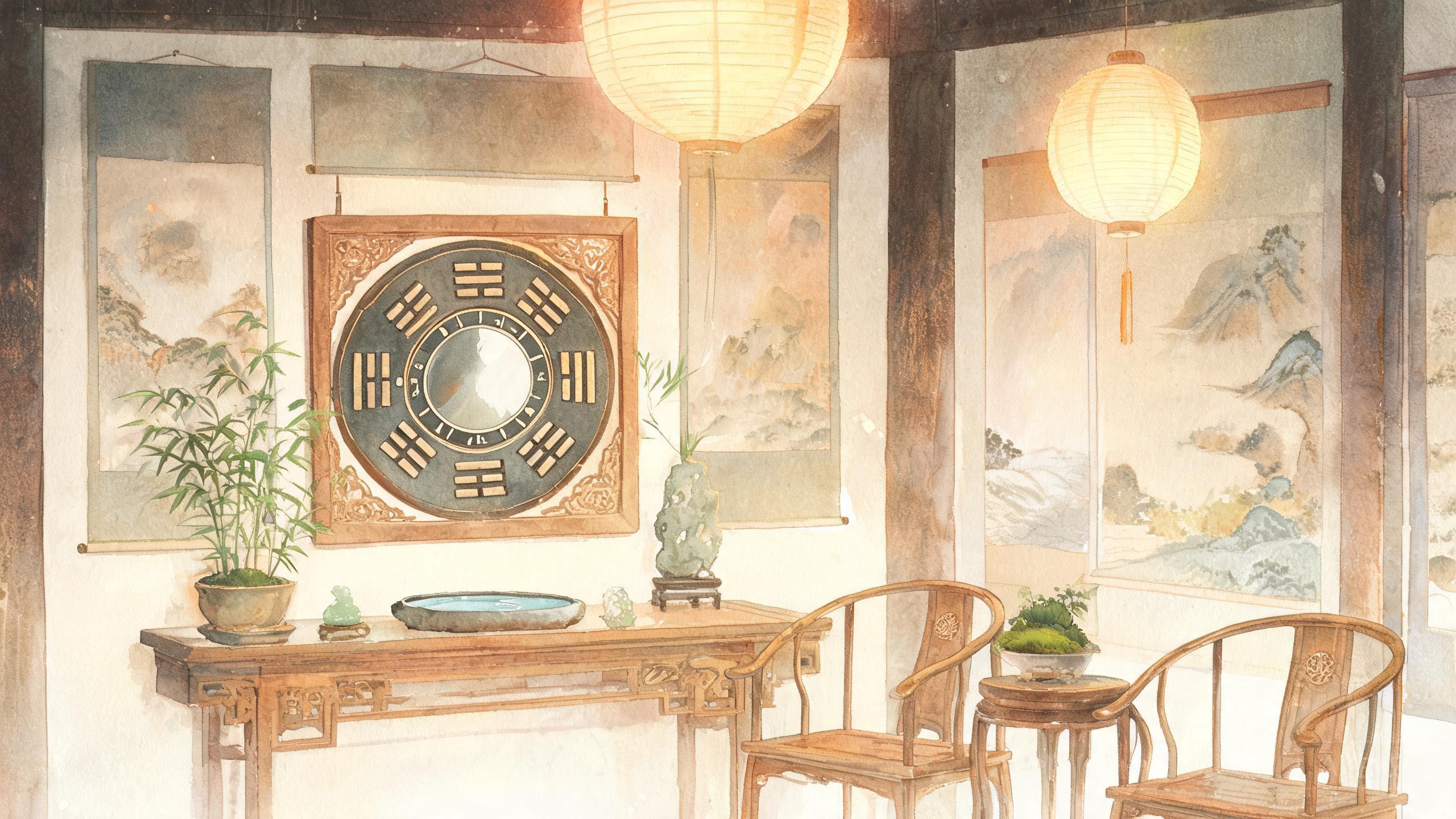
The first step is accurately measuring the grave's orientation. Traditionally, a Luopan (罗盘, Feng Shui Compass) is used for this purpose. The Luopan's graduated markings determine the precise direction. During measurement, place the compass at the center of the Acupoint, keep it level, and read the directional data carefully.
Cultural Context: The Luopan is far more than a compass — it contains multiple concentric rings encoding the Twenty-Four Mountains, Heavenly Stems and Earthly Branches, and the Bagua (八卦, Eight Trigrams). Mastering its use is considered a lifetime pursuit in classical Feng Shui.
Choosing the Direction
Based on the measurement, combined with Dragon, Sand, and Water factors, select an appropriate direction. Direction selection requires synthesizing multiple factors — no single element should dictate the choice. When choosing, be sure to avoid unfavorable sectors, such as those occupied by inauspicious stars like the Five Yellow Sha (五黄煞) or Two Black Giant Door Star (二黑巨门星).
Determining the Precise Degree
After establishing the general direction, you must refine it to an exact degree. The Feng Shui Compass divides the circle into 360 degrees, with each degree carrying its own auspicious or inauspicious significance. When determining the precise degree, practitioners consider the Dragon Vein's Five Elements (五行, Wu Xing) attributes, the deceased's BaZi (八字, Eight Characters birth chart), and the time of burial.
Common Mistakes in Setting Direction
The most frequent error is choosing an inauspicious direction — for example, facing toward the Five Yellow Sha sector, the Two Black sector, or aligning with unfavorable Form Sha (形煞) such as Reverse Bow Sha (反弓水) or Sharp Corner Sha (尖角煞).
Another common mistake is mismatching the grave's direction with the Dragon Vein's path. For instance, if the Dragon Vein flows from west to east, but the grave faces west — turning its back on the Dragon — the Vital Qi cannot effectively gather and concentrate.
Setting Direction in Modern Cemeteries
In modern public cemeteries, direction choices are often restricted. Graves are typically arranged in orderly rows, with directions predetermined by the cemetery's overall layout. In such cases, you can only select the relatively best option within a limited range.
If multiple orientations are available in a cemetery, prioritize directions that face open space, receive ample sunlight, and offer pleasant views ahead. At the same time, avoid unfavorable Form Sha such as high-voltage power towers, smokestacks, and sharp-cornered buildings.
Setting Direction is the most comprehensive element of Yin Dwelling Feng Shui, requiring the integration of Dragon, Acupoint, Sand, Water, and many other factors. A good direction must coordinate with the Dragon Vein's path, harmonize with the water flow, echo the embrace of the Sand, and also account for temporal and personal factors of the deceased.
Setting Direction, Timing, and Place
Setting Direction requires consideration not only of spatial factors but also of temporal ones. In Feng Shui theory, time and space form a unified whole — the same location may carry entirely different auspicious or inauspicious qualities at different times. Therefore, Setting Direction must integrate the current Yuan Yun (元运, Time Period), solar terms, and specific hours for comprehensive judgment.
In traditional practice, Setting Direction is typically performed during an auspicious hour. This hour must coordinate with the deceased's BaZi and the day's Heavenly Stems and Earthly Branches (天干地支). A well-chosen hour amplifies the effect of the chosen direction and enhances the Acupoint's Feng Shui benefit.
Quick Tip: This is why many families consult a Feng Shui master before burial rather than making decisions alone — the interplay of direction, timing, and personal destiny is too complex for rule-of-thumb choices.
Step-by-Step Process for Setting Direction
The procedure can be broken into the following stages:
- Measure the Acupoint: Use the Luopan to measure the center point of the Acupoint and the directional data of its surroundings.
- Determine the general direction: Based on the Dragon Vein's course and water flow, establish a rough directional range.
- Adjust the precise angle: Factor in the configuration of the surrounding Sand to fine-tune the exact angle.
- Finalize the degree: Consider the deceased's BaZi and current Yuan Yun to lock in the precise degree of direction.
Throughout this process, repeated measurement and verification are essential to ensure accuracy. Practitioners must also remain flexible and adjust to real-site conditions rather than rigidly applying theory.
How Setting Direction Affects Family Fortune
In Feng Shui theory, Setting Direction is believed to be closely linked to a family's collective fortune. A good direction can bring luck and blessing to the family; an unfavorable one may lead to generational decline.
Different directions correspond to different influences on fortune. For example:
| Direction | Traditional Influence |
|---|---|
| Southeast | Wealth fortune and career development |
| Southwest | Family harmony and interpersonal relationships |
However, these correspondences are not absolute — they must be interpreted in light of the specific geographic environment and family circumstances.
Quick Tip: Southeast is often highlighted because in classical texts it is associated with the phrase "Purple Qi comes from the East" (紫气东来) — symbolizing renewal and rising fortune. The southwest corresponds to Kun (坤, Earth), the Bagua trigram representing receptivity and harmony.
Auspicious and Inauspicious Judgment
Judging the auspiciousness of a direction is a complex process. Different orientations carry different meanings, and any assessment must integrate the specific geographic environment and time-based factors.
Generally speaking, facing southeast is considered favorable for wealth and career because it is the direction from which "Purple Qi comes from the East." Facing southwest is considered favorable for family harmony because it corresponds to the Kun (坤) trigram — symbolizing inclusiveness and harmony. However, these judgments are not absolute — they must be weighed against the actual geographic environment and should never be applied mechanically.
The Cultural Significance of Feng Shui
Feng Shui culture carries the Chinese nation's profound understanding of nature and life — a precious cultural heritage passed down by our ancestors. In today's highly developed technological society, the principles embedded in Feng Shui — respecting nature and pursuing harmony — still hold important practical meaning. By studying Feng Shui, we can better understand traditional culture while applying ancient wisdom to bring peace and security to our own lives and those of our families. When approaching Feng Shui, we should maintain a rational, scientific attitude: respecting tradition while moving with the times, allowing Feng Shui culture to play a positive role in modern society.
Related Articles
- [[../01-风水入门/15-二十四山向详解.md|Detailed Guide to the Twenty-Four Mountains and Directions]]
- [[../01-风水入门/52-风水罗盘使用进阶技巧.md|Luopan Mastery: Advanced Measurement Techniques from Beginner to Expert]]
- [[../03-财运风水/01-财位基础知识.md|Wealth Position Basics: Bright and Hidden Wealth Positions Explained]]
- [[../05-命理与运势/09-面相断Yin Dwelling风水.md|Face Reading and Yin Dwelling Feng Shui: The Nose as a Mirror of the Grave]]